

A desktop LED grow light does not create one universal “cold-light” temperature. The fixture, driver, canopy air, leaf surfaces, substrate and root zone can all have different readings. To manage the setup, map PPFD at canopy height, measure each thermal layer, define a crop-specific light schedule and change one variable at a time.
The objective is not to keep every point below an arbitrary 40°C threshold. It is to keep the selected fixture within its documented operating limits while meeting the plant protocol for light, air, leaf and root-zone conditions.
Confirm the Fixture and Plant Task
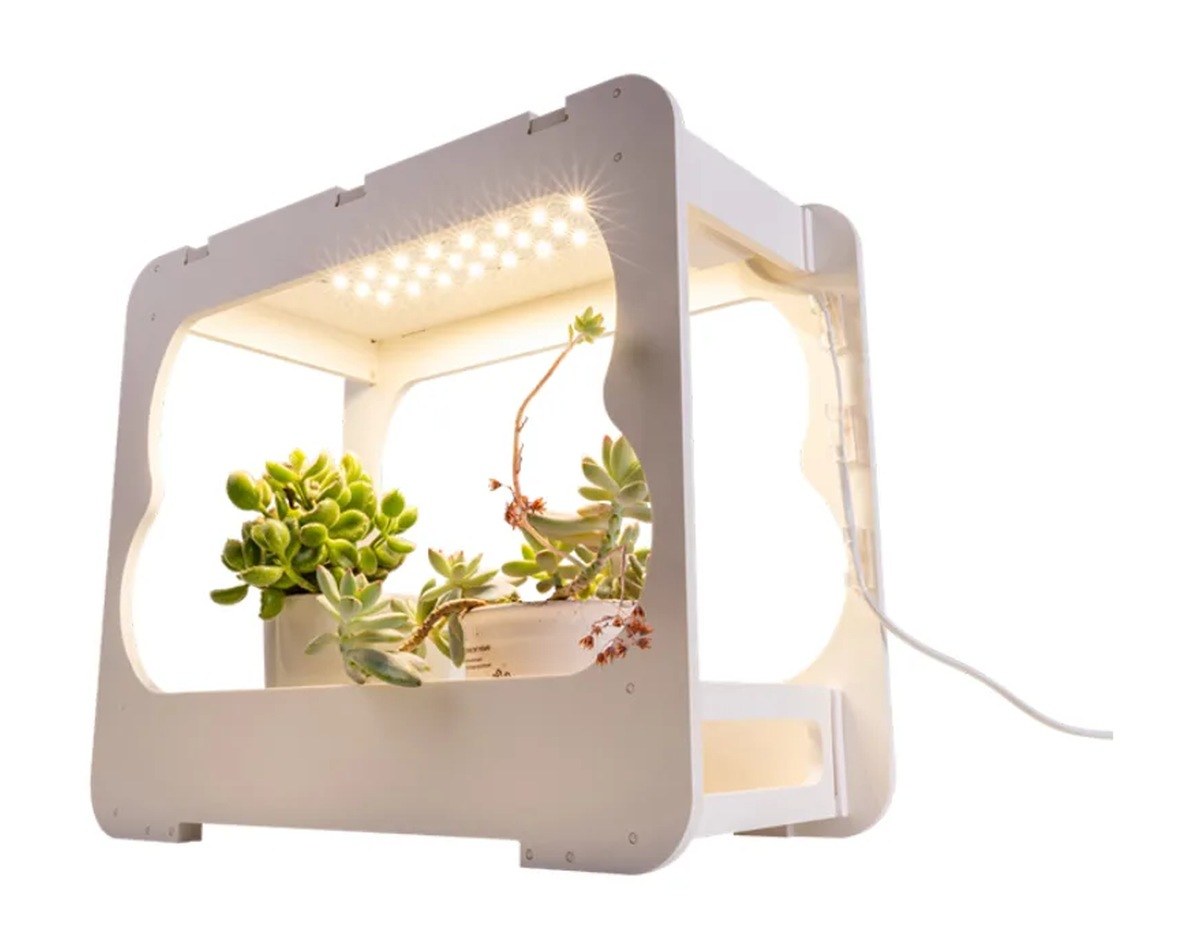
The current New Lights Desktop LED Growing Fixture is a compact freestanding product for small indoor plants. Its published configuration combines a 14 W light engine, 100–265 V input and 17 μmol/s PPF in a 384 × 174 × 320 mm body; the product page also lists 1.1 μmol/J and a red, blue and daylight full-spectrum output.
Those values identify the product configuration, but they do not establish tray-level PPFD, leaf temperature or a universal crop recipe. Before testing, record the exact model, driver, LED recipe, controls, fixture-to-canopy distance, tray size, species, cultivar and growth stage.
| Input | Record before the trial | Why it matters |
|---|---|---|
| Fixture | Model, revision, power, spectrum and controls | Keeps product evidence tied to the tested unit |
| Geometry | Emitting surface, canopy height and tray dimensions | Determines intensity and uniformity |
| Plant | Species, cultivar, stage and density | Changes light and temperature requirements |
| Environment | Room temperature, humidity and airflow | Changes leaf energy balance and water loss |
| Root system | Container, substrate, water and drainage | Separates root stress from light symptoms |
The broader horticultural lighting system design guide covers crop briefs, zoning and commissioning. This article owns the smaller desktop microclimate and measurement task.
Replace “Cold Light” with a Sensor Map
LEDs can direct less radiant heat toward plants than some legacy sources, but the fixture still consumes electrical power. The driver and LEDs release heat, and absorbed light eventually contributes to the energy balance of leaves and surrounding materials. Ventilation, distance, humidity and transpiration determine where temperatures settle.
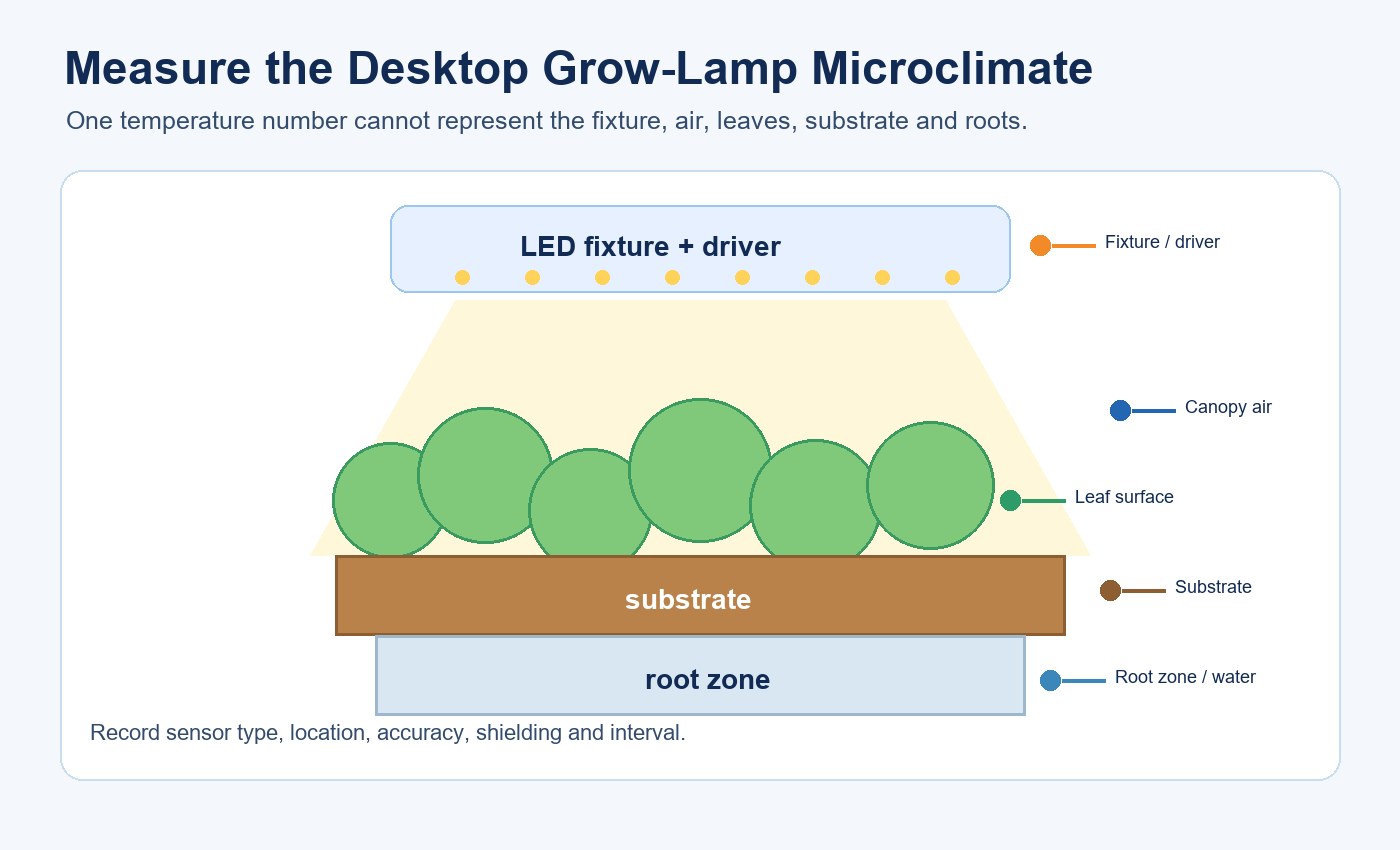
Measure the location relevant to each decision. Fixture and driver temperatures support product evaluation. Canopy-air temperature describes the local environment. Leaf temperature responds to radiation and transpiration. Substrate and root-zone temperature affect water, oxygen and root activity.
| Measurement | Suitable location | Decision it supports | Common interpretation error |
|---|---|---|---|
| Fixture surface | Defined point on housing | Touch, material and installation review | Treating it as leaf temperature |
| Driver or internal reference | Approved accessible point or test setup | Electronics and thermal validation | Assuming the coolest external point represents the driver |
| Canopy air | Shielded point among leaves | Ventilation and environment | Using room thermostat data instead |
| Leaf surface | Representative upper and lower canopy leaves | Plant energy balance | Trusting one convenient leaf |
| Substrate/root zone | Defined depth or solution location | Root and water management | Ignoring small-container temperature swings |
Record sensor type, accuracy, attachment, shielding and interval. For infrared measurements, also control emissivity, viewing angle, spot size and reflected radiation. Compare readings only when the method and location are consistent.
Map PPFD at the Canopy Plane
PPF describes the total photosynthetic photon flux emitted by a fixture. PPFD describes the flux density reaching a surface. The published 17 μmol/s PPF cannot be converted into a dependable tray PPFD without distribution, distance and geometry.
Build a measurement grid across the usable growing area. Record minimum, average and maximum PPFD and state the uniformity method. Repeat the map at each candidate height and after the canopy grows enough to change the distance.
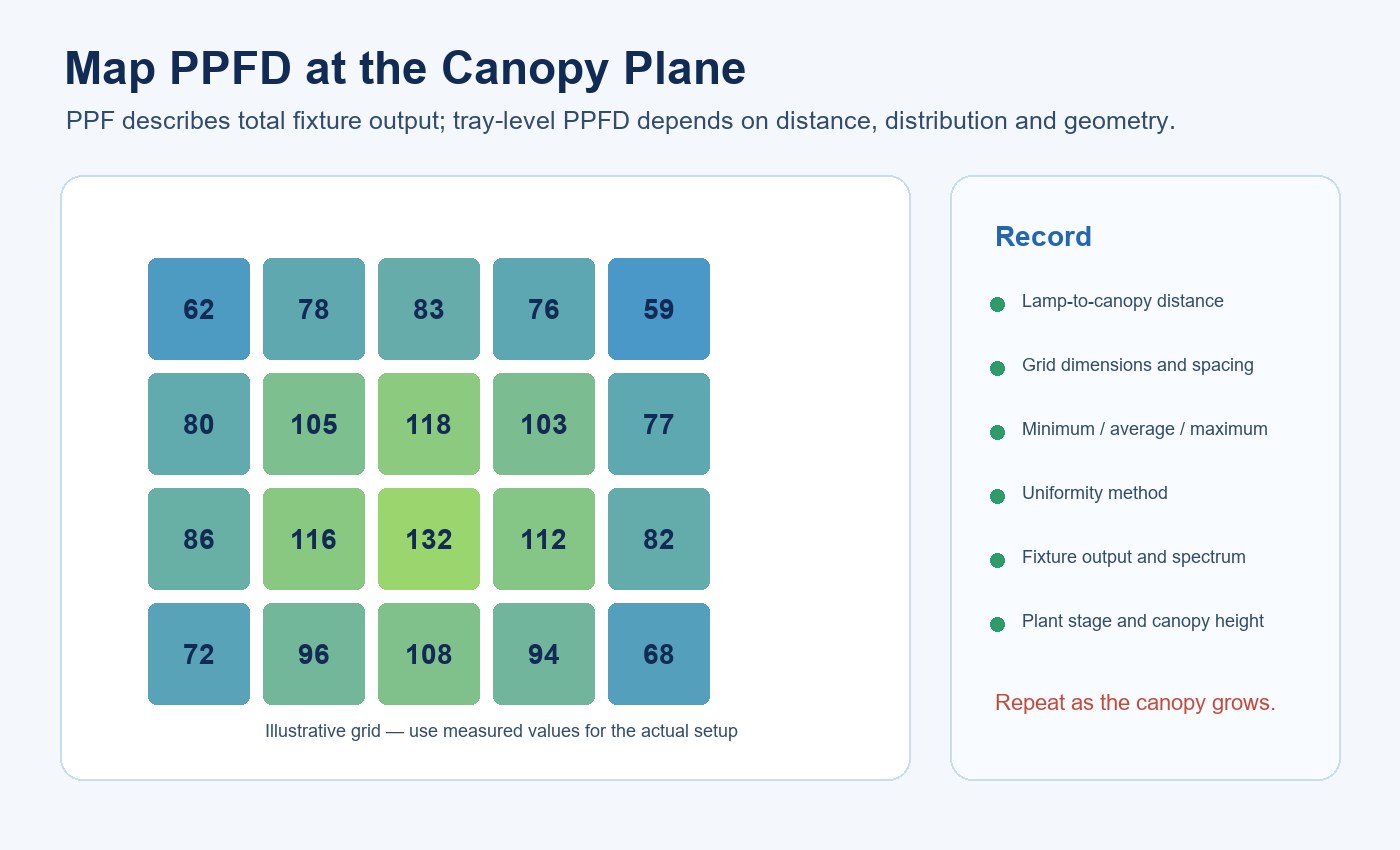
The grow-light coverage and PPFD method explains larger layout calculations. For a desktop fixture, the same principle applies at a smaller scale: approve the plant area that meets the defined range, not the entire physical tray by assumption.
Convert PPFD and Photoperiod into Daily Dose
Photoperiod is the number of light hours per day. Daily light integral, or DLI, combines PPFD and time:
DLI (mol/m²/day) = average PPFD (μmol/m²/s) × light hours × 0.0036
For an illustrative constant average PPFD of 100 μmol/m²/s over 14 hours, DLI is 5.04 mol/m²/day. This calculation does not choose the correct target; it only translates a measured setup into a daily dose. Select the target from a crop- and stage-specific protocol.
Extending the schedule increases daily photons and total operating time even when instantaneous PPFD is unchanged. Avoid continuous light unless the defined plant protocol supports it, and verify timer behavior after a power interruption.
Set Distance from Intensity and Uniformity
Moving the lamp closer commonly raises center PPFD but can reduce uniformity and increase local heating. Moving it higher may widen coverage while reducing intensity. The correct distance is therefore a measured compromise, not a fixed number copied from another fixture.
Start with the manufacturer’s permitted geometry, map the tray and mark the distance from the emitting surface to the canopy. Recheck it as plants grow. If the product has dimming, compare distance and output combinations rather than using height alone.
University of Minnesota Extension recommends keeping grow lights close to seedlings in basic home setups and using gentle airflow, but that advice is practical context rather than a model-specific setting. The actual New Lights fixture still needs a PPFD map and a plant protocol.
Interpret Leaf Temperature with Airflow and Humidity
Leaf temperature can differ from air temperature because leaves absorb radiation and lose heat through convection and transpiration. A well-watered leaf in moving air may behave differently from a stressed leaf under the same lamp. Relative humidity also changes evaporative demand.
Measure canopy air and representative leaves at the same time. Include newly emerged and mature leaves, center and edge positions, and any visibly affected area. Log humidity and airflow state so a temperature change is not attributed to the lamp when a fan, vent or watering event changed.
Compact enclosures can trap warm, humid air. Gentle movement may improve mixing, but excessive airflow can dry a small container quickly. The control objective is a stable plant protocol, not the highest fan speed.
Protect the Substrate and Root Zone
Small pots and reservoirs respond quickly to room conditions, light exposure and evaporation. A healthy-looking upper canopy does not prove that the root zone is within its intended range. Measure substrate or solution temperature at a defined depth and time.
Track moisture, drainage, water temperature and oxygenation where relevant. Keep water away from the supply cable, connectors and electronics. Horticultural use does not establish an ingress rating; follow the exact product documents and the indoor grow-light safety guide for electrical and environmental boundaries.
Diagnose Symptoms Without Guessing
Stretching, bleaching, curling, wilting, slow growth or color change can have multiple causes. Stretching may indicate insufficient usable light, but crowding, spectrum, temperature or plant genetics can affect form. Wilting can involve heat, dry substrate, damaged roots or disease.
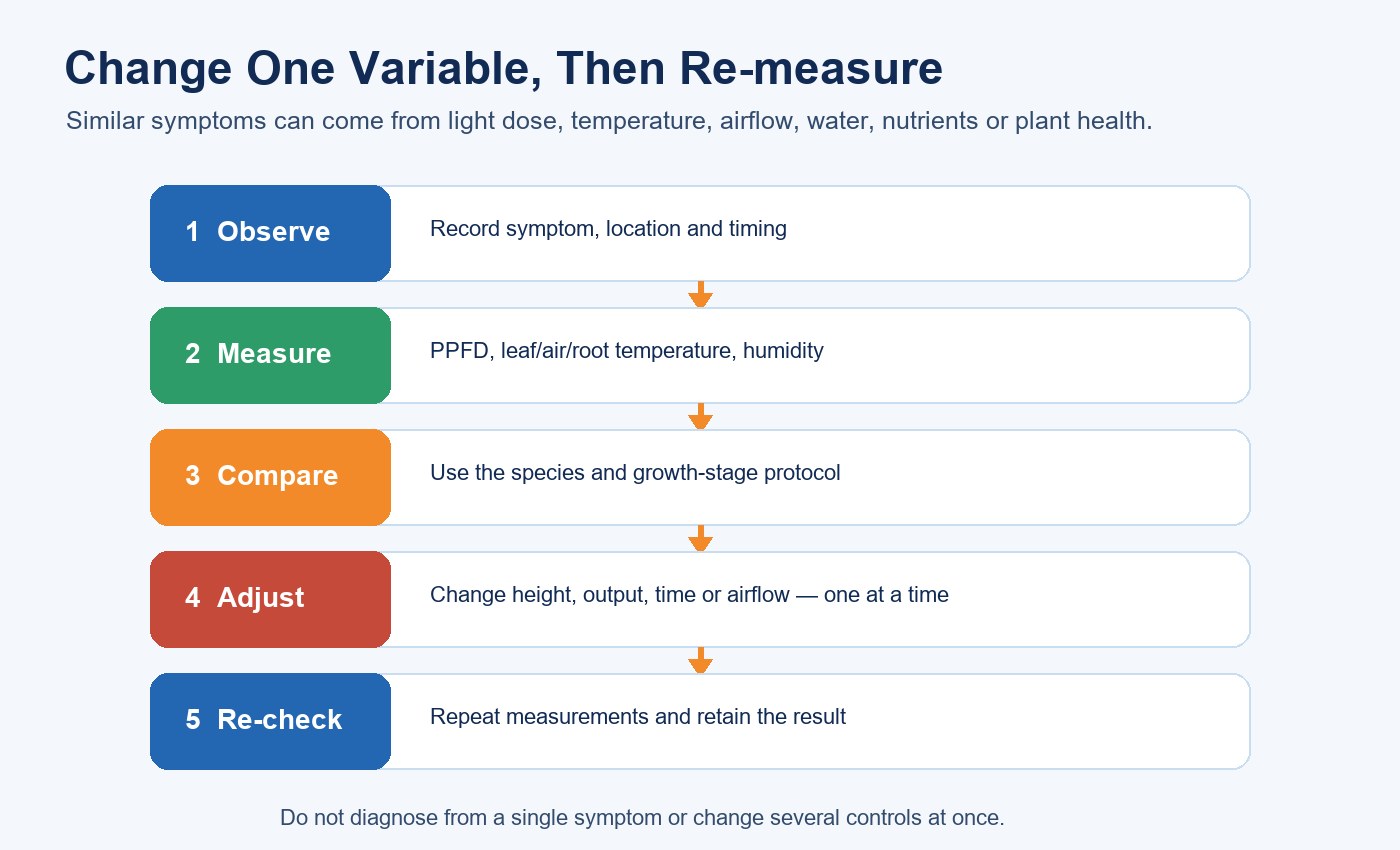
Use the indoor grow-light troubleshooting guide for a symptom-to-test sequence, and the full-spectrum versus red-blue comparison when spectrum is the real decision. Do not change height, power, photoperiod, airflow and watering at the same time; the result will not identify which change mattered.
| Observation | First checks | Possible adjustment | Evidence before acceptance |
|---|---|---|---|
| Stretching toward light | PPFD grid, photoperiod, canopy distance | Raise output or reduce distance within limits | Improved PPFD and compact new growth |
| Bleaching at center | Center PPFD, leaf temperature, spectrum | Reduce output, increase distance or acclimate | Stable color in new growth |
| Wilting during light period | Leaf/air temperature, humidity, substrate moisture | Correct water or airflow; then reassess light | Recovery without creating saturated roots |
| Uneven tray growth | PPFD uniformity, plant density and airflow | Reposition tray or adjust geometry | Reduced center-to-edge variation |
| Root decline | Root-zone temperature, drainage and moisture | Correct substrate, water and container conditions | Healthy new roots and stable canopy |
Run a Bounded Trial
Define success, warning and stop criteria before the fixture is energized. Suitable records may include germination, leaf color, compact growth, root appearance and biomass at a stated time, but the chosen metrics must fit the plant and stage.
Test the warmest expected room condition, longest intended schedule, lowest permitted mounting height and mature canopy density. Allow temperatures to stabilize, then log fixture, air, leaf, substrate and root-zone readings with power, PPFD and humidity.
Retain a control or comparison group when evaluating a new spectrum, height or schedule. The light-controlled seed germination trial guide provides a separate experimental structure for germination questions.
One species, seed lot and setup support only that defined protocol. They do not establish a universal “non-destructive” claim for all plants.
Build the Approval and RFQ Record
Request the exact model, spectrum or SPD, PPF, PPE, PPFD map, input power, controls, temporal light modulation, thermal data, ingress limits, installation instructions and market-specific compliance scope. Tie the approved sample to a revision-controlled configuration.
New Lights’ factory and manufacturing capabilities provide the path for sample and production coordination. For a bounded product review, contact New Lights with the plant protocol, tray dimensions, target PPFD, photoperiod, environment and sensor plan.
| Approval item | Required record | Release condition |
|---|---|---|
| Product identity | Model, revision, LED recipe and driver | Quotation, label, sample and order agree |
| Light delivery | PPFD grid, distance, output and photoperiod | Defined plant area meets the selected protocol |
| Thermal environment | Fixture, air, leaf and root-zone log | Product and plant limits are both met |
| Adjustment method | Baseline, single change and repeated measurement | Cause and effect remain interpretable |
| Production control | Approved sample and critical-component record | Changes trigger scoped review |
| Handover | Timer, distance, watering, airflow and monitoring instructions | Operator can reproduce the approved setup |
Frequently Asked Questions
Does LED “cold light” mean the grow lamp produces no heat?
No. LEDs and drivers still release heat, and absorbed light contributes to the plant and enclosure energy balance. Measure the relevant points under operating conditions.
Is 40°C a universal safe limit for a desktop grow light?
No. The meaning changes depending on whether it refers to the housing, driver, air, leaf, substrate or root zone. Product and crop limits also require defined test conditions.
Can the fixture’s PPF determine the correct plant distance?
No. PPF is total output. Use a PPFD grid at canopy height, together with uniformity and the crop protocol, to set distance.
When should the distance be rechecked?
Recheck when canopy height, tray arrangement, fixture output or plant stage changes. Preserve the same measurement reference.
What should change first when plants show stress?
Measure before changing anything. Compare light, temperature, humidity, airflow, water and root conditions, then adjust one relevant variable and re-measure.
Editorial Sources
- New Lights, “Desktop LED Growing Fixture”: https://new-lights.com/products/horticultural-lighting/home-grow-lights/led-table-growing-fixture/
- University of Minnesota Extension, “A warm-weather jump on seed starting”: https://extension.umn.edu/about/our-stories/news/yard-and-garden-news/a-warm-weather-jump-on-seed-starting
- University of Minnesota Extension, “Troubleshooting seedling issues”: https://blog-fruit-vegetable-ipm.extension.umn.edu/2020/04/troubleshooting-seedling-issues.html