

The number of grow lights you need cannot be determined from floor area, wattage, or a fixture’s marketing coverage alone. It depends on the crop and stage, target PPFD or DLI, photoperiod, canopy dimensions, daylight contribution, fixture photon output, mounting geometry, distribution, losses, and required uniformity.
Use the following method to create an initial fixture count, then verify the layout with a model-specific simulation or PPFD map and measurements at the crop canopy. Treat every number as an input with a source—not as a universal recipe.
Start With the Crop and Production Goal
Define the crop, cultivar, growth stage, propagation or production objective, environmental strategy, and qualified source for the target light level. Different crops and stages respond differently to intensity, photoperiod, spectrum, temperature, carbon dioxide, irrigation, and other conditions.
A generic table that assigns one PPFD range to all seedlings, all vegetative plants, or all flowering plants hides these differences. The target should come from crop-specific research, an experienced grower’s validated recipe, or a controlled trial appropriate to the facility.
Record whether the target is:
- instantaneous PPFD at the canopy;
- average PPFD over the production area;
- minimum PPFD at any accepted point;
- a uniformity ratio;
- total DLI from daylight plus electric light;
- supplemental DLI from electric light only.
These are different design requirements. A layout can meet an average while leaving edge plants below the minimum.
Understand PPF, PPFD, and DLI
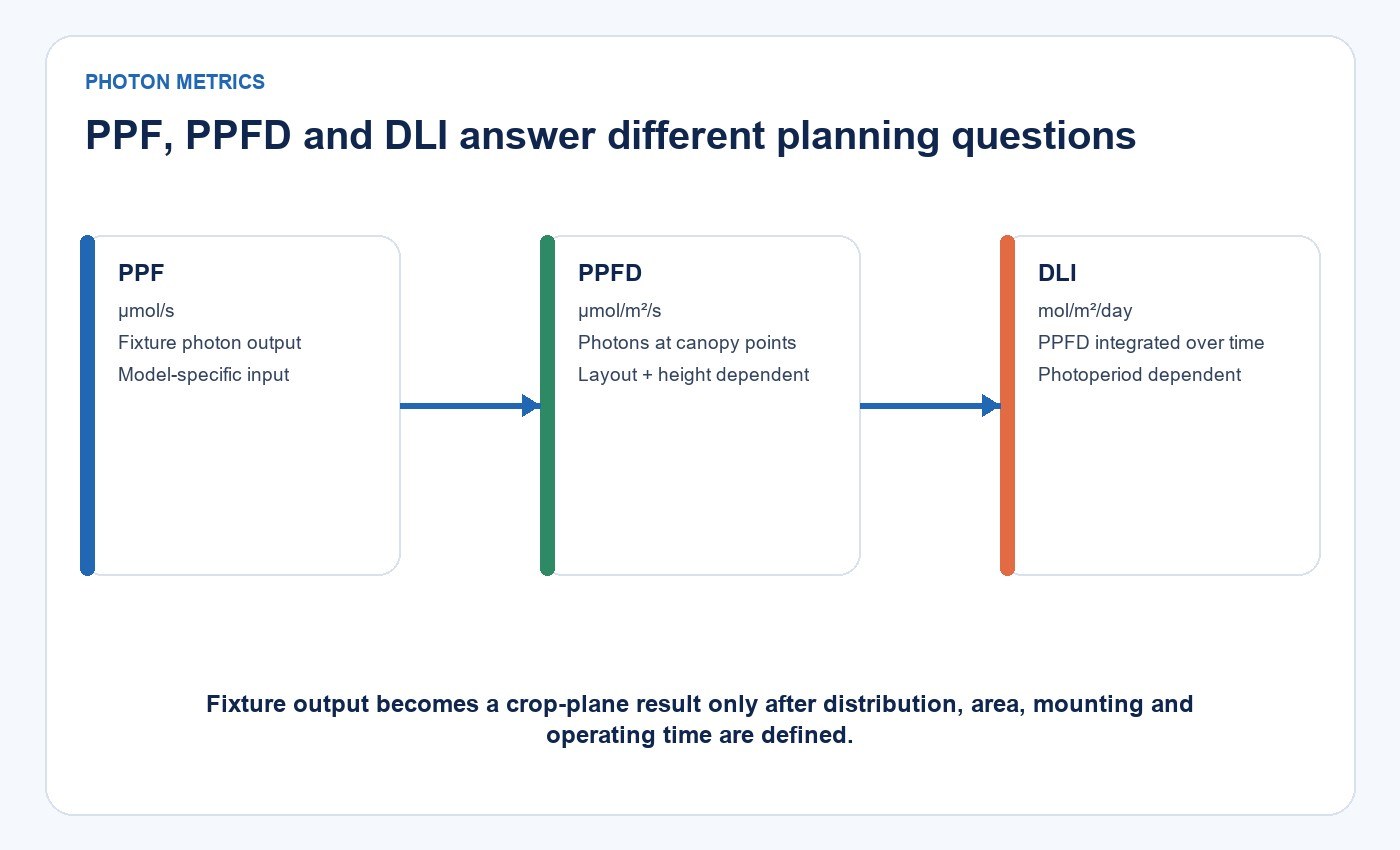
ASABE’s ANSI/ASABE S640 standard defines the plant-radiation quantities and units used in this calculation. Photosynthetic photon flux, or PPF, describes the rate of photons emitted by a fixture within the defined photosynthetic range and is expressed in micromoles per second. It is a fixture-output quantity.
Photosynthetic photon flux density, or PPFD, describes the photon rate arriving on a unit of canopy area and is expressed in micromoles per square meter per second. It depends on fixture output, optics, spacing, height, room surfaces, obstructions, and measurement position.
Daily light integral, or DLI, is the accumulated photon exposure per square meter over a day. If PPFD is constant during the electric-light period:
DLI = PPFD × lighting hours × 3600 ÷ 1,000,000
For example, a constant 250 micromoles per square meter per second for 16 hours contributes 14.4 moles per square meter per day. This arithmetic does not say that 250 is correct for a crop; it only converts a specified PPFD and duration into DLI.
When daylight or dimming varies over time, integrate the measured or modeled PPFD over the day rather than using one instantaneous reading.
Calculate the Supplemental Light Requirement
In a fully enclosed room with no daylight, the electric-light system supplies the planned DLI. In a greenhouse, electric light normally fills a variable gap between the crop target and transmitted daylight at canopy level.
Use seasonal and hourly data when possible. A roof sensor value is not automatically the canopy value because glazing, structure, screens, crops, and geometry affect transmission. Define whether the project is designed for an average day, a low-light design day, a monthly target, or a dynamic control strategy.
If the required supplemental DLI and available lighting hours are known, calculate the required average supplemental PPFD:
Supplemental PPFD = supplemental DLI × 1,000,000 ÷ (hours × 3600)
The selected photoperiod must remain within the crop and production constraints. Extending hours is not an unlimited substitute for intensity.
Define the Effective Canopy Area
Use the plant canopy that must receive light, not automatically the room floor or fixture footprint. Exclude aisles only if the design intentionally excludes them. For benches or multilayer racks, calculate each illuminated layer separately.
Record length, width, shape, gaps, bed spacing, tier spacing, plant height, and expected canopy development. A small early-stage canopy and a mature closed canopy can have different interception and uniformity behavior.
Irregular boundaries should be divided into zones. Different crops, stages, daylight exposures, or mounting constraints may require separate lighting groups rather than one facility-wide average.
Request Model-Specific Fixture Evidence
For each candidate fixture, request:
- tested PPF and input power;
- PPE, calculated as photon output per joule under the stated test conditions;
- spectral quantum distribution;
- photon intensity or distribution data;
- model-specific PPFD maps with test geometry;
- dimensions, mass, mounting, input, dimming, and control limits;
- thermal and environmental ratings supported by evidence;
- safety, EMC, reliability, and maintenance information;
- report number, laboratory, sample model, revision, and date.
The DesignLights Consortium (DLC) Horticultural Technical Requirements V4.0 provides a current qualification and reporting framework for horticultural luminaires, including photon-output, efficacy, distribution and controllability information within the program scope. Qualification is one input to product comparison; canopy delivery still depends on the model, operating state and installed geometry.
Do not derive PPF from wattage unless a verified PPE value applies to the exact operating condition. Do not derive PPFD coverage from PPF alone, because distribution and geometry determine where photons land.
Estimate the Initial Fixture Count
An initial photon-budget estimate can use:
Required canopy photon rate = target average PPFD × canopy area
Then:
Initial fixture count = required canopy photon rate ÷ (fixture PPF × utilization factor)
Round up, then test a physical layout. The utilization factor represents the fraction of emitted PPF expected to reach the defined canopy. It accounts for photons falling outside the crop area or intercepted elsewhere. It is not a universal constant.
For a hypothetical design, assume a 20-square-meter canopy, a target average supplemental PPFD of 300, a verified fixture PPF of 1,500 micromoles per second, and a preliminary utilization factor of 0.75.
Required canopy photon rate is 300 × 20 = 6,000 micromoles per second. Estimated delivered photons per fixture are 1,500 × 0.75 = 1,125 micromoles per second. The quotient is 5.33, so the initial count is six fixtures.
This is not a finished design. Six fixtures could still create unacceptable hotspots, dark edges, structural shadows, or clearance problems. The utilization assumption and layout must be verified.
| Worked estimate | Value | Calculation or decision |
|---|---|---|
| Canopy area | 20 m² | Defined productive crop plane |
| Target average supplemental PPFD | 300 µmol/m²/s | Set by the qualified crop plan |
| Required canopy photon rate | 6,000 µmol/s | 300 × 20 |
| Verified fixture PPF | 1,500 µmol/s | Exact model and operating state |
| Preliminary utilization | 0.75 | Project assumption to validate |
| Initial quantity | 6 fixtures | 6,000 ÷ (1,500 × 0.75), rounded up |
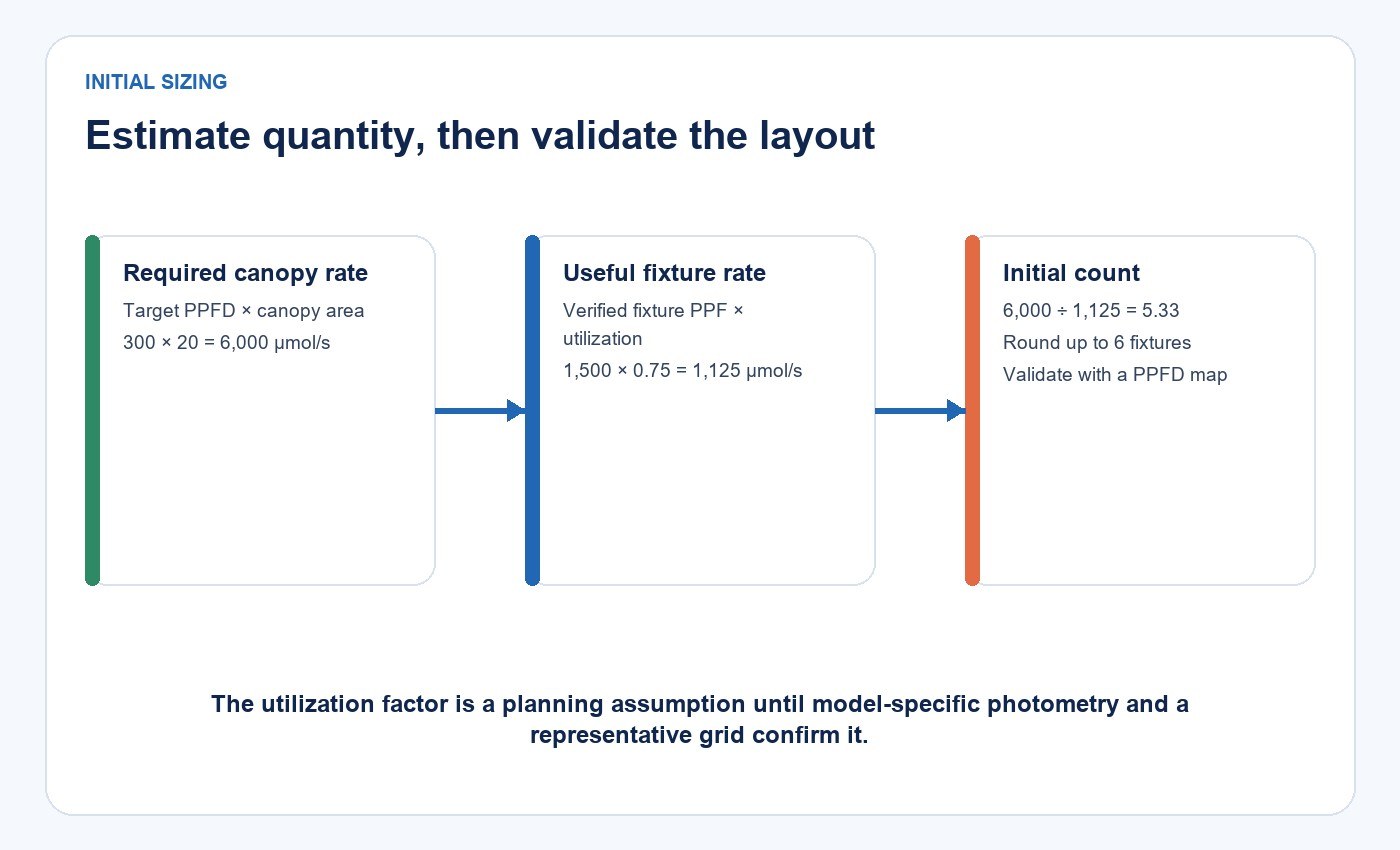
The same calculation gives a different answer if the canopy boundary, target, fixture output or utilization changes. If a PPFD map shows that six fixtures miss the minimum or uniformity requirement, increase or reposition fixtures even though the average photon budget appears sufficient. If the map shows excess output, consider spacing, zoning or dimming before removing equipment needed for edge coverage.
Design for Uniformity, Not Only Average PPFD
Fixture spacing, mounting height, optical distribution, overlap, room reflectance, and canopy shape control uniformity. A single high-output fixture may meet the photon budget but produce a bright center and weak perimeter. Multiple fixtures can improve overlap, but only when their geometry and control are planned.
Specify which uniformity metric will be used, such as minimum-to-average or minimum-to-maximum PPFD, and define the accepted measurement area. Do not remove low edge readings after seeing the results unless the production boundary is formally changed.
Structural members, irrigation lines, HVAC equipment, racks, and plants can cast shadows. Include them in the model or pilot. In greenhouses, the daylight pattern may be less uniform than the electric-light pattern and changes through the day and season.
Treat Mounting Height as a Fixture-Specific Variable
Raising a fixture usually spreads photons over a larger area and lowers peak PPFD; lowering it usually concentrates output. The result depends on the fixture’s dimensions, optics, distribution, neighboring fixtures, and canopy.
Therefore, a universal recommendation such as 12, 18, 24, or 30 inches cannot be transferred across products. Use the manufacturer’s verified map at the stated height as a starting point, then confirm clearance, thermal conditions, irrigation exposure, worker access, and the full grid at canopy level.
As plants grow, the distance to the canopy changes. Define how height, dimming, or fixture groups will be adjusted and how the change will be documented.
Read PPFD Maps Critically
A useful map should identify the exact fixture model and operating state, mounting height, grid size and spacing, measurement plane, room or tent dimensions, surface reflectance, sensor, stabilization, input condition, and whether one or multiple fixtures were used.
Compare maps only when their test conditions are comparable. A high center value on a small grid can look impressive while hiding poor edge coverage. An average without individual points hides uniformity. A map made inside reflective walls may not represent an open bench.
Digitized marketing graphics are planning aids, not final commissioning evidence. Request underlying values or a report where project risk warrants it.
Measure a Representative Canopy Grid
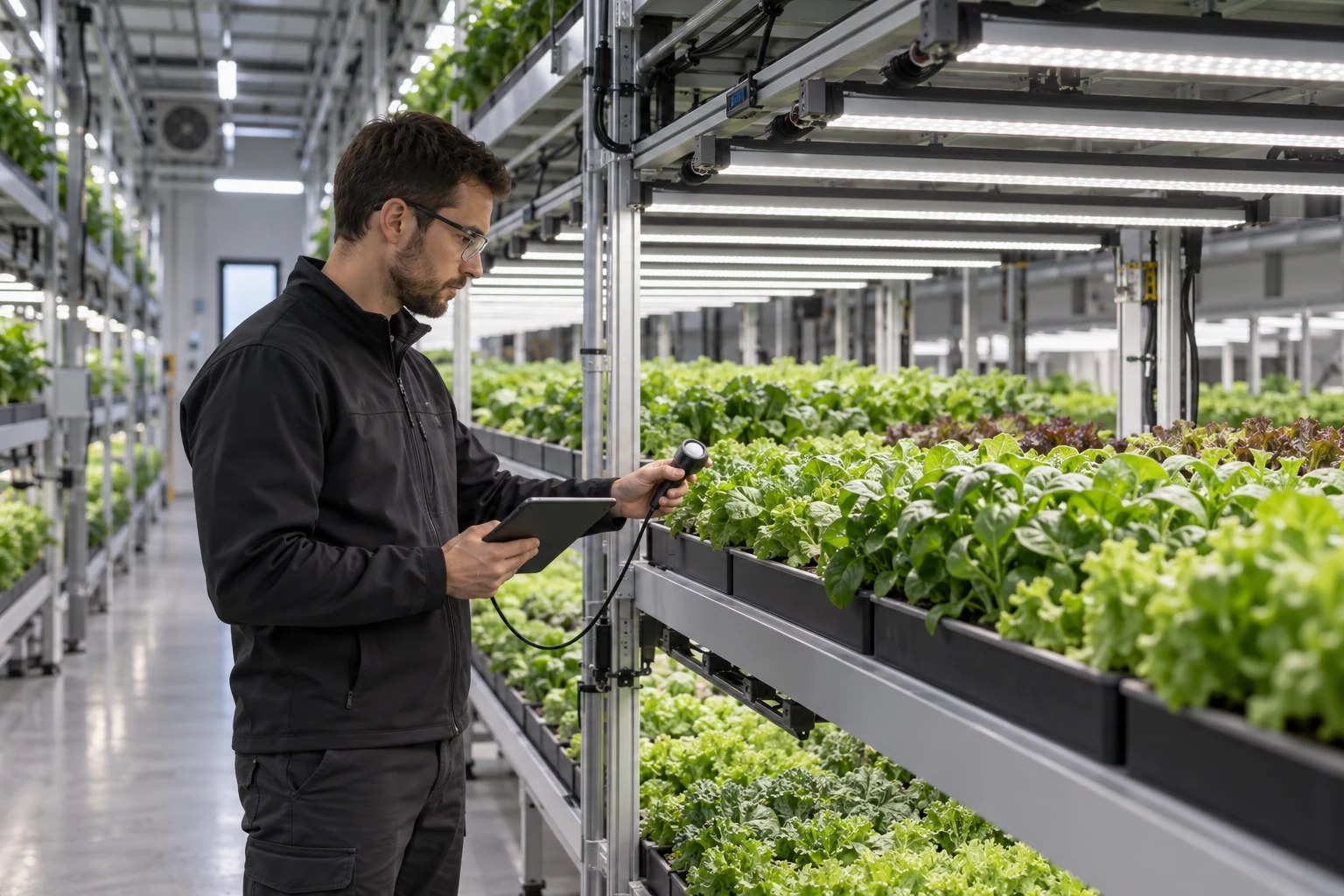
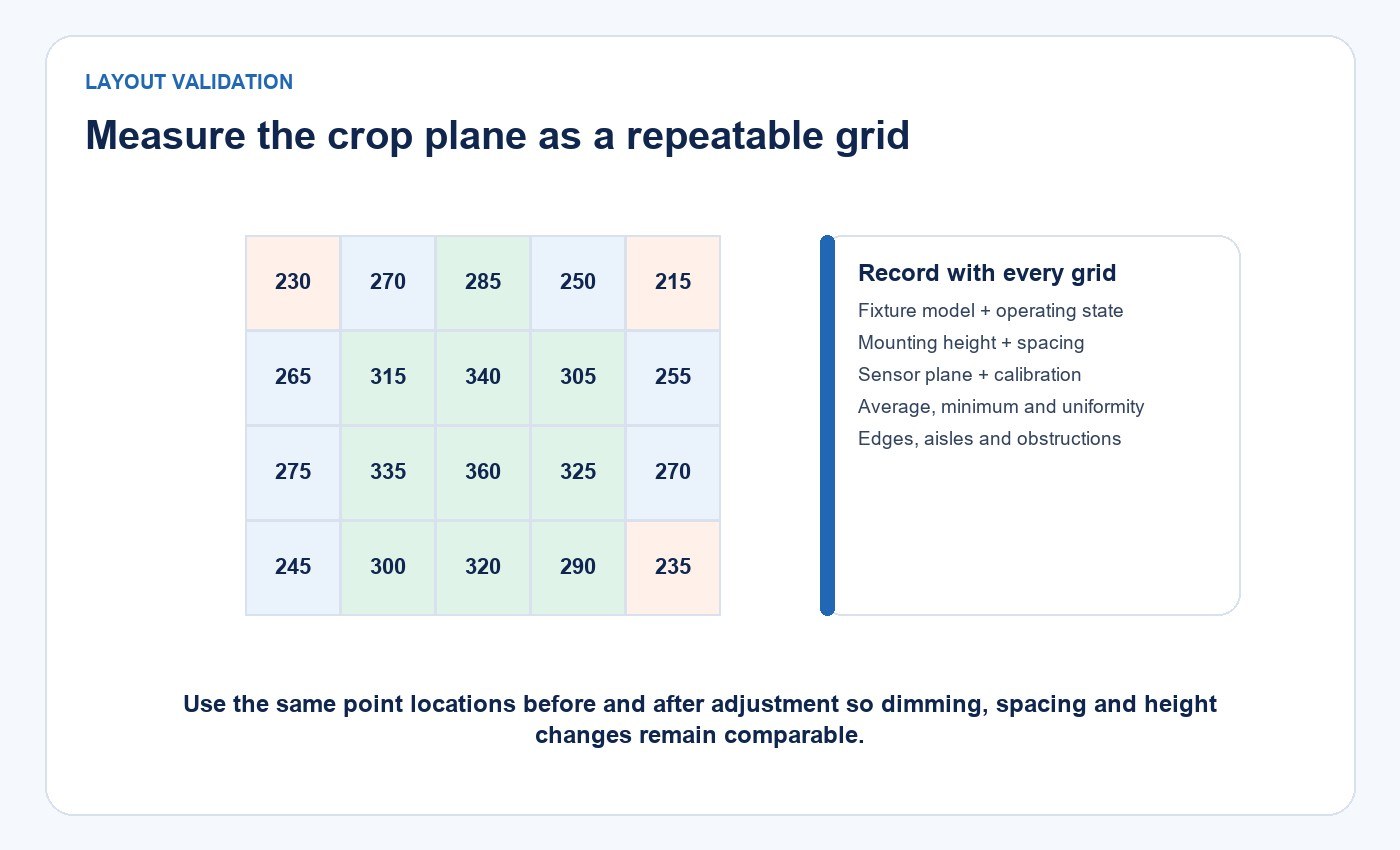
Before full rollout, install a representative bay and measure PPFD on a defined grid at the intended canopy plane. Use a calibrated quantum sensor appropriate to the spectrum and follow its instructions. ASABE lists ANSI/ASABE S642.1 SEP2025 as a current method for measuring and testing electromagnetic radiation sources used for plant growth and development.
Record:
- fixture model, serial or lot, revision, and control setting;
- mounting height and spacing;
- room dimensions, surfaces, and obstructions;
- grid coordinates and sensor orientation;
- input voltage, stabilization time, temperature, and daylight condition;
- every point value, average, minimum, maximum, and chosen uniformity metric.
Separate electric-light measurements from daylight where the design requires it. A phone app may be useful for rough exploration, but it should not replace calibrated project acceptance measurements unless its accuracy has been validated for the device, diffuser, spectrum, and range.
Use Dimming and Zoning to Manage Variation
Dimming can reduce excess output, balance zones, support stages, or respond to daylight. It cannot correct a fundamentally poor distribution in every case. Confirm the relationship between control setting, input power, PPF, spectrum, and PPFD for the exact fixture.
Group fixtures according to crop zone, daylight exposure, tier, or stage. Document minimum dimming level, step size, response, fail state, sensor placement, schedule, and manual override. Recheck the canopy after commissioning changes.
Energy planning should use measured or verified input power at expected operating states and schedules, not only nameplate maximum power.
A Practical Sizing Workflow
- Define crop, cultivar, stage, canopy, environment, and production objective.
- Approve the target PPFD/DLI and photoperiod from a qualified crop source.
- Measure or model daylight contribution where applicable.
- Calculate required supplemental PPFD and canopy photon rate.
- Obtain model-specific PPF, spectrum, distribution, electrical, thermal, and control evidence.
- Select a documented preliminary utilization factor and calculate the initial count.
- Lay out fixtures to meet clearance and uniformity requirements.
- Simulate or review model-specific PPFD maps under matching conditions.
- Install a representative bay and measure a canopy grid.
- Adjust count, spacing, height, zoning, or dimming and repeat acceptance measurements.
Before comparing fixture forms, review types of grow lights and the grow-light fundamentals guide. Buyers can also examine the LED harvest lamp family as a product-category starting point, then contact New Lights with the crop stage, canopy drawing, daylight profile, target DLI, photoperiod, environmental conditions and required evidence for a model-specific layout review.
FAQ
Can fixture wattage determine how many grow lights I need?
No. Wattage is electrical input. Quantity also depends on verified photon output, distribution, canopy area, utilization, crop target, photoperiod, daylight, and uniformity.
Is average PPFD enough?
Not by itself. Check minimum, maximum, distribution, the chosen uniformity metric, and whether every measured point is inside the defined production canopy.
Can I use a manufacturer’s coverage chart?
Use it as a planning input only when it identifies the exact model and test conditions. Verify important projects with matching simulation or canopy-grid measurements.
What mounting height should I use?
There is no universal height. Use model-specific distribution data, clearance and environmental constraints, then measure the actual canopy grid.
How does daylight change fixture count?
For supplemental greenhouse lighting, calculate the DLI gap under the chosen seasonal design condition and control strategy. Daylight contribution must be measured or modeled at canopy level.
Should I add extra fixtures for future expansion?
Design modular electrical and control capacity where justified, but do not install arbitrary excess output. Recalculate and recommission when canopy area, crop, tier, or target changes.
Editorial Sources
- DesignLights Consortium, Horticultural Technical Requirements V4.0: https://designlights.org/our-work/horticultural-lighting/technical-requirements/hort-v4-0/
- ASABE, ANSI/ASABE S640 JUL2017 (R2022), Quantities and Units of Electromagnetic Radiation for Plants: https://elibrary.asabe.org/abstract.asp?aid=48303
- ASABE, Published Standards, including ANSI/ASABE S642.1 SEP2025: https://asabe.org/publications-standards/standards-development/national-standards/published-standards
- Paucek et al., Applications and Development of LEDs as Supplementary Lighting for Tomato at Different Latitudes: https://www.mdpi.com/2073-4395/11/5/835