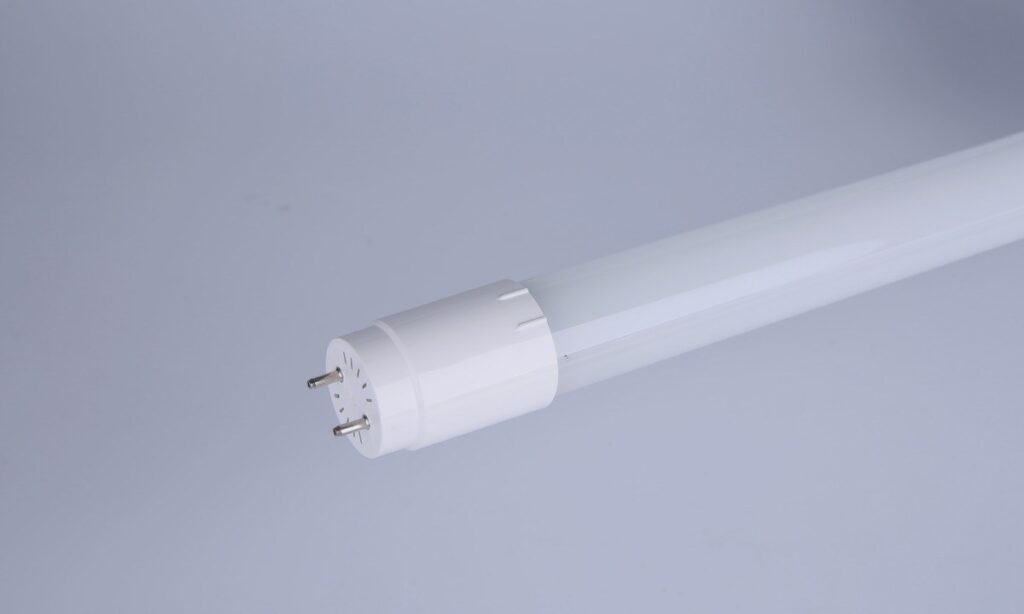


A grow light is a lighting system used to provide or supplement radiation for plant growth and development. Unlike ordinary visual lighting, it is evaluated mainly by the photons delivered to a plant canopy, their wavelengths, their distribution and the time over which plants receive them. New projects can begin with the horticultural and plant-growth lighting solution before moving into product-level comparison.
That does not mean one “plant light” works for every crop. Light requirements vary by species, cultivar, growth stage, production goal and environment. A houseplant near a window, seedlings on a shelf, greenhouse ornamentals and a fully enclosed indoor farm all use artificial light differently.
| Start with | Question to answer | Output for product comparison |
|---|---|---|
| Crop and stage | What plant response is the production plan targeting? | Crop-specific light requirements and evidence source |
| Production system | Is electric light supplemental or sole-source? | Natural-light contribution and control strategy |
| Canopy and structure | What area, height and spacing must be covered? | PPFD map conditions and fixture layout |
| Operating plan | What photoperiod and seasonal schedule apply? | DLI plan, controls and estimated energy |
| Facility limits | What heat, access, water and electrical constraints exist? | Mounting, driver, protection and maintenance requirements |
Why Plants Need Light
Plants use light energy in photosynthesis to produce chemical energy for growth. Light also acts as a developmental signal. Its quantity, spectrum and timing can influence plant form, flowering and other responses.
Lighting is only one part of the growing environment. Temperature, water, nutrients, humidity, air movement, carbon dioxide, root-zone conditions and pest pressure interact with plant response. A grow light cannot compensate for every problem in those systems, and a change in plant growth does not identify lighting as the only cause.
PAR: The Common Photosynthetic Range
Photosynthetically active radiation, commonly abbreviated PAR, generally refers to radiation between 400 and 700 nanometers. University of Missouri Extension describes this as the range commonly used when discussing photons active in photosynthesis.
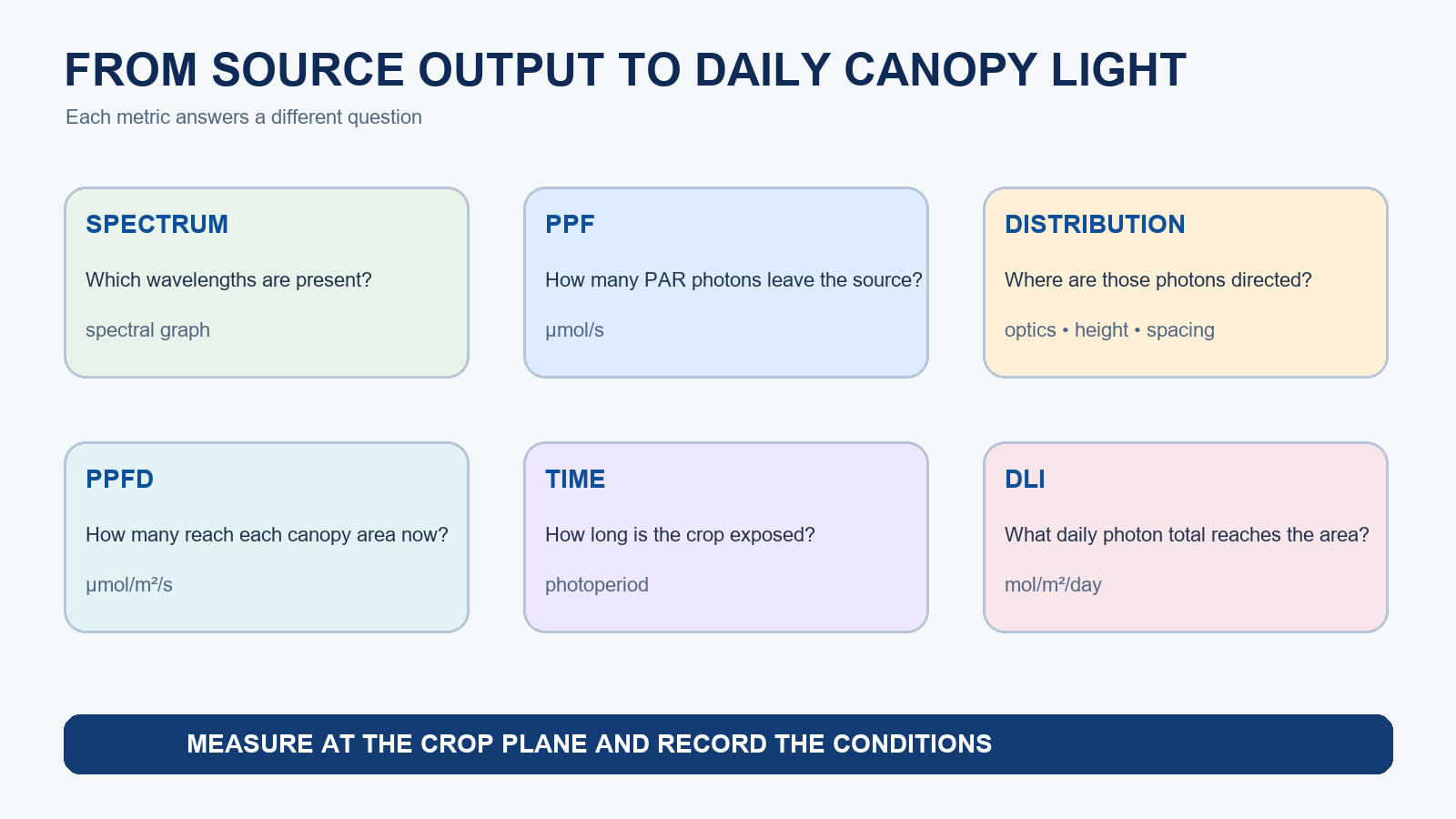
PAR is a wavelength range, not an intensity value. Saying that a fixture emits within PAR does not tell a grower how many photons it produces, where they reach the crop or how evenly they are distributed.
Plants can also respond to radiation outside this traditional range, including ultraviolet and far-red wavelengths. Those responses can depend on crop and environment. A broader spectrum is not automatically superior, and a narrow spectrum is not automatically more efficient for every production objective. Spectrum decisions require crop-specific evidence.
PPF: Photon Output From the Source
Photosynthetic photon flux, or PPF, describes the rate at which a source emits photons within the defined photosynthetic range. It is commonly reported in micromoles per second.
PPF is useful for comparing source output, but it does not describe the area covered or the photon density at the plants. Two fixtures with similar PPF can create different canopy results because of optics, mounting height, spacing, reflectors and the shape of the growing area.
When reviewing a PPF claim, confirm that it applies to the complete fixture and exact model. Also check the measurement method and whether the corresponding input power is stated. A family-level marketing number should not be assigned to every length, wattage or spectrum variant.
PPFD: Photons Reaching the Canopy
Photosynthetic photon flux density, or PPFD, describes the photon flux reaching a unit area at a given moment. It is commonly expressed in micromoles per square meter per second.
PPFD connects the luminaire to the crop plane. It changes with mounting height, distribution, fixture spacing and surrounding reflections. A center value alone can be misleading; the corners and edges may receive much less light.
Use a PPFD map for the exact fixture, spectrum, mounting height and test area, or measure the installed system with an appropriate quantum sensor. Record multiple points across the canopy. The optimal range varies by plant and growth stage, so the measurement must be compared with crop-specific guidance rather than one universal target.
As plants grow, the canopy approaches the luminaire and becomes less uniform. Recheck distance and distribution. Taller plants may receive much more light at the top while shading lower leaves or neighboring plants.
DLI: The Daily Photon Dose
Daily light integral, or DLI, represents the total photosynthetic photon exposure delivered to an area over a day. It connects PPFD with operating time.
A higher instantaneous PPFD used for fewer hours and a lower PPFD used longer can sometimes deliver a similar mathematical DLI. Plant responses are not governed by that number alone. Photoperiod, peak intensity, dark period, temperature and crop physiology still matter. Longer operating hours cannot always compensate safely or effectively for insufficient intensity.
In a greenhouse, DLI includes sunlight and supplemental electric lighting. In a windowless indoor system, the electric lighting supplies the photosynthetic light. This distinction affects sizing, controls and energy cost.
| Metric | What it describes | What it cannot answer alone |
|---|---|---|
| Spectrum | Radiant output by wavelength | Photon quantity, distribution or crop outcome |
| PPF | PAR photon output from the source per second | Area coverage or canopy uniformity |
| PPFD | Instant photon flux at a canopy position | Daily exposure or crop suitability |
| DLI | Daily PAR photon total per unit area | Photoperiod response, peak intensity or spectrum |
| Photon efficacy | PPF divided by input power | Installed distribution, facility energy or crop economics |
Photoperiod: When and How Long Light Is Present
Photoperiod is the duration of light exposure in a 24-hour cycle. Plants differ in their sensitivity to day length, and some flowering responses depend on the relationship between light and uninterrupted darkness.
The operating schedule should therefore be based on the crop and stage. A timer can provide consistency, but the schedule is not a substitute for measuring delivered intensity or considering sunlight. In a greenhouse, controls may respond to both time and accumulated natural light. In an indoor farm, the schedule may be coordinated with temperature, irrigation, labor and energy management.
Avoid running lights continuously unless a crop-specific, validated production method requires it. “More hours” is not a universal pathway to more growth.
Spectrum: More Than a Color Label
Spectrum describes how radiant output is distributed across wavelengths. Grow lights may use broad white light, combinations of red and blue, or channels that include other wavelengths.
Human-vision terms such as lumens, lux and correlated color temperature serve visual-lighting purposes; they do not replace photon-based horticultural measurements. They can still matter for workers, visual inspection and the appearance of plants. The correct data set depends on whether the question concerns plant delivery, human visibility or both.
Ask for a spectrum graph tied to the exact model and operating setting. For tunable products, obtain information for the recipes or channel combinations that will actually be used. Two fixtures called “full spectrum” can have different spectral distributions, and the label does not establish crop performance.
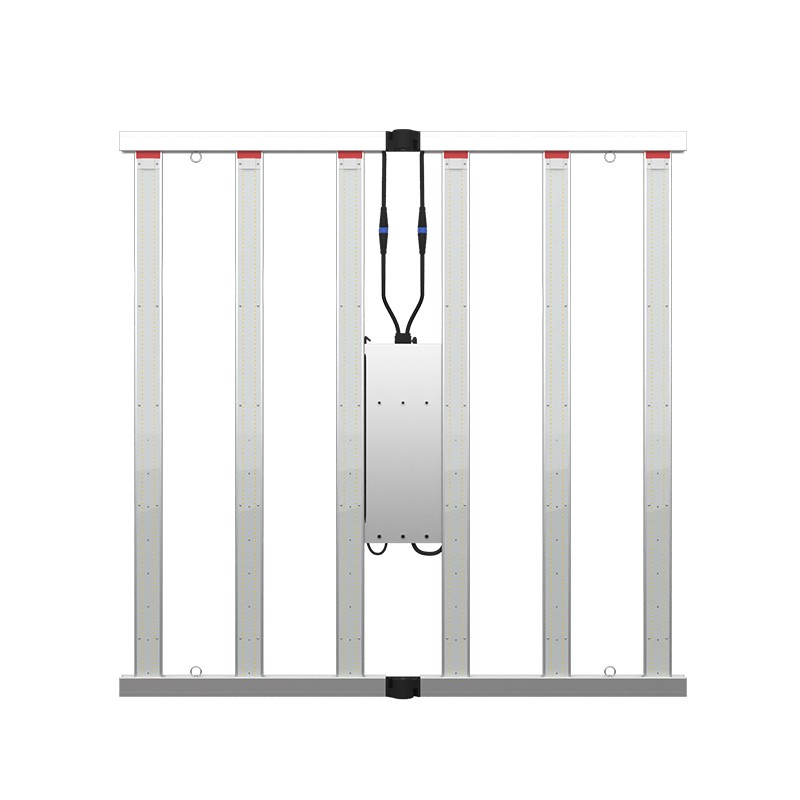
The comparison between full-spectrum and red-blue grow lights explains why spectrum labels must be connected to the crop, stage and production environment.
Photon Efficacy and Energy Use
DOE defines horticultural photon efficacy as PPF divided by input electrical power, expressed in micromoles per joule. It helps compare how effectively a fixture converts input energy into photons within the measured range.
Higher photon efficacy can reduce lighting energy for a given source output, but it does not guarantee a better crop-plane design. Distribution, operating conditions, controls and spectrum still matter. A highly efficient fixture that produces poor edge coverage may require a different layout or more units.
Estimate energy from actual input power, quantity and schedule. Include cooling or heating interactions where they are material. In a greenhouse, lamp heat may affect building loads differently from a dense indoor farm. Economic comparisons need the full production system, not the luminaire purchase price alone.
Typical Use 1: Houseplants and Decorative Interiors
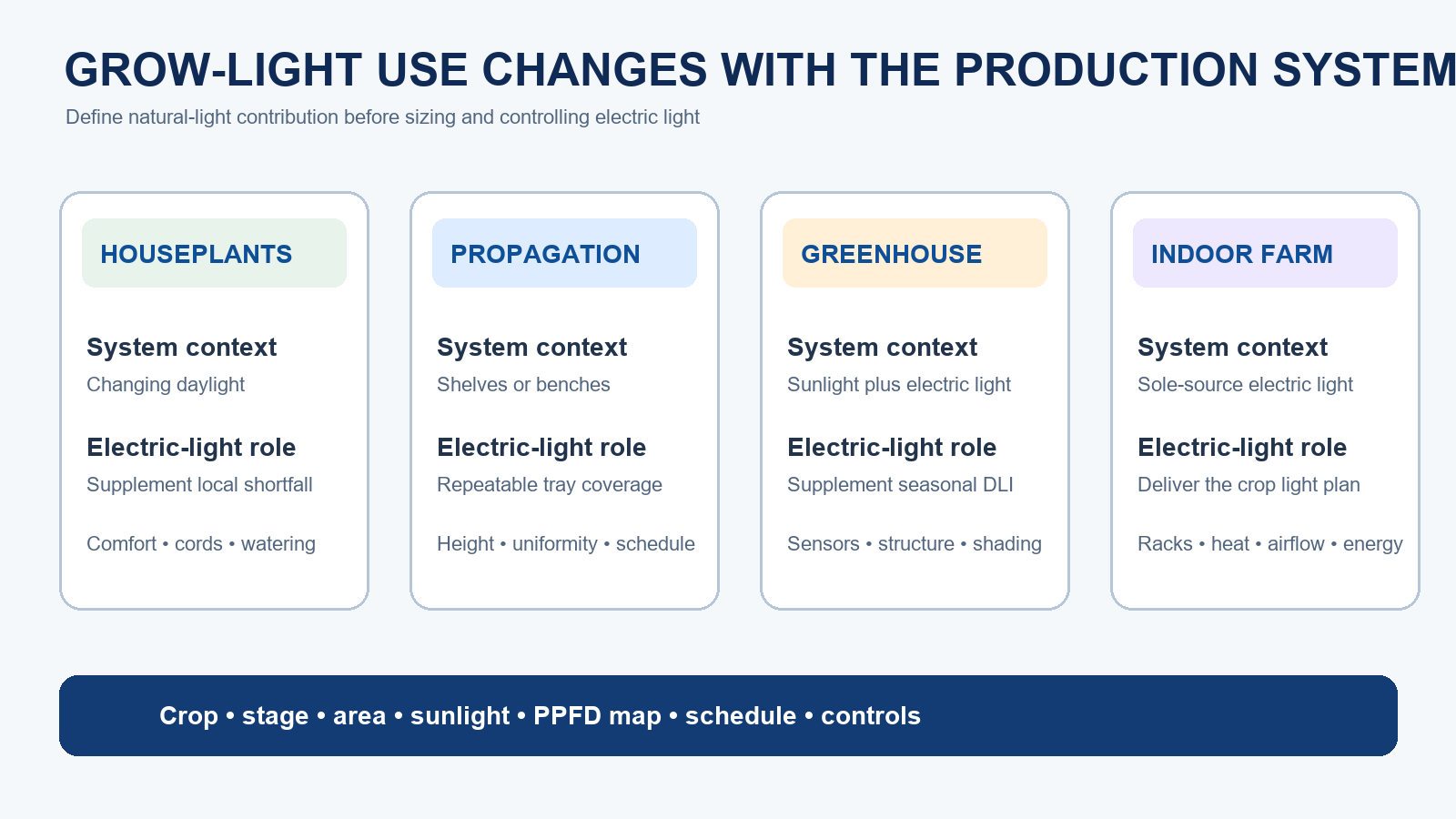
Supplemental lights can support plants that receive inadequate window light, particularly during seasonal low-light periods or when plants sit far from windows. The system should match the plant and placement, provide useful coverage and operate on a consistent schedule.
For small indoor applications, compare the available home grow lights with the actual plant area, mounting distance and timer plan.
For occupied interiors, visual comfort and appearance matter alongside plant metrics. Avoid exposed high-luminance sources in normal sight lines. Secure the fixture, manage cords safely and prevent water from reaching electrical equipment.
Houseplant lighting usually supplements a changing amount of daylight. Observe and measure the combined environment rather than assuming the electric light is the only source.
Typical Use 2: Seed Starting and Propagation
Seedlings and young plants are commonly produced on shelves or benches where controlled lighting improves repeatability. Uniform coverage is important because small differences can create uneven development across trays.
The layout should account for tray dimensions, fixture spacing, height adjustment and plant growth. The crop and stage determine appropriate intensity and schedule. Lighting also interacts with temperature, irrigation and air movement, so the propagation protocol should treat these as one system.
Typical Use 3: Greenhouse Supplemental Lighting
In a greenhouse, grow lights add photons when sunlight is insufficient for a production target. USDA Agricultural Research Service describes supplemental lighting as augmenting ambient sunlight to support crop growth and development.
Sunlight changes throughout the day and season, so a fixed on/off schedule may not deliver a consistent total. Sensors and controls can use measured solar contribution and a target DLI to decide when supplemental lighting is needed.
Greenhouse coverings, structure and plant density affect distribution. Spectral responses observed in a windowless chamber should not automatically be transferred to a greenhouse because sunlight changes the background spectrum. USDA research has documented this contextual difference in specific crops; it is a reason to validate the actual production environment, not a universal result for all species.
Typical Use 4: Sole-Source Indoor Production
In a full indoor farm or growth room, electric lighting provides the photosynthetic radiation. This gives the operator greater control but also makes the lighting design central to energy use, heat management and crop uniformity.
The project needs crop-specific targets, a PPFD distribution plan, operating schedule, control strategy and integration with racks, irrigation, airflow and environmental systems. A single fixture data sheet cannot establish performance across a multi-level growing system.
Commission the installed layout at canopy height and track results by crop stage. Changes in rack spacing, cultivar, density or recipe should be treated as controlled production changes.
Typical Use 5: Research and Controlled Experiments
Growth chambers and research systems may require repeatable spectra, intensity and timing. Documentation and calibration are especially important because a small difference between treatments can undermine the experiment.
Record fixture identity, channel settings, measured spectrum, PPFD grid, distance, schedule, temperature and other environmental variables. Do not assume that a control percentage corresponds linearly to photon output without measurement.
What Evidence Should a Buyer Request?
Before selecting a grow light, request:
- Exact model and spectrum graph.
- PPF and input power for that configuration.
- PPFD maps at relevant heights and areas.
- Photon-efficacy basis.
- Dimensions, mounting and thermal requirements.
- Driver and control information.
- Environmental limits and applicable certifications.
- Warranty, serviceability and change-control details.
Then compare the data with the crop, stage, area and sunlight contribution. A sample or pilot is appropriate when crop response, uniformity or operating cost is commercially important.
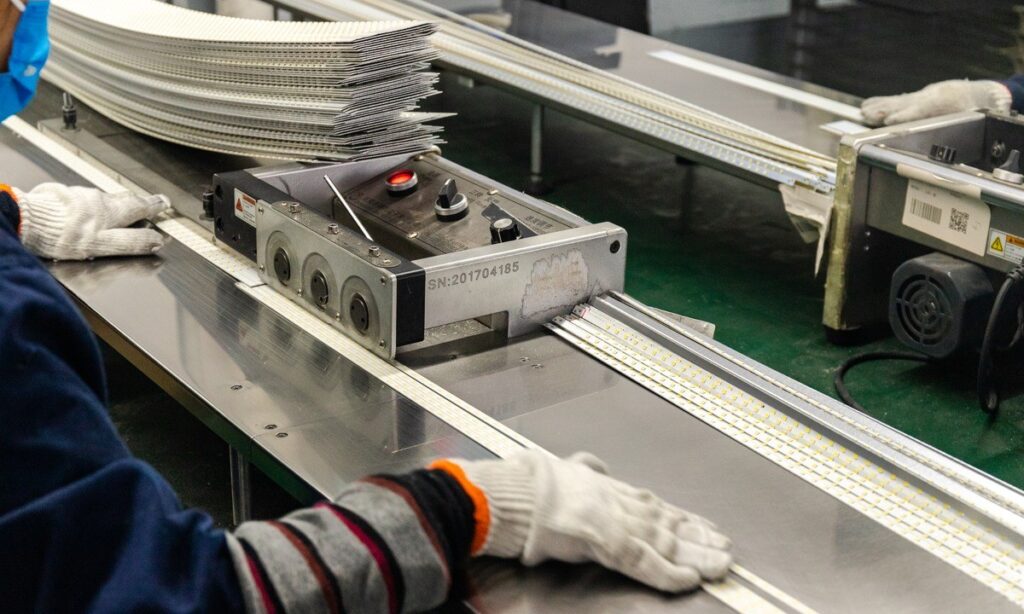
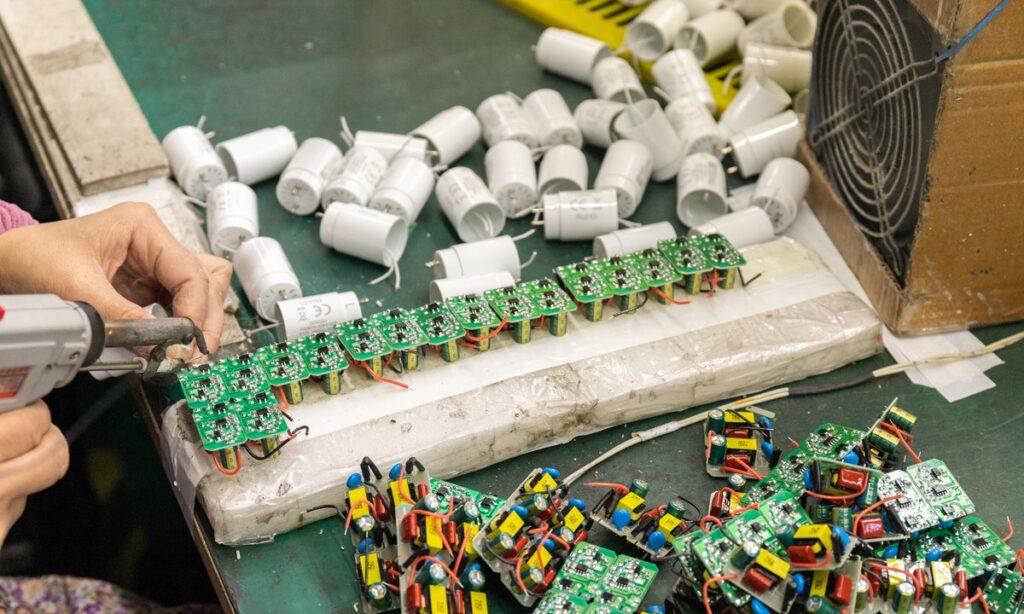
When symptoms appear after installation, use the indoor grow-light troubleshooting guide to separate lighting, plant, environment and control checks. For factory context, review New Lights manufacturing capabilities.
Frequently Asked Questions
Are grow lights different from ordinary LED lights?
They are selected and documented around plant-light delivery. Some general LED sources may support certain plants, but suitability depends on spectrum, PPFD distribution, schedule, environment and crop requirements—not the product label alone.
Are lumens useful for grow lights?
Lumens describe light weighted for human vision. They can help evaluate worker visibility but do not replace PPF, PPFD, spectrum and DLI for plant-light delivery.
What is the difference between PPF and PPFD?
PPF describes photon output from the source per second. PPFD describes photon flux reaching a unit of canopy area at a specific position and distance.
Is DLI just PPFD multiplied by operating hours?
DLI mathematically integrates PPFD over time, but crop response also depends on photoperiod, intensity pattern, spectrum and the rest of the environment. Equal DLI does not guarantee identical results.
Do all plants need a full-spectrum grow light?
No universal spectrum is best for all plants and goals. Use crop- and stage-specific evidence and the actual sunlight or sole-source context.
What information is needed for a grow-light review?
Provide the crop and stage, growing area, natural-light contribution, target PPFD or DLI evidence, mounting constraints, schedule, environment and controls. Buyers can contact New Lights with these inputs for a model-level review after product evidence is confirmed.
Editorial Sources
- University of Missouri Extension, “Controlled Environment Agriculture: Understanding Grow Lights”: https://extension.missouri.edu/publications/g6987
- U.S. Department of Energy, “Energy Savings Potential of SSL in Horticultural Applications”: https://www.energy.gov/sites/default/files/2017/12/f46/ssl_horticulture_dec2017.pdf
- USDA Agricultural Research Service, “Comparison of Supplemental Lighting From High-Pressure Sodium Lamps or Light-Emitting Diodes on Morphology and Nutrient Uptake of Greenhouse Crops”: https://www.ars.usda.gov/research/publications/publication/?seqNo115=370992