

There is no universal winner between full-spectrum and red-blue grow lights. The useful answer depends on the measured spectrum, photon delivery, crop, growth stage, canopy, photoperiod and controlled environment.
A fair comparison starts with the same production target and comparable light at the crop. Then it considers visual work, controls, energy use and crop response. Color names alone cannot support a purchasing decision.
Start With the Decision, Not the Color
The question is not simply whether white-looking light or purple-looking light is better. A commercial grower is choosing a complete operating condition: fixture output, spectrum, distribution, mounting, schedule, controls and environment.
Before requesting a proposal, define:
- crop and cultivar;
- propagation, vegetative, flowering or finishing stage;
- target PPFD and daily light integral (DLI);
- canopy dimensions and fixture-to-canopy distance;
- sole-source or greenhouse supplemental lighting;
- required visual inspection and worker access;
- temperature, humidity, carbon dioxide, irrigation and nutrient controls;
- the production metric that will decide whether a treatment succeeds.
The horticultural grow-light layout planning guide explains how mounting height, spacing and the target plane affect photon delivery. Those layout conditions should be fixed before a spectrum trial begins.
“Full Spectrum” Is Not a Complete Specification
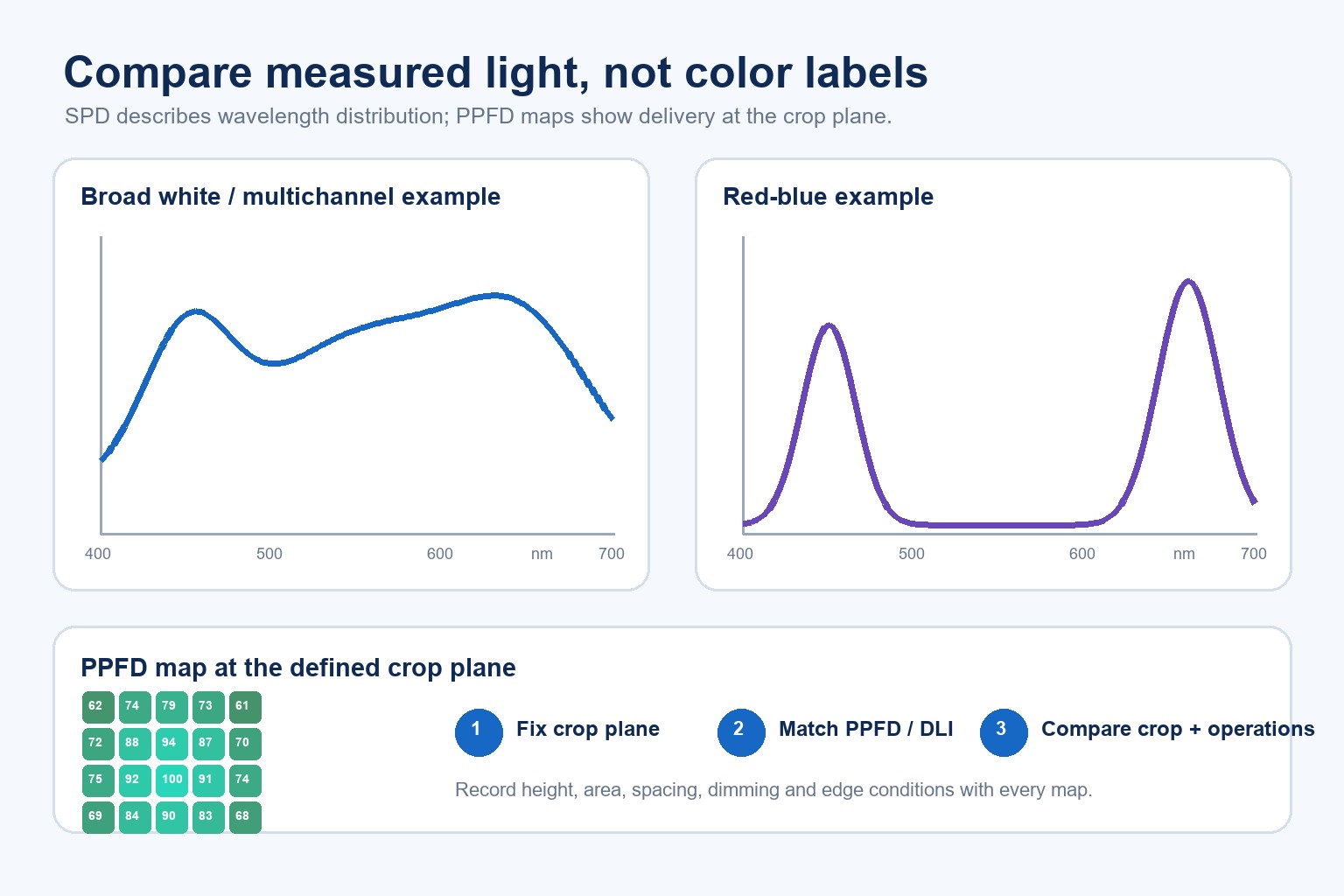
In grow-light marketing, full spectrum usually describes broad output that appears white and covers much of the visible range. It can be produced by phosphor-converted white LEDs, a combination of white and monochromatic channels, or another multichannel design.
The label does not disclose the spectral power distribution (SPD), blue-green-red balance, far-red or ultraviolet content, photosynthetic photon flux (PPF), photosynthetic photon efficacy (PPE), PPFD uniformity or behavior under dimming.
Two products carrying the same label can therefore produce different photon distributions. Ask for measured SPD data for the exact fixture, channel setting and operating power being quoted. For current product families, the New Lights grow-light range provides the appropriate starting point; model-level specifications still control the final comparison.
What Red-Blue Means
A red-blue fixture concentrates output in selected red and blue wavelength bands. The peak wavelengths, bandwidths and channel ratio vary by design. Some systems use fixed ratios; others provide independently controlled channels.
Red and blue photons are important in plant photosynthesis and development, but the phrase “red-blue” still leaves the decisive numbers unknown. A rigorous treatment identifies the measured SPD, photon fractions, PPFD, photoperiod and operating cycle.
NASA plant research, for example, records treatment conditions such as spectrum, PPFD and light cycle rather than relying on a color name. That level of definition makes a treatment repeatable and allows a result to be interpreted within its actual conditions.
Compare Photon Delivery Before Spectrum Preference
Spectrum comparisons are meaningful only when photon quantity and distribution are controlled or explicitly included in the analysis.
| Metric | What it describes | What the buyer should request |
|---|---|---|
| SPD | Output distributed across wavelength | Measured curve for the exact setting and channels |
| PPF | Total photosynthetic photon output | Test method, operating power and stabilization conditions |
| PPE | PPF divided by electrical input | Value for the quoted spectrum and power setting |
| PPFD | Photon density reaching the crop plane | Grid map, test area, height, spacing and edge conditions |
| DLI | Total daily photon delivery | PPFD basis plus the actual photoperiod or dimming schedule |
Electrical watts do not show how many photons reach the canopy. A high-PPF fixture can still create poor uniformity if its optics, mounting height or spacing do not fit the room. Compare systems at the same defined crop plane and include edge zones, not only the brightest center reading.
Use the LED sample evaluation checklist to keep the exact sample, driver, channel setting and test record connected during approval.
Practical Differences Between Broad White and Red-Blue Systems
| Decision area | Broad white or multichannel direction | Red-blue direction |
|---|---|---|
| Human visibility | Usually supports more natural crop and workspace inspection | Purple appearance can make color assessment more difficult |
| Spectral configuration | Broad base may be fixed or combined with controllable channels | Output is concentrated in selected bands; ratio may be fixed or adjustable |
| Crop response | Depends on actual SPD, crop, stage, quantity and environment | Depends on peaks, ratio, crop, stage, quantity and environment |
| Canopy interaction | Green and other photons form part of the complete canopy treatment | Canopy result is not determined by the red-blue label alone |
| Photon efficacy | Must be measured for the exact fixture and setting | Must be measured for the exact fixture and setting |
| Worker tasks | Often easier for scouting, harvest and maintenance | May require a separate white work-light mode or inspection routine |
These are comparison directions, not guaranteed biological outcomes. A system can combine broad-white and narrow-band channels, so buyers should classify the actual configuration rather than force every fixture into one of two marketing categories.
Visual Inspection Is an Operating Requirement
Broad white light generally supports more natural color judgment for human observers. That can help workers examine leaf color, pests, disease signs, nutrient symptoms and harvest condition.
Park and Runkle compared several sole-source LED treatments at controlled PPFD for four ornamental species. Their study found that broad white treatments improved visual color quality relative to blue-red light, while plant responses depended on species and treatment. The finding supports visual assessment as an operational criterion; it does not establish a universal yield advantage.
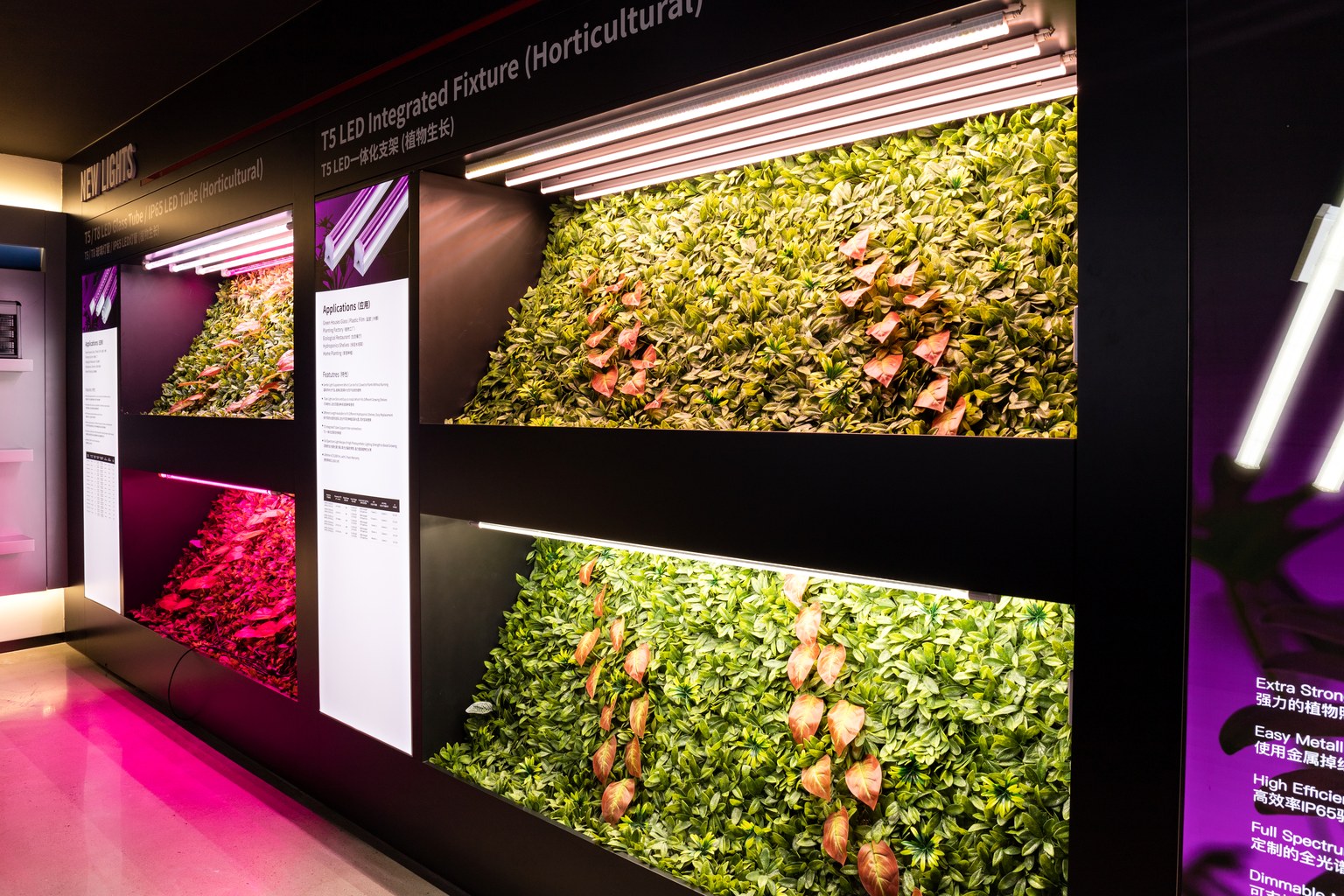
If a red-blue production mode needs separate white work lighting, include that load, control sequence and labor practice in the system comparison. Visual inspection is part of operations, not a substitute for crop measurements.
Green Photons Are Not Simply Wasted
The claim that plants use only red and blue is too broad. Plant response involves multiple photoreceptors, leaf optical properties and canopy structure.
A study of basil grown under white and blue-red light at the same stated PPFD reported different growth and metabolic responses. Its authors also emphasized the influence of genotype, spectral ratio, PPFD, photoperiod, developmental stage and canopy width. Those boundaries are why one basil result should not be presented as a universal crop recipe.
Research also discusses different absorption and canopy-penetration behavior across wavelengths. That does not justify one fixed green percentage for every crop. Evaluate the whole SPD and the measured response of the intended canopy.
Far-Red and Ultraviolet Need Separate Definitions
Some products marketed as full spectrum include far-red or ultraviolet channels; others do not. White appearance cannot confirm either one. Request channel specifications and a measured SPD that extends across the wavelengths relevant to the project.
If far-red or ultraviolet is used, define dose, timing, control behavior and the crop response being evaluated. Also review worker exposure, materials and facility procedures where applicable. Do not turn a biological research result into a product-safety or regulatory conclusion.
Crop, Stage and Facility Type Change the Decision
Spectrum can affect morphology, leaf expansion, stem elongation, flowering and secondary metabolism as well as photosynthetic performance. The direction and magnitude can change with species, cultivar and stage.
Sole-source and greenhouse supplemental lighting also require different reasoning. In a closed room, the fixture provides the designed light environment. In a greenhouse, LED output combines with sunlight that changes by season, weather and time of day.
USDA Agricultural Research Service-hosted greenhouse research compared supplemental treatments containing blue, white, red and far-red radiation under defined greenhouse conditions. Its results belong to that background light, crop set and treatment schedule. A greenhouse result should not be transferred directly to a sole-source room, and the reverse is also true.
For smaller-scale applications, review the home grow-light category; for controlled commercial projects, start with professional grow-light configurations. In both cases, selection still depends on the target crop plane and operating conditions.
Compare Complete Operating Economics
Fixture price and electrical watts are incomplete comparisons. Commercial evaluation should include:
- PPE at the approved spectrum and setting;
- PPFD uniformity and usable growing area;
- fixture quantity, mounting and electrical infrastructure;
- dimming and channel-control behavior;
- photoperiod and seasonal DLI strategy;
- cooling, heating and dehumidification interaction;
- worker inspection lighting and access;
- crop cycle, marketable output and quality criteria;
- cleaning, maintenance and spectral consistency;
- commissioning, monitoring and control labor.
The useful economic result is output from a controlled production system with known energy and operating inputs. If a comparison changes spectrum, PPFD, room temperature and crop density at the same time, it cannot show which variable caused the result.
Run a Controlled Trial When the Decision Matters
A representative trial should document:
- crop, cultivar, stage and production objective;
- measured treatment SPDs at the intended settings;
- PPFD grid, measurement height and DLI;
- photoperiod and channel schedule;
- temperature, humidity, carbon dioxide, irrigation and nutrients;
- canopy density, fixture distance and edge treatment;
- replication, randomization and control treatment;
- outcome metrics and statistical method;
- worker-observation and operational notes;
- electrical energy and relevant facility conditions.
Change one intended variable at a time where practical. Preserve the sample identity and settings throughout the trial. Record both favorable and unfavorable outcomes, including uniformity, visual work, control stability and maintenance observations.
When preparing a project brief, include these conditions in the lighting RFQ workflow so the proposed fixture and evidence can be reviewed against one defined target.
Buyer Checklist
- Obtain the exact-model SPD, PPF, PPE and electrical data.
- Compare PPFD maps at the same crop plane and usable area.
- Confirm whether channel ratios are fixed, preset or independently controllable.
- Define DLI from the real schedule rather than a nominal maximum output.
- Separate sole-source requirements from greenhouse supplementation.
- Include crop scouting and worker-visibility needs.
- Verify environmental limits, controls and certification scope for the target market.
- Run a representative trial when crop performance determines the purchase.
To review a horticultural-lighting brief, contact New Lights with the crop, cultivar, stage, canopy, target PPFD/DLI, photoperiod, facility type and environmental controls.
Frequently Asked Questions
Is full-spectrum light always better for plants?
No. Results depend on the actual SPD, photon quantity, crop, stage, canopy and environment. “Full spectrum” is not a standardized biological recipe.
Are red and blue the only wavelengths plants use?
No. Red and blue are important, but plants and canopies respond to a broader spectral environment. The useful mix is application-specific.
Do red-blue fixtures always use less electricity?
The color label cannot answer that. Compare measured PPF, PPE, PPFD distribution, controls and the operating schedule for the exact systems.
Can PPFD alone compare grow lights?
No. PPFD quantifies photon density over a defined range but does not describe the SPD, map uniformity, photoperiod, DLI or crop response by itself.
Should spectrum change between vegetative and flowering stages?
It can be useful for some crops and production goals, but the schedule should be based on crop-specific evidence and a controlled trial.
What data should a grow-light supplier provide?
Request measured SPD, PPF, PPE, PPFD maps, electrical data, controls, environmental limits, certification scope and any crop-trial evidence with complete conditions.
Editorial Sources
- Park and Runkle, “Spectral effects of light-emitting diodes on plant growth, visual color quality, and photosynthetic photon efficacy”: https://pmc.ncbi.nlm.nih.gov/articles/PMC6095554/
- “Effects of White and Blue-Red Light on Growth and Metabolism of Basil Grown under Microcosm Conditions”: https://pmc.ncbi.nlm.nih.gov/articles/PMC10097113/
- USDA ARS hosted, “Comparison of Supplemental Lighting Provided by High-pressure Sodium Lamps or Light-emitting Diodes for the Propagation and Finishing of Bedding Plants in a Commercial Greenhouse”: https://www.ars.usda.gov/ARSUserFiles/50820500/GPRG/2019PublicationsandSummaries/2019_Comparison%20of%20Supplemental%20Lighting%20Provided%20by%20High-pressure%20Sodium%20Lamps%20or%20Light-emitting.pdf
- NASA Technical Reports Server, “Effects of Supplemental Far-Red Light on Leafy Green Crops for Space”: https://ntrs.nasa.gov/api/citations/20205004376/downloads/Effects%20of%20Supplemental%20Far-Red%20Light%20on%20Leafy%20Green%20Crops%20for%20Space_ICES-2020-380_Final%20%28003%29.pdf