

A useful seed germination light experiment changes one defined light treatment while keeping seed material, temperature, moisture, substrate and handling comparable. Start with a named species and seed lot, define exactly what counts as germination, characterize the light at seed level, use independent biological replicates and measure both the speed and final percentage of germination.
Light does not have one universal effect on every seed. Some species respond to particular spectral cues, while temperature, dormancy, water availability or pretreatment may dominate the result in others. The practical objective is therefore not to find a generic “best lamp.” It is to build a trial that can distinguish a light response from heat, position, seed quality and chance.
Define the Decision Before Choosing a Lamp
Write the decision the experiment must support. Examples include whether a brief spectral treatment changes time to radicle emergence, whether a production photoperiod affects final germination percentage, or whether two lighting programs produce equivalent emergence uniformity.
Separate germination from later seedling growth. A treatment may leave germination unchanged but alter hypocotyl length, leaf expansion or biomass after emergence. If both stages matter, specify separate endpoints and observation periods. The broader horticultural lighting system design guide covers crop targets, facility data and commissioning after the experimental question has been defined.
| Decision input | What to record | Why it matters |
|---|---|---|
| Biological material | Species, cultivar, supplier, lot, harvest or storage history and viability | Different lots can respond differently even under the same environment |
| Germination endpoint | For example, visible radicle at a stated minimum length | Prevents observers from scoring the same seed differently |
| Primary outcome | Final germination, median germination time, uniformity or abnormal seedlings | Determines the sampling interval and analysis |
| Light variable | Spectrum, photon level, exposure timing or photoperiod | Defines what the treatment actually changes |
| Operational decision | Adopt, reject, repeat or scale a treatment | Keeps the trial connected to a usable next step |
If the decision is vague, the protocol tends to change after results appear. Fix the primary outcome, exclusion rules and comparison groups before sowing.
Start With a Species-Specific Germination Protocol
Use an established seed-testing or research procedure for the selected species where one is available. Record substrate, sowing depth, water quality, moisture target, temperature cycle, humidity, gas exchange, sanitation and any scarification, stratification or chemical pretreatment.
USDA Agricultural Research Service germination procedures illustrate the level of detail needed: medium, temperature, programmed light period, identifiers and contamination handling are recorded together. The values in a rice or lettuce procedure should not be copied into an unrelated crop, but the documentation structure transfers well.
Check baseline viability separately when low germination could otherwise be blamed on the lighting treatment. If seeds have a dormancy requirement, complete or deliberately test that treatment rather than allowing dormancy status to vary between groups.
Specify Light as a Measured Treatment
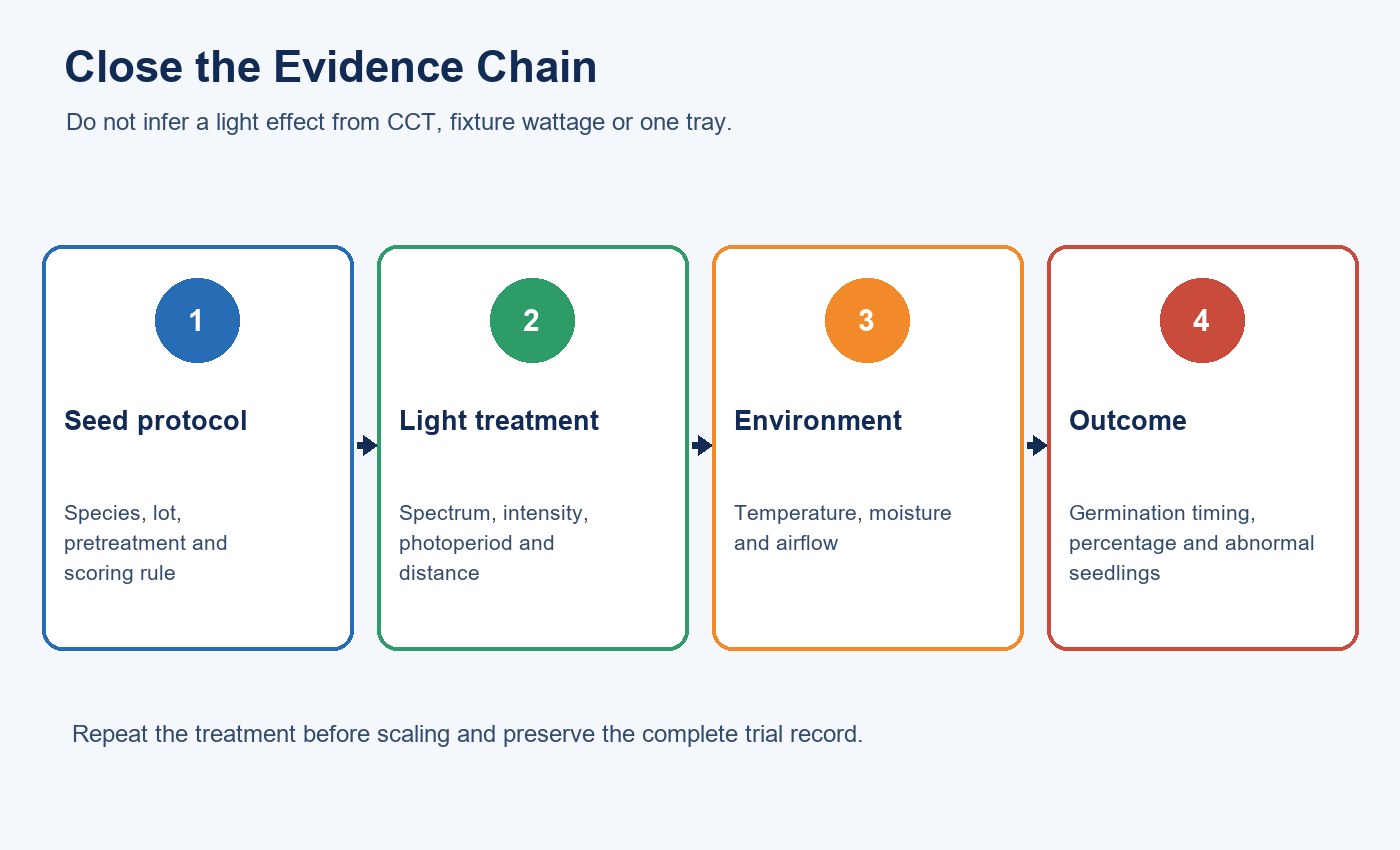
Fixture wattage, CCT and a color name do not define a biological exposure. Measure the spectral power distribution and photon level at the seed plane. Record exposure duration, timing relative to imbibition, distance, sensor orientation, dimming setting and the dimensions of the illuminated area.
For red and far-red questions, characterize the relevant bands and their sequence. Historical USDA ARS phytochrome research showed that red and far-red light can alter germination responses in particular seeds. The decision boundary is species and protocol specific: the historical mechanism supports a controlled comparison, not a universal red-light prescription.
PPFD and daily light integral are valuable for photosynthetic growth, but a germination hypothesis may depend on a short pulse, a particular band or the timing of exposure. Lux weights light according to human vision and should not be the only measurement in a plant experiment. For layout methods after a target photon level has been selected, see the grow-light coverage and PPFD guide.
Map Uniformity Before Placing the Seeds
Measure the treatment area on a grid at the height where the seeds will sit. Record minimum, maximum and average values, plus the uniformity metric used. A tray that looks evenly illuminated can still have meaningful edge-to-center differences.
Allow the fixture to reach thermal stability before mapping it. Repeat selected points during the trial if output may change with temperature, dimming, supply voltage or control behavior. Shield neighboring treatments from spill light and confirm that a dark control remains dark during handling.
| Mapping check | Minimum record | Corrective action when it fails |
|---|---|---|
| Spatial distribution | Grid dimensions, point spacing, sensor height and every reading | Adjust height, spacing or optics; reduce the usable test area |
| Spectral treatment | Measured spectrum at representative positions | Verify channel settings and account for position-dependent shifts |
| Temporal stability | Warm-up time and repeated reference-point readings | Stabilize the fixture or include drift in the uncertainty |
| Dark control | Background reading during the complete handling sequence | Improve shielding and change observation procedures |
| Position assignment | Randomization list for trays or containers | Re-randomize before sowing, not after results appear |
Do not compensate for poor uniformity by averaging all positions together. If treatment and position are confounded, the experiment cannot tell which one produced the difference.
Control Lamp Heat, Moisture and Airflow
A lamp can warm the seed zone even when the room thermostat does not change. Germination may then respond to temperature rather than spectrum. Measure both chamber air and substrate or seed-zone temperature in every treatment.
Use comparable airflow and container geometry. Monitor water loss because warmer or more exposed trays may dry faster. If two light treatments produce different radiant heating, increase separation, add thermal buffering or redesign the controls so temperature remains comparable.
The same principle applies to fans, covers and doors. A treatment chamber opened more often for observation may experience different temperature, humidity and incidental light. Define the handling schedule in the protocol.
Build Controls, Replication and Randomization
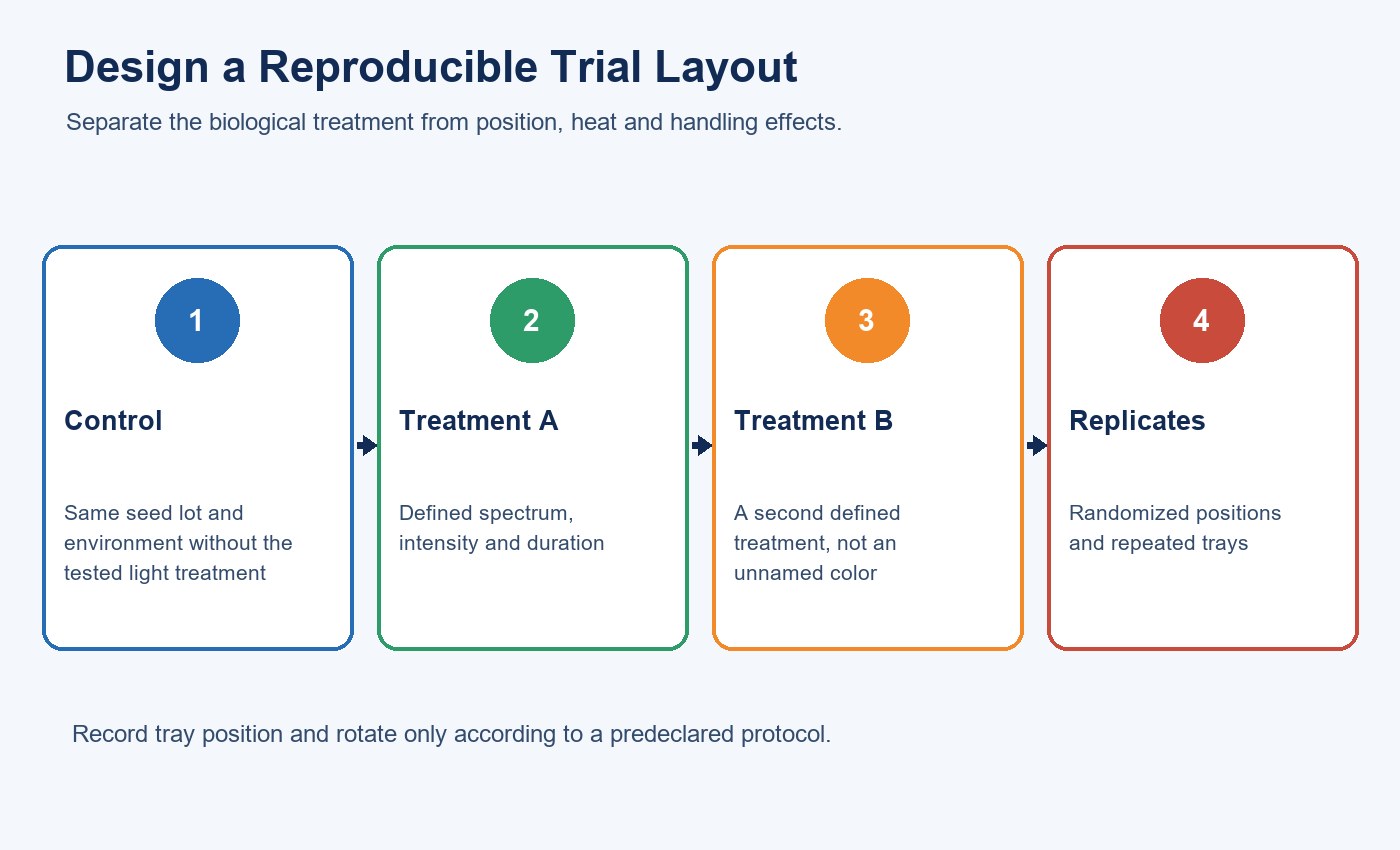
A valid control differs only in the variable under study. Depending on the question, it may be darkness, a reference spectrum, a standard production program or a matched photon dose with a different spectrum.
Use independent biological replicates. Multiple seeds in one tray increase the number of observations, but they do not automatically create multiple independent replicates because they share the same position, moisture and handling. Use separate trays, dishes or containers according to the experimental design.
Randomize positions before the trial. If trays are rotated, define the rotation schedule in advance and ensure that it does not move one treatment into another treatment’s light field.
Worked Example: A Red and Far-Red Germination Test
Suppose a propagation team wants to learn whether a brief red-light exposure changes lettuce germination under its own seed lot and temperature protocol. A compact design could use four groups:
| Group | Light treatment after imbibition | Purpose |
|---|---|---|
| A | Dark control | Establish the baseline under the same temperature and handling |
| B | Measured red exposure | Test the red-treatment effect |
| C | Red exposure followed by measured far-red exposure | Test whether sequence changes the response |
| D | Reference white-light treatment | Compare the experimental pulse with the production program |
Use the same number of independent containers per group, randomize their positions and predefine the observation interval. Choose exposure level and duration from the species protocol or a justified pilot; do not infer them from CCT or fixture wattage. Record final germination percentage and a time-based metric, then repeat a promising result with a new seed lot.
The first bottleneck is usually not statistical analysis. It is treatment integrity: if the red and far-red groups also differ in temperature, photon dose, handling or tray position, the causal comparison has already been weakened.
Characterize the Equipment and Its Controls
Request the exact fixture model, spectral data, output range, dimming method, spatial map, warm-up behavior, electrical input and control interface. Confirm whether channels are independently adjustable and whether a saved setting returns after power cycling.
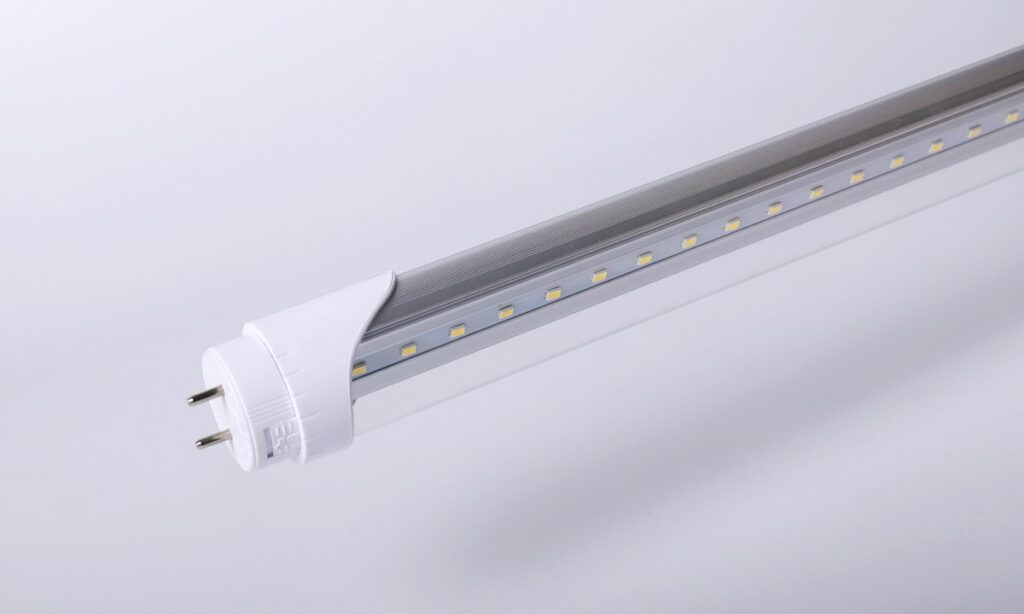
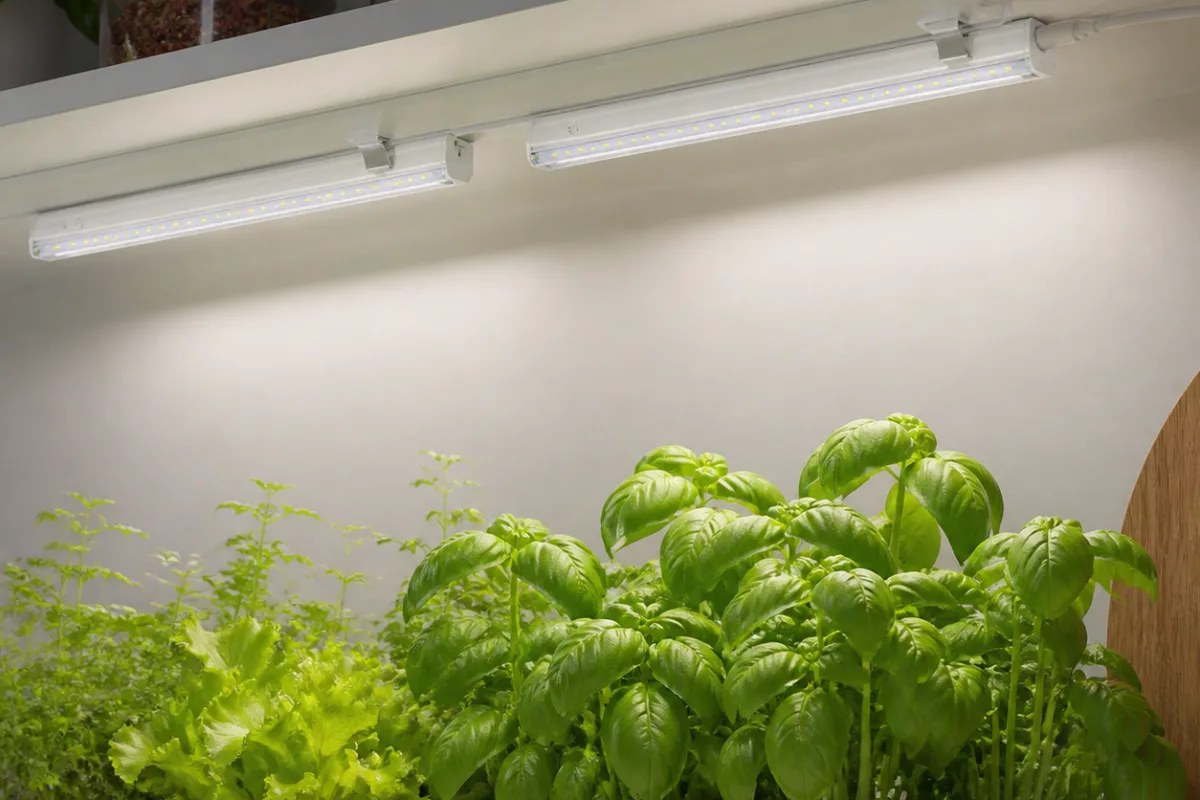
The current New Lights product page identifies the T5 Integrated LED Grow Light Fixture as a slim linear bar for propagation shelves and indoor growing layouts.
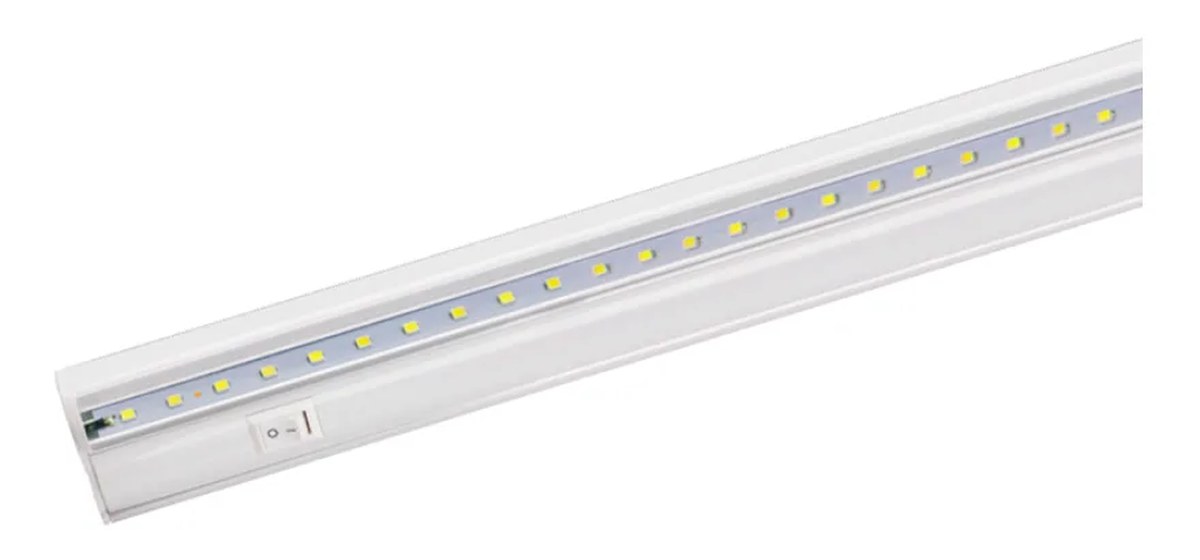
A linear fixture can simplify row or shelf layouts, but physical form does not establish spectral suitability or uniformity. The T5 Integrated LED Grow Light Fixture page identifies the current product family and documented configurations. Match the exact model to the experimental requirement and verify its output over the intended tray.
If UV or intense optical radiation is included, complete the applicable exposure and electrical-safety assessment. The grow-light safety and certification guide provides a broader starting point for equipment and project documentation.
Log the Trial So Another Person Can Reproduce It
Assign a unique identifier to every seed lot, treatment, replicate and position. Log sowing time, pretreatment, environmental setpoints, measured light, watering, observations, alarms, equipment changes and protocol deviations.
Score germination at fixed intervals using the predefined endpoint. Photographs can support the record, but the measurement should not depend only on visual impressions. Report all planned treatments and exclusions, including failed equipment and contaminated units.
| Record set | Required fields | Review question |
|---|---|---|
| Seed identity | Species, cultivar, lot, source, storage and viability | Could seed condition explain the result? |
| Environment | Air and seed-zone temperature, humidity, moisture and airflow | Did a non-light variable drift between groups? |
| Light | Spectrum, photon level, timing, distance, uniformity and stability | Was the intended treatment actually delivered? |
| Experimental design | Controls, replicate unit, randomization and sample-size basis | Are treatment effects separable from position and container effects? |
| Outcomes | Endpoint, observation times, final percentage, time metric and uncertainty | Can the operational conclusion be reproduced? |
| Deviations | Missed observations, contamination, outages and exclusions | Does the conclusion remain valid after deviations? |
This evidence chain—treatment, mechanism, conditions, measurement and decision—is more useful than a single photograph of faster-looking growth.
Validate Before Scaling to Production
Repeat a promising treatment with another seed lot and, where relevant, in the intended production environment. Chamber results may change when tray density, airflow, background daylight or fixture spacing changes.
Evaluate seedling quality separately after emergence. Research on sole-source LED lighting commonly records spectrum, PPFD, photoperiod, temperature, humidity and replication for post-germination growth. Those measurements can inform the next trial stage, but seedling biomass or flowering results do not prove that the same treatment accelerated germination.
When moving from a trial to a facility layout, connect the result to the horticultural and plant growth lighting solution and verify mounting, control, cleaning and maintenance requirements. A treatment that works in a small chamber may still be impractical if the production system cannot reproduce its uniformity or timing.
Put the Experimental Requirement in the RFQ
Give suppliers the species protocol, chamber or shelf dimensions, tray layout, target spectral bands, output range, exposure timing, uniformity requirement, control resolution, environmental conditions and measurement plan. Ask which requirements are standard, which need configuration and which require a production-representative sample.
Request raw measurement data, sensor information, calibration date, test geometry, electrical configuration and model revision. Define how substitutions or firmware changes will be controlled after approval. New Lights’ factory and manufacturing capabilities page describes the route for sampling and production coordination.
For a bounded equipment review, contact New Lights with the protocol, tray geometry and required optical conditions. The discussion can then focus on whether an exact configuration can deliver the specified treatment.
Frequently Asked Questions
Does light always make seeds germinate faster?
No. Response depends on species, cultivar, seed condition, dormancy, spectrum, dose, timing, temperature and moisture. Some seeds germinate well in darkness.
Is a sunlight-like CCT enough to specify the experiment?
No. CCT describes visual color appearance. A biological treatment may require measured spectral distribution, photon level, uniformity, timing and stability.
Can lux be used for a seed germination light experiment?
Lux can document human-visible illuminance, but it should not replace measurements that match the biological hypothesis, particularly when comparing spectra.
How many seeds and replicates are needed?
The required number depends on baseline germination, expected effect, variability, replicate unit and analysis plan. Determine it before testing; many seeds in one shared tray do not automatically create independent replication.
What should be repeated before scaling a treatment?
Repeat the treatment with a new seed lot, confirm the delivered light and environmental controls, and test it in the intended tray density and production geometry.
Editorial Sources
- New Lights, “T5 Integrated LED Grow Light Fixture”: https://www.new-lights.com/products/horticultural-lighting/professional-grow-lights/t5-led-integrated-fixture/
- New Lights, “Horticultural & Plant Growth Lighting”: https://www.new-lights.com/horticultural-plant-growth-lighting/
- USDA Agricultural Research Service, “Tripping the Light Switch Fantastic”: https://www.ars.usda.gov/oc/timeline/light/
- USDA Agricultural Research Service, “Germination Procedures”: https://www.ars.usda.gov/southeast-area/stuttgart-ar/dale-bumpers-national-rice-research-center/docs/gsor-germination-procedures/
- USDA Agricultural Research Service, “Radiation Intensity and Quality from Sole-source LEDs Affect Seedling Quality”: https://www.ars.usda.gov/ARSUserFiles/50820500/GPRG/2018PublicationsandSummaries/2018_Radiation%20intensity%20and%20quality%20from%20sole-source%20light-emitting%20diodes%20affect%20seedling%20quality%20and%20subsequent%20flowering%20of%20long-day%20bedding%20plant%20species.pdf