
Indoor grow-light compliance is not established by collecting the largest number of logos. A defensible purchase connects the destination market, installation conditions, exact ordered model and current evidence. The buyer should be able to trace every important claim from the product label to an official listing, declaration, test report or controlled technical file.
That distinction matters because a grow room combines high optical output, long operating hours, electrical power, heat, controls and environmental exposure. A plug-in luminaire in a dry research room, a hardwired fixture above irrigation and a wireless multi-tier system may require different evidence. UL, ETL, CE, IEC documents and DLC qualification also answer different questions; none should be used as a universal substitute for the others.
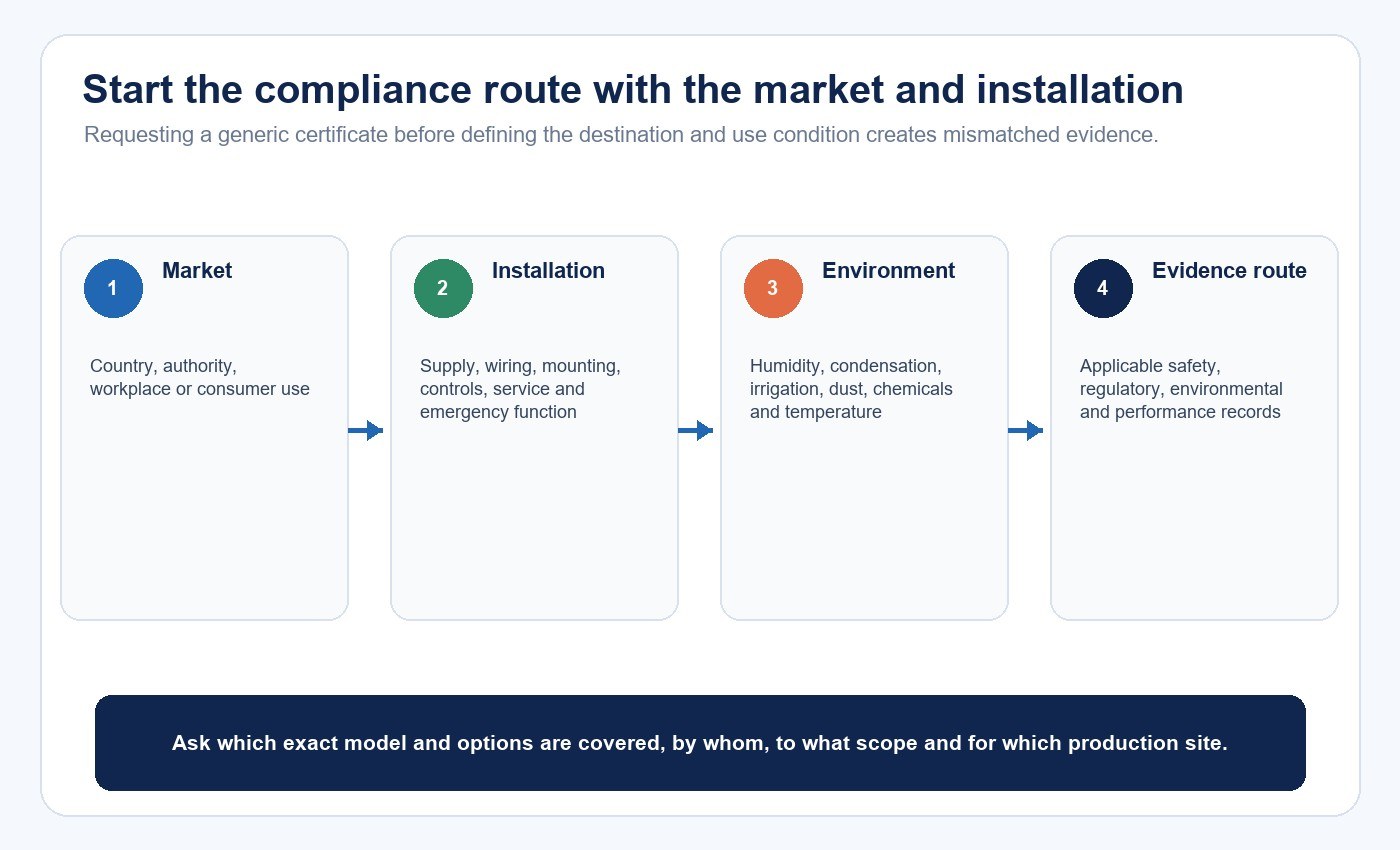
Define the Market and Installation Before Requesting Certificates
Start with the destination country and the actual installation. Record whether the equipment is used in a workplace or consumer setting, who has authority over acceptance, which electrical or building rules are adopted, and whether the product is plug-connected, cord-connected or hardwired. Include supply voltage and frequency, branch circuits, mounting, controls, service access and any emergency function.
Then describe the environment. Indoor agriculture can involve high humidity, condensation, irrigation, mist, fertilizer residue, dust, cleaning chemicals and large temperature changes. Classify the location under the rules that apply to the project rather than translating it into a marketing phrase such as “waterproof.” The broader horticultural lighting system design guide explains how lighting evidence connects with crop, climate, irrigation and controls; this article focuses on product safety and compliance evidence.
The first RFQ question should therefore not be “Is it certified?” Ask: “Which exact model and options are covered, by which organization, to which standard and edition, for which factory, market, rating and installation condition?”
Keep Safety, Regulatory and Performance Evidence Separate
Compliance packages become confusing when different evidence types are stored in one folder without a defined purpose. A test report may describe results. A certification or listing may add authorization to apply a mark and ongoing follow-up obligations. A manufacturer’s declaration may support a regulatory route. A performance program may verify metrics within its own scope. The authority responsible for the installed project still decides whether the installation is acceptable.
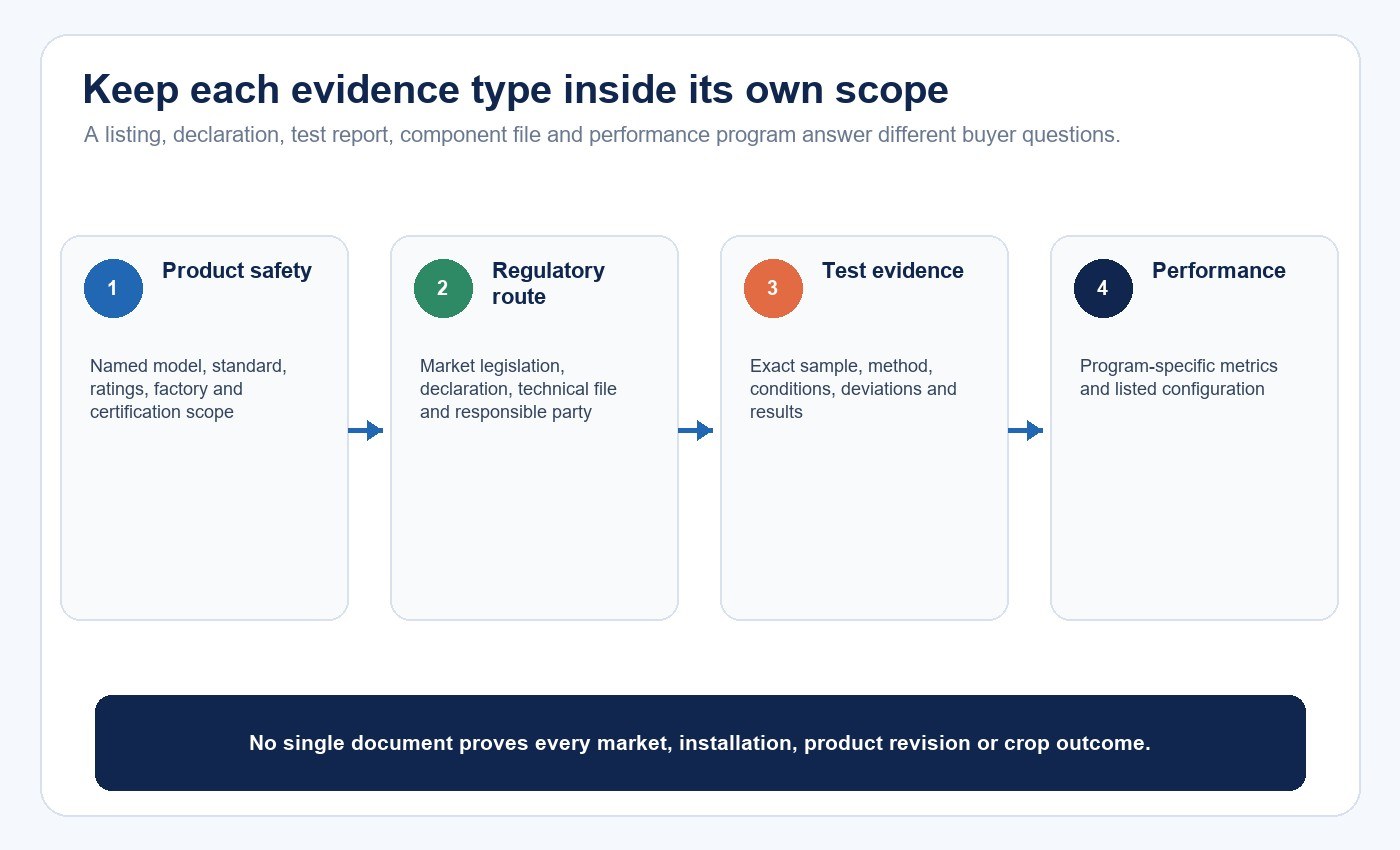
Use the following matrix to prevent one document from being stretched beyond its scope.
| Evidence type | What it can establish | What it does not establish by itself | Buyer verification |
|---|---|---|---|
| NRTL listing or certification | A named product is certified by a recognized organization within a defined standard and scope | Acceptance in every market, every installation or every modified configuration | Search the official database; match model, standard, ratings, factory and label |
| EU Declaration of Conformity | The manufacturer declares conformity with identified EU legislation and standards for the named product | Independent third-party certification in every case or coverage of unlisted variants | Match legal manufacturer, product, legislation, standards, date and signature |
| Laboratory test report | Test methods, samples, conditions and results within the report | Authorization to use a certification mark or coverage of mass production | Check laboratory, report status, exact sample, method, deviations and results |
| Component recognition or certificate | Evidence for a driver, cable, connector, polymer or other component | Compliance of the complete grow-light luminaire | Confirm the component is used within its conditions and assessed in the final product |
| Environmental rating | Performance against defined ingress or location tests | Chemical resistance, condensation endurance, installation workmanship or every wet-location rule | Match enclosure, cable entry, orientation, connectors and test context |
| DLC Horticultural qualification | Program eligibility and reported horticultural performance for a listed configuration | Product-safety certification, CE conformity, installation approval or crop yield | Match the exact model and configuration on the current qualified-products record |
Understand UL 8800 and the NRTL Route
UL Solutions describes UL 8800 as the Standard for Horticultural Lighting Equipment and Systems. Its horticultural-lighting service addresses safety topics associated with plant-growth equipment, including optical exposure, environmental conditions, ingress protection, polymer exposure and wiring considerations within the applicable evaluation.
In the United States, the organization behind the mark matters as much as the standard. OSHA’s Nationally Recognized Testing Laboratory program recognizes private organizations for specified product categories and standards. OSHA states that a properly certified product bears the registered mark of an NRTL, falls within that NRTL’s recognized scope and is certified from an authorized site.
This is why “UL or ETL?” is the wrong first comparison. UL Solutions and Intertek are different organizations, and each operates its own programs and marks. The useful procurement question is whether the certifying organization is recognized for the relevant standard and whether the exact offered product is covered. A logo copied onto a datasheet is not the verification record.
Request the listing or certification number, issuing organization, product category, standard and edition, model family, suffix rules, electrical ratings, environmental conditions, accessories, control options, installation restrictions and manufacturing site. Search the issuer’s official database and compare the record with the production label and installation instructions.
Read CE Marking as a Conformity Process
CE marking is not the European equivalent of an NRTL mark. The European Commission explains that the manufacturer must identify applicable EU legislation and product requirements, complete the required conformity assessment, prepare technical documentation, issue an EU Declaration of Conformity and affix the CE marking.
Which legislation applies depends on the product and configuration. Electrical safety, electromagnetic compatibility, radio functions, hazardous substances, ecodesign and other requirements may need review. The route may include a third party in some circumstances, but CE marking should not be described automatically as third-party certification.
For a grow light, ask for the EU Declaration of Conformity and the controlled evidence index behind it. Match the legal manufacturer, exact product identification, applicable legislation, referenced standards, authorized signature and date. If the driver, wireless module, cord, connector, emergency unit, housing, optics, control system or firmware changes, reassess whether the declaration and supporting technical file still cover the delivered configuration.
Apply IEC Luminaire and Photobiological Standards Within Scope
IEC 60598-1:2024 specifies general requirements and tests for luminaires within its scope. It can provide an international technical foundation, but national or regional adoption, deviations, additional parts and the correct product category still need to be identified. A report title containing “IEC 60598-1” is not enough: compare the tested model, rated supply, insulation class, construction, driver, mounting, ambient rating, ingress condition and report edition with the quotation.
Photobiological review also depends on the actual optical output and intended use. IEC 62471-7:2023 addresses photobiological safety for electrically powered light sources and luminaires that primarily emit visible radiation within its scope. Older files may cite IEC 62471:2006. The applicable route must be selected by competent parties for the specific product, spectrum and market rather than by copying an edition from another luminaire.
Request model-specific optical-safety evidence that identifies the operating mode, spectrum, measurement geometry, distance, exposure basis, classification or required user information, and any protective measures. UV-producing products need additional scrutiny appropriate to their spectral output and intended purpose. Avoid universal claims such as “all LED grow lights are eye-safe” and avoid assigning one mounting distance to every fixture.
Match Environmental Ratings to Real Exposure
An IP code and a North American dry-, damp- or wet-location designation are not interchangeable labels. Each belongs to a defined test and marking context. A high IP number does not independently prove resistance to fertilizer chemicals, condensation cycling, steam, cleaning procedures or an incorrectly installed cable gland.
Review the complete system: luminaire, remote or integral driver, cable entries, connectors, junction boxes, plugs, end caps, control devices and field-made connections. Mounting orientation and installation workmanship can change exposure. One rated component does not transfer its rating to the assembled installation without supporting evidence.
The IP ratings guide for LED lighting provides a separate explanation of IP20, IP44, IP65 and IP67. Use that terminology only after the grow-room exposure has been defined.
Review Thermal, Electrical, Fire and Control Conditions
Long photoperiods and dense arrays can create demanding thermal conditions even when room air feels moderate. Confirm rated ambient temperature, mounting clearance, orientation, driver location, heat-sink condition, insulation-contact restrictions and any output derating. Compare those limits with the hottest credible operating state, not only a commissioning-day reading.
The final installation also needs correct circuit loading, conductor sizing, overcurrent protection, disconnecting means, grounding, cable routing and connector use. Daisy-chain or through-wiring limits must come from the exact product instructions and circuit design. A metal housing, three-prong plug or surge component does not independently establish system compliance.
Controls introduce additional questions. Dimming interfaces, sensors, gateways, wireless modules and network controllers may affect EMC, radio, software and failure behavior. Define what the system does after communication loss, sensor failure, overheating, controller restart and power restoration. A pre-certified radio module does not automatically establish compliance of the complete luminaire.
Treat DLC Horticultural V4.0 as Performance Evidence
The DesignLights Consortium’s Horticultural Technical Requirements V4.0 took effect for applications on April 18, 2025. DLC states that V4.0 applies to eligible LED horticultural fixtures or modules and removed lamps from its qualification categories. It addresses program eligibility and reported horticultural performance; it is not a replacement for product-safety certification, CE conformity or installation approval.
If DLC qualification is required by a utility, program, specification or buyer, search the current qualified-products record and match the exact model and reported configuration. Compare photon output, efficacy, distribution, controllability and other relevant fields with the quotation. The product may still require separate safety and regulatory evidence.
Verify the Exact Model, Label and Production Site
A six-point match is more reliable than a certificate-folder count. Record the verification date and reviewer so the decision can be repeated later.
| Match point | Pass condition | Common failure | Action if unresolved |
|---|---|---|---|
| Issuer and database | Issuer is identifiable and the record is found in its official system | Logo or PDF cannot be tied to an official record | Hold the claim open and ask for the record number |
| Standard and scope | Standard, edition and product category fit the offered equipment | A component or unrelated luminaire standard is cited | Ask the compliance owner to map the correct route |
| Model and suffix | Exact model, suffix and electrical ratings are covered | Similar family name hides a different driver or option | Obtain a written variant explanation or separate evidence |
| Factory | Authorized production site matches the intended source | Certificate belongs to another factory or applicant | Confirm authorization and follow-up coverage |
| Label and instructions | Markings, ratings, restrictions and manual agree with the record | Datasheet, label and certificate use conflicting values | Stop release until controlled documents agree |
| Current status | Listing or file is current and limitations are understood | Suspended, withdrawn, expired or superseded evidence | Resolve status with the issuer or responsible owner |
This method also helps detect a report issued to another company, a certificate for a different driver, a record that excludes a requested control option, or a product label that changes after sample approval. The LED product compliance document checklist can be used to index the full document set.
Control Customization Before It Invalidates Evidence
Horticultural luminaires are often customized for spectrum, output, voltage, optics, mounting, cord, connector, controls, branding, enclosure or emergency functions. Every proposed change should be assessed for its effect on safety, EMC, radio, photobiological exposure, thermal behavior, environmental rating, DLC qualification and certification scope.
Create an approved configuration matrix linking the model code to the bill of materials, drawings, label, firmware, instructions and evidence. Classify each change before production. When a change may affect a listing or conformity file, obtain a written decision from the responsible certification body or compliance owner rather than relying on a salesperson’s assurance.
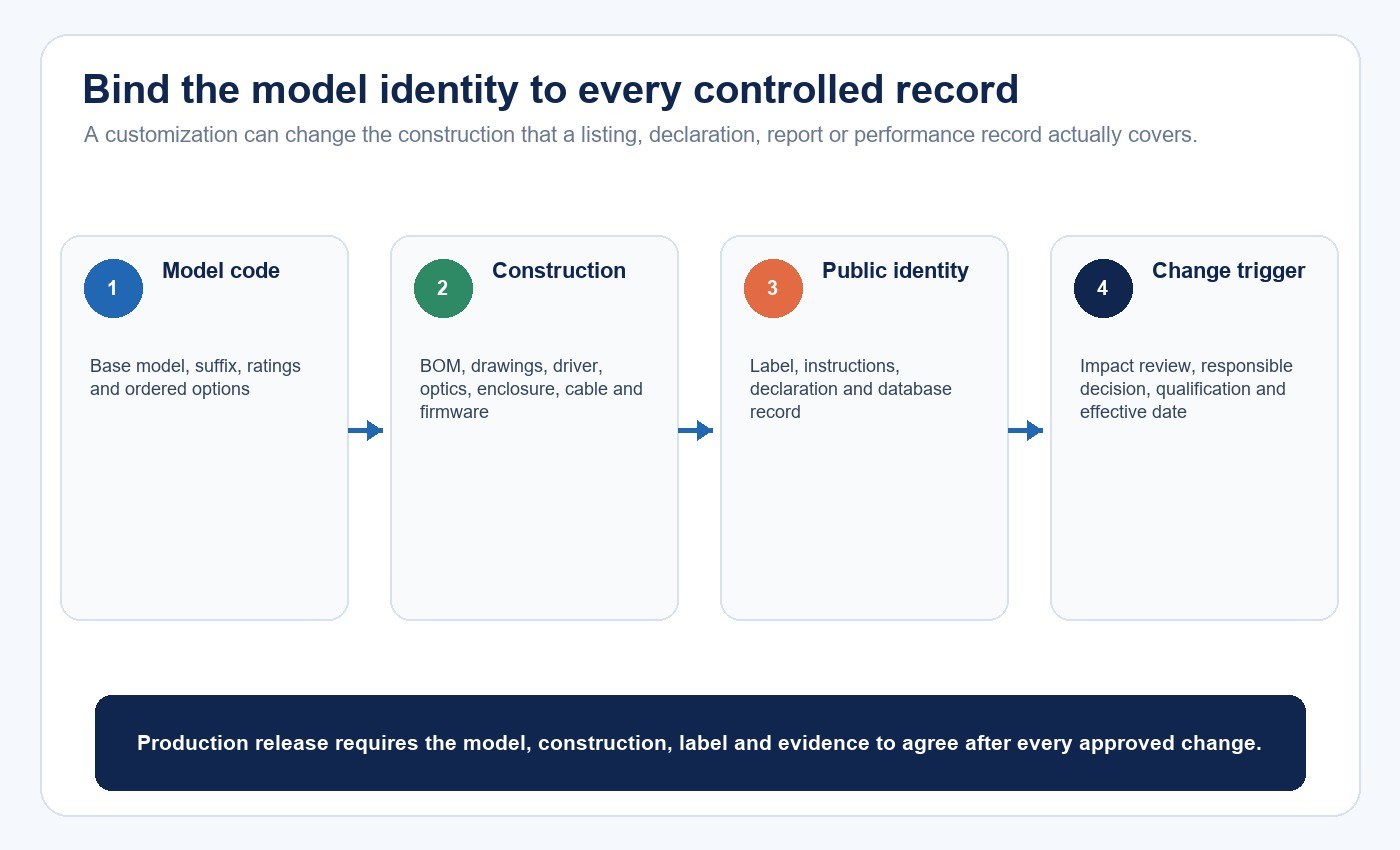
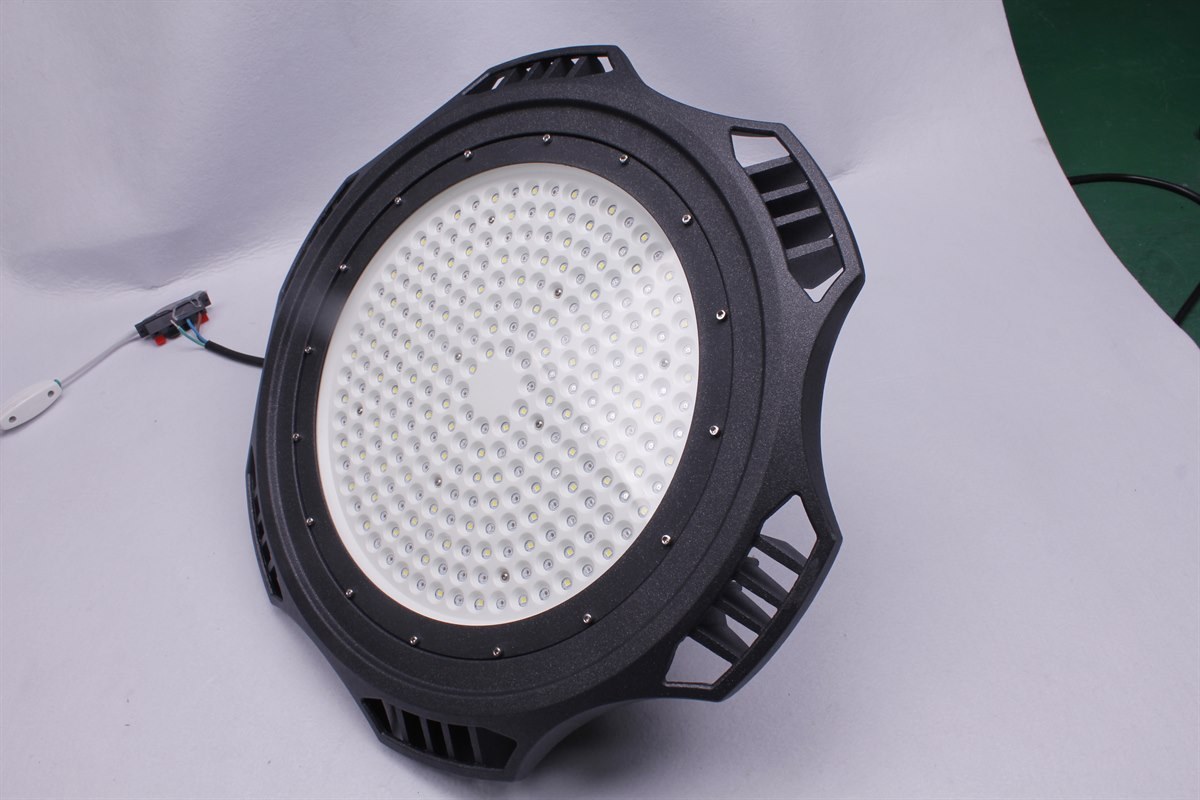
Sample approval should preserve identity, not only appearance. Use the LED lighting sample evaluation checklist to record model, revision, label, driver, controls, operating conditions and acceptance criteria. The New Lights factory and manufacturing overview provides the production context for discussing controlled drawings, component approval and release records.
Build a Model-Bound Compliance Section in the RFQ
The buyer should provide the destination market, project type, installation authority, electrical supply, wiring method, mounting, environmental exposure, cleaning process, operating schedule, spectrum, controls, radio functions and required performance programs. The supplier should return a model-bound evidence index instead of an unsorted certificate folder.
For each requirement, the index should identify the rule or standard, document type, issuer, report or listing number, exact tested model, covered variants, factory, current status, date, exceptions and responsible owner. Mark unresolved points as open. Do not convert “pending,” “similar,” “component only” or “available on request” into a pass.
When the evidence package is stable, inspect a representative sample and compare the delivered label, construction, instructions and options with the approved record. For a project-specific review, contact New Lights with the destination market, grow-room conditions, exact model requirements, controls and required evidence list.
Frequently Asked Questions
Do indoor grow lights always need UL or ETL certification?
Requirements depend on the jurisdiction, product type, workplace or consumer use and installation. For a US workplace or code-controlled project, confirm the adopted requirements and whether certification by an NRTL is required for the exact equipment.
Is ETL less valid than UL?
Not as a general rule. UL and ETL are marks associated with different organizations. Verify that the organization is recognized for the relevant standard and that the exact model, factory and configuration are properly covered.
Does CE marking mean a laboratory certified the grow light?
Not necessarily. CE marking is part of the manufacturer’s EU conformity process. The applicable legislation determines the assessment route and whether third-party involvement is required.
Is DLC qualification a safety certification?
No. DLC Horticultural qualification addresses program eligibility and performance reporting within its scope. It does not replace product-safety certification, EU conformity or installation approval.
Does IP65 prove a grow light is suitable for every wet grow room?
No. Verify the rating’s test context, complete system, orientation, cable entries, connectors, condensation, chemicals, cleaning and any separate wet- or damp-location requirements.
What is the fastest way to reject weak certification evidence?
Try to match the official issuer record, exact model and suffix, standard, electrical ratings, factory, current status and physical label. If any critical field cannot be reconciled, keep the claim open instead of treating a logo or generic PDF as approval.
Editorial Sources
- Occupational Safety and Health Administration, “OSHA’s Nationally Recognized Testing Laboratory Program — Frequently Asked Questions”: https://www.osha.gov/nationally-recognized-testing-laboratory-program/frequently-asked-questions
- UL Solutions, “Horticultural Lighting Testing and Certification Services”: https://www.ul.com/services/horticultural-lighting
- IEC, “IEC 60598-1:2024 — Luminaires — Part 1: General requirements and tests”: https://webstore.iec.ch/en/publication/66620
- IEC, “IEC 62471-7:2023 — Photobiological safety of lamps and lamp systems — Part 7”: https://webstore.iec.ch/en/publication/68810
- European Commission, “CE Marking for Manufacturers”: https://single-market-economy.ec.europa.eu/single-market/goods/ce-marking/manufacturers_en
- Your Europe, “CE marking”: https://europa.eu/youreurope/business/product-rules-compliance/general-product-compliance/ce-marking/index_en.htm
- DesignLights Consortium, “Horticultural Technical Requirements V4.0”: https://designlights.org/our-work/horticultural-lighting/technical-requirements/hort-v4-0/