

An LED compliance file is useful only when every declaration, report, certificate, label and instruction can be traced to the exact product placed on the target market. A folder of current-looking PDFs is not enough if the ordered model, component set, brand, rating or revision cannot be reconciled with the evidence.
Define the destination market and your economic-operator role first. Then build a model-coverage matrix, classify each document by purpose, reconcile the files with the approved sample and artwork, and reopen the review whenever a controlled change affects the evidence boundary.
Start with the Market and Legal Role
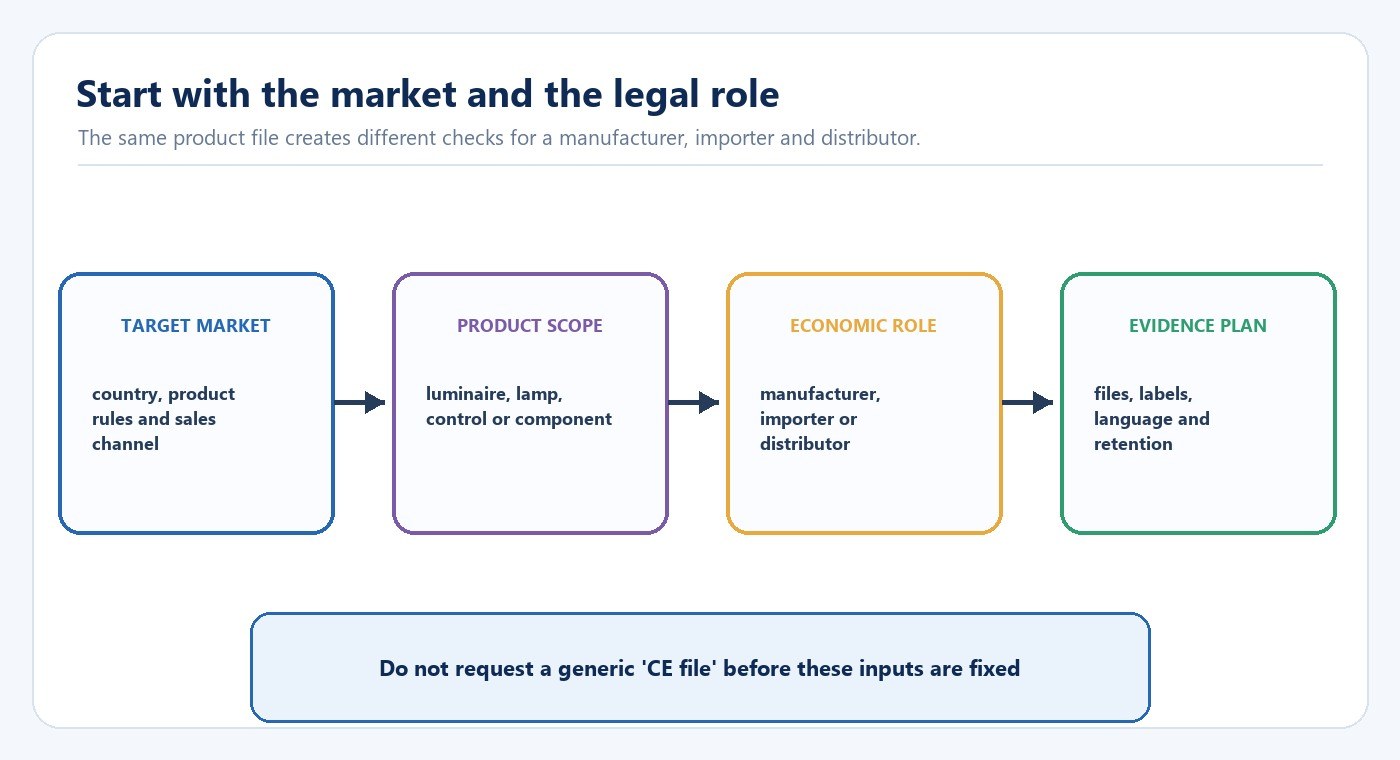
The applicable rules depend on where the product is sold, what the product is and what role each company performs. In the EU, a manufacturer is the party that makes a product or has it made and markets it under its own name or trademark. An importer established in the EU that places a product from a non-EU country on the market must verify that the manufacturer completed the applicable conformity work and that required documentation, marking, traceability and instructions are available.
Private-label arrangements therefore need a named legal path, not just a commercial description. Record the brand owner, manufacturer, importer, distributor, destination country, product category, intended use and sales channel in the RFQ. The European Commission states that CE marking is the manufacturer’s declaration that applicable legal requirements are met; it is not EU approval. Also verify whether CE marking applies to the specific product rather than treating it as a universal product mark.
| Input to freeze | Question to answer | Why it changes the file |
|---|---|---|
| Destination market | Where will the product be placed on the market? | Determines applicable legal and language requirements |
| Product scope | Lamp, luminaire, control, component or system? | Changes directives, standards and required evidence |
| Brand and legal role | Whose name or trademark appears on the product? | Identifies the responsible economic operator |
| Sales configuration | Which voltage, controls, accessories and intended use? | Defines the exact model boundary to be assessed |
Build a Model-Coverage Matrix
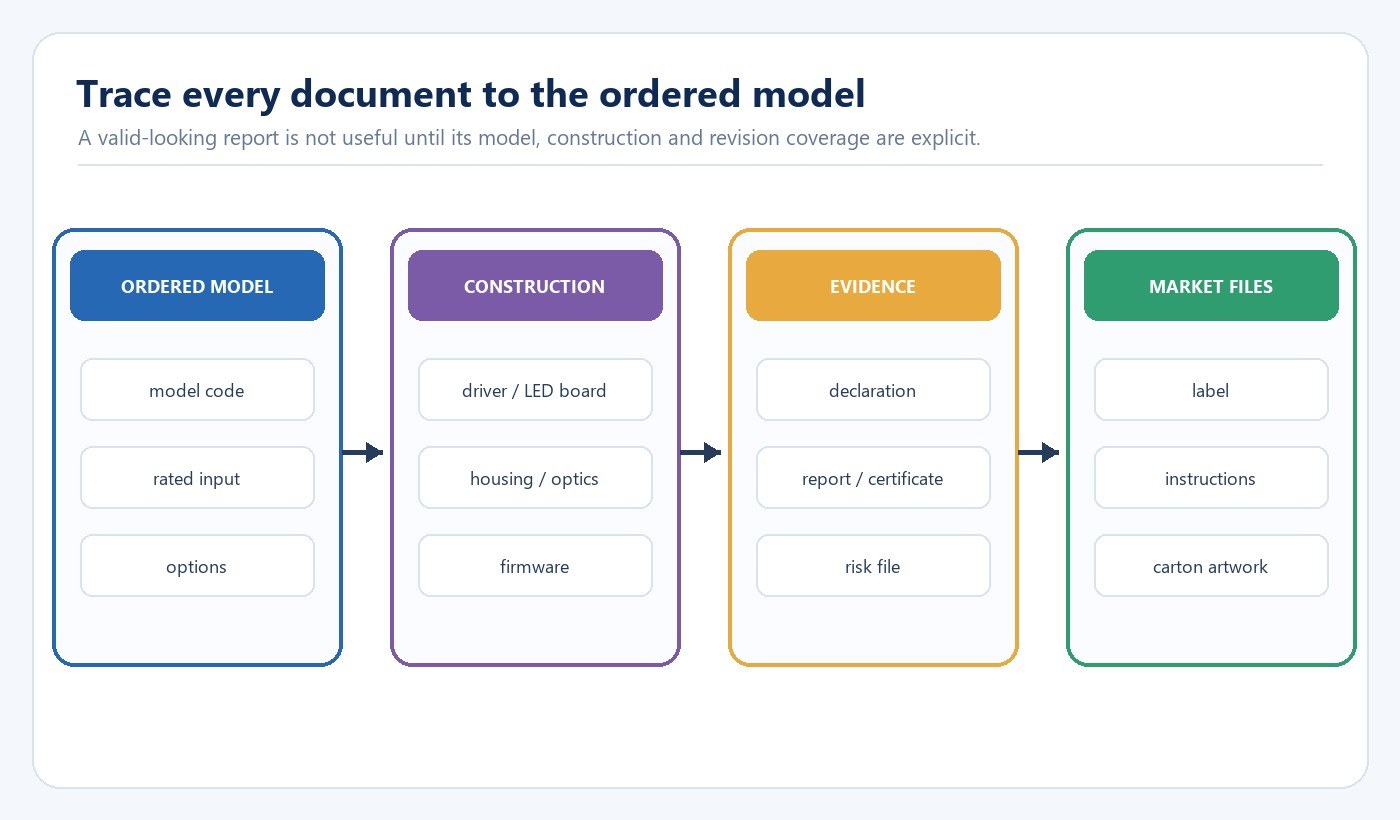
Create one row for each ordered model and revision. Include rated input, control option, driver, LED board, housing, optic, firmware where applicable, label identity, packaging identity and production-intent status. In adjacent columns, identify the declaration, report or certificate that covers that row and whether the coverage is direct or based on a documented family relationship.
| File element | What to match | Release question |
|---|---|---|
| Model identity | Model code, revision, brand and rated input | Does every file point to the ordered configuration? |
| Technical construction | Critical components, housing, controls and firmware | Does the tested construction match the released design? |
| Declarations | Applicable rules, signatory, responsible party and date | Is the declaration current for this model and market? |
| Technical evidence | Applicant, manufacturer, sample and family mapping | Is coverage explicit rather than inferred? |
| Market-facing files | Product label, carton, manual and languages | Do approved files match the shipment? |
Do not accept a family name as coverage evidence by itself. Ask for the model relationship, controlled differences, tested worst case and the rule used to extend results. A small electrical or mechanical change can affect only one requirement, but the impact still needs to be recorded.
Separate Declarations, Reports and Certificates
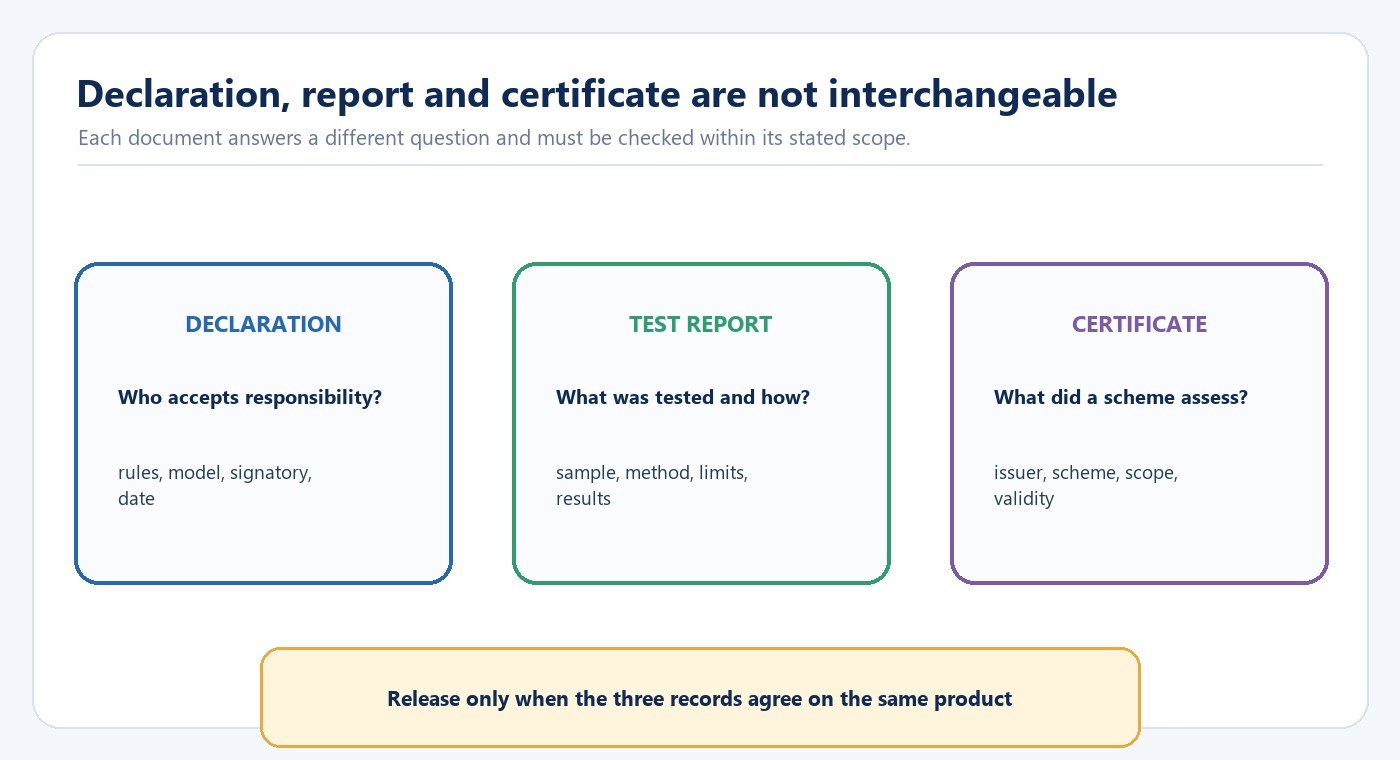
A declaration identifies the responsible party, product and applicable rules. A test report records the sample, method, conditions, limits and results. A certificate records an assessment within a defined scheme and scope. One document should not be treated as a substitute for every other evidence type.
Check the issuer, applicant, manufacturer, model list, issue date, standard edition, sample description, deviations and validity conditions. When a notified body or certification body is involved, verify the activity and scope actually covered. When it is not required, do not add one merely to make the file look more official.
The technical documentation should explain the design, manufacture and operation of the product, identify applicable EU rules and standards, include risk assessment and connect critical components and materials to supporting evidence. Your Europe states that manufacturers must prepare the technical documentation before placing the product on the market and make it available to market-surveillance authorities on request.
Reconcile Labels, Instructions and Traceability
The approved product label should agree with the declaration and technical file. Compare the brand, model, rated electrical information, responsible-party details, required marks, warnings and type, batch or serial traceability. Apply the same check to carton artwork and instructions. A correct report does not cure a shipment label that identifies a different model or rating.
Instructions and safety information may need to be provided in a language easily understood by users in the destination country. Record the approved language versions and artwork revisions. Do not rely on an email attachment that can be replaced without a controlled history.
For general EU technical documentation, Your Europe states a ten-year retention period from the date the product is placed on the market unless the relevant legislation specifies otherwise. Confirm the product-specific legislation and assign an owner and repository for the final records.
Connect Document Control to Factory Reality

The released file must reach purchasing, incoming inspection, production, final inspection and shipment control in a form they can identify. The practical record should connect a requirement to the applicable model, revision, method, result and disposition. The LED lighting sample evaluation checklist explains how to reconcile the physical unit with those controlled records.
Use the supplier review to verify document ownership, revision control, calibration, nonconformance handling and component traceability. The lighting supplier factory audit checklist covers that wider process boundary.
Reopen the Review When Something Changes
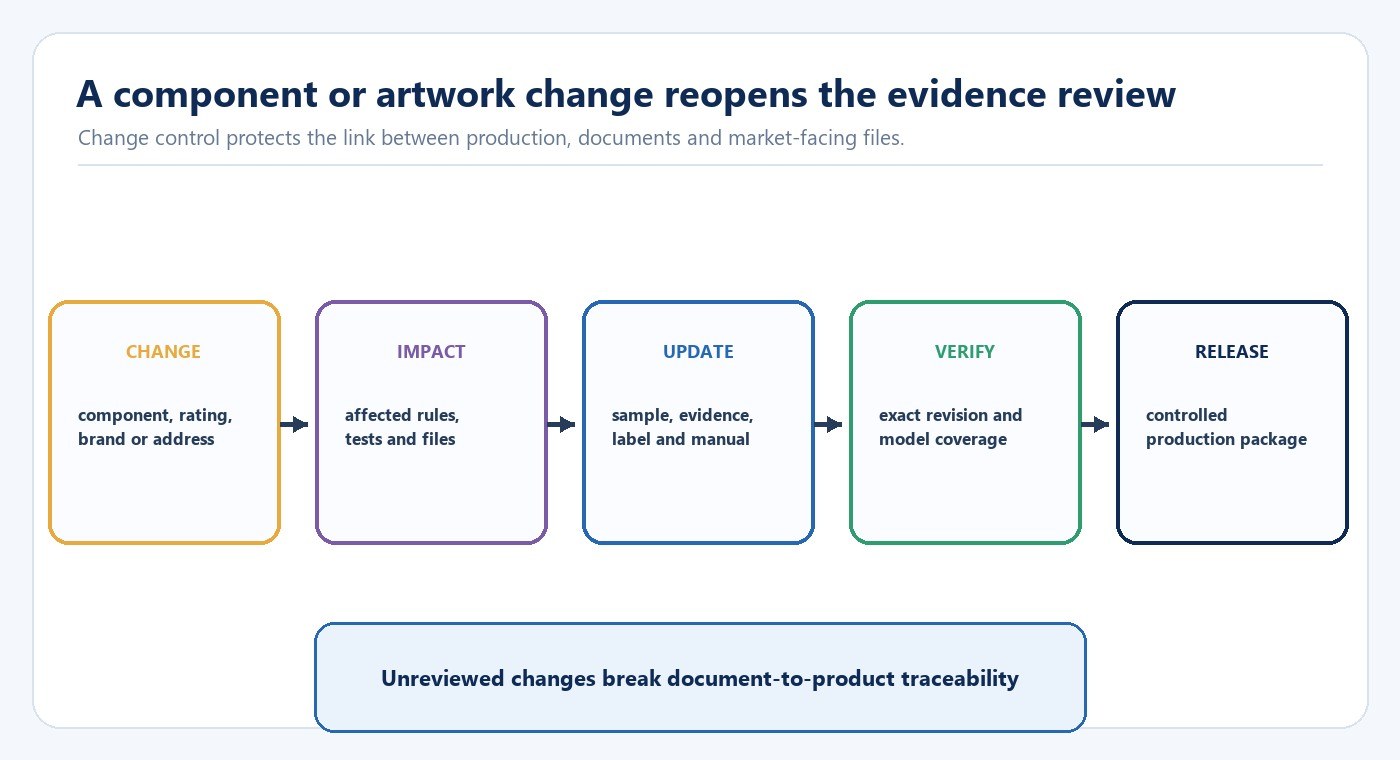
A driver, LED board, housing, optic, cable, firmware, rating, brand, address or intended-use change can reopen part of the compliance review. Record what changed, why, which requirements and reports may be affected, whether a new sample or test is needed, and which declarations, labels or instructions must be revised.
Do not release production because only the drawing was updated. Verify the affected physical sample, evidence and artwork at the same revision. If the change is judged not to affect an item, record the technical basis and approver.
Validate the File Before Order Release
- Record the destination market, product category, intended use, brand and economic-operator roles.
- Give every ordered model a coverage row, controlled revision and production configuration.
- Classify declarations, reports and certificates by their actual purpose.
- Match the tested sample and critical construction to the ordered model.
- Reconcile declarations, labels, carton artwork and instructions.
- Verify language, responsible-party and traceability requirements for the destination.
- Assign owners to every open gap and require objective closure evidence.
- Freeze the approved sample, artwork and specification before production release.
- Route controlled changes through an impact review before shipment.
- Store the final file under the retention rule that applies to the product.
Review relevant New Lights product families and structure the requirement package with the OEM and ODM LED lighting RFQ guide. Electrical evidence should also separate input power, power factor, harmonic distortion and temporal light behaviour; use the LED flicker, PF and THD checklist for that review.
Frequently Asked Questions
Is a CE mark the same as an EU approval certificate?
No. The European Commission describes CE marking as the manufacturer’s declaration that the product meets applicable EU legal requirements. It does not indicate EU approval, and it is required only for products covered by applicable CE-marking rules.
Can one test report cover several LED models?
Sometimes. The family relationship, controlled differences, tested construction and extension logic must show that the ordered model is covered. Similar names or housings are not enough.
Does every document need to be renewed on the same date?
No. Each document follows its own legal, technical or scheme conditions. The practical control is to review the file whenever the product, responsible party, applicable rules, evidence or market-facing files change.
What should an importer request before paying the balance?
Request the final model-coverage matrix, declarations, applicable technical evidence, approved labels and instructions, revision record, open-deviation status and shipment traceability. Send the model list and market requirements through the project enquiry form when a model-specific file set is needed.
Editorial Sources
- European Commission — CE marking: https://single-market-economy.ec.europa.eu/single-market/goods/ce-marking_en
- European Commission — Importers and distributors: https://single-market-economy.ec.europa.eu/single-market/goods/ce-marking/importers-and-distributors_en
- Your Europe — General product compliance: https://europa.eu/youreurope/business/product-rules-compliance/general-product-compliance/index_en.htm
- Your Europe — Preparing technical documentation: https://europa.eu/youreurope/business/product-rules-compliance/general-product-compliance/preparing-technical-documentation/index_en.htm