

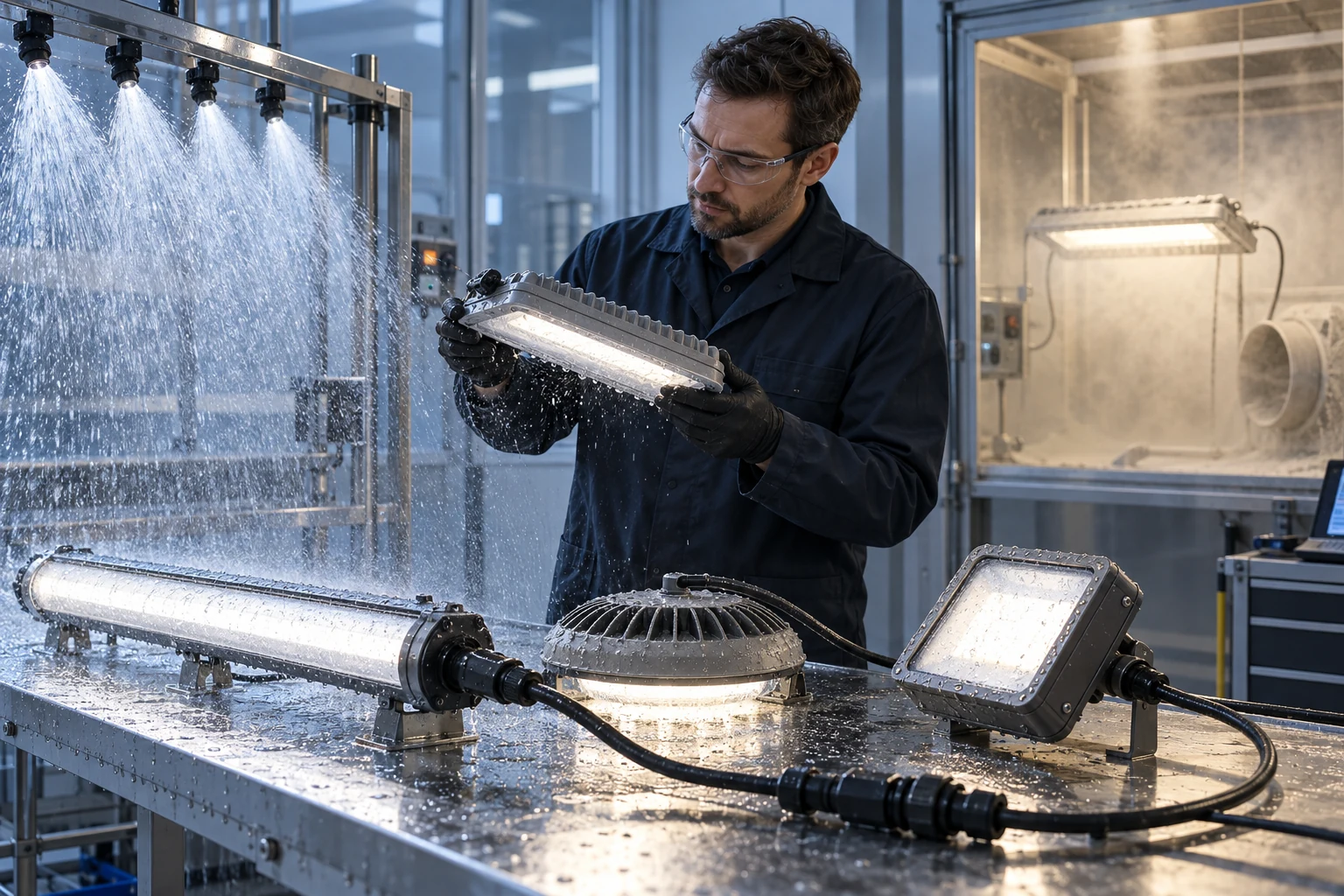
An IP rating describes enclosure protection against access, solid objects and water under defined tests. It does not by itself describe corrosion resistance, UV durability, impact resistance, chemical compatibility, condensation control or whether an installation is suitable for a hazardous location.
The code uses two digits. The first describes protection associated with access to hazardous parts and solid foreign objects; the second describes protection against water. Always read both digits and confirm which parts of the product the rating covers.
How to read the two digits
| Rating | Solid-object meaning | Water meaning | Typical specification question |
|---|---|---|---|
| IP20 | Protection against finger access and objects of the defined size | No rated water protection | Is the location dry and protected from contact with water? |
| IP44 | Protection against objects 1 mm and larger | Protection against splashing water | From which directions can splashes reach the fitting? |
| IP65 | Dust-tight enclosure | Protection against water jets | Are cable entries, connectors and mounting details included in the rating? |
| IP67 | Dust-tight enclosure | Protection against temporary immersion under specified conditions | What immersion depth and duration apply, and is immersion expected in normal use? |
Higher is not automatically better for every project. A sealed product can cost more, retain heat differently and require specific glands or connectors. Specify the exposure, then select the rating and construction that address it.
The International Electrotechnical Commission publishes IEC 60529, the governing international standard behind the IP Code. Its test classifications describe enclosure protection under defined conditions; they do not replace a project review of corrosion, impact, chemicals, temperature, installation or hazardous-location requirements. The Illuminating Engineering Society publication ANSI/IES RP-7-21 separately addresses industrial lighting conditions such as humidity, corrosion, controls and maintenance.
Start with the real exposure
“Indoor” and “outdoor” are too broad for a specification. A dry office ceiling, a sheltered entrance, an open car park, a food-processing wash area and a coastal facade expose products to different combinations of water, dust, temperature, chemicals and mechanical stress.
- Water source: condensation, splash, rain, cleaning spray, hose or temporary flooding.
- Direction and pressure: water from above is different from a jet aimed at a joint or gland.
- Duration: occasional cleaning is different from continuous wet operation.
- Contaminants: salt, oil, detergent, fertiliser and dust can affect materials and seals.
- Temperature cycling: repeated heating and cooling can pull moisture through imperfect joints.
The installation must preserve the rating
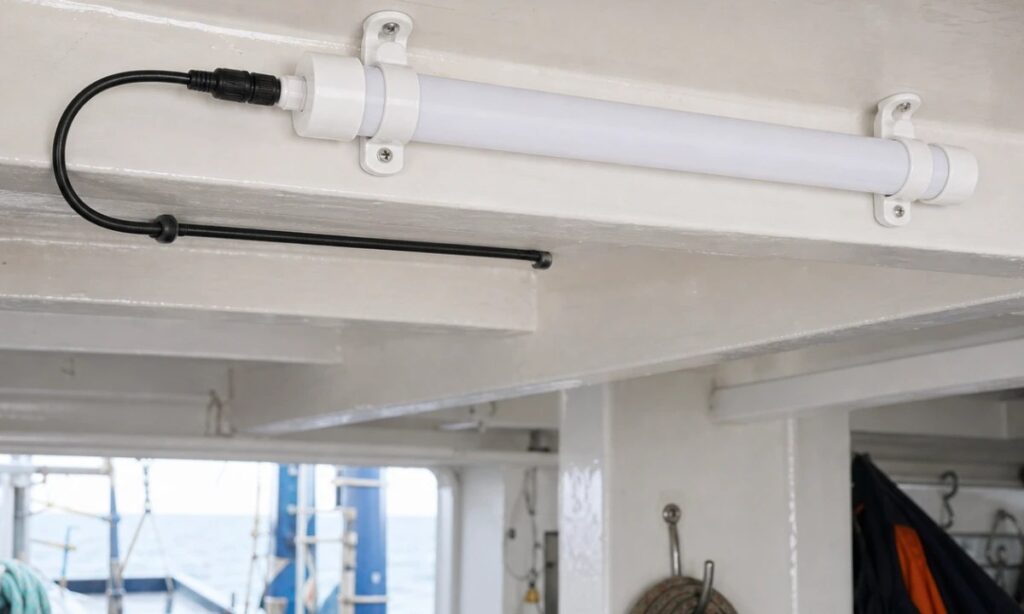
A rated luminaire can lose its enclosure integrity through the installation. Use the specified cable diameter, gland, gasket, screw torque and mounting orientation. Close unused entries with approved plugs. Avoid drilling the housing unless the manufacturer provides an approved method.
Connections outside the luminaire need their own protection. A sealed body does not protect an exposed plug, junction box or driver. For products assembled from separate components, ask whether the stated rating applies to the complete installed configuration or only one component.
IP rating is not a complete durability specification
Add separate requirements where the environment demands them. Coastal projects may need corrosion-resistant materials and coatings. Public areas may require an impact rating. Sun-exposed products need suitable UV and temperature performance. Food, agricultural or industrial areas may expose plastics and seals to chemicals. Hazardous locations require the appropriate equipment classification and cannot be selected from an IP code alone.
What to request from a supplier
- Exact model and configuration covered by the declared IP rating.
- Applicable test report or certificate and the standard edition used.
- Installation instructions showing orientation, glands, seals and closing method.
- Drawings identifying joints, cable entries, external drivers and connectors.
- Material information relevant to UV, corrosion or chemical exposure.
- Any maintenance action required after opening the enclosure.
For wet or dusty linear applications, review the IP65 waterproof linear fixture and the broader industrial and warehouse lighting solution. Outdoor projects should also use the outdoor lighting installation checklist.
Editorial Sources
- International Electrotechnical Commission, IEC 60529: Degrees of protection provided by enclosures (IP Code) — https://webstore.iec.ch/en/publication/2452
- Illuminating Engineering Society, ANSI/IES RP-7-21 Recommended Practice: Lighting Industrial Facilities — https://store.ies.org/product/rp-7-21-recommended-practice-lighting-industrial-facilities/