

Yes, some filament LED bulbs can be dimmed—but not all of them, and a dimmable lamp is not automatically compatible with every dimmer.
The decisive component is not the visible filament-like structure. Dimming depends on the electronic driver inside the lamp and on how that driver interacts with the connected control. The lamp label or datasheet must identify the model as dimmable, and the dimmer must be suitable for the lamp type and connected load. For a project with several lamps, the complete combination should be checked before procurement.
That distinction matters because a combination can switch on normally yet still perform poorly when dimmed. It may flicker at certain settings, buzz, drop out before reaching the desired low level, flash during startup, or remain faintly illuminated when switched off. These symptoms do not prove that every lamp or every dimmer of the same general type will behave identically. They show why compatibility must be verified at model level. The Residential & Decorative Lighting solution provides the wider application context.
The short answer: check the exact lamp, not its appearance
A clear glass envelope and visible LED filaments describe the lamp’s optical and mechanical form. They do not tell you whether its driver was designed to interpret a dimmer’s chopped waveform.
Use this first rule:
- If the lamp is explicitly marked dimmable, it may be used with a compatible dimming control within the manufacturer’s stated conditions.
- If the lamp is marked non-dimmable, do not place it on a dimming circuit unless the manufacturer provides specific written approval for that exact use.
- If the datasheet is silent or ambiguous, treat dimming compatibility as unverified rather than assuming it from the bulb shape or price.
DOE purchasing guidance similarly advises buyers to make sure an LED lamp is compatible with the dimming system. This is a system-level check, not a blanket promise attached to the word “LED.” The broader fixture compatibility guide covers enclosure, dimensions and location conditions beyond dimming.
Why a dimmable filament LED may still be incompatible
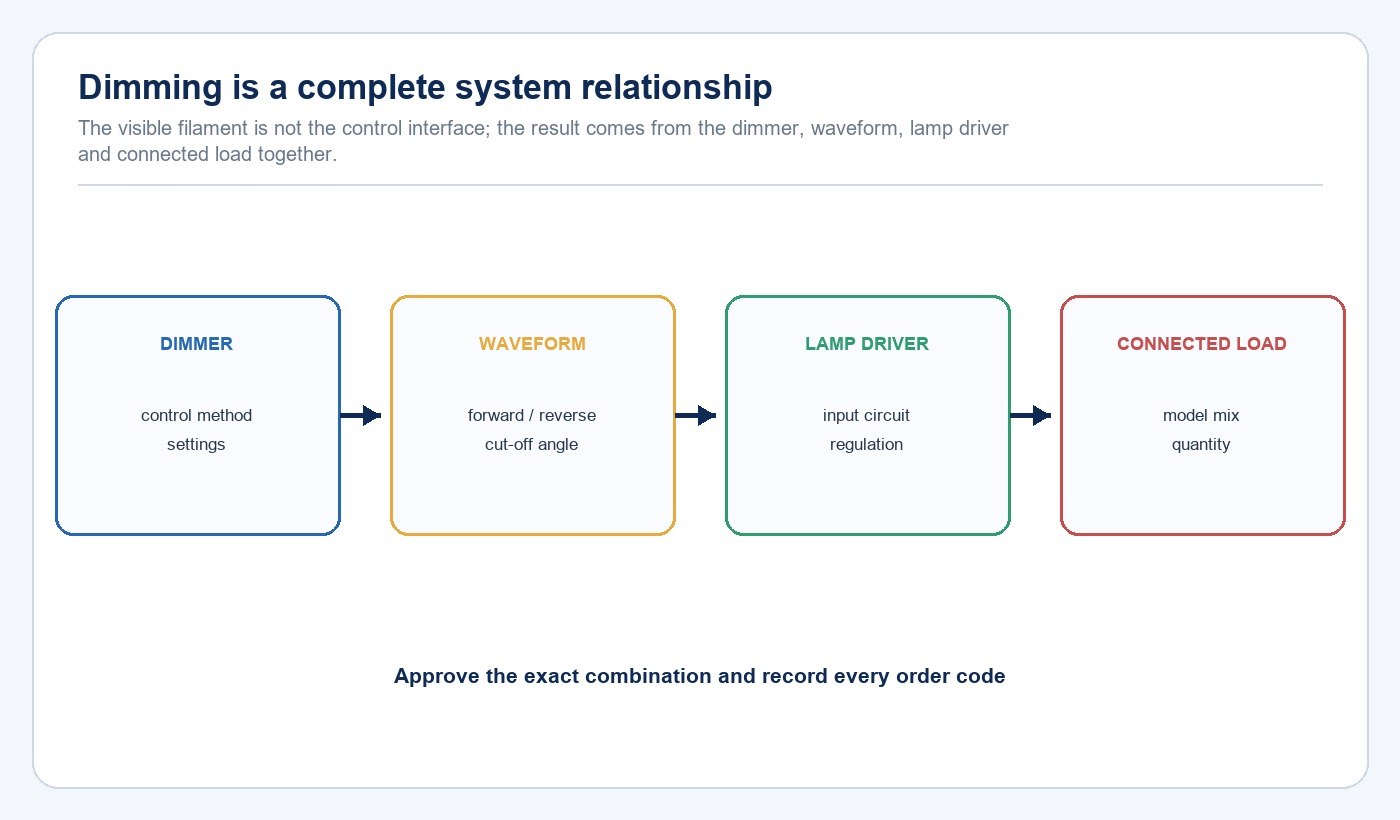
Traditional incandescent lamps respond relatively directly to changes in electrical input. An LED lamp contains electronic circuitry that converts the incoming power into the current required by the emitters. A wall dimmer also changes the electrical waveform according to its design.
The result therefore depends on an interaction among at least three elements:
- the lamp’s driver;
- the dimmer’s control method and settings; and
- the number and combination of loads connected to the control.
Two lamps both labeled “dimmable” may use different drivers. Two wall controls that look similar may use different control methods or have different LED load requirements. A combination that performs acceptably with four lamps may behave differently with one lamp. This is why a generic statement such as “works with standard dimmers” is not enough for a specification.
| Decision field | What must be identified | Why it changes the result |
|---|---|---|
| Lamp | Exact order code, voltage and driver version | Related bulb shapes can use different input circuits |
| Control | Manufacturer, model and control method | Similar wall controls can cut the waveform differently |
| Load | Quantity and any mixed models | Minimum load, maximum LED load and interaction can change |
| Acceptance | Low end, flicker, noise, start-up and switch-off | A combination can turn on yet fail the required behavior |
Start with the dimmable marking and technical documents
Before comparing styles or color temperature, identify whether the exact order code is dimmable. The answer should come from the product label, approved datasheet or manufacturer documentation.
For a purchasing file, record:
- full lamp model or order code;
- base and bulb shape;
- input voltage and frequency;
- rated wattage;
- dimmable or non-dimmable status;
- stated control type, if provided;
- any approved dimmer list or compatibility tool;
- minimum and maximum connected-load conditions;
- declared dimming range, if supported by test evidence.
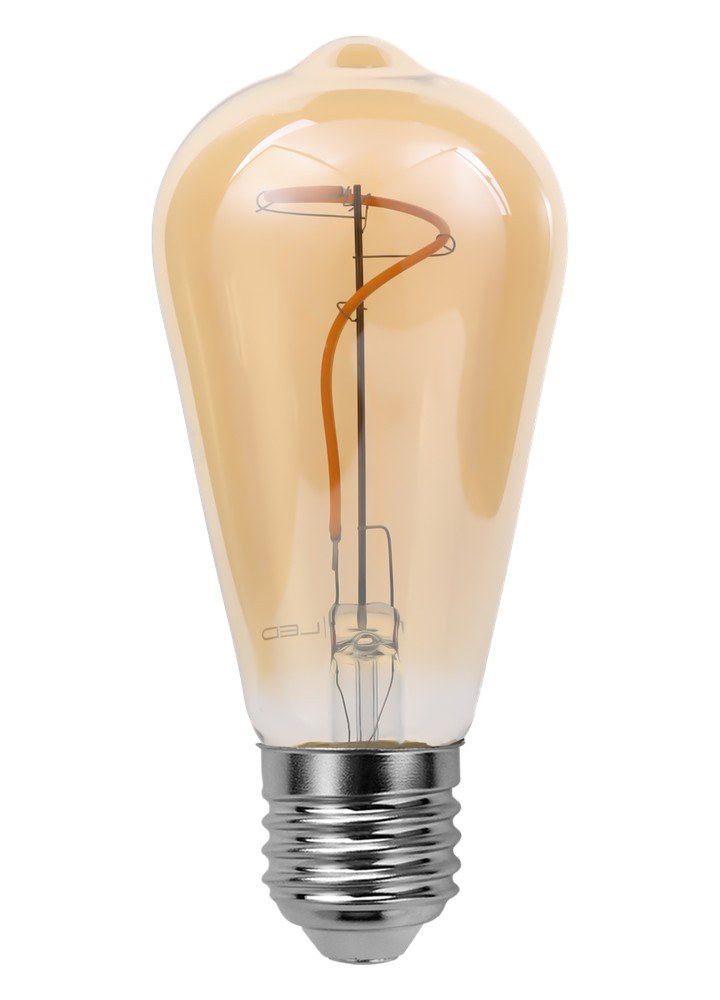
Do not transfer a dimming claim from one related lamp to another only because the envelope and filament arrangement look alike. A product family can contain different wattages, drivers or market-voltage versions. Compatibility evidence should match the actual version being ordered. Decorative shape is a separate selection field; the ST64 example below shows how envelope geometry and filament placement vary before the electrical version is selected.
Match the control type
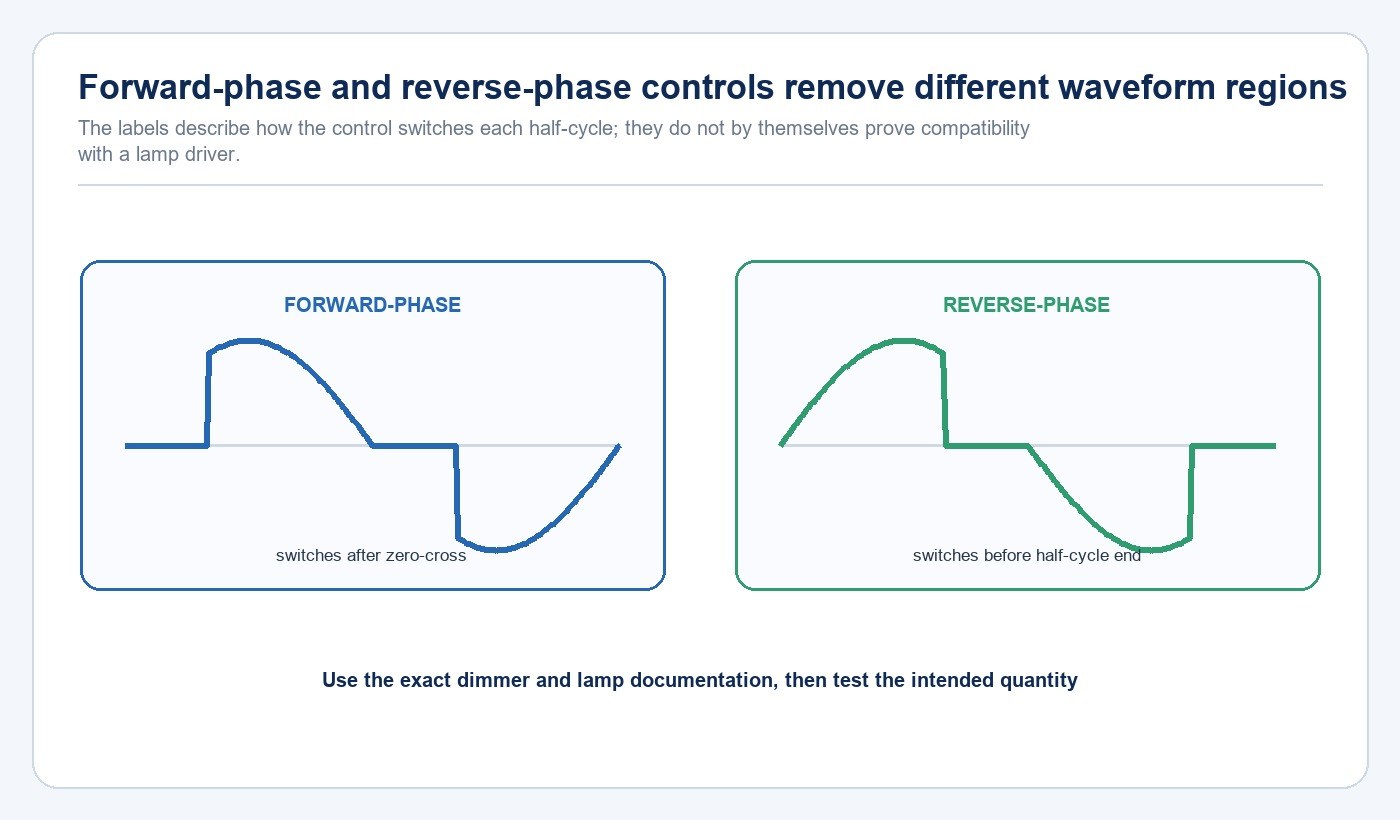
Many retrofit lamps are used with phase-cut wall dimmers, but “phase-cut” is still not a complete compatibility statement. Controls may use forward-phase or reverse-phase operation, and some products are designed to handle a broader range of loads than others. Other lighting systems may use separate control methods that are not interchangeable with a line-voltage replacement bulb.
The control’s documentation should identify the supported load type. If a dimmer was originally selected for incandescent lamps, its front-panel appearance and total wattage marking do not establish that it will operate LEDs correctly.
DOE guidance on phase-cut dimming treats performance as a combination issue. Manufacturer compatibility tools follow the same logic by identifying tested lamp-and-control pairs. For an existing installation, record the exact dimmer model rather than describing it only as “an old wall dimmer” or “an LED dimmer.” The forward-phase and reverse-phase LED dimming guide explains those control paths in more detail.
Do not apply incandescent load ratings directly to LEDs
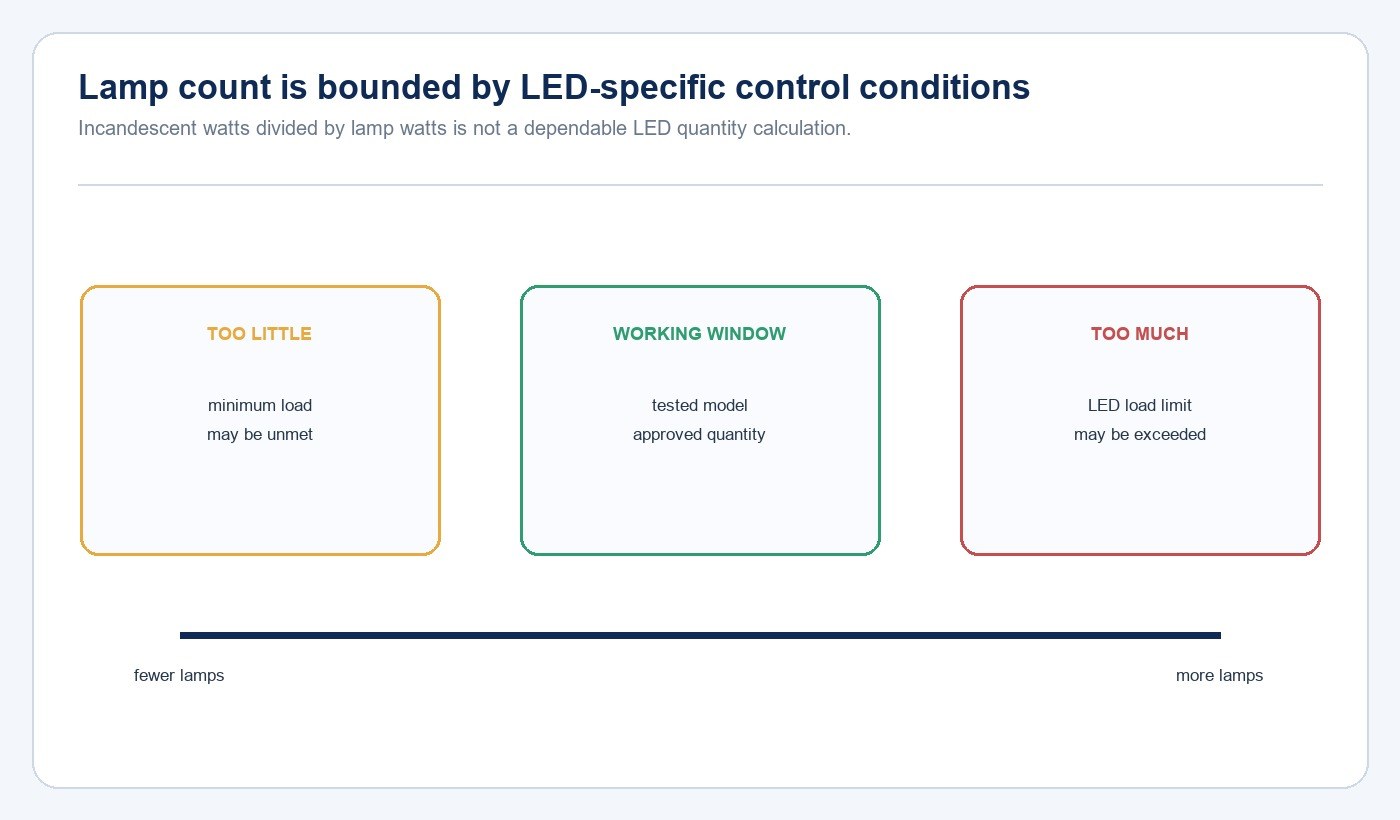
A frequent mistake is to divide an incandescent wattage rating by the wattage of an LED bulb and treat the result as the allowed lamp count. LED drivers present an electronic load, so the applicable limit may be different.
Lutron’s application guidance states that minimum and maximum specifications developed for traditional incandescent and halogen loads do not automatically apply to LED and CFL loads. The correct limit must come from the dimmer’s LED guidance and, where available, its tested compatibility information.
Both ends of the load range can matter. Too many lamps can exceed the control’s supported LED load. Too little connected load may contribute to unstable operation on some combinations. There is no responsible universal lamp-count formula that works for every filament bulb and every dimmer.
What good dimming performance should be checked for
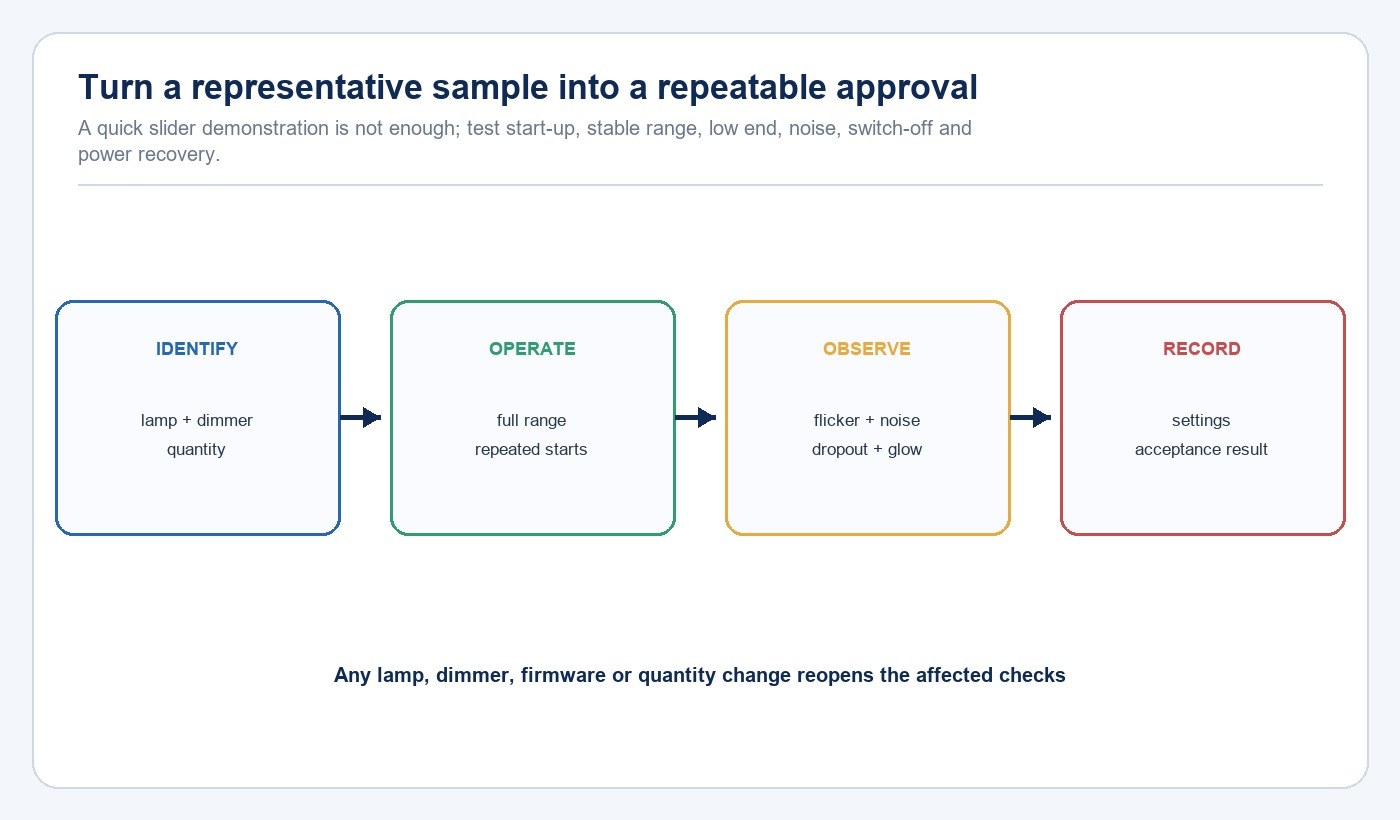
“The lamp dims” is only the first test. A useful sample review should examine the complete operating range and the conditions that matter to the project.
Check at least the following:
- reliable turn-on at the expected control setting;
- stable output through the usable range;
- acceptable low-end level without repeated dropout;
- no objectionable visible flicker during adjustment or steady operation;
- no unexpected flashing or strobing;
- acceptable audible noise from the lamp and control;
- consistent behavior across the intended number of lamps;
- full switch-off without unintended glow, where required;
- recovery after a power interruption.
The result should be recorded for the exact samples tested. A successful test is evidence for that combination under those conditions; a changed driver revision, substitute lamp, control or quantity should reopen the affected checks.
Common symptoms and what to verify
Use the filament LED flicker diagnosis workflow when instability needs a structured circuit-level investigation.
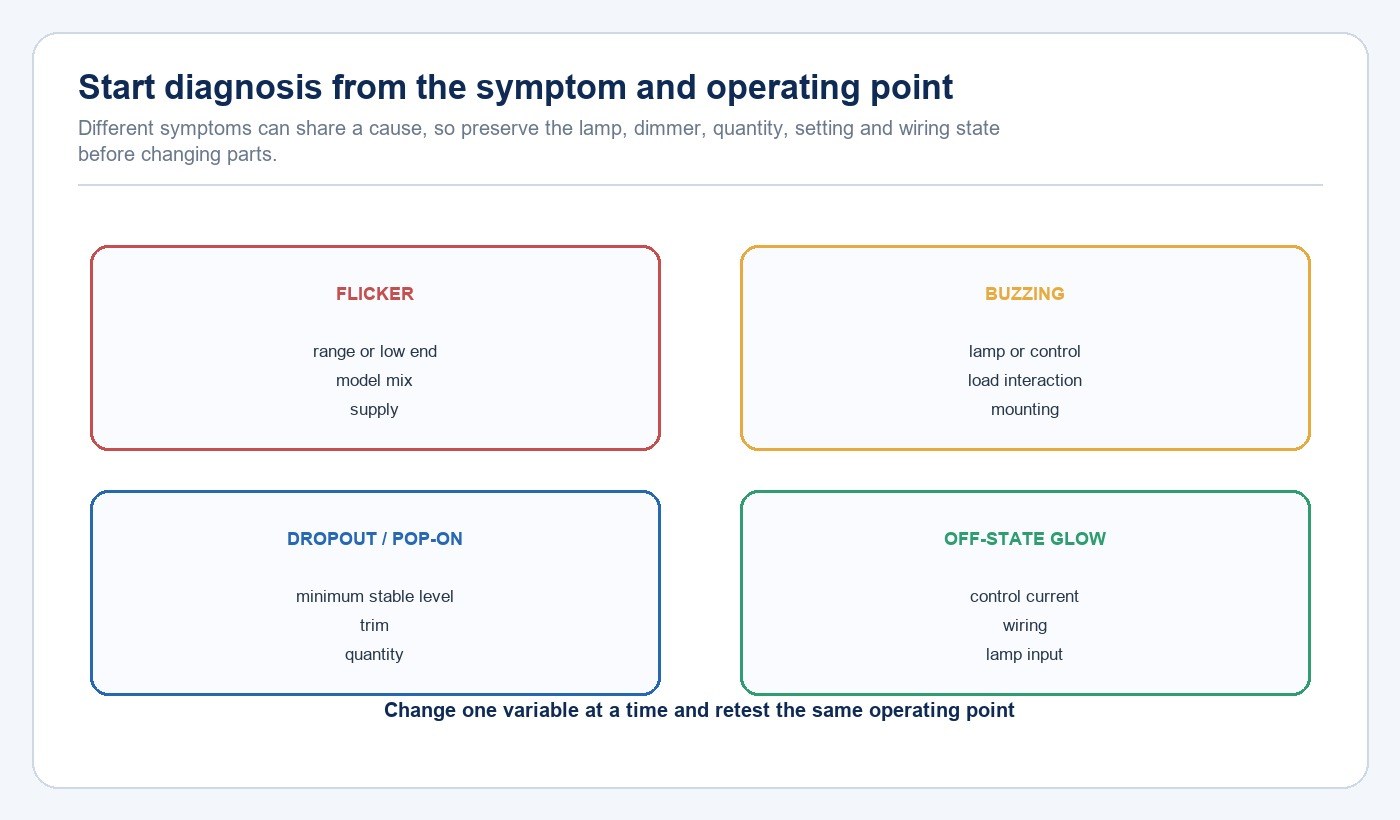
Flicker or strobing
First confirm that the bulb is designated as dimmable. Then check whether the control supports that LED load and whether the problem occurs across the full range or only near the low end. Manufacturer guidance may permit a low-end trim adjustment, but trim is not a substitute for a fundamentally incompatible combination.
Also check whether the circuit mixes different lamp models or technologies. Mixed loads can respond differently to the same waveform, making consistent performance more difficult to predict.
The lamp will not dim very low
The minimum stable light level is combination-specific. A dimmer’s slider may continue moving after the lamp has reached its lowest usable output. Below that point, the lamp may stop changing, become unstable or turn off.
Do not advertise a numerical low-end percentage unless it is supported by a defined measurement and the exact lamp-control pair. Human perception of brightness is also not the same as a simple electrical setting.
Buzzing or audible noise
Audible noise may come from the lamp, the dimmer or both. Compatibility tools often consider noise alongside low-end performance and flicker. If quiet operation is important—for example in hospitality, residential or meeting-room applications—include noise in the sample-approval criteria instead of assuming that a visually stable lamp is acceptable.
Dropout or pop-on
Dropout occurs when the lamp turns off as the setting is reduced. Pop-on describes a lamp that does not start at a very low setting but turns on when the control is raised. These behaviors should be evaluated at the required connected quantity and after repeated switching.
A faint glow when switched off
Some electronic controls pass a small current through the load for their own operation. In an incompatible combination, that current can contribute to ghosting or a faint off-state glow. The remedy depends on the control design, wiring and lamp, so it should not be reduced to a universal accessory recommendation. Follow the control manufacturer’s troubleshooting process or have a qualified electrician evaluate the circuit.
Existing dimmer versus new dimmer: two different workflows
When retaining an existing dimmer, the control model is a fixed project condition. Select lamps using the dimmer manufacturer’s compatibility information where possible, then test the exact proposed lamp and quantity.
When both lamp and dimmer are new, the buyer has more freedom. Select the required lamp appearance, output and electrical version, then choose a control tested for that lamp or obtain written compatibility evidence. This is usually more reliable than selecting both products independently and checking only after installation.
For larger orders, keep the approved lamp and control order codes in the purchasing specification. A later substitution should trigger a compatibility review even if the replacement has the same nominal wattage and bulb shape.
A practical pre-purchase checklist
Before approving a filament LED dimming combination, ask:
- Is the exact lamp model explicitly identified as dimmable?
- What input voltage and market version is being ordered?
- What is the exact dimmer manufacturer and model?
- Which control method does it use, and does its documentation support this LED load?
- Is the lamp listed in a manufacturer compatibility tool or supported by written test evidence?
- What are the dimmer’s applicable LED minimum and maximum load conditions?
- How many lamps will be connected to each control?
- Will different lamp models or technologies share the circuit?
- What low-end behavior, noise level and off-state performance must the project accept?
- Has a representative combination been tested before the full order is released?
Buyers should treat dimming as a model-level selection field, not a visual feature. Review the New Lights factory and manufacturing overview for production context and the download centre for available product files. For a project review, contact New Lights with the lamp model, base, voltage, connected quantity, dimmer model and required behavior. Product-specific compatibility still needs to be confirmed against approved technical evidence.
FAQ
Are all filament LED bulbs dimmable?
No. Only use a lamp on a dimming circuit when the exact model is identified as dimmable and the proposed control combination is compatible.
Can I use a dimmable filament LED bulb with an old incandescent dimmer?
Possibly, but the bulb’s dimmable marking alone is not enough. Identify the exact dimmer and check its LED compatibility guidance, applicable load limits and tested lamp combinations. Sample testing is advisable before a larger installation.
What happens if a non-dimmable LED bulb is connected to a dimmer?
It may operate unstably, flicker, fail to regulate or be exposed to electrical conditions for which it was not designed. Follow the lamp manufacturer’s instructions and use a compatible switching or dimming arrangement.
Why does my filament LED bulb flicker only at low brightness?
The lamp-control combination may have reached its minimum stable operating level. Verify compatibility, connected load, control phase and any manufacturer-approved low-end trim procedure. Do not assume trim will solve every incompatibility.
Does a higher-wattage dimmer support more LED bulbs?
Not necessarily. A rating stated for incandescent or halogen loads cannot automatically be converted into an LED lamp count. Use the control manufacturer’s LED-specific load limits and compatibility information.
Can dimmable bulbs from different brands share one dimmer?
They may respond differently even when each is individually labeled dimmable. Mixed models complicate low-end stability, turn-on behavior and consistency, so the proposed combination should be evaluated as a system.
Do smart dimmers work with every dimmable filament LED bulb?
No. “Smart” describes control features, not universal load compatibility. Check the smart dimmer’s supported load type, wiring requirements, LED limits and tested lamp list.
Editorial Sources
- U.S. Department of Energy FEMP, “Purchasing Energy-Efficient Light Bulbs”: https://www.energy.gov/cmei/femp/purchasing-energy-efficient-light-bulbs
- U.S. Department of Energy, “Dimming LEDs with Phase-Cut Dimmers: The Specifier’s Process for Maximizing Success”: https://betterbuildingssolutioncenter.energy.gov/sites/default/files/attachments/2013_gateway_dimming.pdf
- Lutron, “Minimum and Maximum Loads for LED and CFL Lamps/Fixtures”: https://assets.lutron.com/a/documents/048487.pdf
- Lutron, “Maestro PRO Troubleshooting Guide”: https://support.lutron.com/us/en/product/maestro/article/troubleshooting/MA-PRO-FAQ-Troubleshooting-Guide
- Lutron LED Compatibility Tool: https://webtools.lutron.com/compatibility/us/en/dimmers/macl-lfq/bulbs