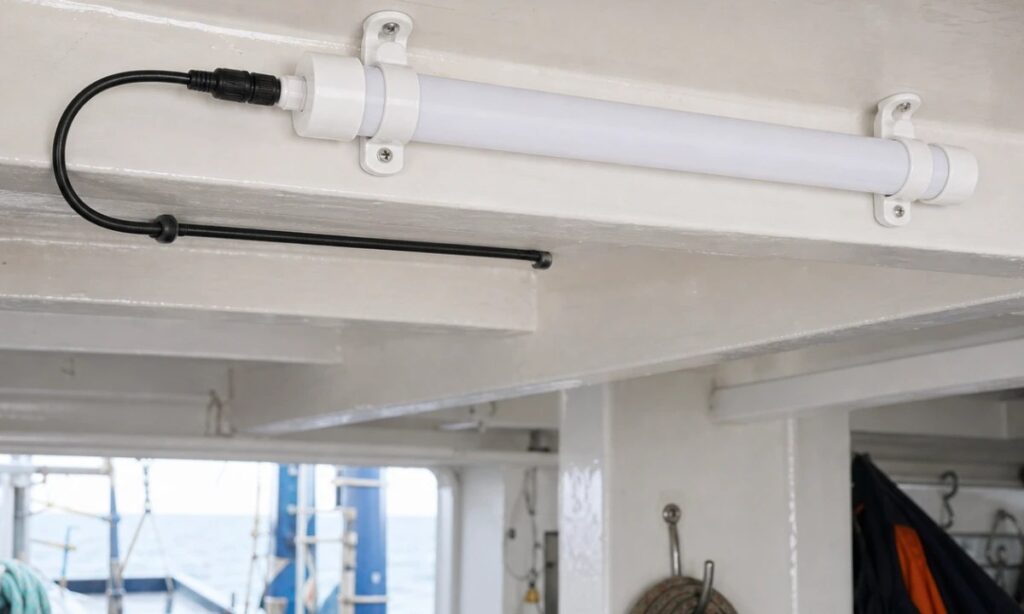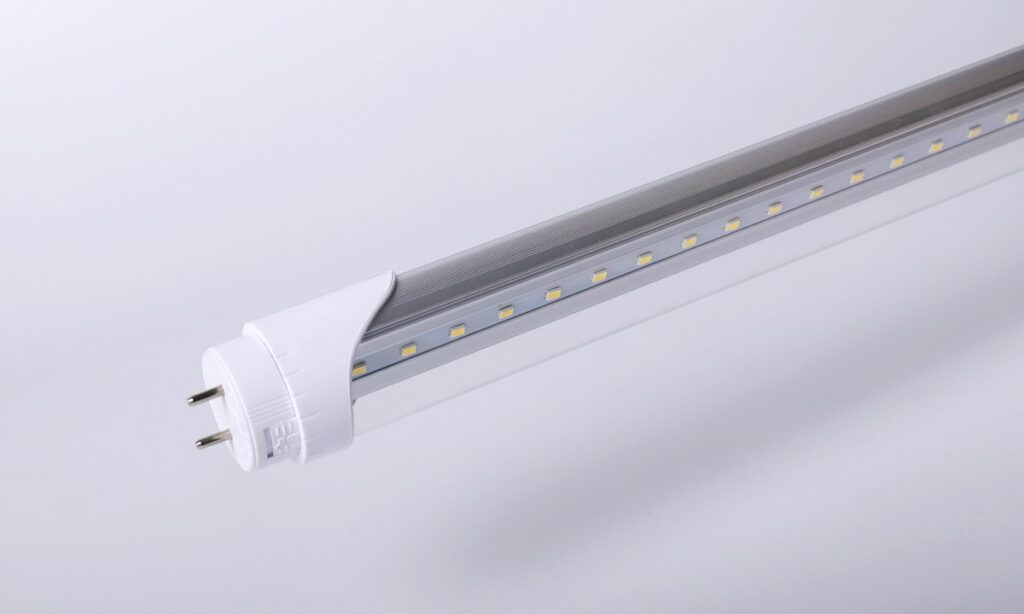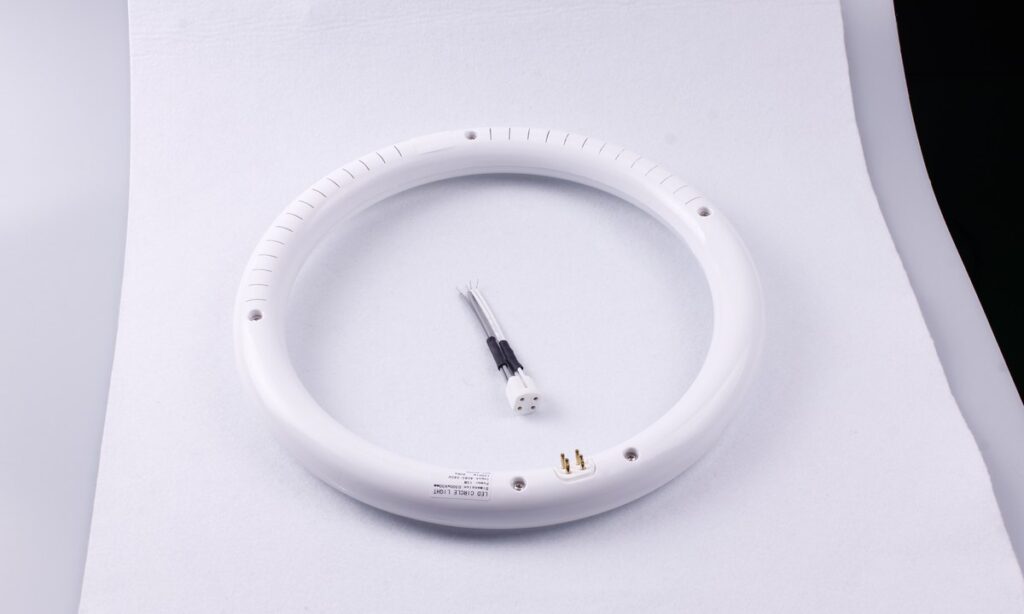


No. An LED filament bulb can be used only when the exact lamp and fixture are compatible.
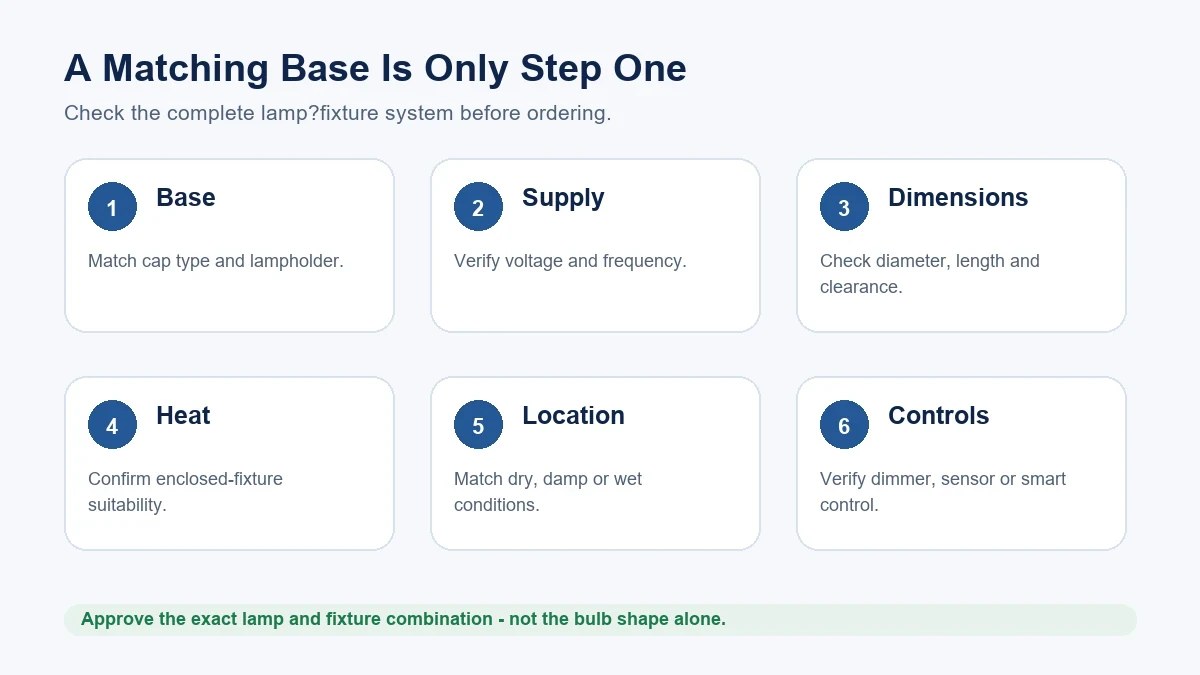
A matching screw base is necessary, but it is not a complete compatibility test. The supply voltage, bulb dimensions, fixture instructions, thermal conditions, environmental location, control method and sometimes the operating orientation also matter. Ignoring one of these checks can lead to poor fit, unstable operation, shortened service or an installation outside the product’s documented conditions.
The safest approach is to compare the lamp and fixture as a system before purchase—not after a full order arrives. The Residential & Decorative Lighting solution shows the wider application context, while this page owns replacement-lamp compatibility.
| Compatibility check | What must match | A common failure mode |
|---|---|---|
| Base and lampholder | Cap designation, contacts and holder condition | The bulb screws in but does not make the intended electrical contact |
| Supply | Rated voltage, frequency and any transformer or ballast | A market-specific lamp is ordered for the wrong supply |
| Physical fit | Overall length, diameter, neck and fixture opening | The base fits but the envelope or driver housing does not clear the fixture |
| Thermal condition | Open or enclosed fixture approval and ambient limits | Heat collects around a lamp not approved for the enclosure |
| Environment | Dry, damp, wet or outdoor marking | A covered location is mistaken for product approval |
| Controls | Dimmable status, dimmer type, connected quantity and other controls | Full output works but low-end dimming flickers or drops out |
1. Match the base and lampholder exactly
Start with the lamp base designation and the fixture’s lampholder. Similar-looking screw bases are not necessarily interchangeable, and a bulb should never be forced into a holder.
If the bulb construction itself is still unclear, the filament LED and standard LED comparison explains how their internal arrangement and light distribution differ without treating either format as universally interchangeable.
Check:
- base designation;
- contact arrangement;
- lampholder condition;
- whether the fixture uses a standard replaceable lamp or a proprietary source;
- any restrictions in the fixture instructions.
A loose, corroded, damaged or heat-discolored lampholder is not corrected by installing a new LED bulb. Have the fixture evaluated before reuse. Do not use improvised adapters unless the adapter, lamp and fixture combination is specifically permitted for the application.
2. Verify voltage and frequency
The base may fit even when the electrical version is wrong. Confirm that the lamp’s rated input matches the actual supply and the fixture configuration.
For an international order, model names can conceal market-specific differences. Record the complete order code, not only the bulb shape or wattage. A 120 V version and a 220–240 V version may look identical but are not substitutes.
Also check whether the fixture contains a transformer, ballast, electronic switch, sensor or other control. A self-ballasted LED replacement lamp generally expects the supply arrangement stated in its instructions. It should not be connected through equipment that the lamp manufacturer has not approved.
3. Check physical dimensions and clearances
LED replacement lamps contain driver electronics, commonly near the base. U.S. Department of Energy FEMP guidance notes that this can make some LED lamps larger than incandescent lamps near the base, even when the familiar bulb envelope looks similar.
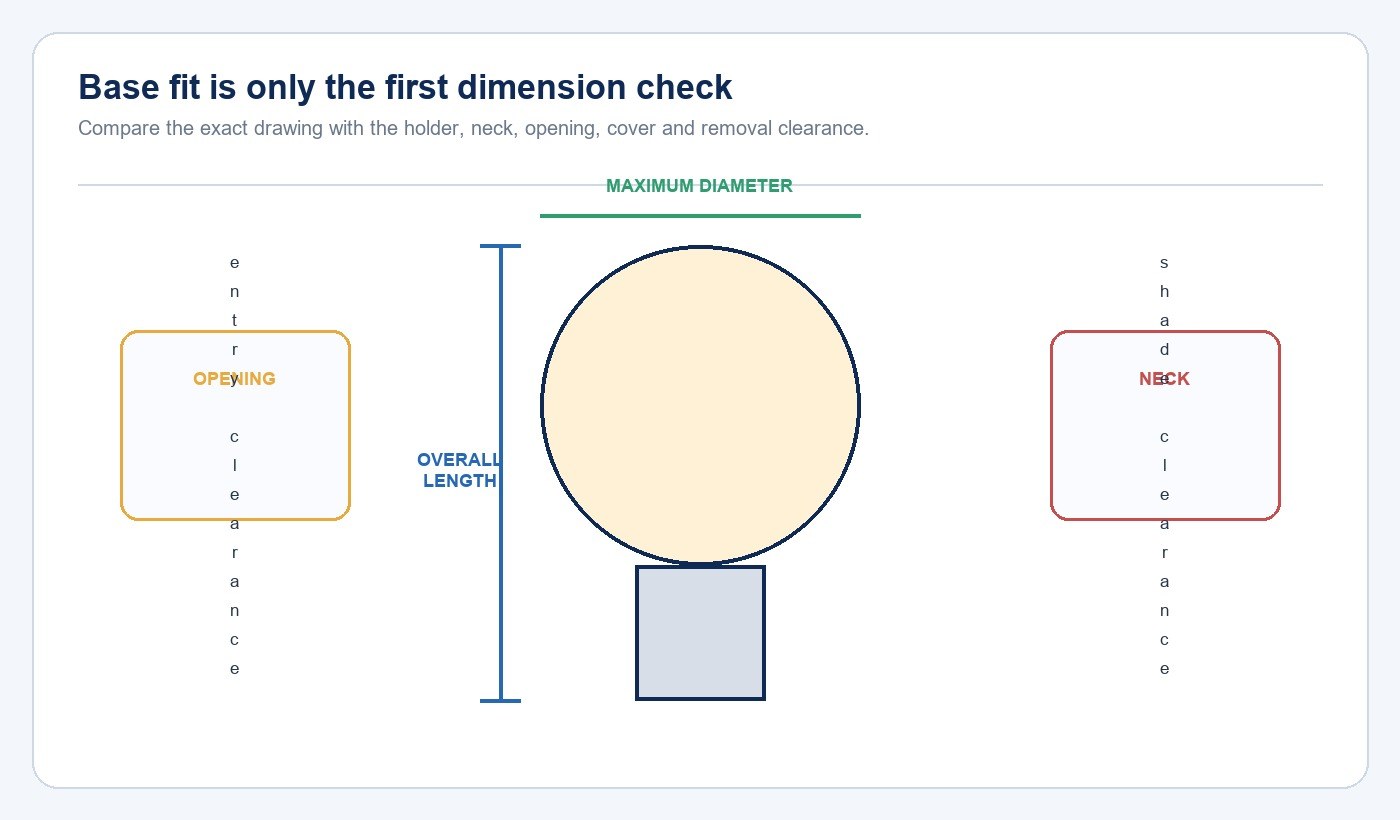
Measure more than the maximum bulb diameter. Relevant dimensions can include:
- overall length;
- maximum envelope diameter;
- neck diameter and taper;
- distance from base contact to the widest point;
- fixture opening;
- shade or cage clearance;
- depth available below a cover;
- room for installation and removal.
A bulb may enter the shade but still fail to seat fully in the lampholder. It may also touch a cover or place the luminous filaments in a different optical position from the original lamp. Compare dimension drawings for the exact model instead of relying on shape names such as A, G, ST or T alone.
For envelope and source-visibility choices, compare the clear and frosted LED filament bulb guide. Weight can matter in delicate decorative lampholders, portable fixtures or multi-arm fittings. If the replacement is materially heavier than the original source, verify the fixture’s mechanical suitability.
4. Respect the fixture’s lamp limits and instructions
Many fixtures carry a maximum lamp wattage or other lamp restrictions. An LED that consumes fewer watts than the original incandescent lamp may reduce electrical load, but that fact alone does not establish complete suitability.
Follow both sets of instructions:
- the fixture’s permitted lamp types and limits; and
- the LED lamp’s permitted fixture and operating conditions.
Do not exceed the fixture’s maximum rating. Do not assume that low wattage overrides restrictions involving enclosure, orientation, temperature, controls or spacing. If the fixture labeling is missing or unreadable, the compatible replacement cannot be confirmed from appearance alone.
5. Treat enclosed fixtures as a separate condition
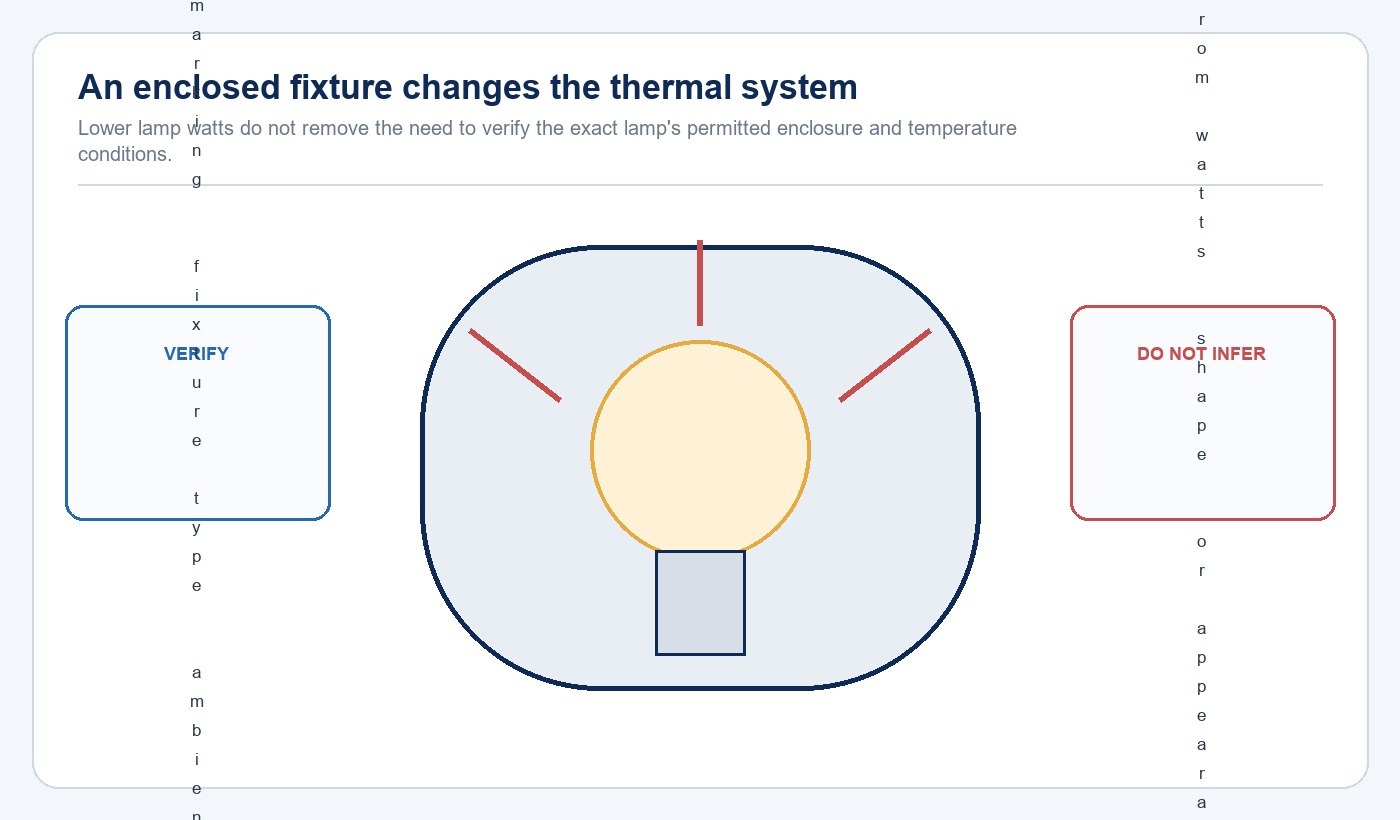
A fully enclosed fixture can trap heat around the lamp. U.S. Department of Energy FEMP guidance warns that this heat buildup can affect the performance and life expectancy of some LED products and tells buyers to check whether the lamp is suitable for the application.
This is especially important for filament-style LEDs because their decorative appearance may encourage use inside glass globes, jars and sealed covers. The fact that the lamp consumes less power than an incandescent source does not prove that its internal driver will remain within its permitted temperature under enclosure.
Use a lamp in a fully enclosed fixture only when the exact lamp documentation allows it and the fixture itself is suitable. Pay attention to:
- fully enclosed versus open-bottom shade;
- ambient temperature;
- lamp position;
- number of lamps in the enclosure;
- clearance around the driver area;
- any derating or application restriction.
Do not drill ventilation holes, remove safety covers or alter the fixture to accommodate a lamp unless the fixture manufacturer provides an approved method.
6. Verify indoor, outdoor, damp and wet suitability
“Outdoor” is not one condition. A pendant under a deep porch, a wall lantern exposed to wind-driven rain and a landscape fitting near irrigation can present different moisture exposure.
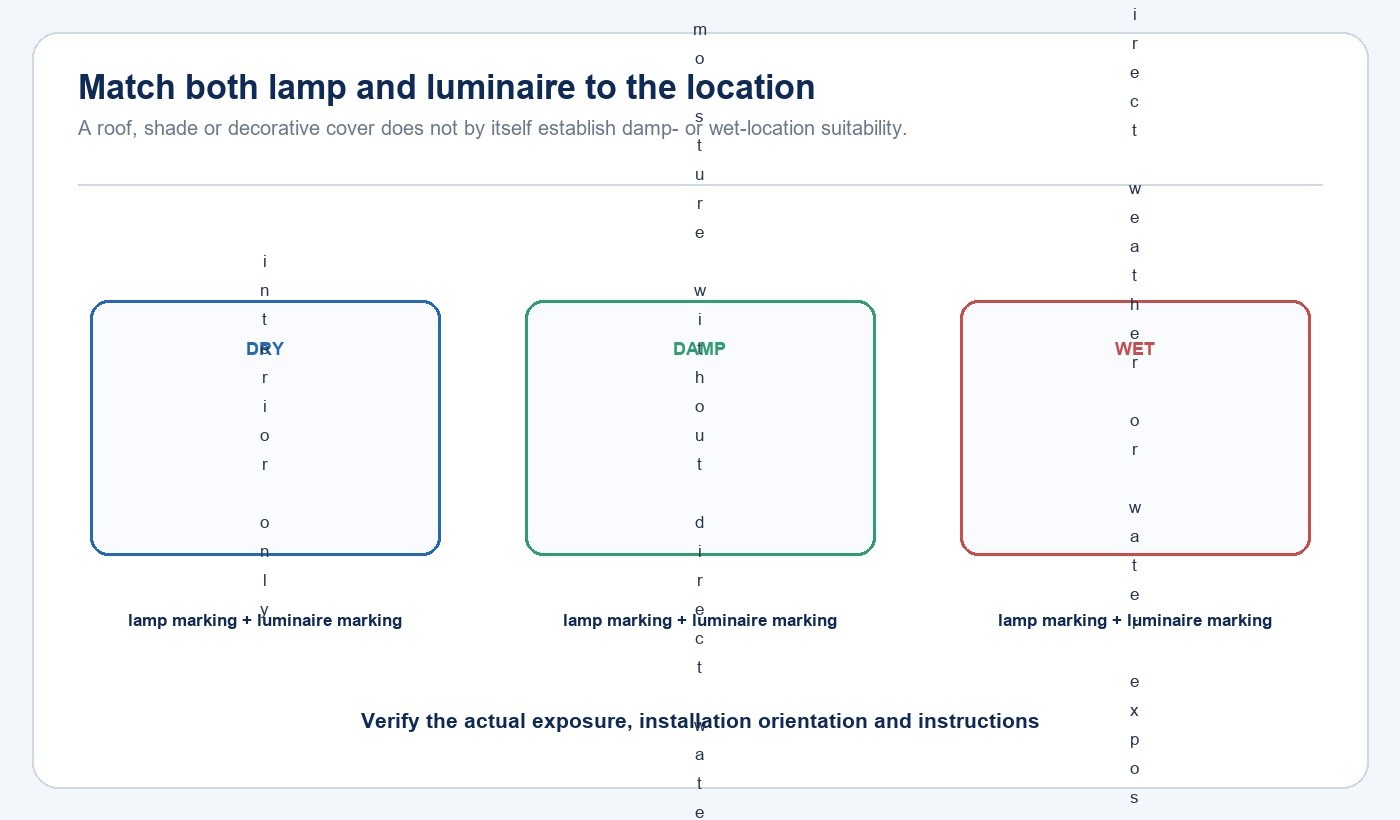
UL Solutions’ luminaire marking guidance distinguishes dry, damp and wet locations and relies on product markings to show intended use. The lamp and the luminaire both need to be appropriate for the actual installation.
Before using a filament LED outdoors, check:
- whether the lamp is marked for outdoor, damp or wet conditions as required;
- whether the fixture is listed or marked for the location;
- whether the lamp is protected from direct water where required;
- the permitted ambient-temperature range;
- the fixture’s enclosure and drainage design;
- whether the installation orientation affects water protection or heat flow.
A roof or decorative cover does not automatically convert an indoor-only product into an outdoor-rated one. Likewise, a bulb described as “outdoor” does not make an indoor fixture suitable for rain.
7. Confirm dimming and other controls
If the fixture is connected to a dimmer, timer, sensor, smart switch or electronic transformer, compatibility must include the control system.
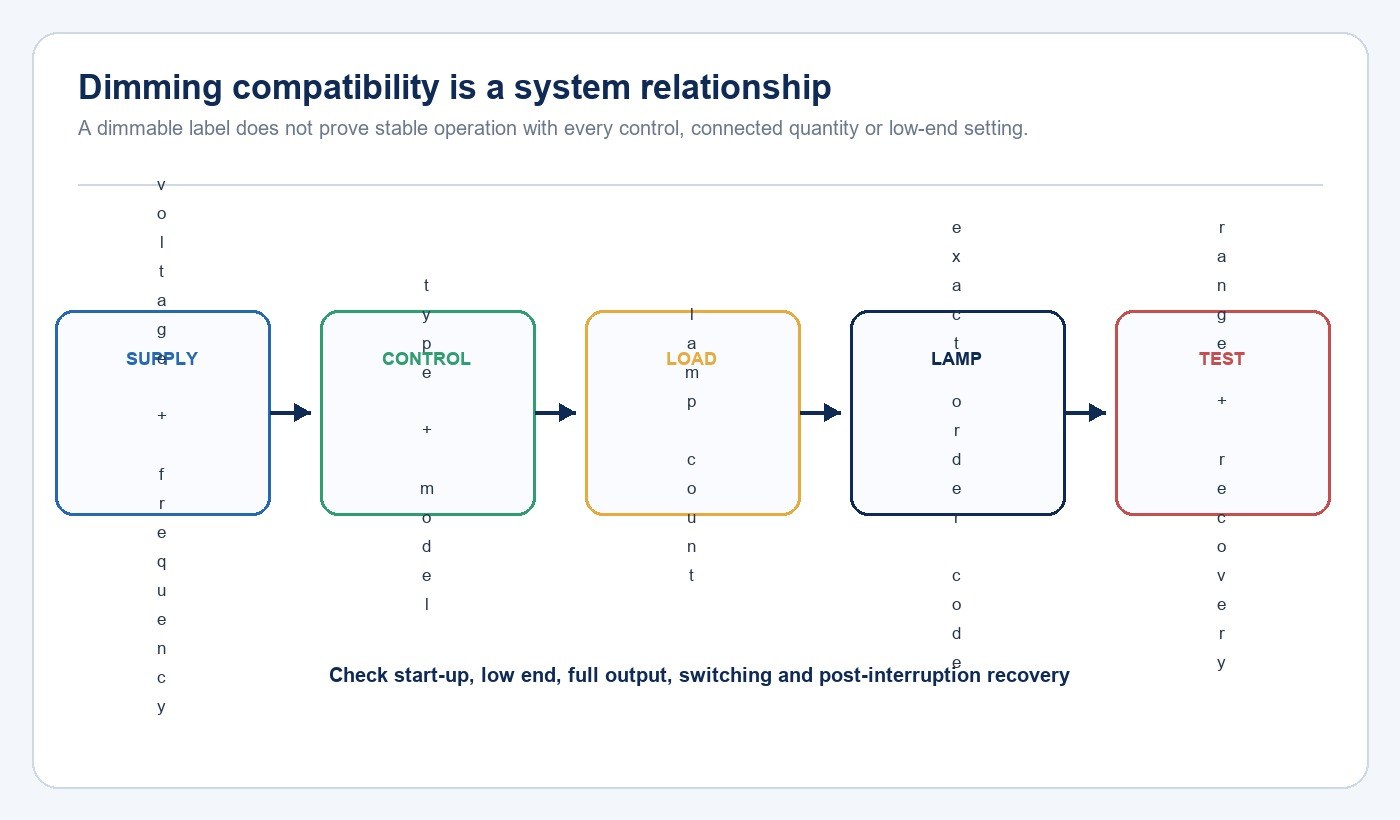
For dimming, the lamp must be explicitly identified as dimmable, and the exact dimmer should support the lamp type and connected load. A matching base and normal full-output operation do not prove stable dimming. Flicker, buzzing, dropout or ghosting may appear only at certain settings.
Use the filament LED dimming compatibility guide to check lamp quantity, low-end behavior and the exact control before approving a dimmed installation.
For other controls, check the lamp and control manufacturers’ instructions. Electronic switches can pass small currents or produce switching conditions that some lamps do not handle as expected. Record the complete control model and the number of lamps on the circuit.
Operating orientation can matter
Some lamps allow any position; others carry restrictions. Base-up, base-down and horizontal operation can change how heat moves through the lamp and fixture. Outdoor products may also have orientation requirements related to water protection.
Do not infer orientation suitability from the visible filament structure. Use the exact product instructions. If the documentation is silent and the application is thermally demanding, request written confirmation rather than turning an unknown into a product promise.
Common fixture scenarios
Open decorative pendant
This can be a straightforward application when base, voltage, dimensions, fixture limits and controls match. Still check that the bulb fits through the shade opening and that its weight and visual scale suit the fixture.
Sealed glass globe
Treat it as an enclosed-fixture condition. Use only a lamp documented for that environment and verify temperature and orientation restrictions.
Table or floor lamp with a dimmer
Check both physical fit and control compatibility. Some portable-lamp dimmers or electronic switches may not be suitable for the proposed LED.
Outdoor wall lantern
Verify the location rating of the luminaire and the environmental suitability of the lamp. A weather-protected location still requires the correct product marking and installation.
Vintage or older fixture
Inspect the lampholder, wiring, insulation and labeling. Age alone does not make a fixture incompatible, but damaged components or missing information can prevent a safe conclusion. Have uncertain fixtures evaluated by a qualified electrician.
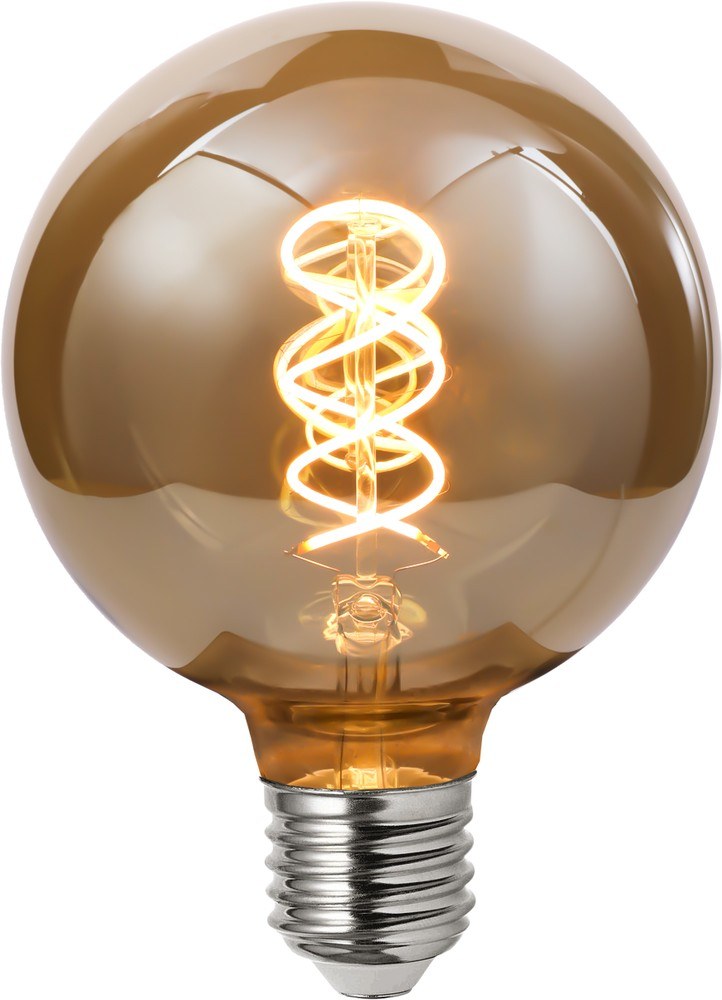
A decorative envelope can change clearance, luminous position and source visibility even when the screw base is familiar. The New Lights example below is included to make those physical checks concrete; use the exact model drawing and application instructions for an approval decision.
A pre-purchase compatibility checklist
Before approving a filament LED replacement, record:
- exact fixture model or clear photos of its labeling;
- lampholder and base designation;
- supply voltage and frequency;
- original lamp type and fixture maximum rating;
- bulb maximum diameter, overall length and neck clearance;
- open, semi-enclosed or fully enclosed construction;
- dry, damp, wet or outdoor exposure;
- expected ambient temperature and operating orientation;
- dimmer, sensor, timer, transformer or smart-control model;
- exact LED lamp order code and approved application conditions.
When comparing general LED filament bulb products, use the product family as a starting point and verify the exact model before ordering. The New Lights factory and manufacturing overview explains the production context, and the download centre is the route for available product documents. For project support, contact New Lights with fixture photos, lampholder, supply voltage, enclosure, location, control method and required dimensions.
FAQ
If the base fits, is the LED filament bulb compatible?
Not necessarily. Base fit is only one check. Voltage, dimensions, fixture limits, enclosure, environment, controls and product instructions must also match.
Can I replace a 60 W incandescent bulb with a lower-wattage LED filament bulb?
Only after confirming the LED’s light output, base, voltage, dimensions and application conditions. Lower power does not by itself prove enclosed-fixture, outdoor or dimmer compatibility.
Can LED filament bulbs be used in enclosed fixtures?
Some can, but only if the exact lamp is documented for fully enclosed fixtures and the fixture conditions remain within the stated limits.
Can filament LED bulbs be used outside?
Only when both the lamp and luminaire are suitable for the actual dry, damp or wet location and are installed according to their instructions.
Will any dimmable filament LED work in a dimmer-equipped fixture?
No. The lamp must be dimmable and compatible with the exact control type and connected load. Model-level compatibility or representative testing is preferable.
Does bulb shape guarantee physical fit?
No. Shape codes describe a general form, while actual length, diameter, neck profile and driver housing can differ. Use the product drawing.
Can an LED filament bulb be installed sideways?
Only if the lamp documentation permits that operating position and the fixture remains suitable. Orientation can affect heat and, outdoors, water protection.
Editorial sources
- U.S. Department of Energy FEMP, “Purchasing Energy-Efficient Light Bulbs”: https://www.energy.gov/cmei/femp/purchasing-energy-efficient-light-bulbs
- U.S. Department of Energy CALiPER, “Application Summary Report 20: LED PAR38 Lamps”: https://www1.eere.energy.gov/buildings/publications/pdfs/ssl/caliper_20_summary.pdf
- UL, “Luminaires Marking and Application Guide”: https://taiwan.ul.com/wp-content/uploads/2014/09/Luminaires_MG.pdf
- U.S. Department of Energy, “Specifying LED in a World of Continuous Change”: https://www.energy.gov/sites/prod/files/2014/11/f19/miller-hershman-yorgey-willcock_specifying_detroit2014.pdf