

Gate and house-number lighting should make the correct address recognizable from the real approach without exposing visitors, neighbors or cameras to unnecessary glare.
Start with the number, background and viewing geometry. Then add only the light needed to reveal the identifier, walking route and gate hardware. Product selection comes after the project has defined approach directions, stopping positions, control states, weather exposure and maintenance access.
Start with the Address and Approach Geometry
Confirm which identifier must be displayed and where local authorities, postal services, property managers or emergency-access rules expect it. Requirements for character size, location, language, illumination and visibility vary, so a generic article cannot replace the applicable project rule.
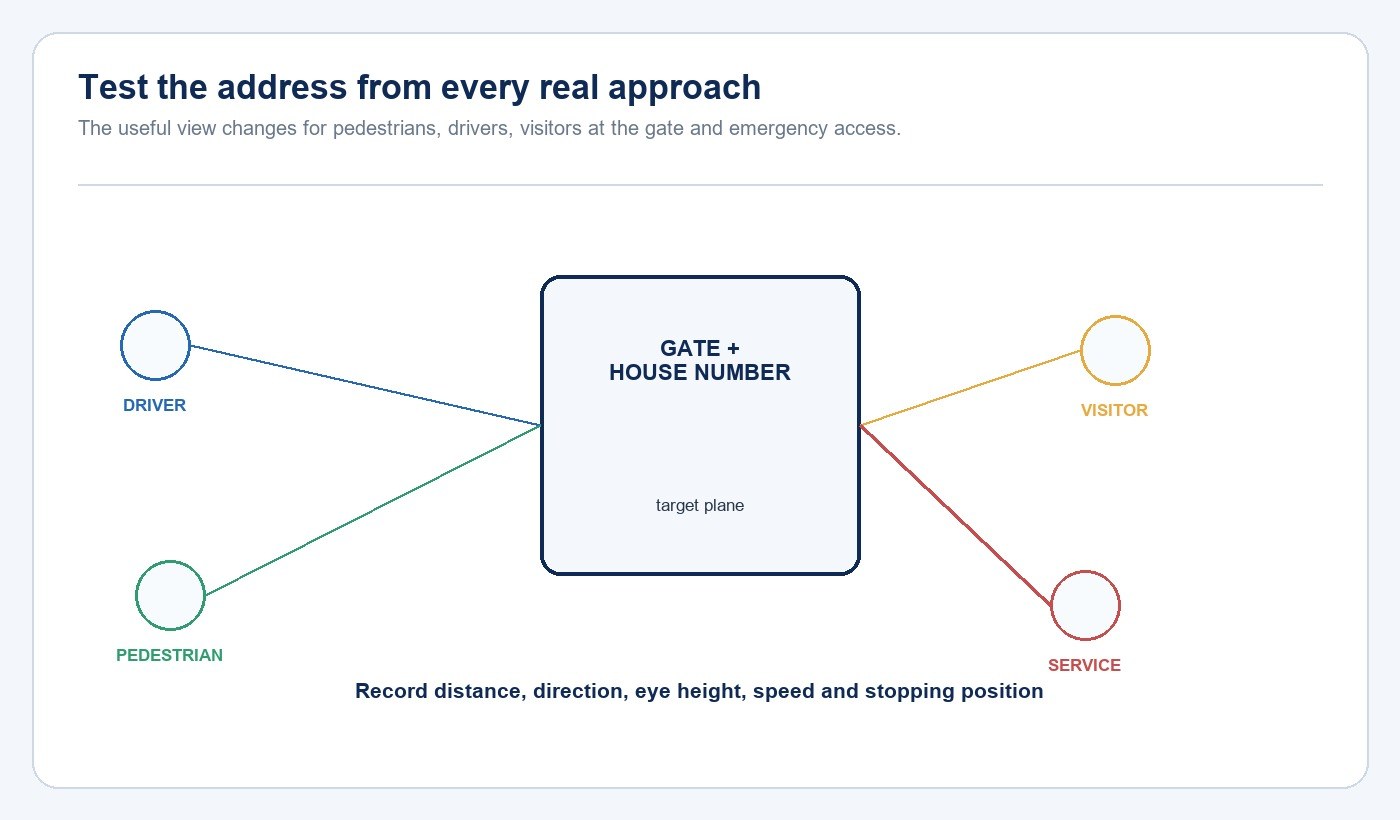
Draw the gate, driveway, pedestrian entrance, building face, vegetation, parked vehicles and likely stopping points. Record distance, direction, eye height and whether the observer is walking, driving or waiting at the intercom. A number that reads clearly when standing directly in front of it can disappear at an oblique vehicle approach.
Build Legibility before Adding Output
Recognition depends on a chain: clear number form, spacing, contrast against the background, even light across the face and an unobstructed view. Glossy metal, patterned stone, deep relief and foliage can reduce useful contrast even when a meter records more light nearby.
Compare the number in daylight and darkness. Check whether raised characters cast hard shadows, whether a backlit plate blooms around its edges, and whether the chosen color remains distinct from the background. If recognition fails because of clutter or geometry, increasing output can make the scene brighter without making the address easier to read.

Separate Identification, Route and Security Tasks
Identification light serves the address face. Route light helps visitors read steps, thresholds and the path to the gate. Local task light may serve a keypad, lock, parcel box or intercom. Security or camera-support lighting has its own coverage and control requirements. One source can support several tasks, but each task should have a separate acceptance check.
The Outdoor, Garden & Solar Lighting solution provides the wider application context. For façade, doorway and vertical-surface choices, continue with the outdoor wall and entrance lighting guide.
| Task | Target | Failure to check |
|---|---|---|
| Address identification | Number face and background | Low contrast, shadow or blocked view |
| Pedestrian route | Step, threshold and direction | Dark transition or exposed source |
| Gate operation | Intercom, keypad, lock or parcel point | Body shadow or reflective glare |
| Camera support | Face and decision zone | Source bloom or uneven exposure |
| Boundary control | Property-side target only | Spill toward road, neighbor or sky |
Protect Sightlines and the Camera Image
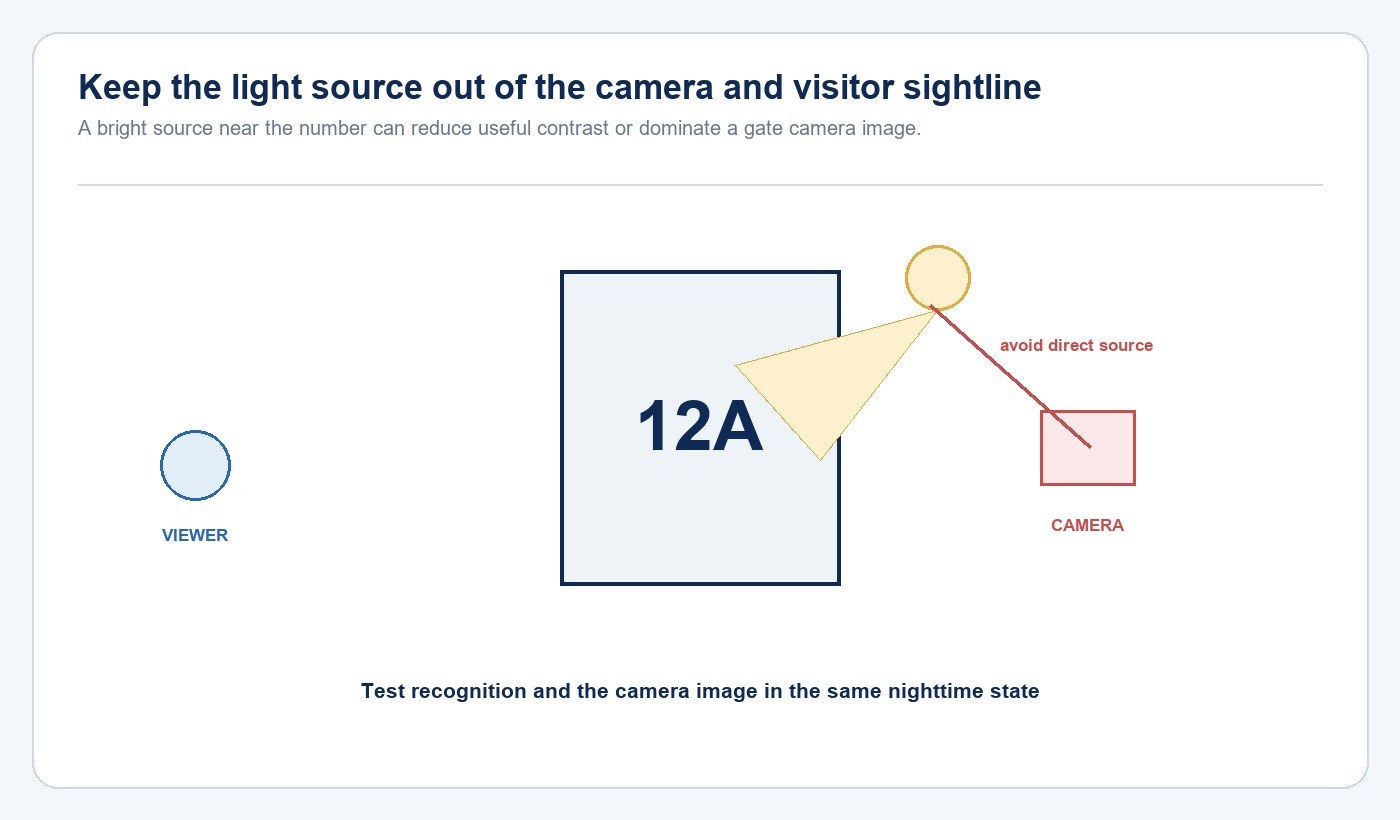
Stand at the gate and look toward every source. Repeat the check from the driveway and neighboring direction. Shield or reposition sources that dominate the field of view. Wet paving, pale stone and reflective number plates can create additional glare paths that are not obvious in a dry daytime inspection.
Review the security camera in the same operating state. A bright source near the number or aimed toward the lens can reduce useful exposure on a visitor or identifier. Test the camera’s day-night transition, infrared behavior where applicable, motion state and recovery after the light changes.
Choose the Product from Mounting and Control Evidence
Compare the exact model’s distribution, source shielding, mounting surface, cable entry, enclosure construction, control interface, operating temperature and service method. A photocell product can simplify dusk-to-dawn operation; a motion response can reduce the normal level; a solar product can avoid trenching. None of those labels proves that the product suits the site without checking orientation, detection geometry, operating schedule and environmental exposure.
DarkSky International and Illuminating Engineering Society describe responsible outdoor lighting as useful, targeted, low level, controlled and warm-colored. Apply the principle to the gate: direct light only to defined tasks, use the lowest useful level, limit operating time and minimize shorter-wavelength content where practical and permitted by the project requirements.
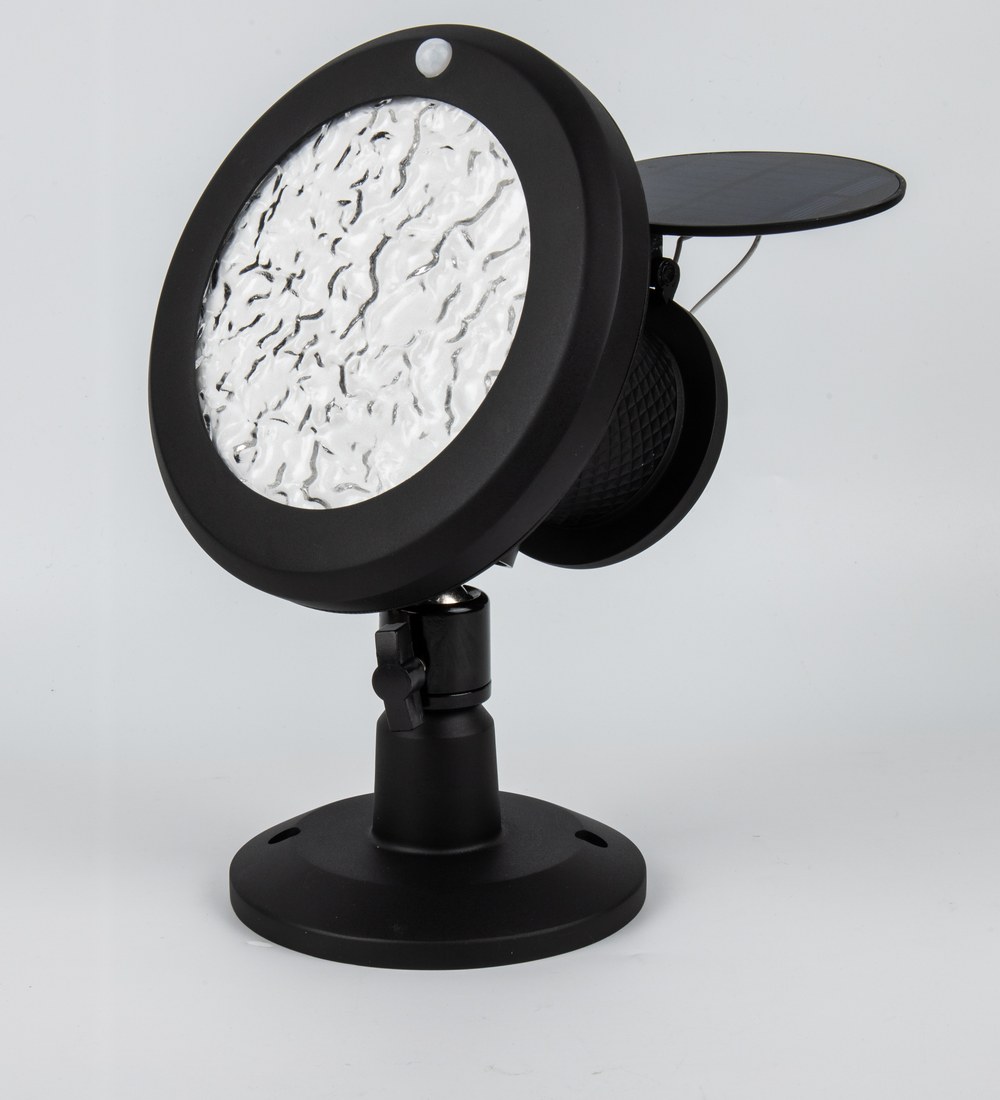
A wired project may instead begin with a documented photocell wall-light housing. Treat each route as a starting point: the final acceptance must follow the selected product documents and a representative nighttime sample.
Write the Control States
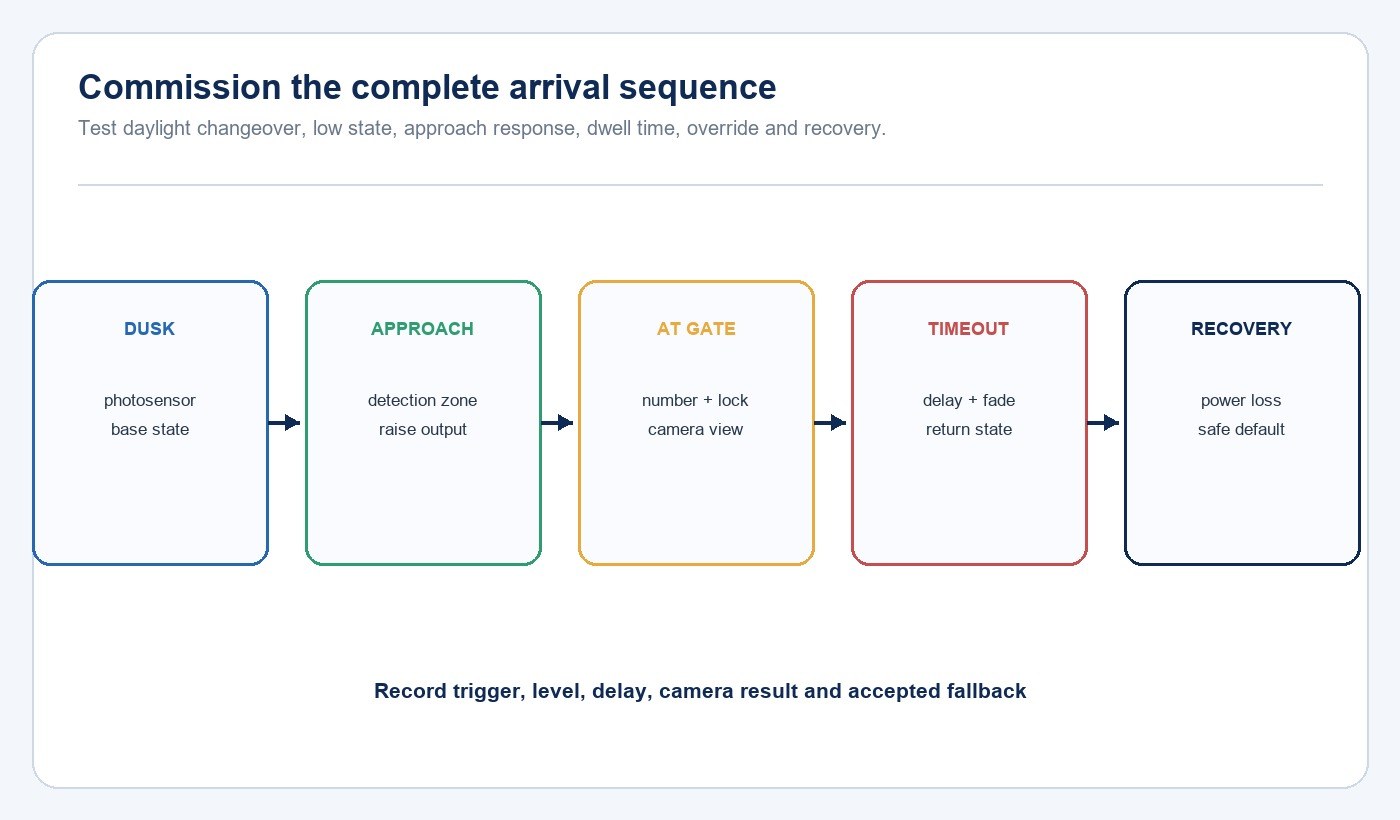
Define the daylight state, normal night state, approach response, dwell time, manual override, timeout and recovery after power loss. If identification must remain available when a motion sensor fails or a network is offline, state the fallback explicitly. Avoid using a sensor name as a substitute for a sequence of operation.
U.S. Department of Energy exterior-lighting guidance discusses schedules, photosensors and occupancy strategies and calls for commissioning of sensor location, sensitivity, timeout and programmed response. The accepted settings should be recorded so maintenance does not silently return the site to unsuitable defaults.
Commission after Dark
Use representative vehicles, pedestrians, vegetation and camera settings. Approach from each required direction, stop where a real visitor would stop, read the number, locate the gate hardware and observe source visibility. Repeat after rain or with a wetted representative surface when reflections are material to the project.
| Test state | Observe | Record |
|---|---|---|
| Driver approach | Recognition before the decision point | Distance, direction and obstruction |
| Pedestrian approach | Number, steps and source visibility | Viewpoint and accepted setting |
| Visitor at gate | Intercom, keypad and body shadow | Task result and correction |
| Camera view | Face, number and source bloom | Camera mode and light state |
| Timeout/recovery | Return level and fallback | Delay, default and responsible owner |
Gate and House-Number Lighting Checklist
- Confirm the locally required identifier and display conditions.
- Map driver, pedestrian, visitor and service viewpoints.
- Check number form, spacing, background and obstruction.
- Separate identification, route, gate-task and camera functions.
- Control direct glare, reflections and boundary spill.
- Compare exact mounting, enclosure, control and service evidence.
- Write all normal, override, timeout and failure states.
- Commission recognition and camera performance after dark.
Frequently Asked Questions
How bright should a house-number light be?
There is no universal output. Use the lowest level that produces reliable recognition from the required approaches after number form, contrast and aiming have been corrected.
Should the light be above or below the number?
Either can work. Test shadow direction, source visibility, weather exposure, mounting access and the normal approach angle before choosing.
Can one motion light serve the number and security camera?
Possibly, but only if the approach response, number contrast, visitor exposure, camera image and fallback state all pass together.
Is a solar wall light suitable for every gate?
No. Solar exposure, panel orientation, battery and load evidence, operating schedule, detection behavior and seasonal conditions must support the task.
Prepare the Project Brief
Send the site plan, address-display requirement, daytime and nighttime photographs, approach directions, stopping points, mounting surface, power route, camera position, control sequence and available product documents. The New Lights factory and manufacturing overview provides production context, the New Lights download centre provides current document routes, and the New Lights project enquiry form starts a scoped review.
Editorial Sources
- DarkSky International and Illuminating Engineering Society, “Five Principles for Responsible Outdoor Lighting”: https://darksky.org/resources/guides-and-how-tos/lighting-principles/
- U.S. Department of Energy, “Exterior Lighting Controls Guidance”: https://betterbuildingssolutioncenter.energy.gov/resources/exterior-lighting-controls-guidance