

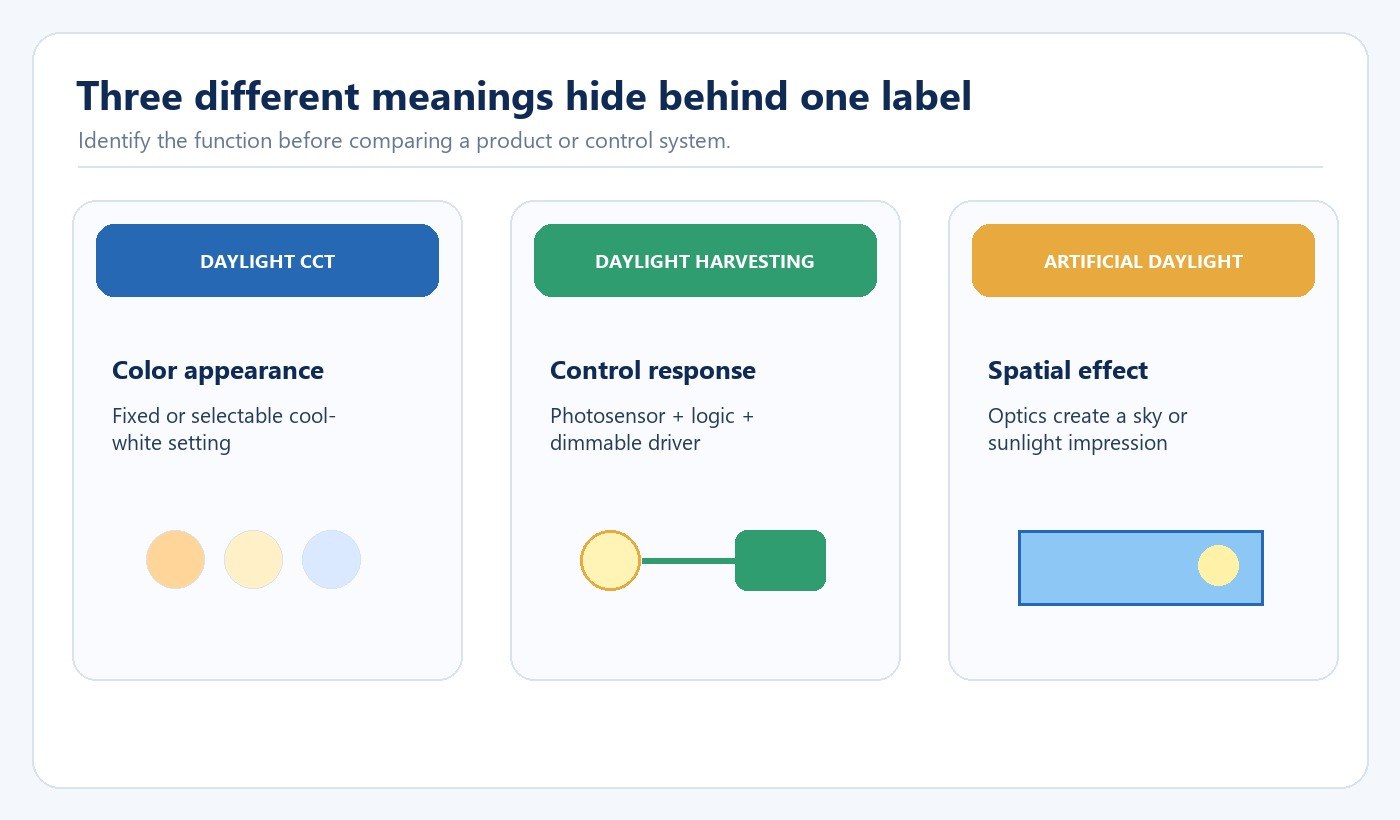
“Daylight LED panel” is not one precise product category. It can mean an ordinary LED panel with a cool-white color appearance, an LED panel connected to daylight-responsive controls, or an artificial skylight designed to create a sky-and-sun impression. These options solve different tasks and require different evidence.
The word daylight alone does not prove that a panel senses ambient light, dims automatically, changes color temperature or reproduces natural daylight. Before comparing quotations, identify the intended function and exact model.
First Identify Which Meaning Applies
| If the project means… | Required system | Evidence to request first |
|---|---|---|
| A daylight-like white color | Fixed-CCT or CCT-selectable LED panel | Exact CCT, chromaticity tolerance, color rendering, output and driver data |
| Automatic response to window daylight | Photosensor, control logic, dimmable driver and commissioned zone | Sensor type, topology, protocol, sequence, dimming range and commissioning method |
| A visual sky or sunlight effect | Artificial-skylight optical system | Installed appearance, optical construction, dimensions, directionality, controls and photometry |
Meaning 1: Daylight Can Describe CCT
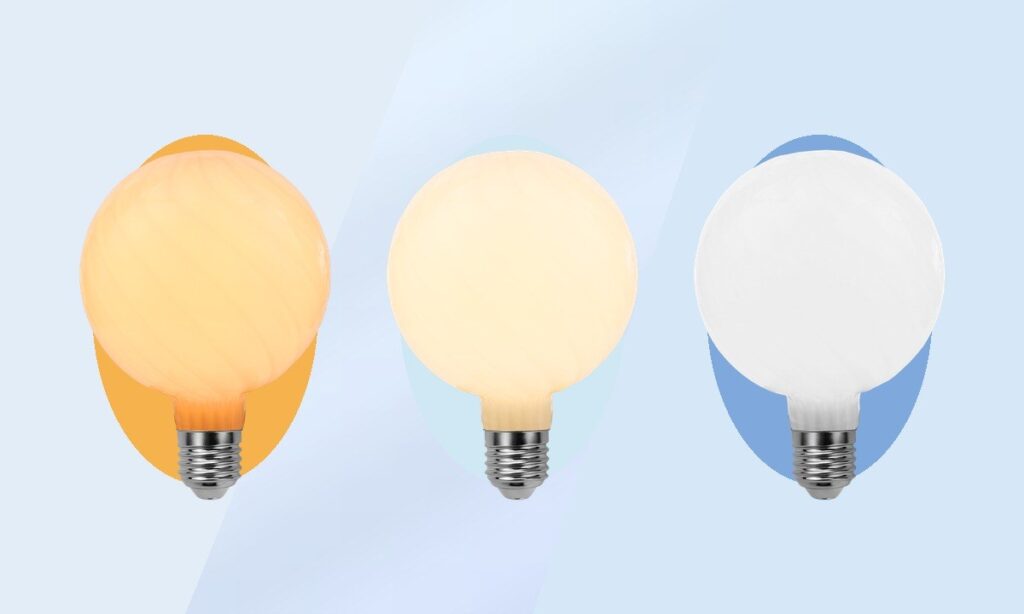
In retail and project language, daylight often describes a cooler white correlated color temperature. The U.S. Department of Energy defines CCT as a condensed description of white-light color appearance. It does not identify the complete spectrum, color rendering, direction or source of the light.
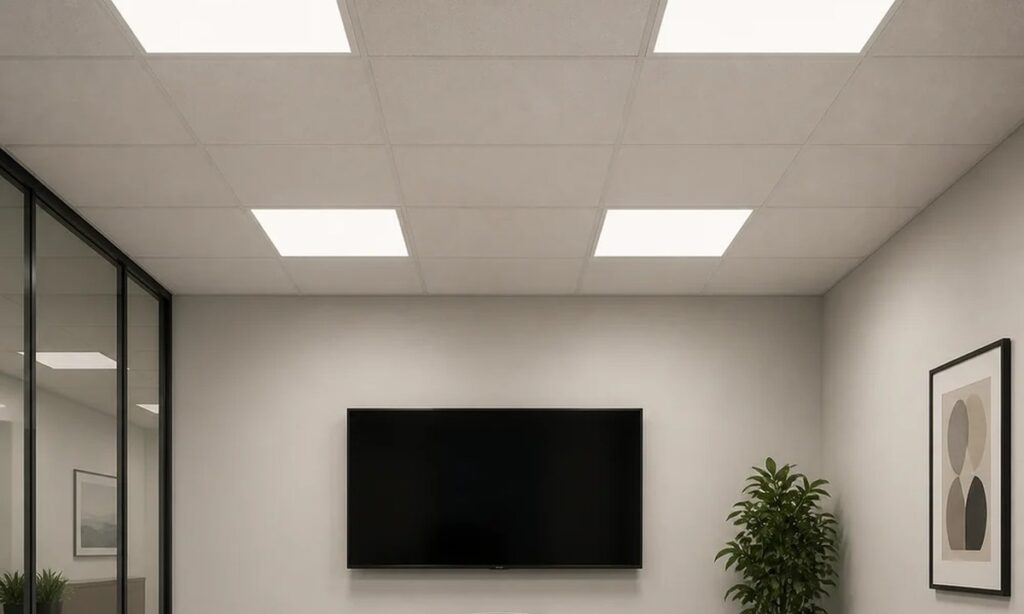
A fixed-CCT panel can be a conventional edge-lit or back-lit luminaire with no sensor and no automatic response. Its driver powers the LED array while the optical system spreads light across the luminous surface. An edge-lit design sends light through a guide plate; a back-lit design positions LEDs behind a diffuser with space for optical mixing.
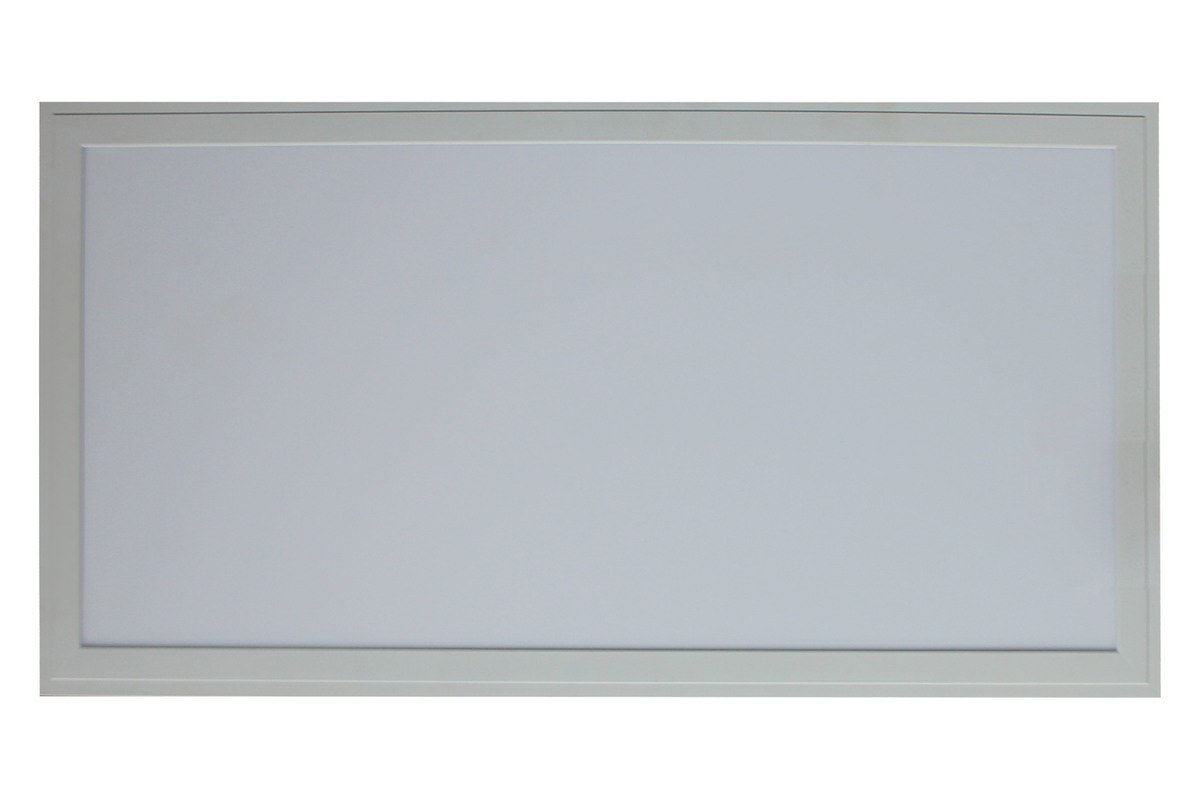
The visible face and frame do not reveal whether the quoted model is fixed-CCT, selectable or controllable. Sample approval should record that function together with the exact product code, driver and control interface.
For size, mounting, optics and driver selection, use the broader commercial LED panel selection guide. The panel versus downlight planning guide addresses layout intent rather than the meaning of the daylight label.
CCT Is Not a Complete Description of Daylight
Natural daylight changes with time, weather, orientation, glazing and surrounding surfaces. Its spectrum, intensity and direction all vary. A source carrying a daylight CCT label represents a color-appearance region; it does not automatically match those other properties.
Two LED sources with a similar CCT can render materials differently because their spectral power distributions differ. The DOE therefore treats CCT as useful but incomplete and discusses color fidelity separately. For a color-sensitive project, review chromaticity tolerance, CRI or other specified color-quality measures, and evaluate a representative sample under the real finishes.
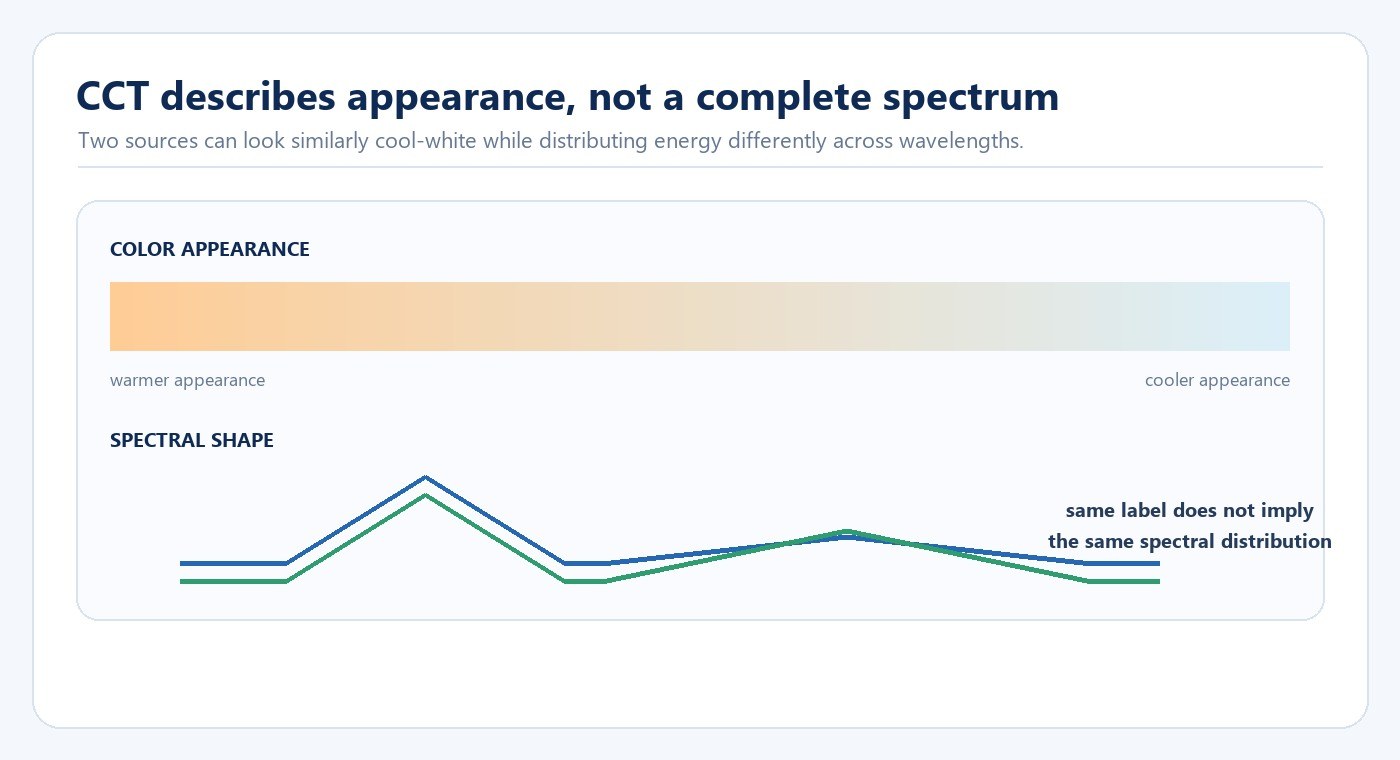
Do not treat the word daylight as evidence of sunlight equivalence, circadian performance or suitability for a color-critical task. Those conclusions need separately defined metrics and test conditions.
Selectable CCT and Tunable White Are Separate Functions
A CCT-selectable panel normally offers discrete settings chosen during installation. A tunable-white system can move between warm and cool white using multiple LED channels and a compatible controller. The DOE notes that the control architecture and mixing algorithm determine how intensity and color behave across the range.
Neither feature automatically responds to window daylight. A project can combine tunable white with daylight harvesting, but the specification must separate intensity control, color control, schedules, sensor response and user overrides. Otherwise two suppliers may quote systems with very different behavior under the same informal label.
| Light-color function | Available settings | Typical control boundary |
|---|---|---|
| Fixed CCT | One factory-defined white point | Intensity may be fixed or separately dimmable |
| CCT-selectable | Several discrete white points | Setting is commonly selected during installation |
| Tunable white | A continuous or programmed warm-to-cool range | Separate or coordinated intensity and color commands |
| Tunable white plus daylight harvesting | Color range plus automatic output response | Color logic, daylight response and overrides must be commissioned together |
Meaning 2: Daylight Harvesting Is a Control System
The U.S. Department of Energy and PNNL describe daylight-responsive lighting as a coordinated control system. Daylight harvesting uses available natural light as an input to reduce electric-light output when the controlled area already has sufficient light. The behavior belongs to the complete system: photosensor, control logic, controllable driver, zoning and commissioning.
A closed-loop sensor views the occupied area and responds to the combined result of daylight and electric lighting. An open-loop sensor views incoming daylight without directly measuring the controlled electric-light contribution. The choice affects placement, calibration and stability.
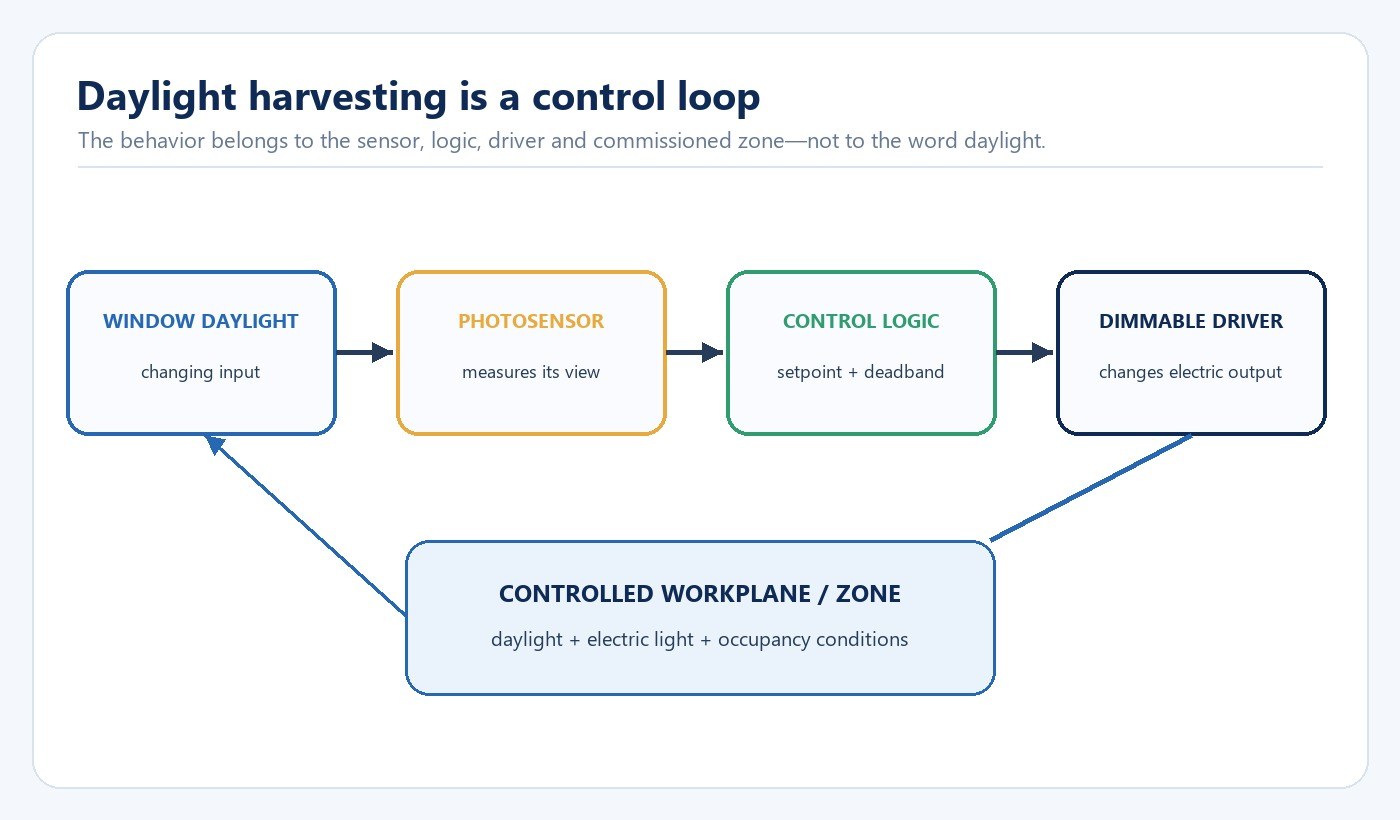
The controller can command the driver through 0–10 V, DALI, a digital network, wireless control or another supported interface. Protocol compatibility alone is insufficient: the minimum dimming level, fade behavior, failure state and control sequence must also match the project.
Commissioning Determines Whether the Loop Works
Commissioning establishes the high level, minimum level, setpoint, response speed and deadband. Deadband limits repeated brightening and dimming when clouds move or readings fluctuate near a threshold. Occupancy controls, schedules and manual overrides must be coordinated with the daylight response.
Sensor placement matters because a sensor can be dominated by the luminaire, window glare, a bright work surface or an unrelated zone. Furniture, blinds, finishes and later space changes can alter the relationship between the sensor reading and the task area. The design therefore needs a documented control zone and a practical recommissioning method.
| Symptom | Likely boundary to inspect | Useful evidence |
|---|---|---|
| Lights hunt on cloudy days | Response time, deadband or sensor view | Commissioning record and live trend observation |
| Window row dims but inner row does not | Zoning or sequence may be intentional or incorrect | Zone drawing and sequence of operations |
| Output never falls low enough | Driver minimum, controller limit or high-end trim | Driver curve and programmed limits |
| Area becomes too dark after furniture changes | Sensor-to-task relationship changed | Re-measurement at defined task points |
Meaning 3: Artificial Skylight Is an Optical Category
An artificial skylight aims to create a visual impression associated with a window, blue sky or directional sunlight. It may use a deep optical cavity, a luminous sky surface, directional optics, tunable color or programmed scenes. That goal is different from providing uniform general lighting with a flat panel.
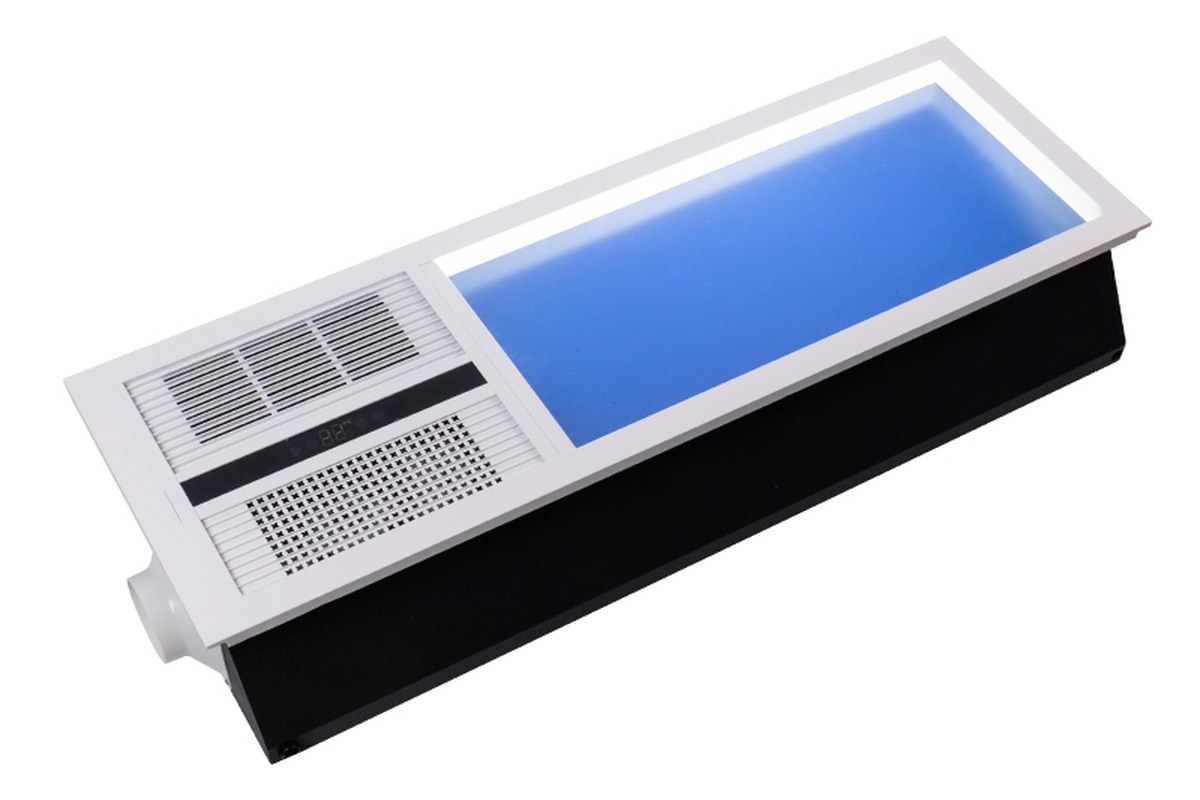
An artificial skylight may also use schedules, sensors or tunable controls, but those are added functions. Its optical effect does not prove daylight harvesting, and daylight harvesting does not create a realistic sky view. Review the artificial skylight project planning guide for viewing geometry, recess depth, room surfaces and mock-up decisions.
A Buyer’s Decision Sequence
Start with the result the room needs, not the product nickname.
- Define the outcome. Is the task cool-white appearance, automatic electric-light reduction, tunable color, or an architectural sky effect?
- Define controlled variables. State whether intensity, CCT, scene, occupancy and daylight response are fixed or adjustable.
- Identify included components. Separate luminaire, driver, sensor, controller, gateway, user interface and commissioning service.
- Request model-specific evidence. Match photometry, color, dimming and control documents to the quoted product code and revision.
- Build a representative mock-up. Test the actual finishes, window condition, sensor location and viewing positions.
- Freeze the approved configuration. Record product codes, settings, addresses, sensor location and change-control requirements.
The LED lighting sample evaluation checklist provides a repeatable way to record identity, configuration, test purpose and acceptance criteria. For manufacturing and configuration-control questions, review New Lights factory and manufacturing capabilities.
What to Put in the RFQ
For a fixed or selectable panel, request dimensions, mounting, input, power, lumens, efficacy, CCT settings, chromaticity tolerance, color rendering, UGR or luminance data where relevant, flicker, driver, dimming method and thermal limits.
For daylight harvesting, add sensor type, placement rules, zoning, topology, protocol, dimming range, setpoints, response time, deadband, fail state, override behavior and commissioning deliverables. Confirm which parts and services are included.
For an artificial skylight, request optical construction, dimensions, recess depth, directional effect, color range, control behavior, mounting, photometry and representative installed evidence. Do not compare it with a flat panel on lumens alone.
If the requirement is still ambiguous, contact New Lights with the room dimensions, ceiling, window orientation, desired visual effect, CCT behavior and control sequence.
Frequently Asked Questions
Does every daylight LED panel have a light sensor?
No. Daylight may describe only the white-light color. Daylight-responsive operation requires a photosensor, control logic and a compatible dimmable driver.
Is a daylight panel automatically tunable white?
No. It may have one fixed CCT or several selectable settings. Continuous tunable-white behavior must be specified for the exact model and controller.
Does daylight harvesting change color temperature?
Not necessarily. Its primary control variable is usually electric-light output. Color tuning is a separate function unless the sequence explicitly coordinates both.
Can a daylight LED panel reproduce sunlight?
A CCT label does not establish spectral, directional or visual equivalence to sunlight. Artificial-skylight products use a different optical architecture and still require model-specific evaluation.
Why do daylight-responsive lights keep changing on cloudy days?
The response time, deadband, setpoint or sensor view may be unsuitable. Review and recommission the complete control zone before replacing the panel.
Can the translated legacy URLs all redirect to this English article?
Not by default. The English, French, German and Spanish legacy URLs remain separate migration decisions until language-equivalent destinations and redirect scope are approved.
Editorial Sources
- U.S. Department of Energy, LED Basics
- U.S. Department of Energy, LED Color Characteristics
- U.S. Department of Energy, Understanding LED Color-Tunable Products
- U.S. Department of Energy and Pacific Northwest National Laboratory, Lighting Controls Guide