

A reliable low-temperature T8 LED installation starts with the actual conditions at the fixture and the exact electrical architecture. Record the lowest start temperature, normal operating range, temperature cycling, condensation, controls and emergency functions. Then verify the tube, ballast or driver, lampholders, enclosure and wiring as one system before installation.
Do not select from a room label such as “freezer” or “cold warehouse” alone. Two positions in the same facility can have different temperatures, moisture exposure and service access. This guide focuses on installation and cold-condition commissioning. If the unresolved question is enclosure or ingress protection, use the separate walk-in-freezer IP and low-temperature guide.
Define the Cold Condition at the Fixture
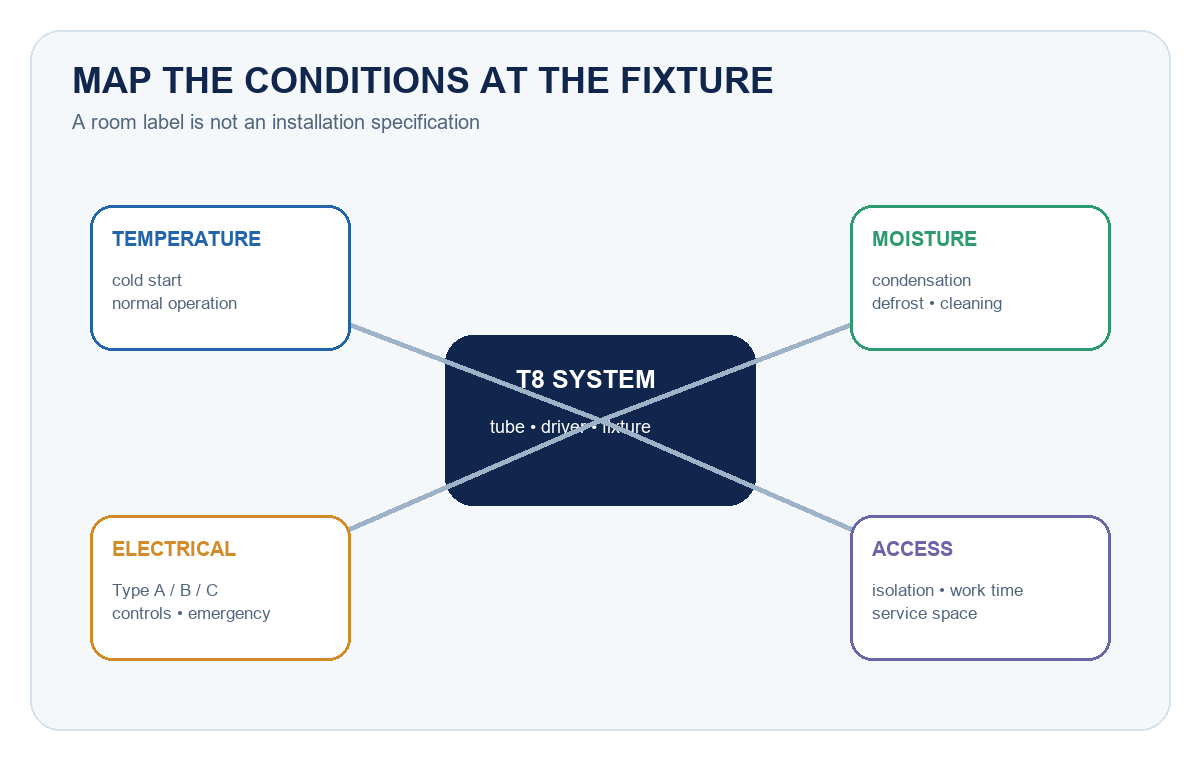
Begin with measurements and operating states, not a generic climate zone. Record the temperature where the tube operates and where the ballast, driver, sensor or emergency component is located. Include the lowest condition after shutdown, the normal loaded condition and transitions caused by doors, defrost, cleaning or seasonal changes.
A driver above a refrigerated case may be warmer than the tube. A fixture near a cold-room door may repeatedly meet warm humid air. An unheated warehouse may be dry but experience long off-periods followed by a very cold start. These differences change what evidence and testing the project needs.
| Site input | What to record | Why it changes installation |
|---|---|---|
| Cold start | Lowest temperature after the longest expected off-period | A component may operate when already warm but fail to start at the lowest condition |
| Normal operation | Typical and highest local temperature at each component | Confirms the full operating envelope, not only the cold extreme |
| Temperature cycling | Door openings, pull-down, defrost and seasonal transitions | Repeated transitions can introduce condensation and configuration faults |
| Moisture | Condensation, frost, dripping, splash, washdown and cleaning chemicals | Defines the enclosure, sealing, cable-entry and maintenance questions |
| Electrical system | Supply, ballast/driver, lampholders, wiring and controls | Determines the Type A, B or C path and compatible components |
| Access and safety | Work duration, isolation, inside release, ladders and service space | Controls the method, staffing and safe return to operation |
Check Starting and Operating Ratings Separately
The minimum operating temperature and minimum starting temperature answer different questions. A system that remains lit as a space cools may behave differently after a power interruption and a long cold soak. Request both values for every relevant component and confirm the conditions behind the rating.
For Type A, the existing fluorescent ballast remains in the operating path, so its exact model, age, starting method and temperature rating matter. For Type B, the tube’s internal electronics and the approved conversion determine the starting path. For Type C, the external driver and its location are part of the assessment. Sensors, relays, communication devices and emergency batteries may have separate limits.
DOE’s refrigerated-display-case specification used a defined application temperature range together with luminaire and driver requirements. The useful lesson is the specification method: low-temperature suitability belongs to an identified system and operating envelope, not to the word “LED.”
Choose the Retrofit Architecture Before the Product
UL Solutions distinguishes Type A, Type B and Type C retrofit paths and ties certified conversions to identified host luminaires, components, instructions and field labels. The architecture changes installation work, failure points and future maintenance.
| Retrofit path | Existing equipment retained | Installation decision | Low-temperature evidence to verify |
|---|---|---|---|
| Type A | Fluorescent ballast and host wiring | Confirm the exact lamp-ballast combination without modifying the luminaire | Ballast and lamp cold start, compatibility, dimming and enclosed-use conditions |
| Type B | Host luminaire and permitted lampholders; ballast bypassed | Follow the exact branch-circuit conversion, energized-end arrangement and field labels | Tube electronics, lampholders, connections, converted-luminaire scope and cold start |
| Type C | Host luminaire with an external LED driver | Install the approved lamp-driver system and preserve driver service access | Driver and lamp ratings, cable limits, controls, location and fault behavior |
| Type A+B | Depends on the selected approved mode | Document which mode is installed and how future service will identify it | Evidence for the actual mode, not only the product’s alternate capability |
The general LED tube installation guide explains how to identify the retrofit type before work begins. For product-family architecture, review the New Lights Type A T8 family, Type B ballast-bypass family and Type A+B hybrid family. Match any candidate to model-level instructions and project conditions.
Treat Condensation as a Transition Problem
Cold air itself is not the only environmental issue. Warm humid air entering during door openings, products moving between zones, defrost cycles and cleaning can place water on cold surfaces. Record when moisture forms and where it travels rather than describing the whole room as simply damp.
Inspect the lens or enclosure, gaskets, end seals, cable glands, conduit entries, lampholders and drainage or orientation details. Do not add sealant that blocks an intended thermal or drainage path. Replace damaged sealing parts with the approved components and preserve the installation orientation.
An IP code addresses defined ingress tests for the enclosure to which it applies. It does not establish starting temperature, chemical resistance, food-zone suitability or the performance of an unverified assembled retrofit. The IP ratings guide explains the code itself, while the freezer article applies it to specific exposure positions.
Plan the Work Before Entering the Cold Space
Prepare the product, instructions, tools, labels, replacement parts and test forms outside the cold zone where practical. Confirm the isolation boundary and prevent unauthorized re-energization. Limit unnecessary door-open time and coordinate with refrigeration and operations teams so the work does not create a temperature-control or food-handling problem.
OSHA’s warehousing guidance says listed or labeled equipment should be installed and used according to its listing or labeling instructions and treats electrical hazards and cold stress as separate concerns. The project plan should therefore cover both the conversion method and the people performing it.
Qualified personnel should complete wiring changes under the applicable site procedure and local requirements. Do not use an article as a generic line-voltage diagram. For Type B or Type C work, the exact energized contacts, lampholders, conductor routing, labels and component combination come from the approved instructions.
Keep Controls and Emergency Functions in Scope
Door switches, occupancy sensors, dimming controls and network devices need their own environmental and starting checks. Verify their location, sensing behavior, timeout, restart state and communication after the system has reached the representative cold condition. A lamp that starts correctly does not compensate for a sensor that fails to detect motion or a controller that returns to the wrong state.
Identify emergency circuits before conversion. Confirm the emergency driver or battery, charging, transfer behavior, required duration and functional test for the exact system. Cold can affect batteries differently from ordinary lighting electronics, so do not assume an LED tube replacement preserves an existing emergency function.
Commission After a Representative Cold Soak
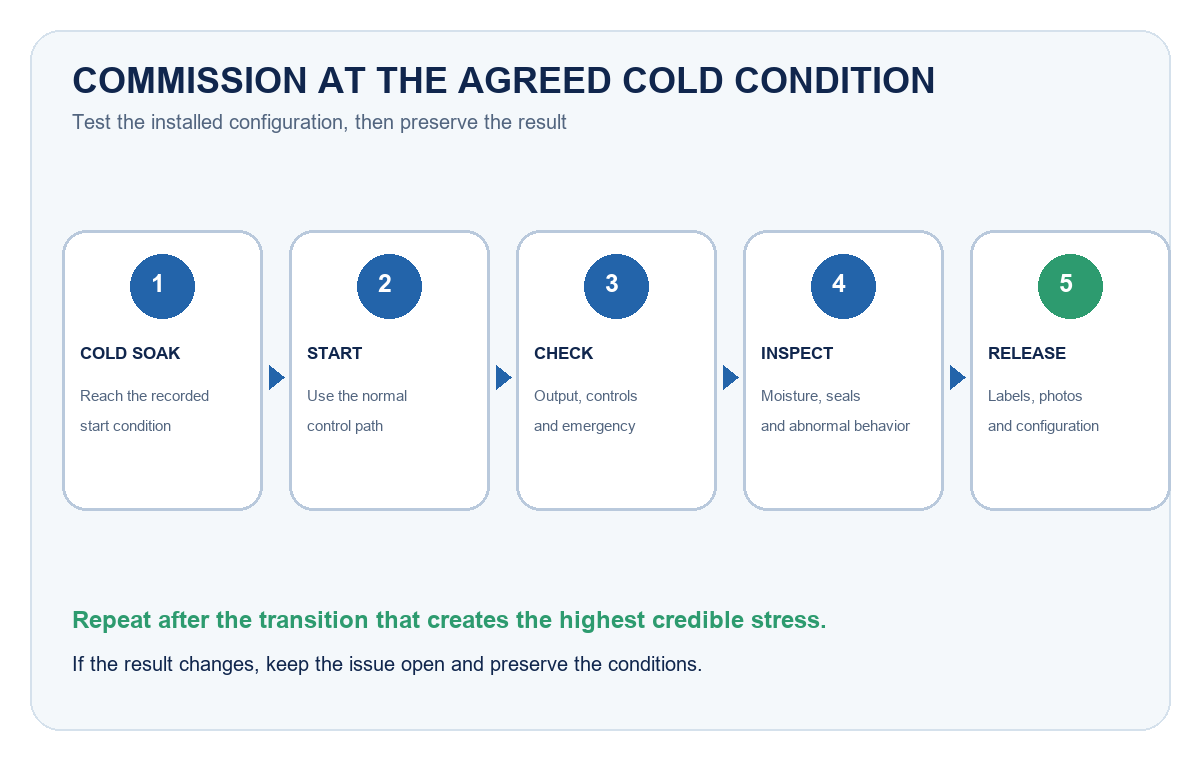
Room-temperature switch-on proves only a limited state. After installation, allow the space and relevant components to reach the agreed test condition. Then start the system from its normal control path and record the result by fixture or zone.
A useful acceptance sequence includes supply and configuration identification, cold start, stable operation, control response, visual uniformity, moisture inspection, restart behavior and final labeling. Repeat the observation after a representative door or defrost cycle when that transition creates the highest risk.
If several models or retrofit routes are being compared, use the LED lighting sample evaluation checklist to keep conditions and acceptance criteria consistent. The commercial LED tube retrofit guide then carries the accepted sample into a wider rollout.
Record the Configuration for Maintenance
The maintenance file should identify the host luminaire, tube, ballast or driver, lampholder arrangement, wiring mode, control settings, labels, enclosure parts and approved spares. Include photographs after installation and the conditions used for cold-start acceptance.
Type A systems retain ballast maintenance. Type B systems need durable conversion labels and a record that prevents later installation of an incompatible fluorescent or LED tube. Type C systems need the external driver location and lamp-driver pairing. Type A+B systems need the installed mode clearly identified.
Track delayed starts, cycling, condensation, driver or ballast faults and control failures by position and condition. If operating temperatures, cleaning chemistry, defrost cycles or controls change, reassess the system rather than assuming the original acceptance still applies. The lighting maintenance and spare-parts guide provides a broader record structure.
Frequently Asked Questions
Do LED tubes work better in cold temperatures?
Some LED systems are designed for low-temperature operation, but suitability depends on the complete lamp, ballast or driver, controls, enclosure and environment. Verify exact starting and operating ratings instead of assuming cold is always beneficial.
Can a Type A T8 use the existing ballast in a cold room?
Only when the exact lamp-ballast combination is approved for the site’s temperature and electrical conditions. Room-temperature compatibility does not establish reliable cold starting.
Should the ballast always be bypassed in a cold-room retrofit?
No. Choose Type A, Type B, Type C or Type A+B from the host luminaire, approved product system, installation scope and maintenance plan. Bypassing the ballast changes the wiring and certification boundary.
Is IP65 enough for every low-temperature installation?
No. Ingress protection must match the exposure and the object carrying the rating. Cold start, condensation, chemicals, controls, impact and application markings remain separate checks. The New Lights IP65 T8 family is a product-format reference, not a universal cold-room specification.
What should be tested after installation?
Record a start after representative cold soak, stable output, control and sensor response, restart state, emergency function where applicable, moisture or frost condition, labels and final configuration.
Prepare the Supplier Review Package
Send the actual minimum start temperature, normal operating range, moisture and cleaning conditions, host fixture labels, ballast or driver, lampholders, wiring mode, controls, emergency function and destination market. Ask for exact-model ratings, compatibility, instructions, labels and commissioning criteria.
When those inputs are ready, contact New Lights for a bounded product and sample review. A useful answer should identify the specific configuration and unresolved evidence rather than rely on a generic “cold-ready” description.
Editorial Sources
- UL Solutions, FAQ — UL Certified LED Retrofit Luminaire Conversion Kits: https://www.ul.com/thecodeauthority/knowledge/faq-ul-certified-led-retrofit-luminaire-conversion-kits
- UL Solutions, LED Retrofit Luminaire Conversion Kits — A Safer, More Sustainable Lighting Option: https://www.ul.com/sites/default/files/2024-10/AHLCS1359771_Retrofit_White_Paper_Digital_Final.pdf
- U.S. Department of Energy, REA Refrigerated Display Case LED Lighting Performance Specification: https://www.energy.gov/sites/prod/files/2014/04/f14/rea_refrig_display_spec.pdf
- Occupational Safety and Health Administration, Warehousing — Hazards and Solutions: https://www.osha.gov/warehousing/hazards-solutions