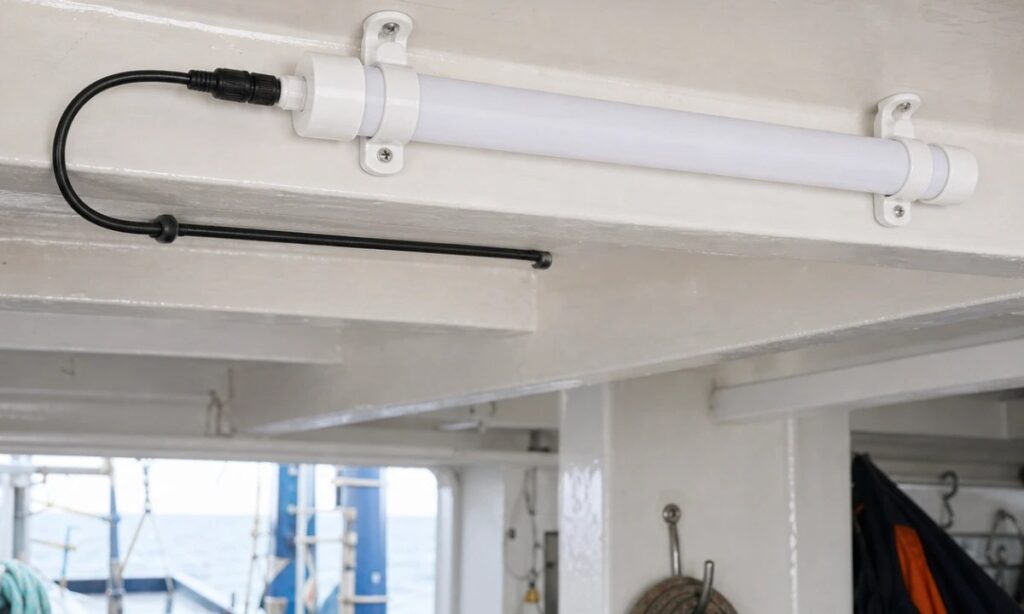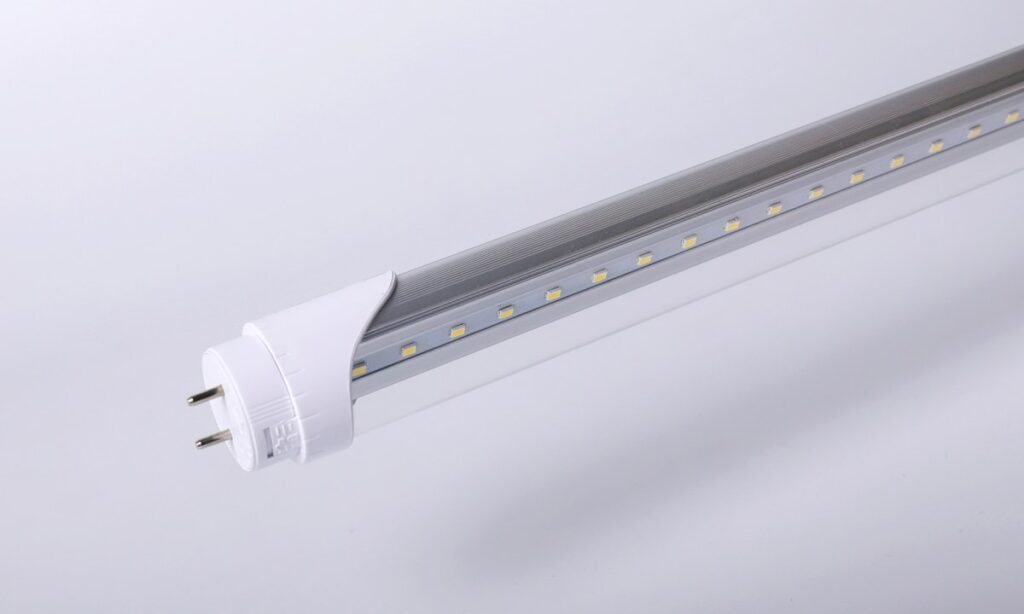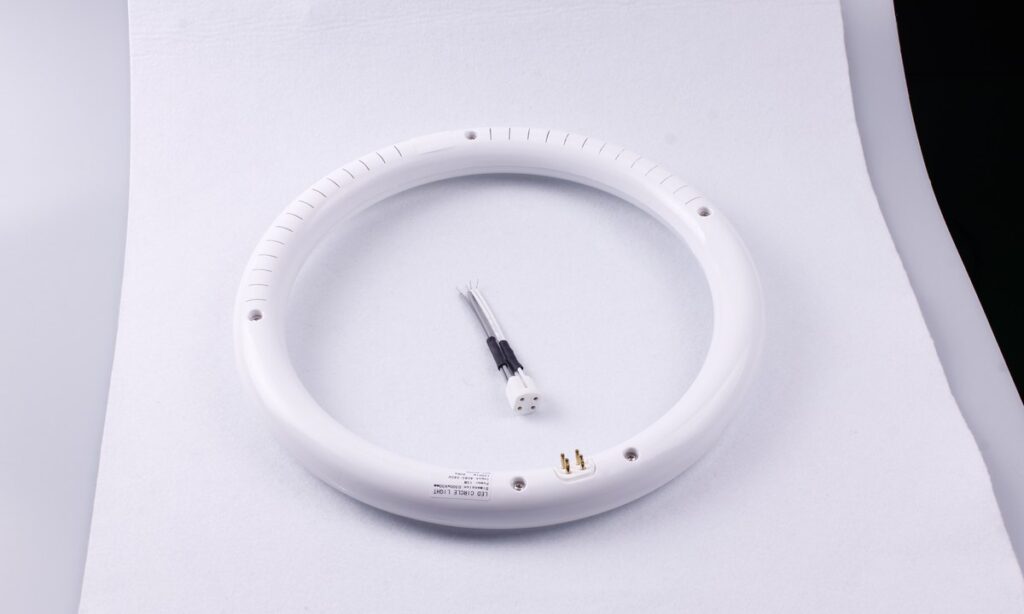


A T8 fresh-food LED tube can be installed in an existing fixture only after the tube length, G13 lampholders, supply, input arrangement, fixture condition and operating environment have been matched to the exact product instructions. The color option comes after those checks, not before them.
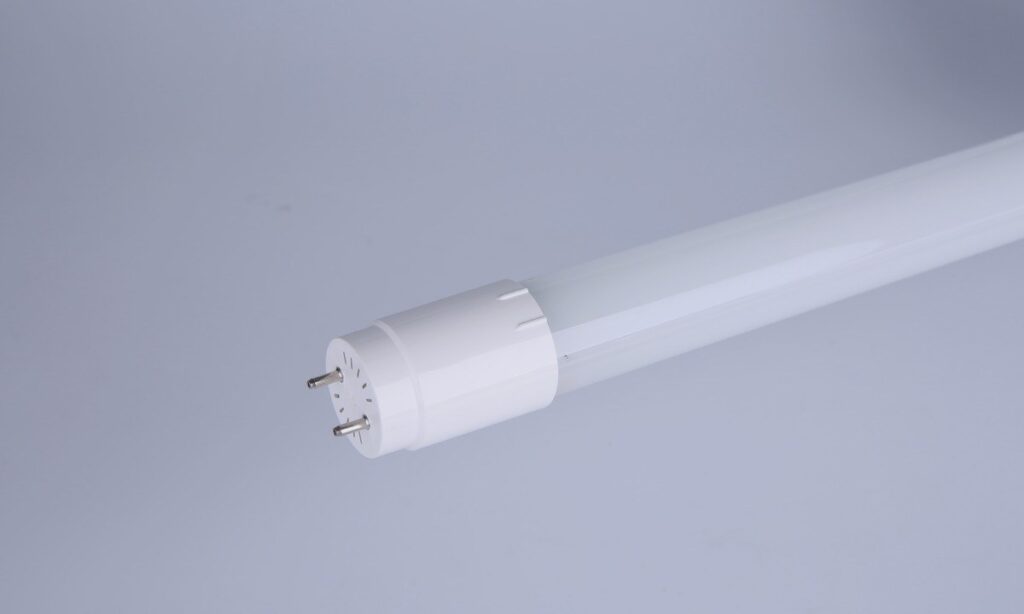
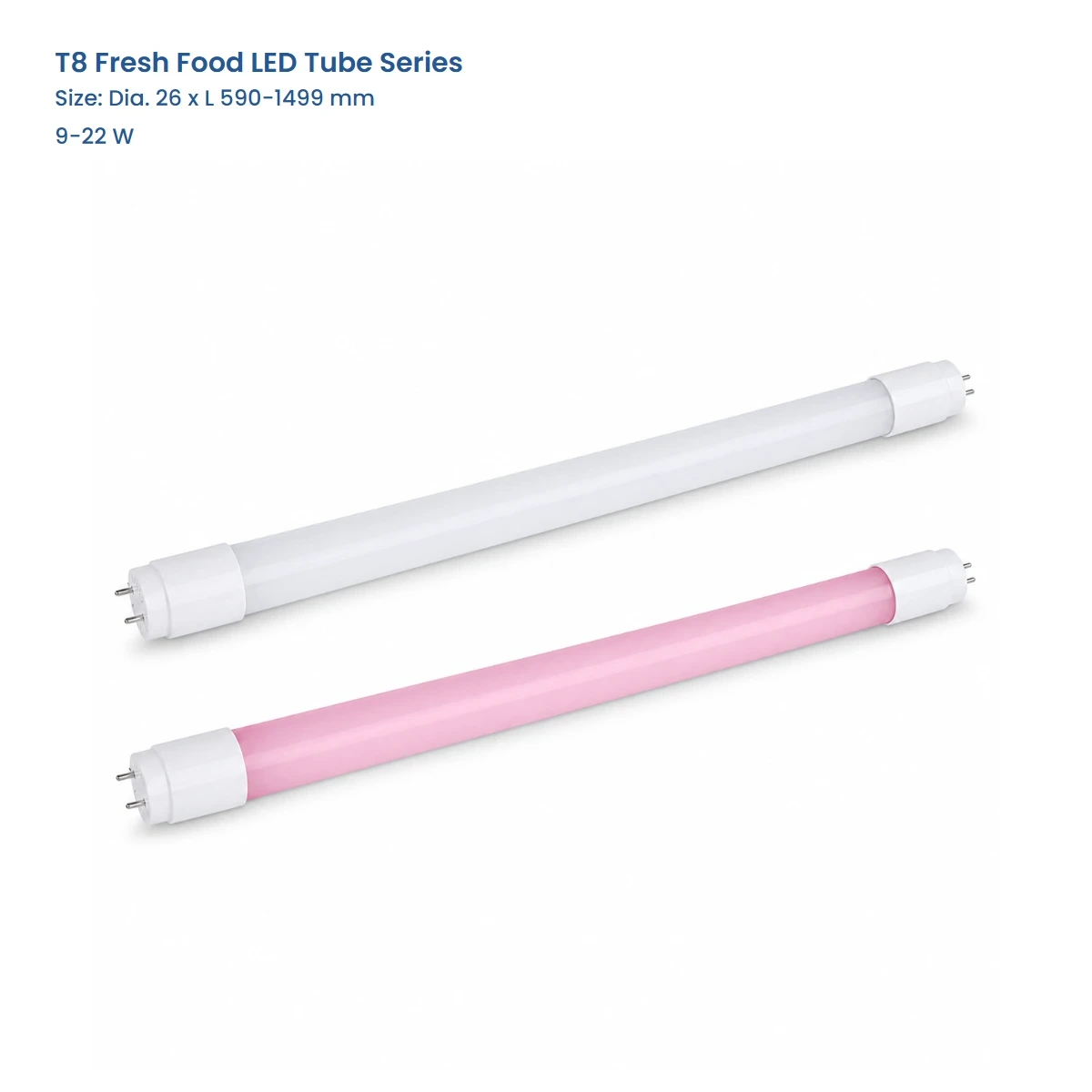
For a New Lights project, begin with the published T8 Fresh Food LED Tube series. It includes four G13 T8 sizes from 590 to 1499 mm and separate S and U input versions. Confirm the required length, input version, food category and optional low-temperature end-cap configuration before production. Do not infer the wiring arrangement from the G13 pins or model name.
This guide organizes the work from fixture survey through sample approval. The general LED tube installation guide covers broader Type A, Type B and Type C identification; this article stays focused on fresh-food display fixtures.
Define the Display Task Before Selecting the Tube
Fresh-food lighting changes the visual presentation of merchandise. Meat, seafood, produce and bakery displays can have different color priorities, packaging materials and ambient-light conditions. One spectrum should not be treated as a universal choice for every counter.
Record what the display must accomplish:
- merchandise category and representative products;
- packaged or exposed food;
- case type, shelf geometry and viewing direction;
- existing illuminance and uniformity;
- desired appearance of reds, greens, yellows, whites and packaging;
- surrounding ceiling, shelf and accent lighting;
- operating temperature, defrost cycle and moisture exposure;
- cleaning method and breakage-protection requirement;
- target market and applicable electrical and food-establishment rules.
Keep visual merchandising and food preservation as separate subjects. A spectrum can change color appearance, but freshness, shelf life and food safety depend on other controlled processes and evidence.
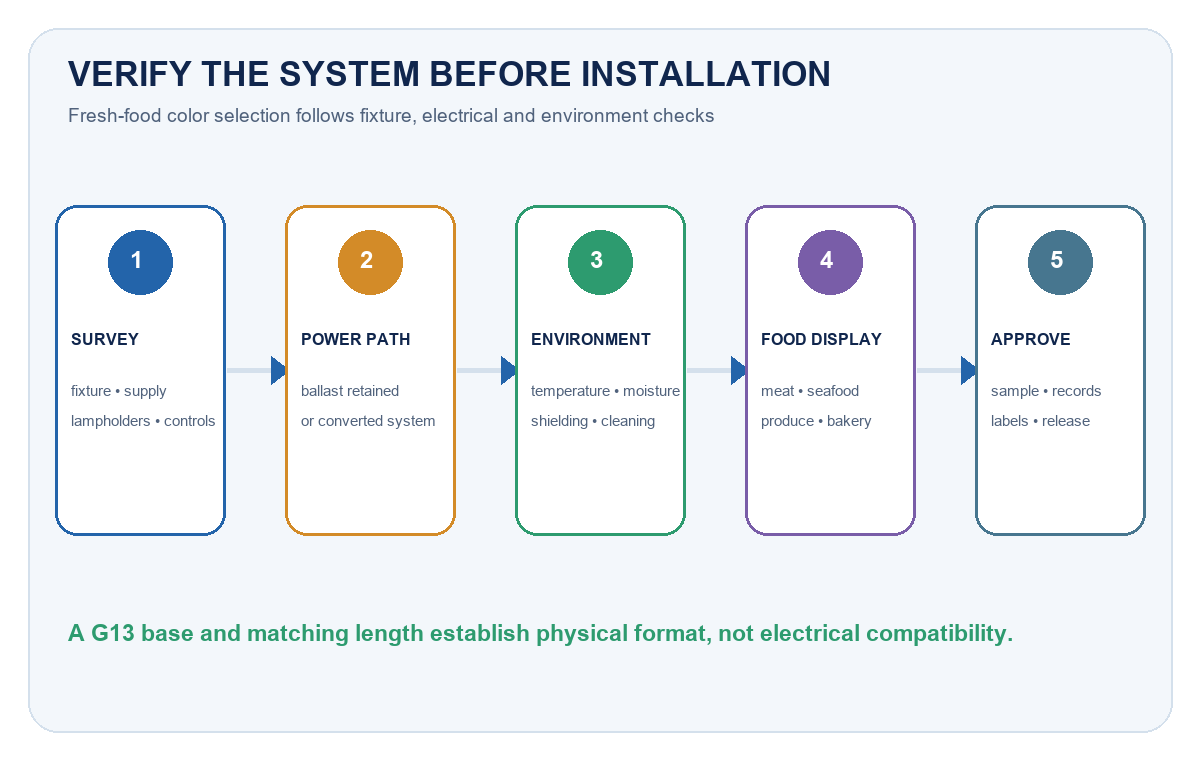
Survey the Existing Fixture as a Complete System
Photograph the fixture label, lamp markings, ballast or driver, lampholders, wiring diagram, lens or guard, cable entries and controls. Record the supply voltage and the number and length of lamps. If the light is part of a refrigerated case, also record the case manufacturer, model and any lighting-conversion instructions.
Physical fit is only one gate. A 26 mm T8 tube with G13 pins may enter the same lampholder as a fluorescent lamp while requiring a different power path. The fixture may be ballast-operated, already converted for direct input, or built around an external driver. The existing labels and wiring record determine which branch requires investigation.
Inspect condition before choosing a lamp. Brittle lampholders, heat discoloration, corrosion, cracked lenses, failed gaskets, loose conductors or damaged cable entries should be corrected within the approved fixture scope. A replacement tube cannot restore a deteriorated enclosure or make an unsuitable socket arrangement acceptable.
If controls or emergency equipment are present, include them in the survey. Dimming, sensors, door switches, relays and emergency drivers can change compatibility and commissioning requirements even when the tube itself fits.
Identify the Electrical Path and Exact Input Version
UL Solutions describes certified retrofit work around the identified host luminaire, kit components, installation instructions and field-applied labels. For an existing fluorescent-style fixture, the practical decision is whether the ballast remains, is bypassed under an approved conversion, or is replaced by an external LED driver.
| Existing-system path | What remains in the circuit | Evidence required before work | Maintenance consequence |
|---|---|---|---|
| Ballast-compatible lamp | Existing fluorescent ballast and host wiring | Exact lamp-ballast compatibility, supply, lamp quantity, controls and temperature range | The ballast remains a future failure and replacement item |
| Direct-input conversion | Approved lampholders and branch-circuit arrangement | Exact input end, socket requirements, conductor routing, conversion instructions and labels | Future relamping must follow the converted-fixture label |
| External-driver system | Matched LED driver and lamp system | Driver input/output, lamp pairing, cable limits, location, controls and temperature | The driver location and pairing become part of the service record |
| Unidentified or previously modified fixture | Unknown components or wiring | Trace the system, compare it with labels and obtain the correct instructions or field evaluation | Stop selection until the installed configuration is resolved |
The New Lights fresh-food series lists S input at AC 180–265 V with power factor above 0.5 and U input at AC 85–265 V with power factor above 0.9. These are product input options. They are not substitutes for the model-specific wiring diagram, lampholder arrangement or destination-market instructions. Select and document the actual version supplied to the project.
OSHA 1910.333 requires safety-related work practices for exposed electrical hazards and generally requires live parts to be deenergized before work, with lockout or tagging and verification of the deenergized condition. Qualified personnel should perform any fixture wiring or conversion under the applicable site procedure and local rules.
Match the New Lights Series to the Fixture Length
The accepted New Lights product page identifies four models in the same 26 mm G13 format. Use the fixture’s measured lamp length and construction record rather than choosing only by nominal fluorescent wattage.
| New Lights model | Tube size | Rated power | Selection checkpoint |
|---|---|---|---|
| XGYT8B102FF-E9 | 26 × 590 mm | 9 W | Confirm the 590 mm fixture length, S or U input and spectrum option |
| XGYT8B103FF-E12 | 26 × 895 mm | 12 W | Confirm the 895 mm fixture length, S or U input and spectrum option |
| XGYT8B104FF-E18 | 26 × 1199 mm | 18 W | Confirm the 1199 mm fixture length, S or U input and spectrum option |
| XGYT8B105FF-E22 | 26 × 1499 mm | 22 W | Confirm the 1499 mm fixture length, S or U input and spectrum option |
Do not use an “equivalent wattage” alone to approve the retrofit. The fixture geometry, diffuser, mounting position and distribution determine how light reaches the merchandise. Confirm the product’s measured output and the project’s target illuminance as separate inputs.
Buyers comparing adjacent specialty formats can also review the broader Specialty Tubes category, while retail planners can place the lamp decision within a wider commercial and retail lighting solution.
Check Food-Area Protection and Cleanability
Determine what is below and around the fixture during normal operation and maintenance. Exposed food, clean equipment, utensils and unpackaged single-use articles create a different breakage boundary from fully packaged merchandise behind a closed lens.
The FDA Food Code 2022 is a model code used by jurisdictions. Section 6-202.11 addresses light-bulb shielding, coating or other shatter resistance in specified areas, with stated exceptions. Confirm the code actually adopted for the facility and whether protection is provided by the lamp, a fixture lens or another approved guard.
Do not remove an existing diffuser simply to increase brightness. It may contribute to breakage protection, cleanability, glare control and distribution. Check that lenses and guards can be removed and refitted by the approved method, that seals are intact and that added components do not create ledges or gaps that collect residue.
Coordinate the installation with store operations. Protect or remove exposed food and clean equipment, contain debris, and restore the case to the facility’s cleaning and release procedure before merchandise returns.
Verify Refrigerated-Case and Moisture Conditions
Some fresh-food displays operate in refrigerated cases; others are open bakery or produce shelves at room temperature. Record the conditions at the tube, lampholders and driver or ballast rather than assigning one temperature to the whole display.
The New Lights product page offers an optional no-pin-hole end-cap configuration for low-temperature refrigerated displays. Confirm that option before production when it applies. It does not replace checks for cold starting, condensation, ingress, cleaning chemicals, fixture seals or the ratings of the other components.
Warm humid air, door openings, defrost cycles and cleaning can place moisture on cold surfaces. Inspect where condensation forms and where water can travel. The low-temperature T8 installation guide covers cold-start and transition testing, while the IP ratings guide explains why an enclosure code must be matched to the object and exposure it actually covers.
Approve Color With Samples, Not a Label Alone
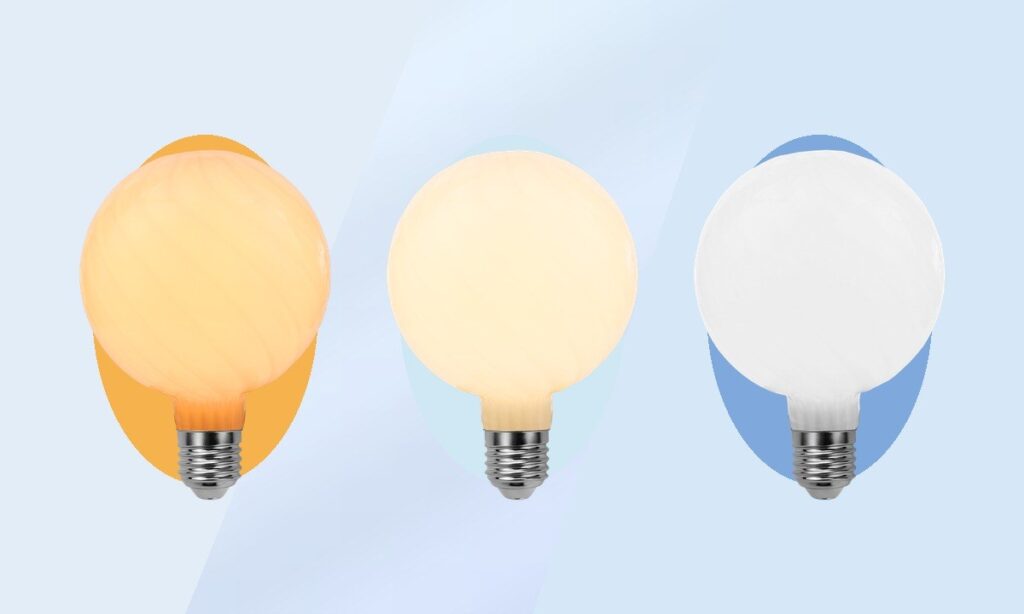
Color appearance is produced by the light spectrum interacting with merchandise, packaging, case materials and surrounding light. CCT describes the chromatic appearance of nominally white light, but it does not show how specific reds, greens or yellows will be rendered.
The U.S. Department of Energy’s TM-30 guidance describes a set of measures and graphics for communicating color rendition, including fidelity, gamut and hue information. Request the available spectrum and color data for the exact option, then validate it with the real food categories and packaging used by the store.
Use the same case, lens, mounting position, control setting and ambient lighting for every candidate. Include a reference condition. Review product faces from the shopper’s viewing direction and check packaging, labels, whites and adjacent merchandise as well as the target food color.
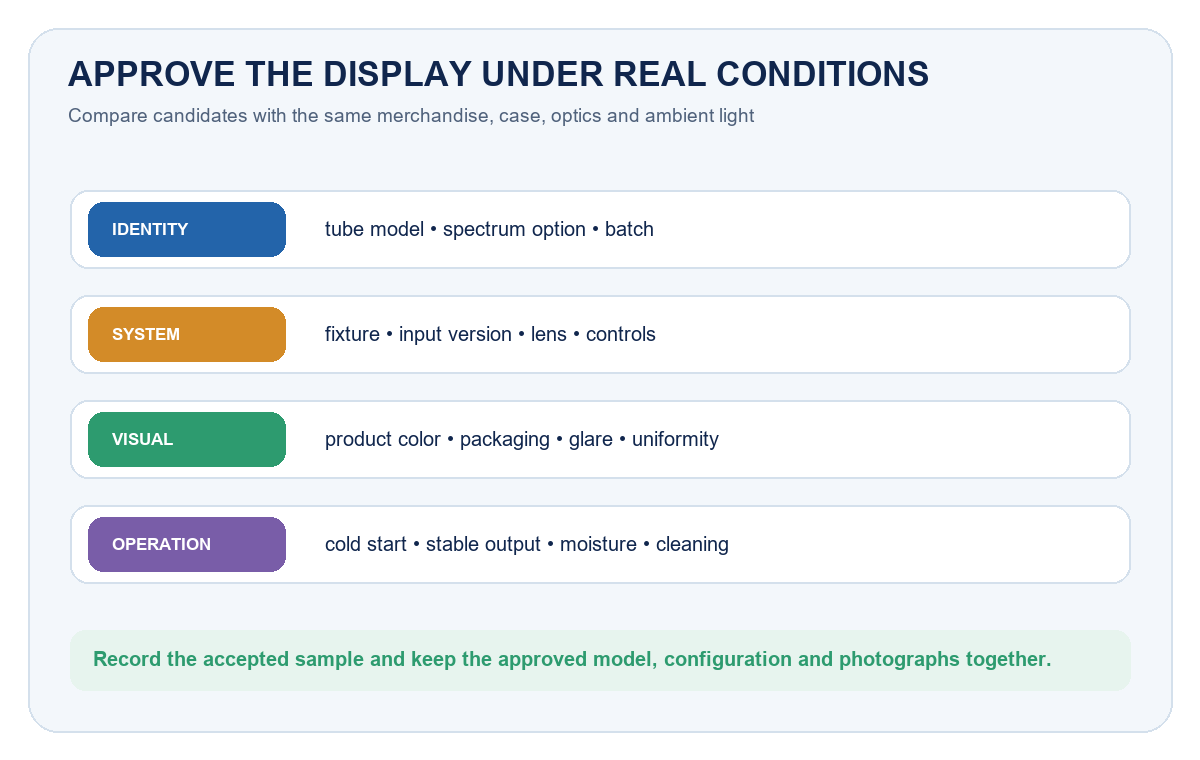
The LED lighting sample evaluation checklist provides a repeatable way to compare candidates. Record photographs with controlled exposure settings where possible; automatic camera processing can otherwise exaggerate or hide color differences.
Plan the Installation and Commissioning Record
Before work, assemble the approved tube model and version, manufacturer instructions, fixture survey, conversion kit where required, field labels, replacement lenses or seals, test equipment and cleaning materials. Define who can isolate the circuit, perform wiring, inspect the work and release the display.
A practical sequence is:
- confirm the fixture, lamp length, input version and spectrum on the work order;
- isolate the circuit and verify the deenergized condition under the site procedure;
- protect merchandise, food-contact items and the work area;
- inspect and correct approved fixture components before installing the tube;
- follow the exact wiring or conversion instructions and apply required labels;
- refit the lens, guard, seals and other protective components;
- clean and release the area under the facility procedure;
- test start-up, controls, stable operation, distribution and color appearance;
- repeat cold or moisture-transition checks where they form part of the use condition;
- file the installed model, photographs, instructions, labels and accepted sample record.
Commission the completed row or case, not just one lamp on a bench. Check dark positions, color inconsistency, visible flicker, noise, reflections in glass, glare from exposed tubes and uneven light on front and rear product faces. If the sample and installed result differ, investigate model, spectrum option, batch, lens, orientation, control level and ambient light before accepting the work.
For a multi-store rollout, the commercial LED tube retrofit guide helps carry the accepted configuration into a repeatable scope, and the lighting maintenance and spare-parts guide helps preserve replacement control after handover.
Frequently Asked Questions
Can a T8 fresh-food LED tube replace any fluorescent T8?
No. Match the length, G13 lampholders, electrical input, host fixture, protection and environmental conditions to the exact product and installation instructions. The same tube shape does not establish electrical compatibility.
Which New Lights fresh-food T8 length should I choose?
Measure the existing lamp and fixture and compare it with the published 590, 895, 1199 and 1499 mm options. Then confirm the corresponding 9, 12, 18 or 22 W model, S or U input version and spectrum option.
Does the fresh-food spectrum make food stay fresh longer?
Fresh-food lighting is selected for visual presentation. Do not treat it as a preservation or food-safety process unless a separate, relevant system has been validated for that purpose.
Is the no-pin-hole end cap enough for a refrigerated display?
No single end-cap feature covers the whole application. Confirm cold start, condensation, ingress, fixture seals, cleaning exposure, lampholders, controls and the exact low-temperature configuration.
What information should be sent for a compatibility review?
Send the fixture and case nameplates, existing lamp and ballast or driver, supply voltage, wiring and lampholder photographs, lamp length, food category, temperature and moisture conditions, cleaning method, target market and required spectrum or sample objective.
Prepare the Project Review
When the survey is complete, contact New Lights with the fixture evidence, required length, S or U input version, merchandise category, operating environment and destination market. The review can then focus on the exact tube configuration, sample plan and documents needed for the project.
Editorial Sources
- New Lights, T8 Fresh Food LED Tubes: https://new-lights.com/products/led-tube-lights/specialty-led-tubes/t8-fresh-food-lighting-led-tube/
- UL Solutions, FAQ — UL Certified LED Retrofit Luminaire Conversion Kits: https://www.ul.com/thecodeauthority/knowledge/faq-ul-certified-led-retrofit-luminaire-conversion-kits
- U.S. Food and Drug Administration, Food Code 2022: https://www.fda.gov/food/fda-food-code/food-code-2022
- U.S. Food and Drug Administration, 2022 Food Code — Print Version: https://www.fda.gov/media/184685/download
- Occupational Safety and Health Administration, 1910.333 — Selection and Use of Work Practices: https://www.osha.gov/laws-regs/regulations/standardnumber/1910/1910.333
- U.S. Department of Energy, TM-30 Frequently Asked Questions: https://www.energy.gov/cmei/ssl/tm-30-frequently-asked-questions