

Type A, Type B and Type A+B describe how a tubular LED lamp is intended to receive power. They are not grades of brightness, efficiency or quality. Type A operates through a compatible fluorescent ballast. Type B uses an internal driver after the luminaire is configured for direct branch-circuit input. Type A+B is a dual-mode product, but each permitted operating mode still has its own conditions and instructions.
Reading the type marking is therefore only the first step. The project team must match the exact lamp identity to its installation instructions, ballast list where applicable, input configuration, luminaire-conversion markings and local approval requirements. Tube length and a G5 cap can confirm physical format; they do not identify the electrical route.
What the Three Type Labels Tell You
UL Solutions describes Type A as a direct replacement lamp that operates from the host luminaire’s integral ballast without modifying the luminaire. Type B is intended to operate from branch-circuit power through fluorescent-style lampholders in a purpose-built or converted luminaire. A dual-mode Type A/B lamp can operate in both arrangements only when it carries the applicable certification and is installed under the instructions for the selected mode.
The U.S. Department of Energy uses the same architecture distinction in its tubular LED guidance. That distinction is useful because it tells a buyer where to look next: the ballast evidence for Type A, the conversion and input evidence for Type B, or both sets for Type A+B.
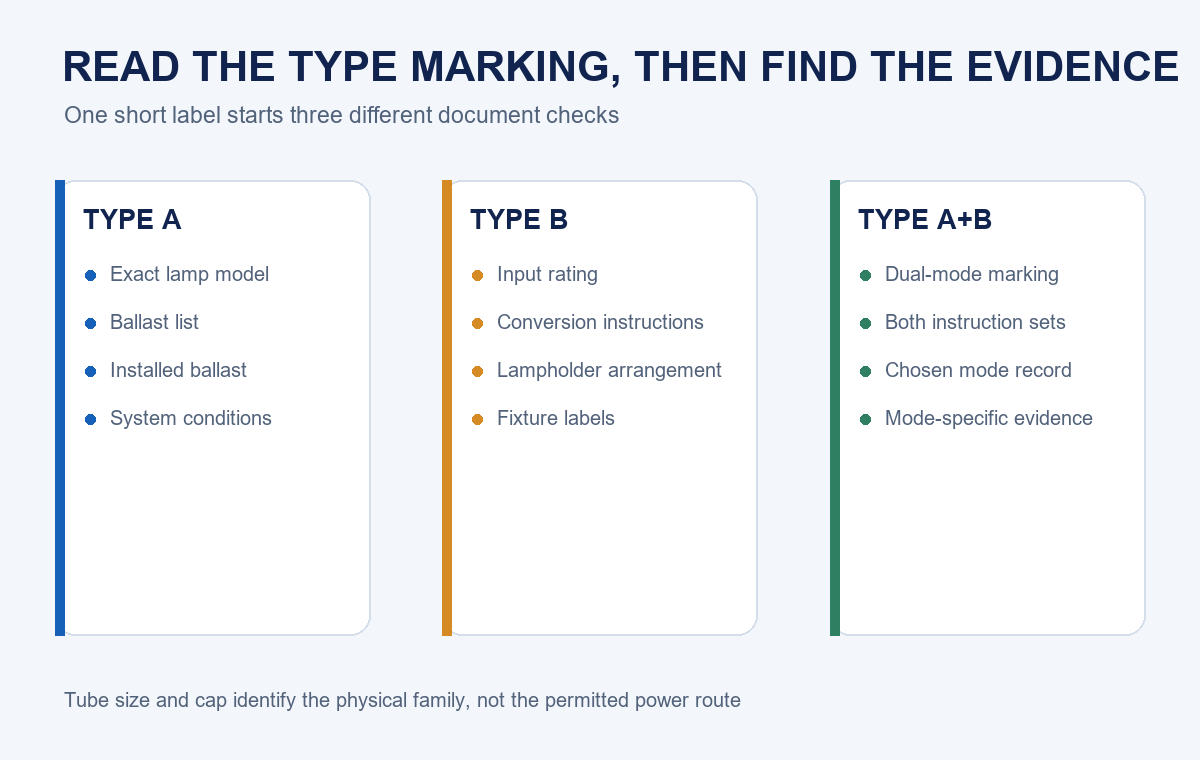
| Marking | Intended power route | First evidence to locate | Question the marking does not answer |
|---|---|---|---|
| Type A | Through a compatible fluorescent ballast | Exact lamp model and current ballast compatibility list | Whether the installed ballast is listed and operating correctly |
| Type B | Branch circuit to an internal lamp driver after the permitted conversion | Installation instructions, input rating and conversion labels | Whether the existing lampholders and wiring arrangement suit that conversion |
| Type A+B | Either approved Type A operation or approved Type B conversion | Dual-mode certification, instructions for both modes and the relevant mode-specific evidence | Whether both modes are permitted for the exact product and fixture |
Type A: Find the Ballast Evidence
A Type A marking means the ballast remains part of the operating system. Do not stop at a general statement such as “ballast compatible.” Record the lamp model exactly as printed, then find the manufacturer’s current compatibility document and match the installed ballast by manufacturer and model number. Also note the ballast type, supply voltage, lamp count and any control or emergency function connected to the fixture.
A listed combination can still be a poor project choice if the installed ballast population is inconsistent, near the end of its service plan or difficult to replace. The label identifies the operating route; the site survey determines whether retaining that route is practical. Buyers comparing a ballast-retained project with a converted project can use the separate T5 Type A versus Type B decision guide after the label check is complete.
For a ballast-compatible New Lights starting point, review the Electronic-Ballast-Compatible T5/T6 LED Tubes page, then request the documentation for the exact proposed model and installed ballast combination.
Type B: Read the Input and Conversion Markings
A Type B marking moves the ballast out of the operating circuit. The lamp’s internal driver receives branch-circuit power through the converted luminaire arrangement defined by its instructions. This is electrical conversion work, not simply another lamp exchange.
Read the lamp input rating, the permitted connection arrangement and every instruction supplied with the conversion kit. The converted luminaire may require durable relamping and warning labels so future maintenance staff know that the fixture no longer follows the original fluorescent circuit. Lampholder condition, whether the holders are shunted or non-shunted, and whether power is supplied at one or both ends must be resolved from the exact instructions rather than from the word “Type B” alone.
UL Solutions notes that relevant Type B and Type A/B conversion products are investigated under the luminaire retrofit requirements that apply to their certification. Installation must follow the certified product instructions and applicable electrical rules. For project sequencing and field controls, continue with the guide to installing LED tube lights safely.
Type A+B: Verify Each Mode Separately
Type A+B can simplify stocking or provide a future conversion path, but “dual mode” does not make the lamp universally compatible. Treat it as two documented use cases attached to one product identity.
For Type A operation, verify the exact ballast combination. For Type B operation, verify the permitted conversion, input configuration, lampholders, labels and installer requirements. Confirm that the product carries the certification or listing needed for both intended uses in the destination market. If a facility plans to start on ballasts and bypass them later, record which fixtures have moved to the second mode; otherwise the same lamp model may exist in electrically different luminaires across the site.
| Record field | Type A operation | Type B operation | Why it belongs in the asset record |
|---|---|---|---|
| Lamp manufacturer and exact model | Required | Required | Prevents visually similar lamps from being substituted |
| Ballast manufacturer and model | Required | Removed from operating path | Preserves the compatibility basis |
| Input voltage and frequency | Record system conditions | Match lamp and instructions | Confirms the intended electrical input |
| Lampholder and connection arrangement | Inspect condition | Match conversion instructions | Controls safe replacement and servicing |
| Fixture conversion label | Normally not applicable | Required where specified | Tells maintenance staff how the fixture now operates |
| Controls and emergency equipment | Verify combination | Verify converted system | These functions can change product suitability |
| Installation date and mode | Record Type A | Record Type B | Prevents mixed-mode maintenance errors |
T5 and G5 Do Not Define the Power Path
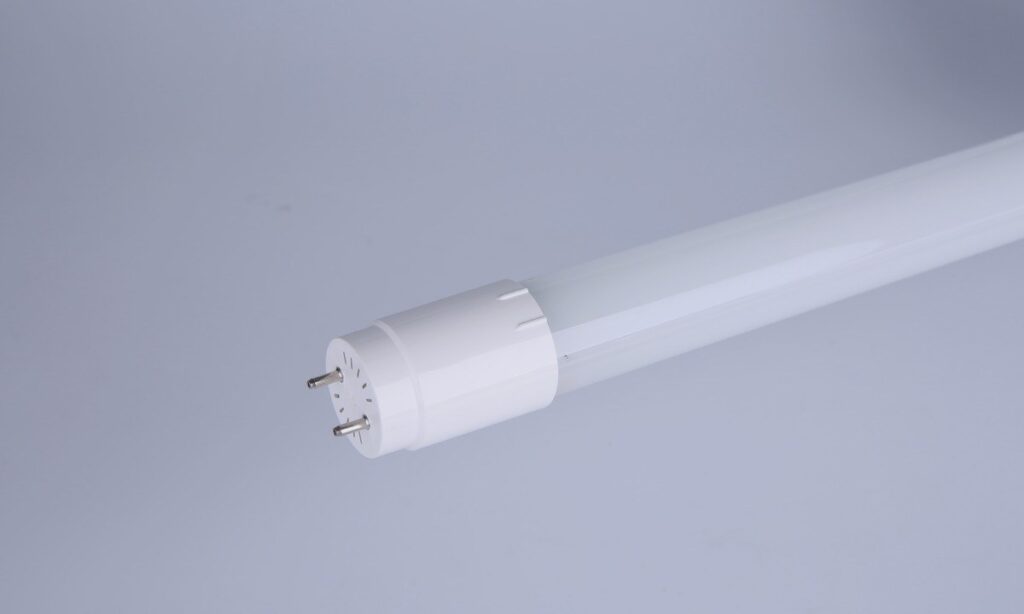
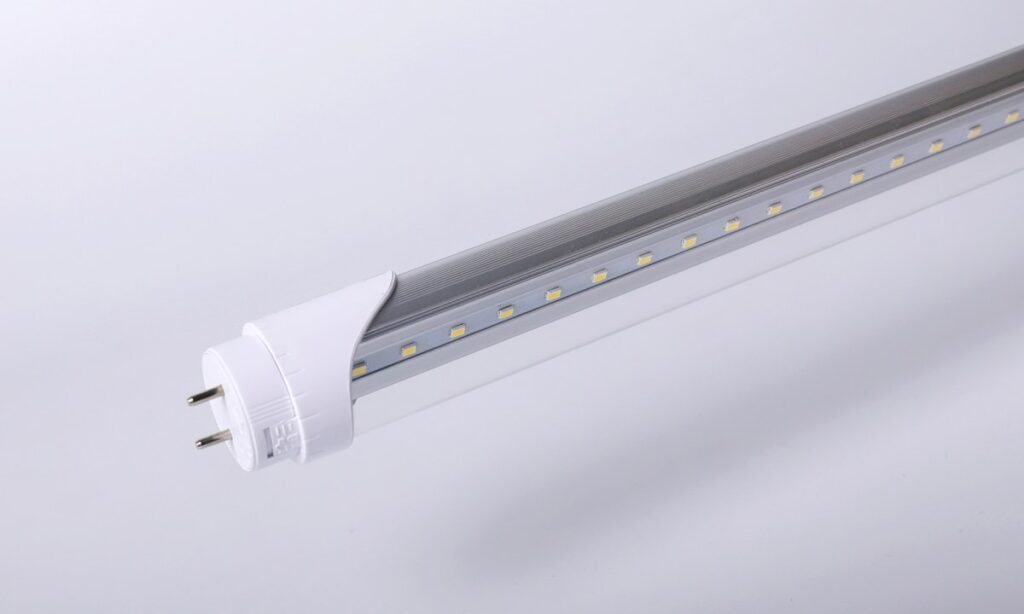
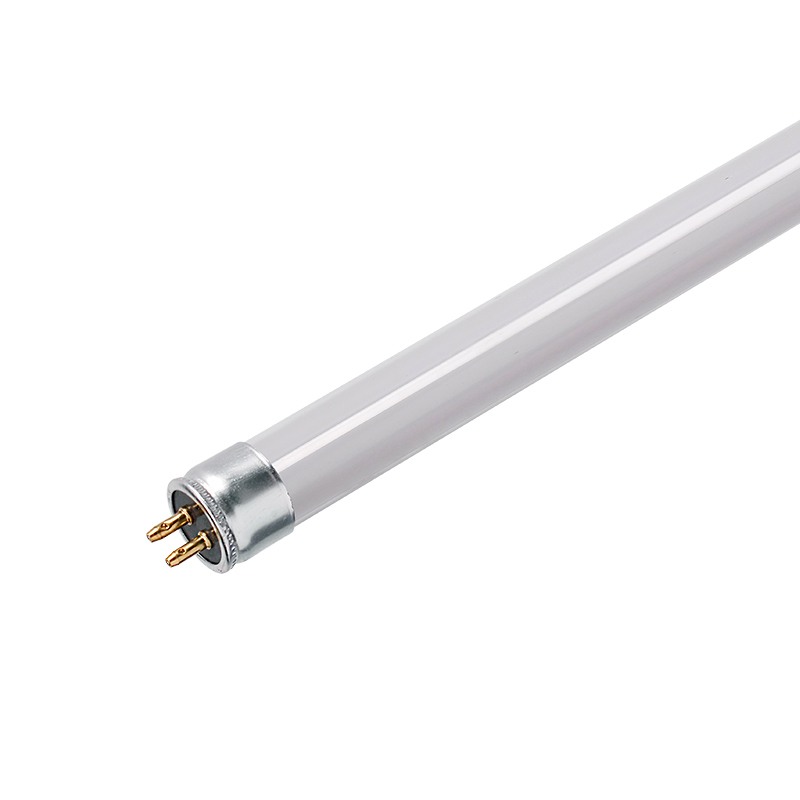
T5 refers to a tubular lamp diameter convention, and the commonly associated G5 cap has two pins. IEC 62776 includes double-capped LED retrofit lamps with G5 and G13 caps within its published scope. These identifiers help organize physical lamp families, but the same form factor can be used by products with different power architectures.
Before procurement, compare overall length, cap, pin spacing, fixture clearances and optical orientation. Then perform the separate electrical and documentation checks. The New Lights T5 and T6 LED tube family is the appropriate product-family destination when the mechanical format is known and an exact configuration still needs to be selected.
A Label-Reading Sequence for an Existing Fixture
Start with the installed equipment, not a supplier shorthand. Photograph the existing lamp, ballast label, fixture label, lampholders and any emergency or control components. Transcribe model numbers rather than relying only on photographs; a missing character can change a compatibility result.
Next, open the proposed lamp’s current datasheet and installation instructions. Match every mode-specific requirement and record unresolved fields as questions. A representative sample should then be evaluated in the actual system before a broad purchase. The LED lighting sample evaluation checklist provides a repeatable record for fit, function, electrical behavior, documents and packaging.
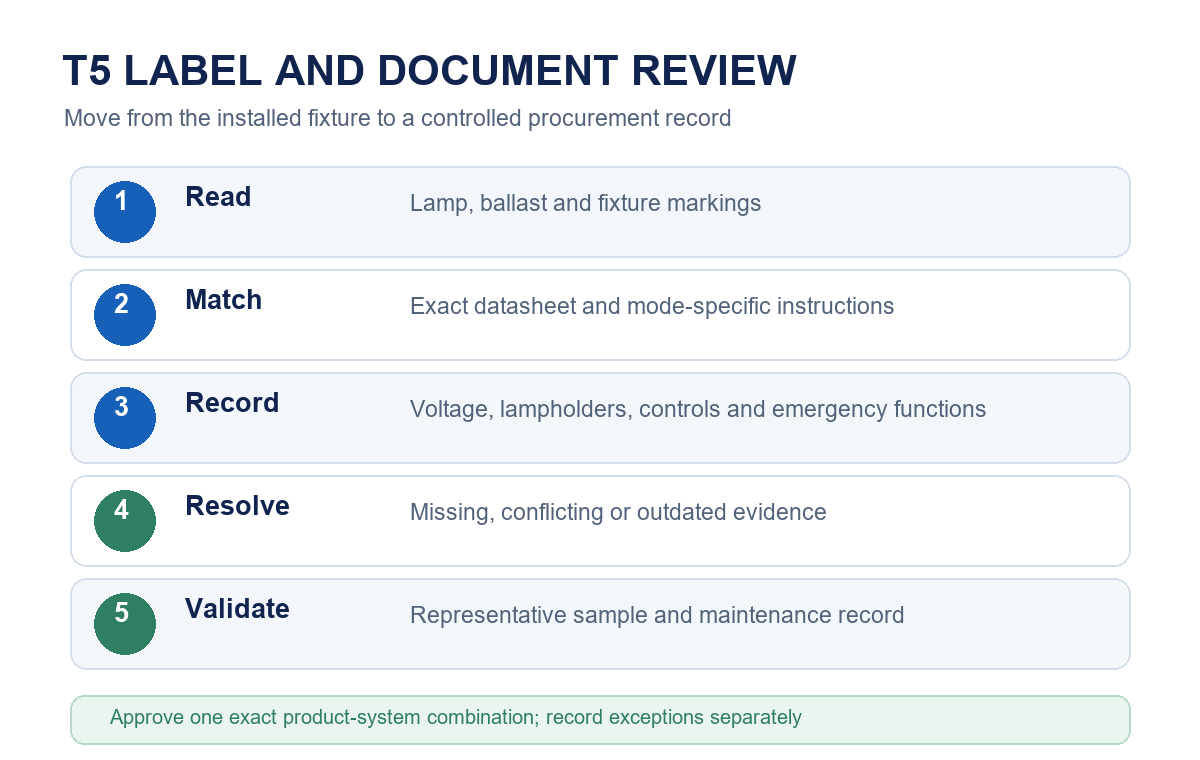
- Record the installed lamp, ballast, fixture, voltage, lampholders, controls and emergency functions.
- Transcribe the exact proposed LED lamp model and every electrical marking.
- Match the selected Type A, Type B or Type A+B mode to its current instructions and certification evidence.
- Resolve missing or conflicting information before ordering or conversion work.
- Validate a representative fixture and retain the approved record for maintenance.
Documents to Request Before Procurement
The procurement file should contain the product datasheet, installation instructions, current ballast list for Type A operation, applicable certification evidence, warranty terms and any conversion or relamping labels. Ask the supplier to identify documents by exact model and revision date. A family brochure can introduce options, but it should not replace mode-specific instructions.
For a multi-site or mixed-fixture project, create a matrix that maps each fixture group to one approved lamp model and operating mode. Separate exceptions instead of forcing them into the dominant solution. Where lamp-only retrofit is not the right route, the fluorescent lighting replacement solution page provides a broader planning path for luminaires, controls and project coordination.
Common Label-Reading Errors
- Treating Type A+B as universal ballast compatibility.
- Assuming every Type B lamp uses the same powered-end arrangement.
- Using T5, G5 or tube length as evidence of electrical compatibility.
- Accepting a compatibility claim without matching exact lamp and ballast model numbers.
- Ignoring emergency drivers, dimming controls, sensors or unusual fixture wiring.
- Removing the ballast without retaining the required converted-fixture labels and records.
- Mixing Type A and Type B versions in inventory without a fixture-level service record.
Frequently Asked Questions
Is Type A+B always better than a single-mode lamp?
No. Dual-mode capability is useful only when both documented modes fit the facility’s installation and maintenance plan. A single-mode product can be easier to govern when the site standard is already fixed.
Can I identify a Type B tube by looking at the pins?
Not reliably. The G5 cap identifies the physical interface, while the lamp marking and installation instructions define the permitted power arrangement.
Does Type A mean any electronic ballast will work?
No. Match the exact lamp model to the manufacturer’s current ballast compatibility evidence and confirm the installed operating conditions.
Can a Type A+B lamp be installed on a ballast now and converted later?
Only when the exact product supports both uses and each installation follows its applicable instructions and certification conditions. Record the operating mode at fixture level after conversion.
What should I send a supplier for a compatibility review?
Send clear fixture and label photographs, transcribed lamp and ballast model numbers, supply voltage, lamp count, lampholder details, controls, emergency functions, installation environment and planned quantity. Contact New Lights with that evidence for a scoped review.
Choose the Next Step
If the immediate task is interpreting an existing marking, complete the document matrix first. If the architecture still needs to be chosen, use the Type A versus Type B comparison after the installed system is known. If the product family is already fixed, move to exact model documentation and sample validation. This sequence keeps a short type label from being mistaken for a complete compatibility decision.
Editorial Sources
- UL Solutions, “Frequently Asked Questions: UL Certified LED Retrofit Luminaire Conversion Kits”: https://www.ul.com/thecodeauthority/knowledge/faq-ul-certified-led-retrofit-luminaire-conversion-kits
- U.S. Department of Energy, Federal Energy Management Program, “LED Troffer Retrofit Lighting and Controls Guidance”: https://www.energy.gov/sites/default/files/2017/03/f34/led_troffer_retrofit_guide.pdf
- International Electrotechnical Commission, IEC 62776 published scope: https://webstore.iec.ch/en/publication/7425