

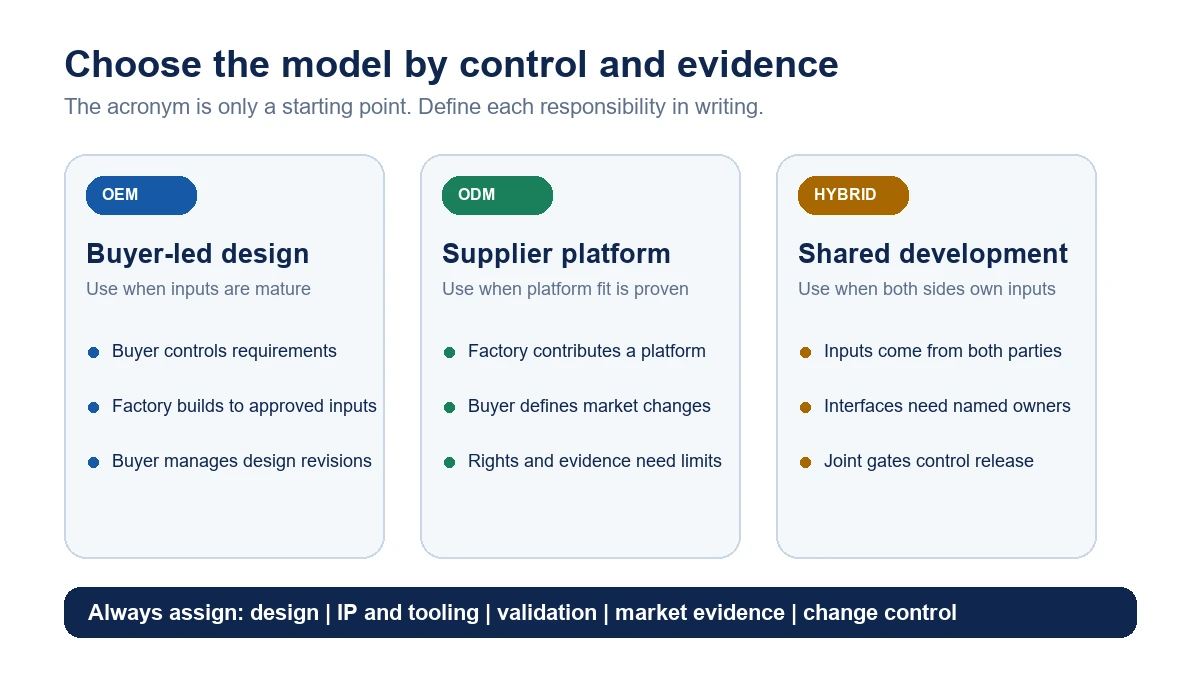
OEM and ODM are useful shorthand for two manufacturing relationships, but the label alone does not tell you who owns the design, who pays for tooling, who validates the product or who carries the obligations in the sales market.
In a typical OEM pattern, the buyer supplies a mature design or a tightly controlled specification and the manufacturer produces to those requirements. In a typical ODM pattern, the manufacturer contributes an existing platform or more of the product design, while the buyer defines the market, brand and required modifications. Many lighting projects sit between those poles.
The right choice depends less on the acronym and more on the responsibilities, evidence and control your business needs.
OEM and ODM are commercial descriptions, not complete contracts
WIPO has described OEM production as manufacturing to a customer’s specifications and ODM as including both design and production. That distinction is useful, but companies use the terms differently. One supplier may call a color and packaging change “OEM,” while another calls the same work “ODM.”
Before comparing quotations, translate each label into a written scope:
- Who creates the electrical, optical, mechanical and thermal design?
- Which existing platform, if any, is being modified?
- Who owns the drawings, firmware, tooling and resulting improvements?
- Who selects critical components?
- Who defines the target-market standards and labeling?
- Who arranges testing and holds the reports?
- Who can approve substitutions or design changes?
- What happens if the relationship ends?
If those questions are unanswered, an attractive unit price does not describe the real project.
What an OEM lighting project usually looks like
An OEM-oriented project generally begins with buyer-controlled inputs. These may include drawings, a bill of materials, target performance, industrial design, approved components, packaging and test requirements. A review of the supplier’s factory and manufacturing controls should then confirm whether those inputs can be translated into repeatable production.
This model can suit a business that already has:
- a mature product definition;
- internal engineering or an external design owner;
- clear acceptance criteria;
- a target-market compliance plan;
- resources to manage revisions and technical files;
- a reason to control product differentiation closely.
The manufacturer still contributes manufacturing engineering, process controls, supplier management and production feedback. “Build exactly this” should not mean ignoring manufacturability, safety or component availability. The parties need a controlled method for resolving conflicts between the buyer’s design intent and production reality.
OEM does not automatically mean a completely unique product, exclusive tooling or buyer ownership of every production detail. Those rights must be stated in the agreement.
What an ODM lighting project usually looks like
An ODM-oriented project often starts from a manufacturer-developed platform. The buyer may select from established housings, drivers, optics or configurations and request changes in performance, finish, branding, packaging or market version. Reviewing the available lighting product families helps separate an existing platform from a clean-sheet development request.
This model can suit a business that:
- wants to build a range without creating every design from zero;
- has strong market and channel knowledge but limited product-engineering capacity;
- can accept a shared or supplier-owned platform;
- needs defined customization rather than a clean-sheet design;
- values existing manufacturing maturity and available evidence.
ODM does not automatically mean “off the shelf.” Some programs include substantial engineering work. It also does not automatically mean fast, low-cost or certified for the buyer’s market. A change to wattage, driver, emergency function, sensor, enclosure, label or installation method can affect testing and documentation.
The buyer must understand which parts of the platform are fixed, which can be changed and what evidence remains valid after each change.
The hybrid model is common in lighting
Many projects combine buyer-owned and supplier-owned inputs. For example, a buyer may define the housing appearance and market requirements while the manufacturer selects a proven driver platform and develops the thermal arrangement. Alternatively, the buyer may adopt an existing luminaire and fund a unique optical accessory or control option.
This can work well, but only if the interface is explicit. A responsibility matrix should identify the owner and approver for each field:
| Workstream | Buyer-owned example | Supplier-owned example | Joint decision example |
|---|---|---|---|
| Product requirements | target market and application | platform limits | final requirement freeze |
| Industrial design | brand-specific appearance | standard housing | customized trim or finish |
| Electrical design | required control protocol | driver implementation | approved component list |
| Optical design | beam or distribution target | lens and LED configuration | sample acceptance |
| Compliance | market and economic-operator role | test samples and technical inputs | test plan and corrective actions |
| Packaging | brand and language | structural packaging proposal | final artwork release |
| Change control | approval authority | change notification | disposition and revalidation |
The matrix matters more than whether the project is called OEM, ODM or “custom.”
Compare design ownership and change control
Design ownership has two dimensions: legal rights and practical control.
Legal rights cover patents, industrial designs, copyright in drawings, firmware, trademarks, trade secrets and licenses. Practical control covers access to editable files, component specifications, tooling data, test records and revision history.
WIPO guidance recommends defining background IP, ownership of results, permitted use, confidentiality, termination and assignment in supplier agreements. A vague sentence stating “all IP belongs to the buyer” may not resolve who owns a pre-existing supplier platform or an improvement developed during the project.
Clarify:
- background IP brought by each party;
- foreground IP created during the project;
- ownership or license for tooling and molds;
- rights to use the design with other factories or customers;
- access to source files and manufacturing data;
- treatment of improvements;
- confidentiality and restricted use;
- return or destruction of materials after termination.
Then connect IP terms to engineering change control. The party that owns a design is not necessarily the party authorized to make unannounced production substitutions. Define which components are critical, what notice is required and when revalidation is mandatory.
Do not outsource market responsibility by assumption
A contract manufacturer can provide test samples, technical data and certification coordination, but the buyer must still understand its role in the target market.
European Commission guidance states that importers or distributors selling a product under their own name take on manufacturer responsibilities and need sufficient information about design and production. In the United States, U.S. Consumer Product Safety Commission guidance emphasizes that manufacturers and importers remain responsible for applicable product-safety obligations and should control materials and unauthorized substitutions.
The exact duties depend on product type, market, brand arrangement and applicable law. The practical lesson is consistent: do not assume that an OEM or ODM label transfers all compliance responsibility to the factory.
For each market, identify:
- the legal manufacturer or responsible economic operator;
- applicable product rules and standards;
- certification or declaration route;
- owner of the technical file;
- test-report holder and model coverage;
- labeling, traceability and language requirements;
- post-market monitoring, complaint and recall responsibilities.
Obtain advice for the relevant jurisdiction when legal interpretation is required.
Evaluate evidence, not only the sample
A visually acceptable sample does not prove that the production product is validated. The approval package should connect the physical sample to controlled documents.
A lighting project may need:
- signed requirement specification;
- approved drawings and bill of materials;
- driver, LED, optical and material declarations;
- safety, EMC, performance or environmental test evidence as applicable;
- photometric files and reports;
- marking and label artwork;
- packaging and instruction files;
- golden sample or limit samples;
- inspection criteria and test plan;
- revision and change-notification procedure.
In an ODM project, ask which evidence belongs to the base platform and which must be repeated for the customized version. In an OEM project, confirm whether the buyer’s design evidence remains valid after manufacturing changes.
Time, cost and MOQ are outputs of scope
It is tempting to say that ODM is always faster and cheaper because it starts from an existing design. That may be true for a limited branding change, but it is not a rule. A new market version, driver, control system, enclosure or certification program can create substantial work.
Likewise, OEM does not automatically mean a high MOQ. The commercial result depends on tooling, component commitments, test cost, setup time, packaging and supplier capacity.
Compare quotations on the same scope. Separate:
- non-recurring engineering;
- tooling and ownership;
- testing and certification;
- samples and revisions;
- unit price and volume tiers;
- component commitments;
- packaging development;
- freight and Incoterms;
- change and cancellation exposure.
A low unit price with unclear tooling, evidence and change rights can carry a higher lifecycle cost.
Which model fits your business?
Choose an OEM-led structure when your design is mature, differentiated and tightly controlled, and when your team can supply and maintain complete technical inputs.
Choose an ODM-led structure when a verified supplier platform fits the market need, customization boundaries are acceptable, and your business understands the ownership and evidence limitations.
Choose a hybrid structure when both parties contribute important design elements. In that case, invest extra effort in interface ownership, IP, validation and change control. If the project spans several applications, compare the relevant lighting solutions before defining one common platform or separate product scopes.
None of these choices removes the need for supplier qualification. Review manufacturing controls, traceability, component governance, evidence access, corrective-action process and capacity for the exact product category.
RFQ checklist
Include the following in an OEM or ODM lighting RFQ:
- target markets and sales channels;
- product application and installation environment;
- design maturity and files available;
- required electrical, optical, mechanical and control features;
- customization boundaries;
- expected annual and order volumes;
- certification and technical-file requirements;
- IP, tooling and exclusivity expectations;
- sample, pilot and production-release gates;
- critical-component and change-notification rules;
- packaging, labeling and language requirements;
- required deliverables if the relationship ends.
To discuss a project, contact New Lights with the target market, design maturity, expected modifications, volumes, certification evidence and ownership requirements. Supplier-specific capabilities should be confirmed in a separate written project scope.
FAQ
What is the main difference between OEM and ODM lighting?
In common usage, OEM production follows buyer-controlled specifications, while ODM includes more supplier-developed design or an existing supplier platform. Contracts vary, so responsibilities must be defined in writing.
Is ODM always cheaper than OEM?
No. Cost depends on customization, tooling, testing, certification, components, volume and commercial terms. Compare equivalent scopes rather than labels.
Who owns the design in an ODM project?
Ownership depends on background IP, newly created work and the contract. Define ownership, licenses, permitted use, improvements, source-file access and termination rights before development.
Can a buyer use an ODM product under its own brand?
Often yes under an agreed private-label arrangement, but branding, market responsibility, documentation, labeling and IP rights must be confirmed for the target market.
Who is responsible for certification?
The supplier may coordinate testing or provide evidence, but legal and commercial responsibilities depend on the product, market and economic-operator roles. Record who owns each task and document.
Can OEM and ODM approaches be combined?
Yes. Hybrid projects are common. A responsibility matrix should define ownership and approval for each subsystem and project gate.
What should happen when a component changes?
The agreement should define critical components, advance notice, approval authority, required testing, document updates and production traceability before the change is released.
Editorial sources
- WIPO, “World Intellectual Property Report 2022”: https://www.wipo.int/edocs/pubdocs/en/wipo-pub-944-2022-en-world-intellectual-property-report-2022-the-direction-of-innovation.pdf
- WIPO, “IP Agreements with Suppliers: What Ventures Need to Know”: https://www.wipo.int/en/web/ip-commercialization/w/blog/ip-agreements-with-suppliers-what-ventures-need-to-know
- WIPO, “Technology Transfer Agreements”: https://www.wipo.int/en/web/technology-transfer/agreements
- European Commission, “Importers and Distributors”: https://single-market-economy.ec.europa.eu/single-market/goods/ce-marking/importers-and-distributors_en
- U.S. Consumer Product Safety Commission, “Manufacturing Best Practices”: https://www.cpsc.gov/business–manufacturing/business-education/business-guidance/BestPractices