

There is no single lifespan for every decorative or colored LED light. The answer depends on the exact lamp or luminaire, how its rated life is defined, its driver and optical construction, and the conditions in which it operates.
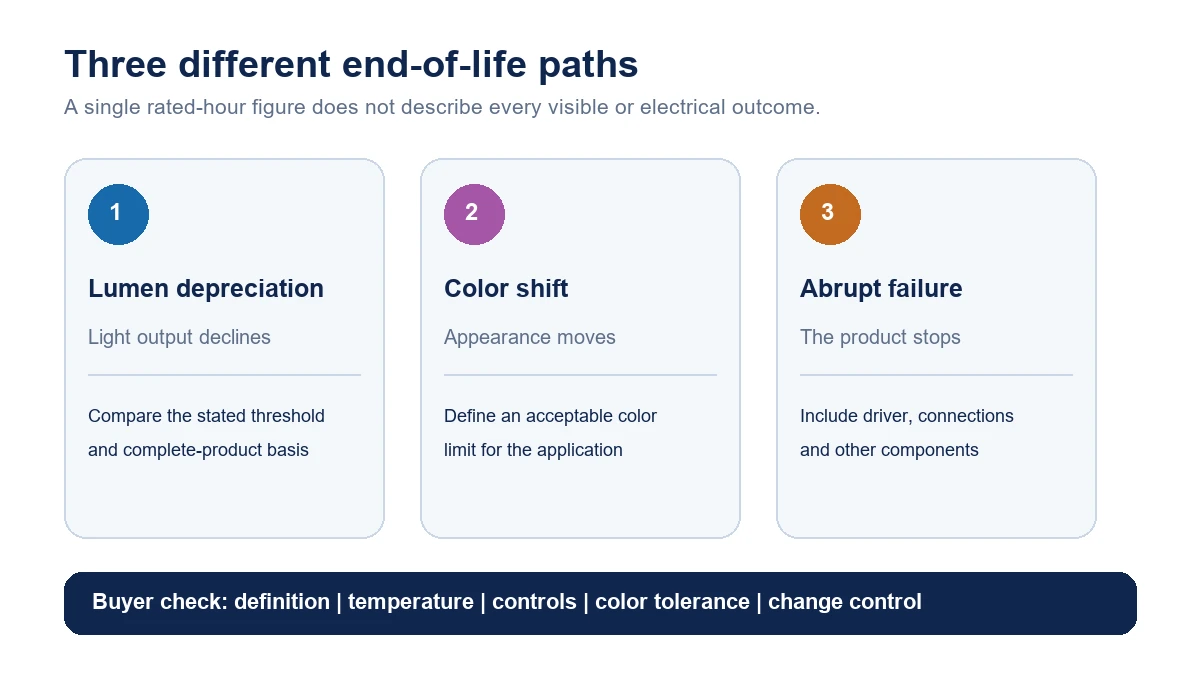
It also depends on what “end of life” means for the application. One product may continue emitting light but become too dim. Another may shift away from the intended color. A third may stop working because an electronic component fails. These are different outcomes, and a single hour figure does not describe all of them.
For purchasing or project planning, compare the model-level evidence behind the lifetime claim—not a generic statement about LED technology.
Rated life is not a countdown to sudden failure
Incandescent lamps are often understood as working until the filament breaks. LED products age differently. DOE explains that LED useful life is commonly described by the number of operating hours until light output falls to a defined percentage of its initial value, often 70% in general explanations.
That does not mean every LED product uses the same threshold, nor that the product switches off at that hour. A life claim should identify:
- the metric used, such as lumen maintenance;
- the stated threshold;
- the population or statistical basis, where applicable;
- the test and projection method;
- the operating conditions;
- whether the claim covers the complete product or only an LED component.
If a datasheet gives only “long life” or an hour number without a definition, the buyer does not yet have enough information for a technical comparison.
Decorative lights have at least three aging paths
| Aging path | What the user notices | Evidence to compare |
|---|---|---|
| Lumen depreciation | the product remains on but becomes dimmer | lumen-maintenance threshold, test basis and operating condition |
| Color shift | the appearance no longer matches the design intent | initial color, tolerance, measurement method and application limit |
| Abrupt failure | the product or one function stops operating | complete-product reliability, driver and connection coverage |
1. Lumen depreciation
The product continues operating, but its output gradually declines. Whether that decline matters depends on the application. A small reduction may be difficult to notice in a single decorative lamp. It may be more visible in a row of lamps installed at different times or operated for different hours.
For a display, facade or hospitality space, plan how replacement batches will be managed. Mixing old and new products can reveal differences even when each item is still functioning.
2. Color shift
Color can change over time even when output remains usable. DOE lifetime guidance notes that color change can become the limiting factor in some applications and that acceptable limits depend on the use case.
This is especially relevant to decorative and colored lighting because color is often the main design purpose. A small chromatic change that would be acceptable in a utility space may be objectionable in a coordinated retail display, architectural feature or hospitality installation.
Color shift can involve the LED package, phosphor, optical materials, diffuser, reflector, temperature and operating environment. The cause cannot be diagnosed reliably from a photograph or from the word “LED.”
3. Abrupt failure
An LED product can also stop emitting light because a driver, connection, solder joint or other component fails. DOE distinguishes such catastrophic failure from gradual lumen depreciation.
This is why an LED package’s lumen-maintenance projection is not automatically the lifetime of the complete decorative product. Buyers should ask whether the declared life describes the lamp or luminaire as a system and how electronic failures are handled in the claim.
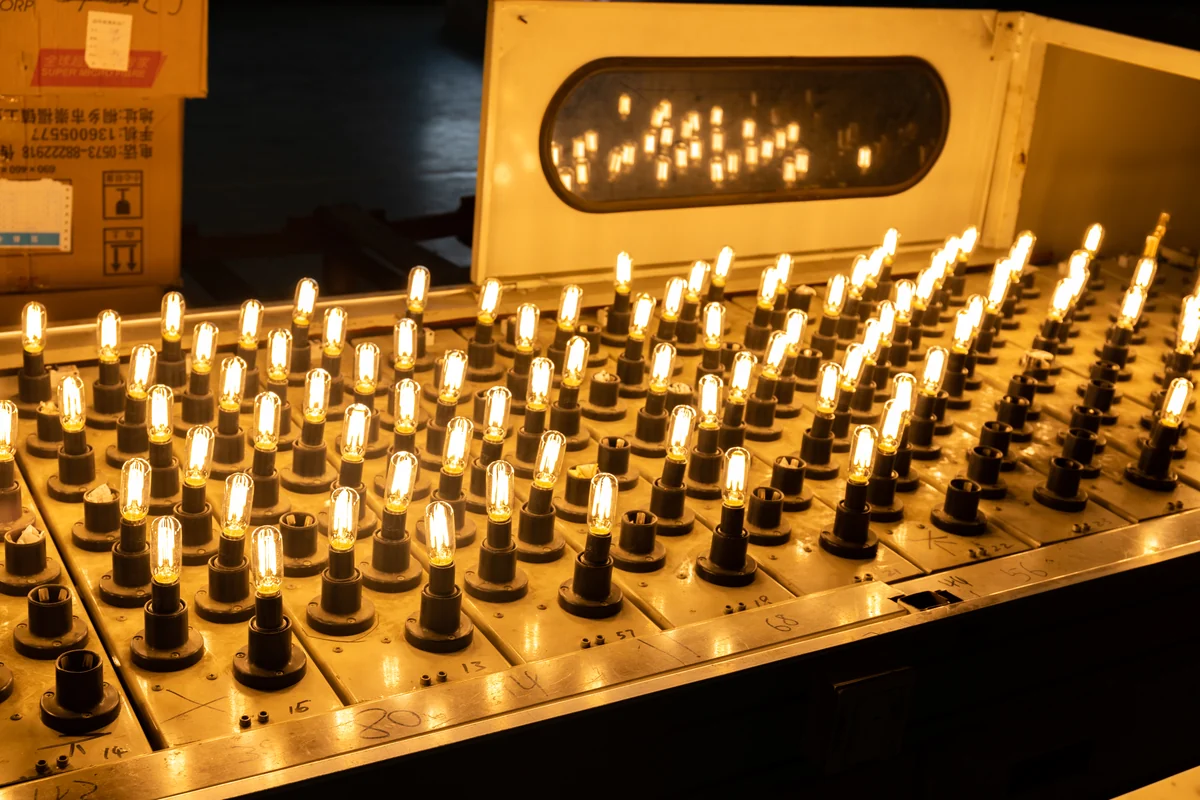
Colored light can be produced in different ways
“Colored LED” is not one construction. A product may use directly emitting colored LEDs, phosphor-converted white LEDs behind a colored envelope, RGB or multi-channel LEDs, or another optical combination. Each approach can have different color-control and aging behavior. The decorative LED bulb family shows why product shape and visible effect must be separated from a model’s documented lifetime evidence.
For fixed-color products, compare the declared color coordinates or wavelength data when those details matter. For color-changing products, review the control system, channel balance, calibration and the behavior of preset scenes. A marketing name such as “red,” “amber” or “warm white” is not a complete technical definition.
Do not assume that two products with the same initial appearance will age identically. Materials, thermal design, LED loading and driver quality can differ even when the bulb shape is similar.
Heat and enclosure conditions matter
LEDs produce less waste heat than many traditional sources for an equivalent lighting task, but their electronics and emitters still operate within thermal limits. Higher operating temperatures can affect output, color and component reliability.
Decorative products are frequently installed in glass globes, lanterns, tight shades or clustered arrangements. These settings can restrict airflow and raise the temperature around the driver. If the product is intended for an enclosed fixture, that condition should be stated in its documentation.
Check:
- maximum ambient temperature;
- enclosed-fixture suitability;
- operating orientation;
- number of lamps in the enclosure;
- clearance around the lamp base or driver;
- proximity to other heat sources;
- outdoor temperature and moisture conditions.
Lower wattage alone does not prove that a lamp is suitable for a sealed decorative fitting.
Dimming and control can affect the experience
A decorative lamp may spend much of its life on a dimmer, timer, sensor or smart control. Compatibility should therefore be part of the product selection.
A lamp marked dimmable is not guaranteed to work with every dimmer. Poor combinations may flicker, buzz, drop out or fail to reach the desired low level. Color appearance may also change during dimming, depending on the product design. Compare the exact control requirement when reviewing broader LED bulb families.
For RGB or multi-channel products, control failure can be perceived as color failure. Record whether the rated life applies only to the light engine or also to the driver, controller and communication components. For a commercial installation, evaluate the complete controlled system rather than only a lamp operated at full output.
Switching frequency and duty cycle
Daily operating hours affect how quickly a rated number of hours is accumulated, but switching and control behavior may also matter. Avoid assuming that every LED tolerates unlimited switching. Check the manufacturer’s declared switching cycle or application guidance where frequent operation is expected.
Seasonal decorative products create a different planning problem: they may operate for relatively few hours but spend long periods in storage. Storage temperature, moisture, cable handling, connector condition and repeated installation can become important even when the LEDs have accumulated little operating time.
For permanent architectural products, long daily duty cycles and elevated ambient temperatures may dominate instead. A useful comparison starts with the actual operating profile.
Convert rated hours into years carefully
A simple planning conversion is:
`estimated calendar years = rated hours ÷ operating hours per day ÷ 365`
This calculation only converts units. It does not predict the exact failure date. It assumes the rated-life basis applies to the installation and does not account for color acceptance, electronics failure, elevated temperature, control incompatibility, storage damage or product changes.
For example, two installations using the same product may reach the same accumulated hours at very different calendar ages. Their ambient conditions and switching patterns may also differ. Present the calculation as a maintenance-planning estimate, not a warranty.
What buyers should request
For a decorative or colored LED product, request evidence for the exact model and market version:
- complete order code and revision;
- rated-life value and definition;
- lumen-maintenance basis for the complete product;
- treatment of abrupt failures, if stated;
- initial color data and any available color-maintenance evidence;
- driver and control configuration;
- ambient-temperature and enclosure conditions;
- dimmer or controller compatibility;
- outdoor, damp or wet-location suitability where relevant;
- warranty scope and exclusions;
- change-notification and component-substitution policy.
For installations where visual uniformity matters, add sample approval and batch consistency to the procurement plan. Consider retaining replacement stock from the same controlled version, especially when a later batch could create visible color differences.
Warning signs in lifetime claims
Treat a claim as incomplete when it:
- gives an hour number without defining the endpoint;
- cites only an LED package report for a complete lamp;
- omits operating temperature or enclosure limits;
- promises no color change without a measurement basis;
- treats warranty length and rated life as the same concept;
- applies one value to multiple drivers or product revisions without evidence;
- assumes that every colored or decorative LED has the same behavior.
A warranty is a commercial commitment with conditions. Rated life is a technical statement with a defined basis. Neither automatically proves the other.
Buyers can begin with the verified decorative product category above. For a model-level discussion, contact New Lights with the product type, daily operating hours, fixture enclosure, ambient conditions, required color consistency and control method.
FAQ
Do decorative LED bulbs suddenly fail at their rated-life hour?
Not necessarily. A rated-life value may describe gradual lumen depreciation rather than a sudden switch-off. Read the exact definition used for the model.
Why do colored LED lights change color over time?
Possible contributors include LED package behavior, operating temperature, optical materials, assembly and the environment. The exact cause requires product-level evidence and evaluation.
Is color shift included in L70?
No. L70 describes light-output maintenance. Color shift is a separate characteristic and may become unacceptable before or after the lumen threshold is reached.
Do enclosed decorative fixtures shorten LED life?
They can raise operating temperature. Use only a lamp documented for the enclosure and conditions, and follow both lamp and fixture instructions.
Does dimming extend the life of a decorative LED?
It cannot be promised universally. The effect depends on the lamp, driver, dimmer, operating level and thermal conditions. Compatibility must be verified first.
How should I compare two colored LED lifetime claims?
Compare the same endpoint, test basis, operating conditions, complete-product coverage, color evidence, driver configuration and warranty terms.
Are seasonal LED decorations limited mainly by operating hours?
Not always. Storage, moisture, cable and connector handling, repeated installation and control electronics can matter even when operating hours are low.
Editorial sources
- U.S. Department of Energy, “LED Basics”: https://www.energy.gov/cmei/ssl/led-basics
- U.S. Department of Energy, “LED Luminaire Lifetime: Recommendations for Testing and Reporting”: https://www.energy.gov/eere/ssl/articles/led-luminaire-lifetime-recommendations-testing-and-reporting-0
- Federal Trade Commission, “The FTC Lighting Facts Label: Questions and Answers for Manufacturers”: https://www.ftc.gov/business-guidance/resources/ftc-lighting-facts-label-questions-answers-manufacturers