

Choose an LED balloon light when a temporary work zone needs broad, diffuse illumination from a central position and workers move through the area in several directions. Choose a floodlight when the priority is directional throw or a specific task surface, a light tower when a much larger area needs elevated coverage, and string lights when illumination must follow a route or extend through multiple rooms.
The useful comparison is not “balloon versus traditional” as a technology slogan. It is a matched-system decision based on the required illuminance, uniformity, glare, mounting height, footprint, electrical supply, exposure, relocation frequency and controls. A balloon light can improve the visual environment in the right layout, but it does not replace every portable or temporary lighting format.
Define the Lighting Task Before the Fixture
Start with the occupied area, work plane and operating period. Record where people stand, walk, inspect materials, drive equipment or face reflective surfaces. Then identify shadows, obstructions, access routes and any places where a tripod or cable would create interference.
The U.S. Occupational Safety and Health Administration publishes minimum illumination values for construction areas, but a minimum value alone does not describe distribution, glare or task visibility. Measure or calculate the maintained result at the relevant work plane. For international projects, also apply the local workplace, electrical and construction requirements that govern the site.
This task definition should come before product selection. The broader guide to choosing LED lighting for a project explains how application boundaries, evidence and sample review fit into the purchasing process.
What Is an LED Balloon Work Light?
An LED balloon work light combines a high-output source with a diffusing envelope and a portable support, commonly a tripod or mast. The diffuser increases the apparent source area and distributes light around the fixture. The product should not be confused with a decorative balloon lamp, inflatable event light or ordinary household globe.
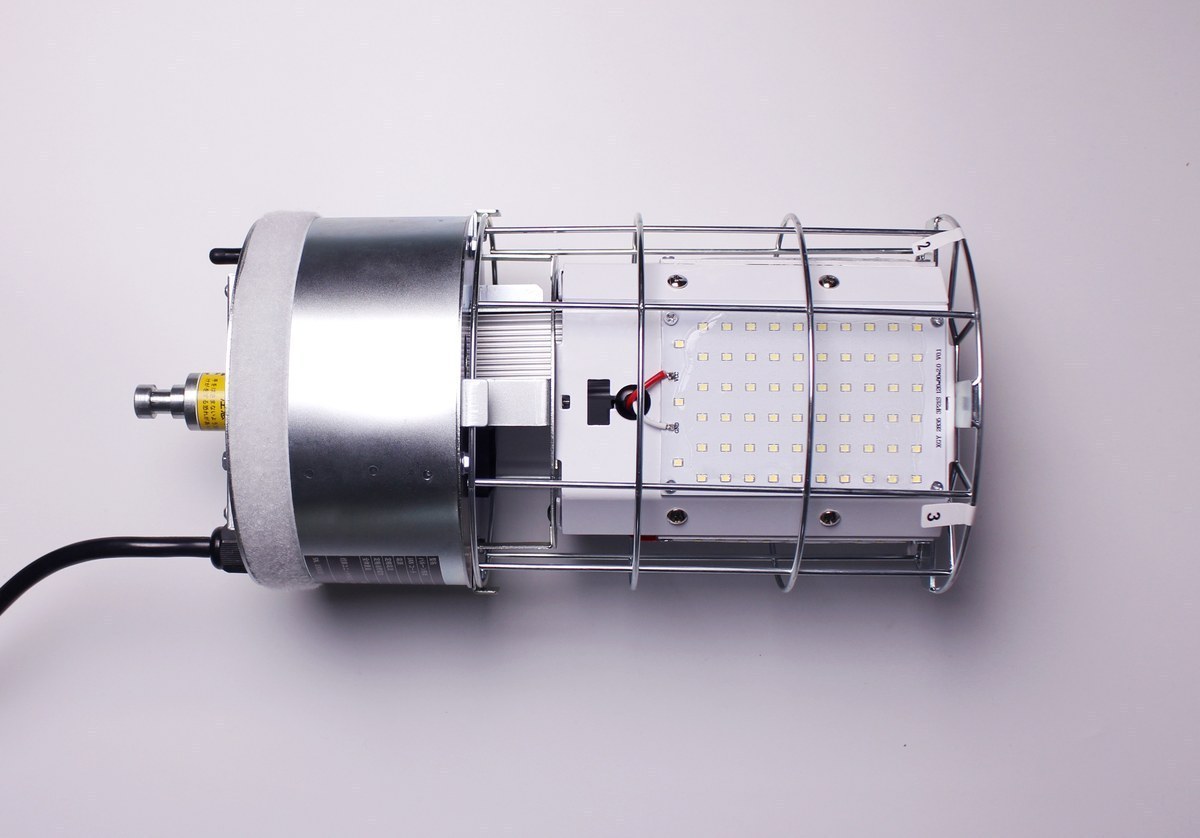
Diffusion changes how people see the source, but it does not create light without trade-offs. The envelope absorbs or redirects some output, the mounting system occupies floor space, and the complete assembly must remain stable. Evaluate the system as a source, diffuser, support, cable and power arrangement rather than comparing only the LED wattage.
Compare the Four Main Temporary-Lighting Formats
The first table is a routing tool. It identifies the format most likely to suit the dominant site condition; it does not replace a lighting layout or the exact product instructions.
| Format | Strongest use case | Main advantage | Main constraint | Evidence to request |
|---|---|---|---|---|
| LED balloon light | Open temporary zone with people working in several directions | Broad diffuse distribution from one central point | Tripod footprint, mast stability and diffuse-light losses | Photometric data, mounting limits, ingress rating and complete-system dimensions |
| Portable LED floodlight | Façade, wall, machine, excavation or task surface needing directional light | Efficient placement of light toward a defined target | Higher source luminance, sharper shadows and aim sensitivity | Beam data, aiming range, glare review and mounting method |
| Mobile light tower | Large outdoor area requiring high mounting and long throw | Wide coverage from elevation and fewer ground-level units | Larger footprint, transport, fuel or power logistics and wind management | Mast rating, stability instructions, photometrics and operating requirements |
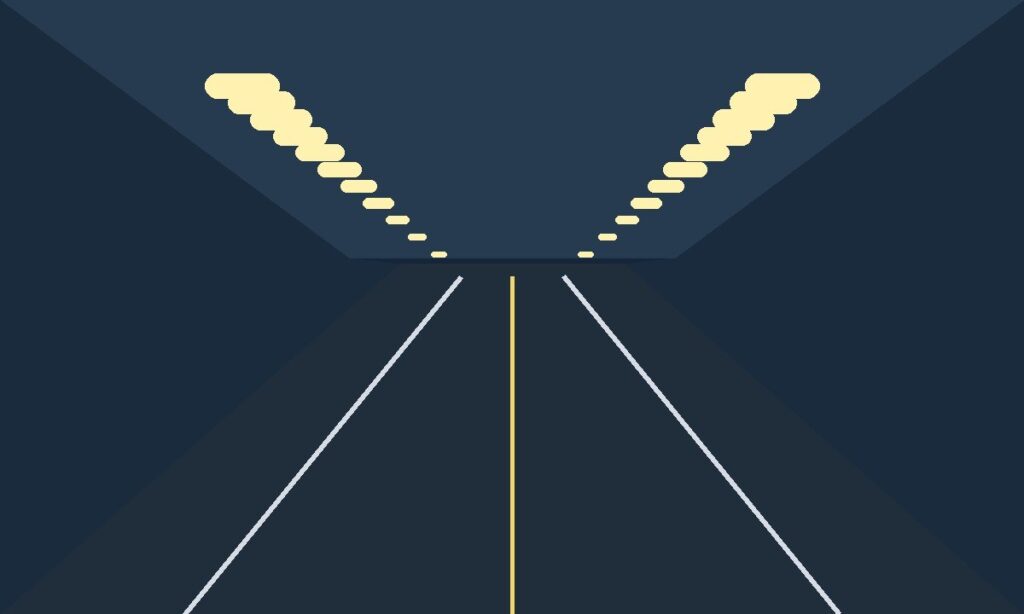
| Temporary string light | Corridor, tunnel, stair route or repeated work bays | Distributed points follow a long or irregular path | More connection points, cable management and limited long-range throw | Maximum run, spacing, guards, connector rating and supply limits |
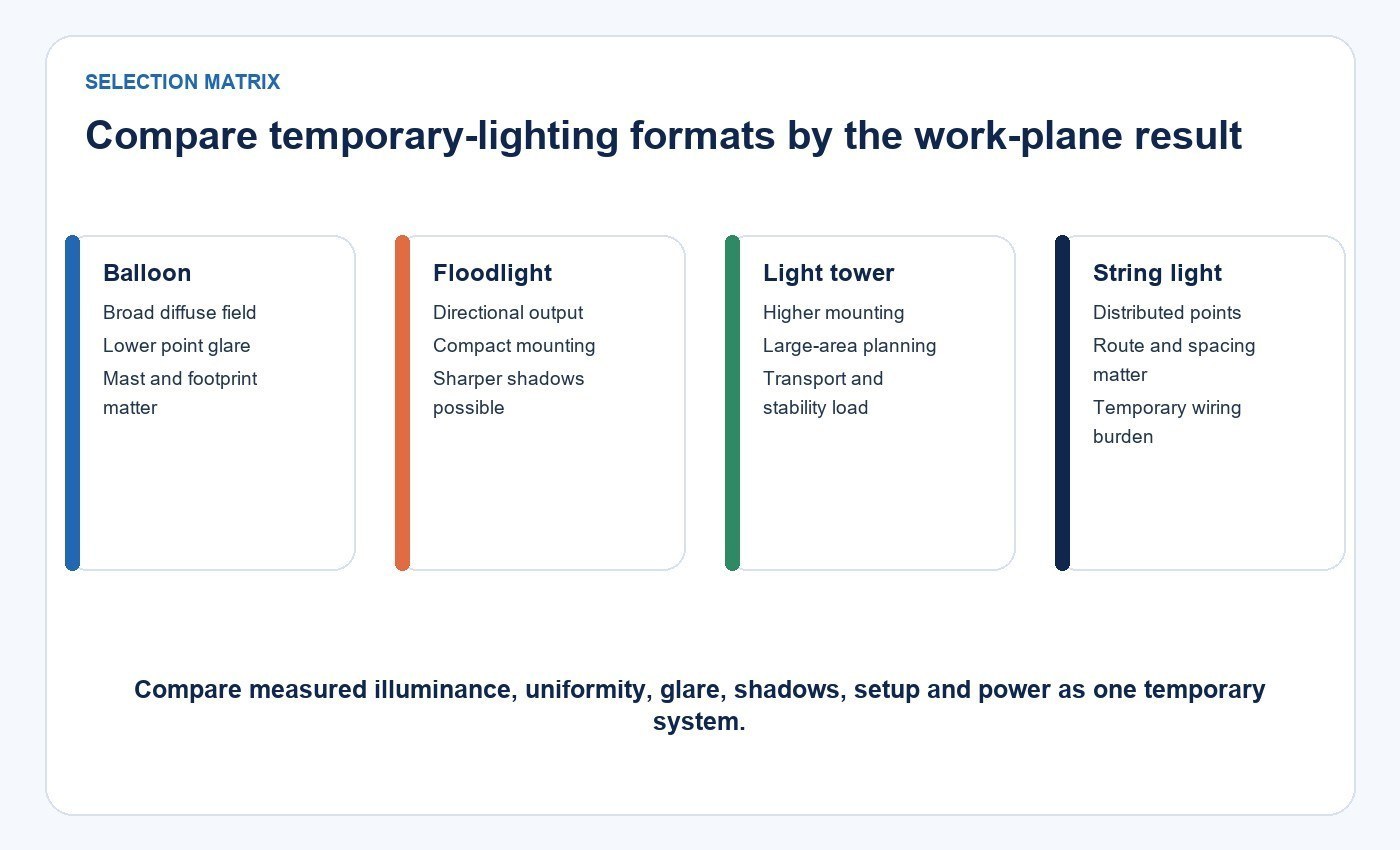
Many sites need more than one format. A balloon light can provide ambient coverage while task lights add vertical illumination or detail at inspection stations. The LED work light range is therefore best reviewed by application role rather than by wattage alone.
Compare Illuminance and Uniformity, Not Fixture Lumens Alone
Lumens describe total emitted light; they do not tell you how much reaches each work location. Two fixtures with similar lumen output can produce very different results because of distribution, mounting height, obstruction, aiming and surface reflectance. A directional flood can produce a high reading near its beam center and weak values outside it. A diffuse balloon can distribute light more evenly but may deliver less intensity to a distant target.
Define measurement points before a sample trial. Include the center, edges, circulation paths, vertical task faces and shadow-prone positions. Record mounting height and fixture position so competing systems are tested under the same conditions. Compare average and minimum illuminance together; a high average can hide dark zones.
The U.S. Department of Energy notes that LED system performance depends on the light source, power supply, luminaire design and operating environment. That is why a purchasing comparison needs complete-system evidence rather than an efficacy number copied from one component.
Evaluate Glare and Shadow Control
The Illuminating Engineering Society defines glare as a sensation caused by luminance within the visual field that is sufficiently greater than the viewer’s adaptation level. Its effect changes with source size, position, luminance, number of sources and the surrounding field.
A balloon diffuser enlarges the apparent source and can make a centrally located fixture more comfortable to view than a small exposed high-luminance source. That does not guarantee a glare-free result. A fixture placed close to eye level, beside a glossy surface or in a dark surrounding area can still be distracting. Conversely, a properly aimed and shielded floodlight may be the better choice when workers do not look toward the beam.
During a trial, observe the fixture from normal working and walking directions. Check whether tools, workers or stored materials create moving shadows. If detail work depends on surface texture, add directional task lighting rather than expecting one diffuse source to provide every visual cue.
Treat the Tripod, Mast and Footprint as Part of the Product
Portable lighting often fails at the layout stage, not the lumen calculation. Mark the fully deployed footprint on the floor plan. Keep legs, cable loops and controls outside traffic lanes, door swings, material routes and equipment turning areas. Confirm whether the mast can be adjusted without entering a hazardous position and whether the assembled unit can pass through the intended access points.
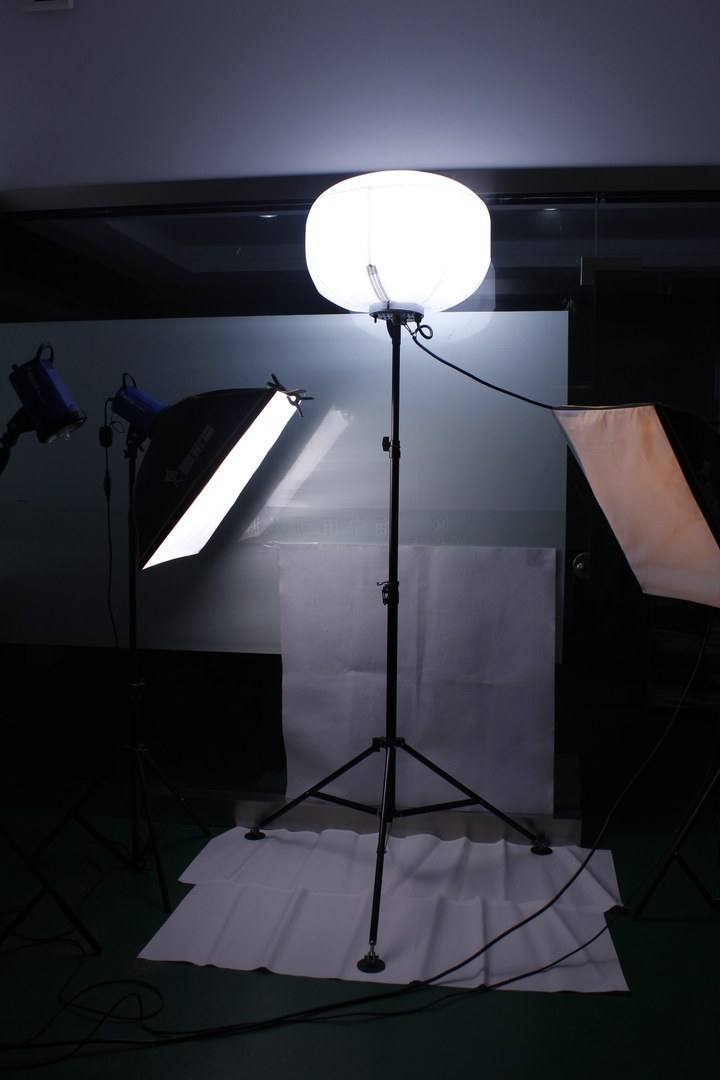
For outdoor use, ingress protection and structural stability are separate decisions. An enclosure rating describes resistance to defined dust and water conditions; it is not a wind rating for the deployed tripod. Review the IP rating guide for LED lighting and obtain the manufacturer’s setup, ballast, wind and shutdown instructions for the complete assembly.
Plan the Electrical Supply and Temporary Wiring
Record supply voltage, frequency, available circuit capacity, cable length, connector type and upstream protection. Confirm the full system input, not only the nominal LED module wattage. Voltage drop, extension arrangements and simultaneous loads can change starting and operating behavior.
OSHA’s temporary-wiring rules address issues such as lamp guarding, cord protection and suitable flexible cords on U.S. construction sites. The applicable requirements depend on the installation and jurisdiction. Route cables away from sharp edges, water, vehicles and walking paths, and use equipment and protection approved for the environment.
If the site can contain flammable gases, vapors or liquids, ordinary portable lighting must not be assumed suitable. Hazardous-location classification and approved equipment require a separate engineering and compliance decision.
Separate Weather Resistance from Site Stability
An IP code answers a bounded enclosure question under a defined test. It does not establish resistance to overturning, impact, vibration, salt exposure, cable strain or every rain condition during field use. Read the exact product documentation for orientation, connector condition and operating limits.
Site stability depends on tripod geometry, mast height, surface level, ballast method, cable pull and wind. Raising a luminaire changes leverage on the support. Establish a maximum deployed configuration for the site and define when the unit must be lowered or removed. Do not improvise ballast in a way that blocks access or damages the stand.
Use a Product-Specific Example Without Generalizing It
The current New Lights XGYBL-240W balloon light product page provides a useful example of the fields that belong in a buyer’s comparison. These values describe that model and should not be treated as universal balloon-light specifications.
| XGYBL-240W field | Published value | Purchasing significance |
|---|---|---|
| Input power | 240 W | Use for circuit and energy calculations with the complete input data |
| Luminous efficacy | 110 lm/W | A source-level performance input; layout still determines work-plane illuminance |
| Distribution | 360° | Supports central ambient coverage around the deployed unit |
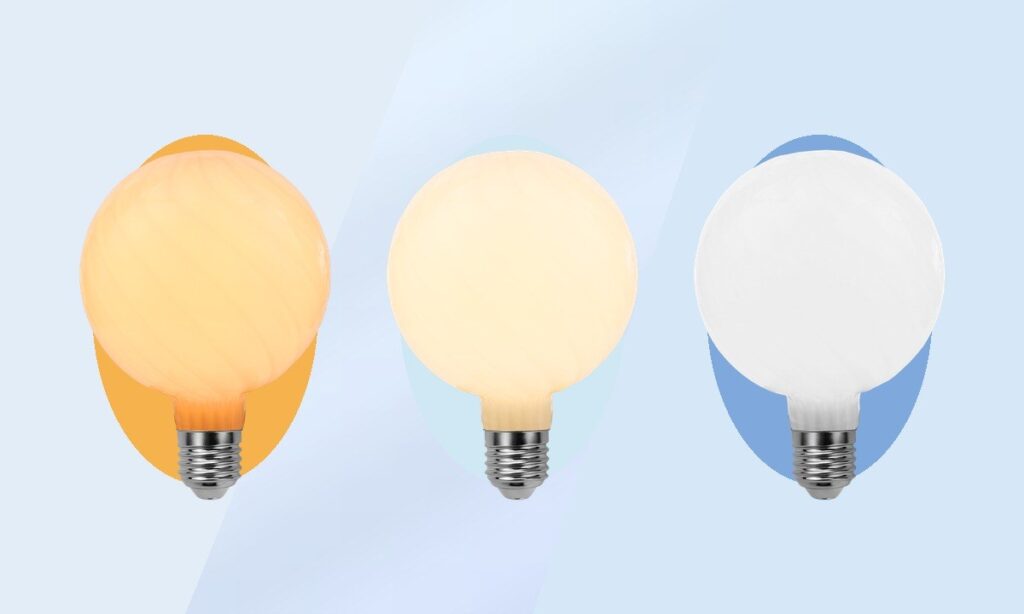
| Color temperature | 5000 K or 6500 K | Select against task, visual preference and project requirements |
| Tripod height | 1.1–1.95 m | Affects distribution, eye-level exposure, access and stability review |
| Balloon size | Ø600 × 400 mm | Affects apparent source size, transport and clearance |
| Deployed footprint | Ø880 mm | Must be checked against traffic and working-space constraints |
| Cable options | 3 m, 5 m or 10 m | Changes supply placement and cable-management planning |
The complete system can then be tested in a representative location. Record illuminance at agreed points, visual comfort, shadowing, cable routing, setup time and any interference with the work process.
Compare Lifecycle Cost at the System Level
Energy use is one line in the cost model. Add the quantity of fixtures, operating hours, setup and relocation labor, cable and distribution equipment, maintenance access, diffuser replacement, transport volume and downtime. A more efficient source may still be an expensive system if poor distribution requires extra fixtures or repeated repositioning.
Compare alternatives against the same required result. If a balloon system uses fewer positions but has a higher unit price, calculate the labor and distribution consequences. If a floodlight uses less power at one task surface but creates dark circulation zones, include the additional fixtures needed to correct them. Avoid universal savings percentages unless the baseline and measured conditions are defined.
Run a Representative Site Trial
Choose a trial area that includes the difficult conditions, not only an open demonstration space. Include obstructions, reflective surfaces, normal worker routes and the intended electrical arrangement. Use the actual mounting height and cable length.
- Record the baseline fixture positions, input power and illuminance points.
- Install the candidate system according to its instructions.
- Measure center, edge, minimum and vertical-task illuminance under the same conditions.
- Observe glare, moving shadows, flicker, noise and visual comfort from normal viewpoints.
- Time setup, relocation and packing, and record the floor space occupied.
- Inspect cable routing, connectors, controls and protection after operation.
- Document exceptions before approving a wider rollout.
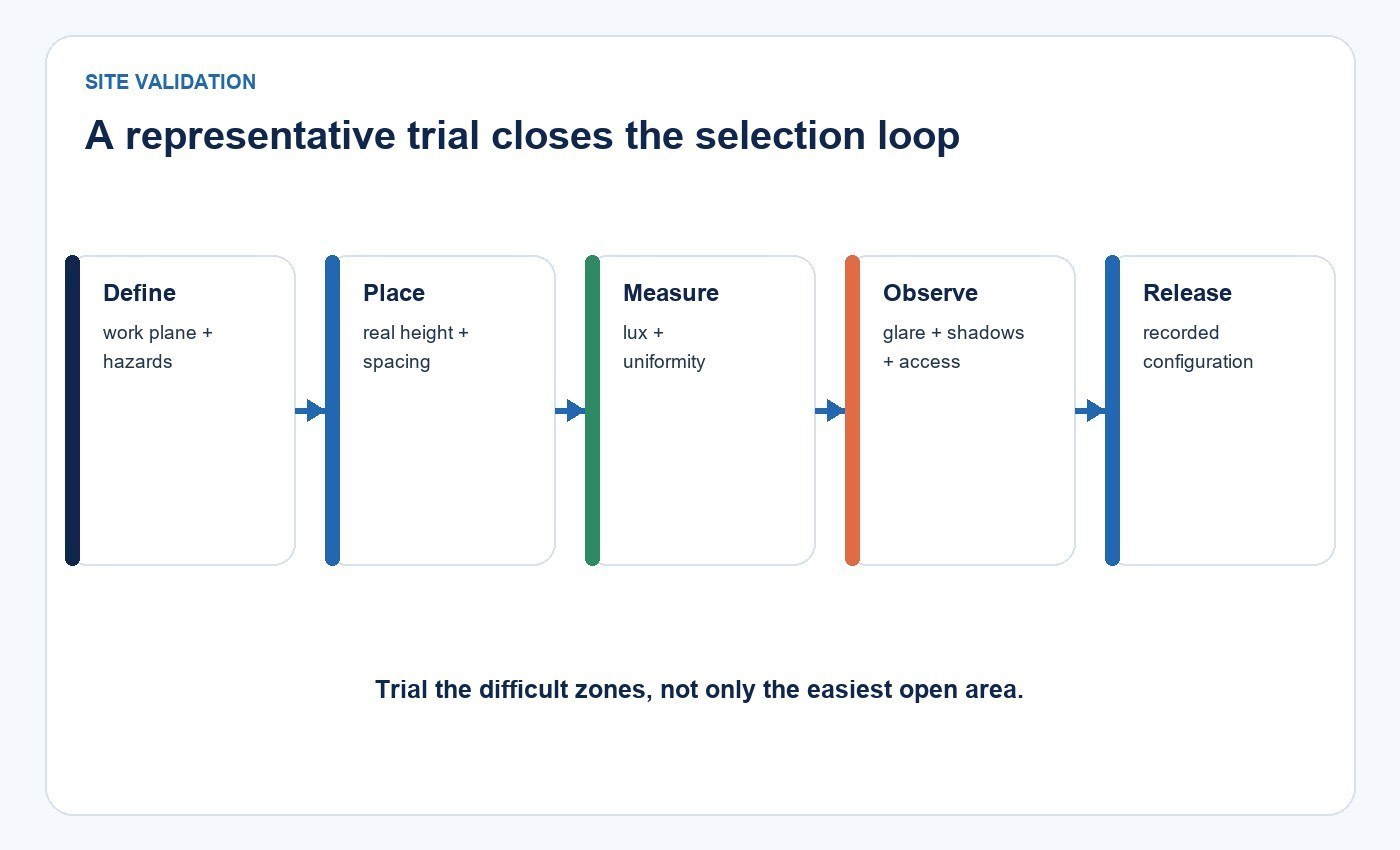
This process turns “better lighting” into a repeatable comparison. It also reveals whether the site needs a mixed system rather than a single fixture type.
Build the RFQ Around the Decision
Ask suppliers for the exact model identity, input data, photometric file or distribution information, dimensions, mass, tripod range, deployed footprint, ingress rating, ambient limits, connector and cable options, controls, instructions, approvals and warranty terms. Request a sample when the layout, glare or workflow result cannot be established from documents alone.
For a wider industrial program, place the equipment decision inside the industrial and warehouse lighting solution. Buyers comparing several portable formats can also review the portable LED work light category before freezing the shortlist.
Frequently Asked Questions
Are LED balloon lights brighter than floodlights?
Not as a universal rule. Brightness at the task depends on output, distribution, distance, aiming and the measured point. Balloon lights favor broad diffuse coverage; floodlights favor directional intensity.
Do balloon lights eliminate glare?
No. A diffuser can reduce apparent source luminance and soften shadows, but mounting position, background luminance, viewing direction and reflective surfaces still determine the visual result.
Can an IP65 balloon light stay outside in any weather?
IP65 describes defined dust and water ingress resistance for the rated enclosure. It does not establish wind stability, flood resistance, connector suitability or permission to leave a deployed tripod unattended.
Is 360-degree light always more efficient?
No. It is useful when work surrounds the fixture. If the required area lies mainly in one direction, a controlled flood beam may place more of the available light on the task.
What should I send New Lights for a project review?
Send the site plan, work-plane requirements, operating hours, supply, indoor or outdoor conditions, mounting and access limits, expected relocation frequency and any local compliance requirements. You can contact New Lights with the project brief and available drawings.
Editorial Sources
- U.S. Department of Energy, “LED Basics”
- Illuminating Engineering Society, “Glare”
- U.S. Occupational Safety and Health Administration, “1926.56 Illumination”
- U.S. Occupational Safety and Health Administration, “1926.405 Wiring Methods, Components, and Equipment for General Use”
- U.S. Occupational Safety and Health Administration, “1926.151 Fire Prevention”
- New Lights, “Tripod LED Balloon Work Light”