

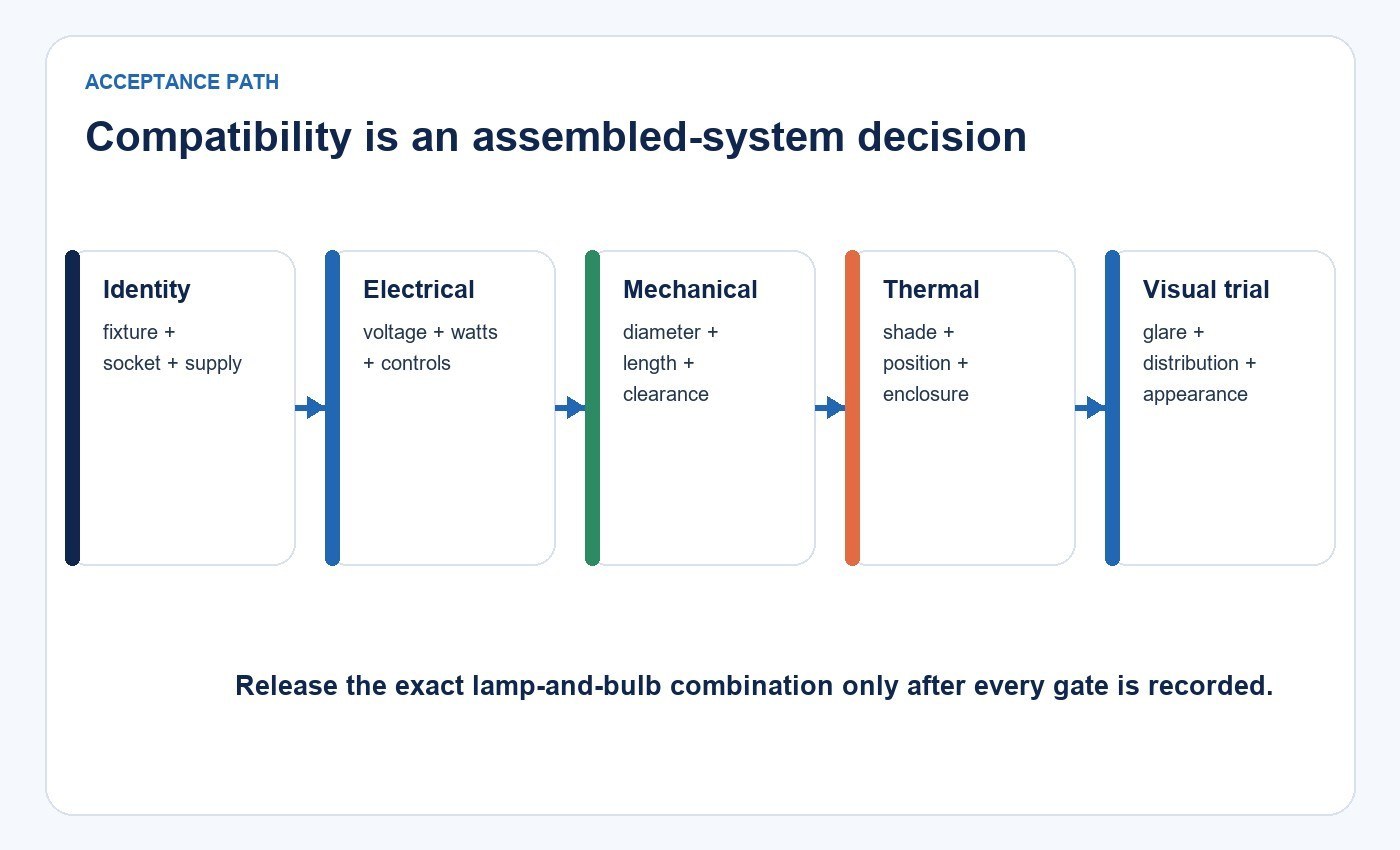
Before choosing a bulb, identify whether the decorative table lamp contains a replaceable lampholder at all. An integrated-light or low-voltage decorative assembly is selected as a complete product; it should not be treated like a conventional mains table lamp with a screw-in bulb. If the lamp does use a replaceable bulb, compatibility then depends on the exact base, supply, actual input watts, physical envelope, thermal condition and control circuit.
That sequence prevents the most common purchasing error: starting with bulb shape or style before confirming the lamp architecture. A bulb can appear to fit and still be electrically unsuitable, too large for the shade, thermally restricted or unstable on the installed dimmer.
First Identify the Lamp Architecture
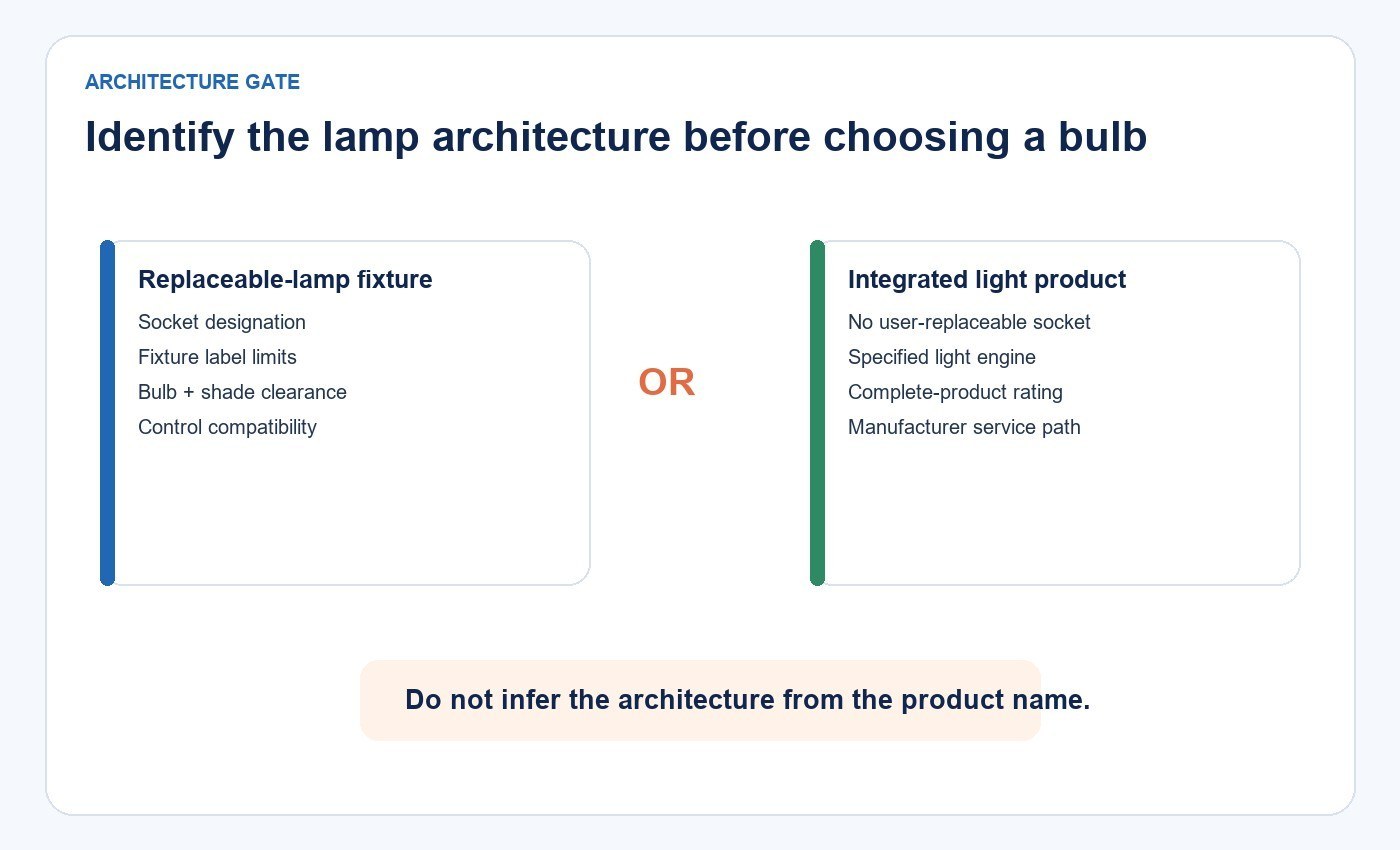
Look beneath the shade, around the light source and on the underside label. The visible light element may be a removable bulb, a fixed LED module, a low-voltage decorative element or part of a sealed rechargeable product. These architectures have different replacement and service paths.
| Lamp architecture | What you should find | Correct purchasing task |
|---|---|---|
| Replaceable-bulb lamp | A named lampholder, replaceable lamp designation, mains or low-voltage rating and maximum input | Match the bulb to every published fixture limit |
| Integrated LED table lamp | Fixed LED light source and driver or control specifications | Select and qualify the complete lamp; do not add a separate bulb |
| Low-voltage decorative assembly | Defined DC input or battery arrangement and an integrated decorative light element | Confirm the complete model, supply and operating arrangement |
| Unidentified or modified lamp | Missing label, altered cord, unknown socket or no reliable instructions | Stop selection until the assembly is identified and evaluated |
The current New Lights Glass & Lime decorative table lamp product page presents a compact glass-and-lime product with selectable internal decorative forms and rated power below 0.5 W. Its published specification does not list an E26 or E27 replacement-bulb socket. Treat the complete model and its specified operating arrangement as the selection object instead of assigning a generic screw-in bulb from the product name alone.
Read the Fixture Label Before the Bulb Package
For a replaceable-bulb table lamp, record the manufacturer, model, supply voltage and frequency, lampholder designation, maximum actual lamp wattage and any restrictions on bulb type or operating position. The label may be on the underside, cord tag, socket shell or inside the shade area. The instructions may add limits for enclosed use, dimming, three-way operation or clearance.
The fixture rating has priority over a replacement comparison printed on a bulb carton. The U.S. Consumer Product Safety Commission documented a lamp recall in which a label allowed 40 W lamps even though the socket was designed for 25 W; the mismatch could melt the switch. That case is specific, but the decision rule is broad: use the documented limit for the complete lamp, not a visual guess.
If a lamp has been rewired, fitted with an adapter or imported into a different supply system, the original label may no longer describe the installed assembly. Treat that as an electrical evaluation task rather than a bulb-shopping shortcut.
Match the Base and Lampholder Designation
A screw base that enters a socket is not enough. ANSI/NEMA C81.61 defines dimensional requirements for electric-lamp bases, and the lamp and lampholder designations should match the applicable system. Similar-looking bases can differ in dimensions, contact geometry and intended market.
Inspect the lampholder for cracks, looseness, corrosion, discoloration or heat damage. The bulb should seat without force, cross-threading or exposed conductive parts. An adapter changes height, contact location, leverage and clearance; it also creates a new combination that must be supported by the product instructions.
The article Can LED Filament Bulbs Be Used in Any Light Fixture? covers broader fixture boundaries for filament products. This page keeps the narrower table-lamp task: identify the lamp architecture, read the fixture limits and verify the assembled fit under its shade.
Match Voltage, Frequency and Circuit Type
The bulb input rating must cover the supply delivered at the lampholder. A matching base cannot make a 120 V bulb suitable for 230 V, or a mains bulb suitable for a low-voltage transformer. Record whether the lamp uses direct mains, a transformer, a rechargeable supply, an electronic touch switch, a three-way socket, a timer or another control circuit.
Some electronic switches pass a small current when nominally off. Some low-voltage systems require a particular load range. A smart bulb may need continuous power, while a conventional dimmer changes its supply waveform. These interactions can produce ghosting, noise, flicker, limited dimming range, delayed start or failure to turn fully off.
Use Actual Watts for the Fixture Limit
“60 W equivalent” is a brightness comparison, not the LED bulb’s electrical input. The U.S. Federal Trade Commission explains that lumens describe brightness while watts describe energy use, and the Lighting Facts label reports both. Use the bulb’s actual stated watts when checking the lamp’s maximum input; use lumens when choosing the required light output.
The maximum limit can protect more than the socket. The cord, switch, shade, wiring and complete thermal construction all contribute to the rating. Selecting a lower-watt LED may reduce heat input compared with a traditional source, but it does not override base, voltage, enclosure or control restrictions.
Measure the Bulb and Shade as an Assembly
Bulbs with the same base can have different maximum diameters, overall lengths, neck profiles, light centers and mass. The U.S. Department of Energy notes that integrated LED drivers can make lamps larger near the base than incandescent bulbs, which is why a nominal replacement can fail the physical-fit check.
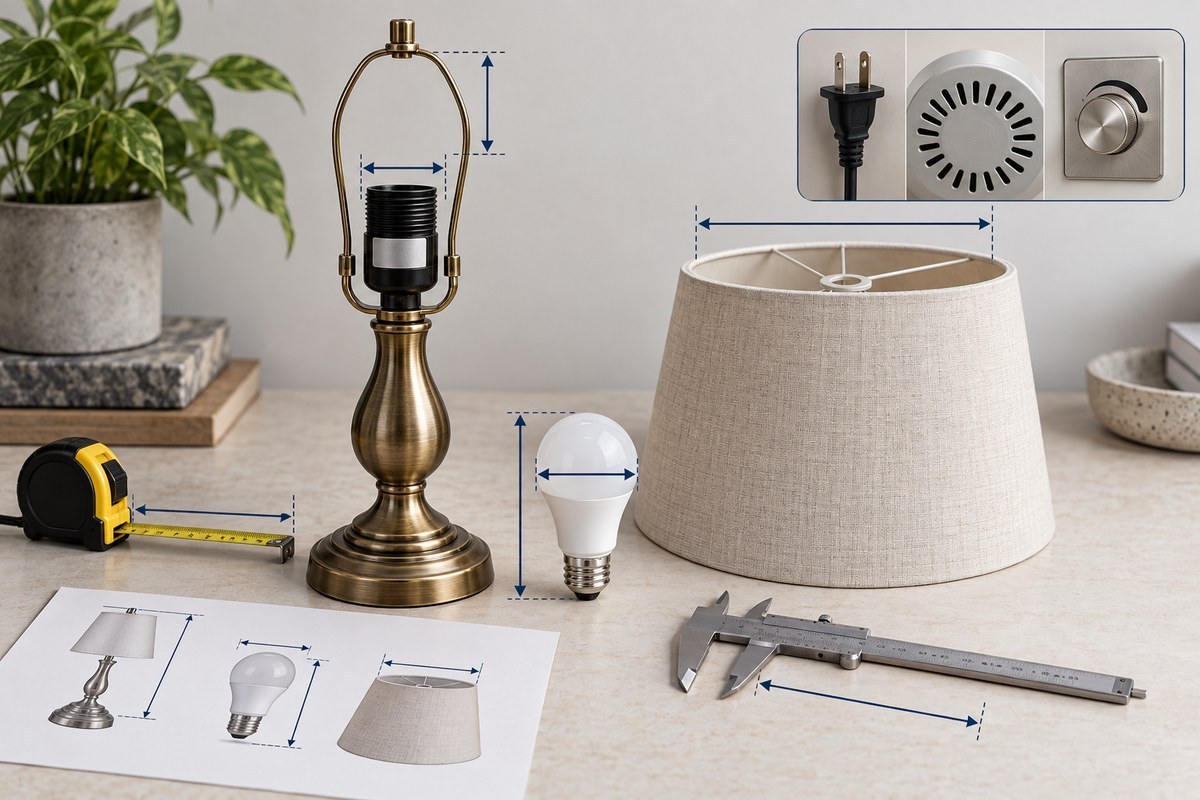
Measure the available height from the seated bulb position, the shade opening, the narrow clearance near the socket and the distance to fabric, plastic, glass, wiring and decorative parts. Check whether the emitting area sits at the intended height. An oversized globe may fit the socket but touch the shade; a long candle lamp may expose the bright source above it; a heavy bulb may make a small table lamp unstable.
Check the Thermal Condition and Operating Position
Determine whether the bulb operates in an open, semi-enclosed or enclosed space. DOE purchasing guidance notes that fully enclosed fixtures trap heat and advises checking whether the lamp is approved for that application. Also check ambient-temperature limits, base-up or base-down restrictions and ventilation requirements on the exact bulb documentation.
A glass globe, mineral base or metal socket does not define the complete thermal path. Heat can affect the LED driver, lampholder, switch, shade, adhesive and nearby wiring. Persistent odor, discoloration, flicker, softened material or a hot switch calls for disconnection and investigation.
Verify Dimmers, Three-Way Sockets and Smart Controls
A bulb marked dimmable is not automatically compatible with every dimmer. Verify the exact control type, recommended lamp list, minimum and maximum load, usable dimming range and off-state behavior. For a three-way socket, select a bulb designed for that switching sequence. For a touch lamp, confirm the electronic switch and bulb combination.
Smart bulbs normally expect stable continuous power so their radio and control electronics remain available. Combining one with a phase-cut dimmer or repeatedly switched socket can conflict with its instructions. Decide which device owns dimming, scheduling and on/off control before ordering.
Choose Light Output and Appearance After Compatibility
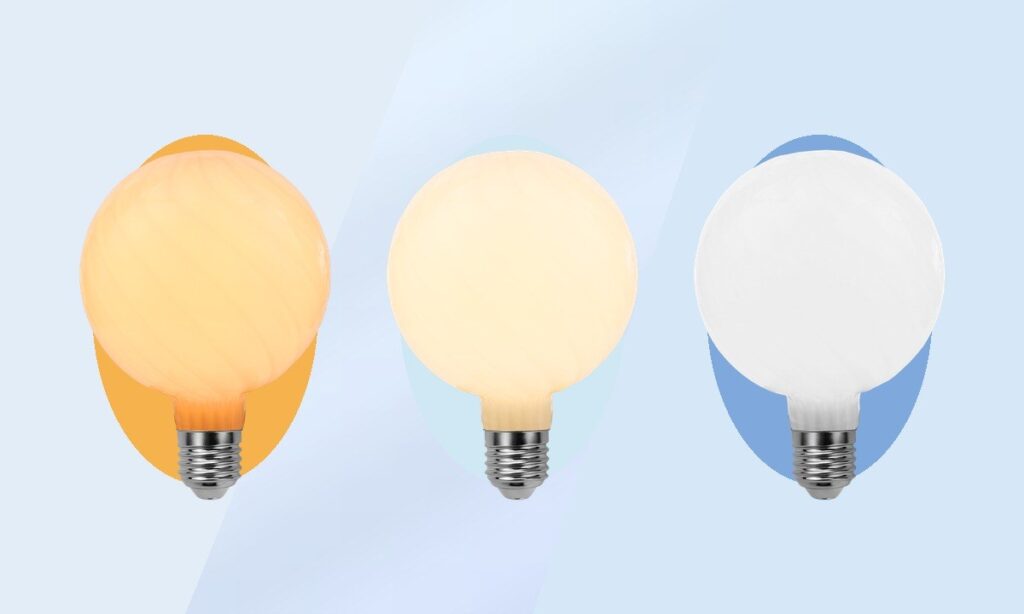
Once the safety and fit checks pass, define the visual result. Choose lumens for the required task, distribution for the shade, correlated color temperature for the intended atmosphere and color-rendering performance for the objects being viewed. Clear filament bulbs create a different luminance pattern from frosted lamps, while globe, candle and tubular envelopes change both proportion and light center.
For hospitality or retail programs, evaluate a sample in the actual shade and viewing position. A technically compatible bulb can still produce glare, uneven shade brightness, a visible hot spot or an unintended color shift. The residential and decorative lighting solution provides the wider application context; the compatibility record remains specific to the lamp-and-bulb combination.
Work Through a Bounded Example
Suppose a table lamp label identifies a specific screw lampholder, a 230 V supply and a maximum input of 25 W. The shade opening and seated height are measured, and the lamp uses a simple mechanical switch. A candidate LED bulb with the matching base, 230 V input and 7 W actual power clears the electrical screen, but it is not yet approved. Its diameter, length, enclosed-use rating, operating position and shade clearance still need to pass.
If the same lamp instead contains a fixed 4.5 V decorative light element with no replaceable lampholder in its specification, the 7 W screw bulb is not a candidate at all. This first branch in the decision process prevents a long compatibility checklist from being applied to the wrong architecture.
Build a Purchasable Compatibility Record
| Decision field | Evidence to record | Reject or escalate when |
|---|---|---|
| Architecture | Replaceable socket, integrated LED or low-voltage assembly | The light-source path is unclear |
| Electrical | Base, voltage, frequency, actual watts and circuit type | Any rating is missing or mismatched |
| Physical | Diameter, length, neck, seated height, mass and shade clearance | The bulb touches, binds or destabilizes the lamp |
| Thermal | Open/enclosed rating, position, ambient and ventilation | The product instructions exclude the condition |
| Controls | Switch, dimmer, three-way, touch or smart-control support | Compatibility is assumed from “dimmable” alone |
| Optical | Lumens, distribution, CCT, color rendering and glare review | The sample fails the intended visual task |
Photograph the label and socket, record dimensions and attach the candidate bulb specification. For repeat orders, keep the approved lamp model, bulb model, market and control combination together. A generic statement such as “fits table lamps” is too broad for purchasing control.
For a bounded New Lights review, contact New Lights with the product model, label, socket photograph, supply, shade dimensions, control details and intended market. The LED bulb range can then be filtered against those inputs rather than treated as universally interchangeable.
Frequently Asked Questions
Does every decorative table lamp accept a replaceable bulb?
No. Some products use an integrated LED, low-voltage decorative element or sealed rechargeable assembly. Identify the architecture and product documentation before selecting a bulb.
Can I choose a bulb only by matching E26 or E27?
No. The base designation is one check. Voltage, actual watts, dimensions, thermal use, operating position and controls must also match the exact lamp.
Does “60 W equivalent” count against a 25 W fixture limit?
Use the bulb’s actual input watts for the fixture limit. The equivalent-watt phrase describes a brightness comparison; lumens are the direct brightness measure.
Can any dimmable LED bulb work in a touch table lamp?
No. Touch controls and dimmers use different electronic designs. Check the lamp or control instructions and the bulb manufacturer’s compatibility information for the exact combination.
Is a glass lamp body enough to keep an LED bulb cool?
No. Thermal conditions depend on the complete bulb, socket, shade, enclosure, airflow, operating position and surrounding materials. Follow the exact product ratings.
Editorial Sources
- New Lights, Glass & Lime Decorative Table Lamp Bases: https://new-lights.com/products/decorative-ambient-lighting/lamp-holders-bases/decorative-table-lamp-base-glass-integrated-lime/
- National Electrical Manufacturers Association, ANSI C81.61-2019 — Electric Lamp Bases: Specifications for Bases (Caps) for Electric Lamps: https://www.nema.org/docs/default-source/standards-document-library/ansi-c81-61-2019-contents-and-scope.pdf
- U.S. Consumer Product Safety Commission, Floor and Table Lamps Recall 18-747: https://www.cpsc.gov/Recall-Products/Floor-and-Table-Lamps
- U.S. Federal Trade Commission, Shopping for Light Bulbs: https://consumer.ftc.gov/articles/shopping-light-bulbs
- U.S. Department of Energy FEMP, Purchasing Energy-Efficient Light Bulbs: https://www.energy.gov/cmei/femp/purchasing-energy-efficient-light-bulbs