


 English
 Español
 Deutsch
We sincerely look forward to establishing a long-term development partnership with you with good quality and professional services.
Excerpt
A practical guide to choosing LED panel lights for offices, schools, and retail spaces. Learn how glare, color temperature, CRI, installation, and reliability affect project performance.
Quick Answer
For most office and education projects, LED panel lights with 4000K color temperature, low glare (UGR<19), flicker-free drivers, and even light distribution are usually the most practical choice.
For retail spaces, the priority often shifts toward higher CRI, better product presentation, and a lighting layout that supports visual appeal.
The right LED panel light is not defined by wattage alone. It should be selected based on application, comfort, installation compatibility, and long-term reliability.
Many commercial spaces look bright enough at first glance. But after a few hours, the problems become obvious. Employees feel tired, students experience reflections or uneven light, and products in retail displays look flatter than expected.
In many cases, these problems are not caused by insufficient brightness. They come from the wrong lighting specifications for the actual environment. A panel light can look good on paper and still perform poorly in real use if glare control, color temperature, driver stability, or layout are not considered carefully.
This guide explains how to evaluate LED panel lights from a practical project perspective, so buyers and sourcing teams can make better decisions before installation begins.
Who This Guide Is For
This guide is useful for:
-
commercial lighting buyers
-
mporters and distributors
-
contractors and fit-out teams
-
facility managers
-
OEM/private label sourcing teams
-
architects and interior project teams
It is especially relevant for projects where visual comfort, compliance, installation efficiency, maintenance control, and supply consistency all matter.
Why This Issue Matters
Key takeaway: Lighting problems in commercial spaces are often caused by poor glare control, uneven distribution, or unsuitable specifications, not simply by low brightness.
Lighting affects more than visibility.
In offices, it influences concentration, visual comfort, and how long people can work without fatigue. In classrooms, it affects reading clarity, board visibility, and screen comfort. In retail, it directly changes how products, colors, and materials are perceived.
Poor panel light selection can also create hidden project risks. A solution that seems acceptable during installation may later cause complaints because of glare, flicker, unstable drivers, inconsistent color appearance, or difficult maintenance.
For B2B buyers, this means panel light selection should be treated as a decision about application performance and project stability, not just unit cost.
Key Factors to Evaluate Before Choosing LED Panel Lights
Key takeaway: Buyers should evaluate LED panel lights based on comfort, application fit, installation method, and long-term stability, not lumen output alone.
1. Brightness and Light Uniformity
Brightness matters, but uniformity matters just as much.
-
Offices and classrooms often target around 300–500 lux
-
Retail display areas may require higher brightness depending on layout
What it means in practice:
Even light distribution reduces visual fatigue and avoids bright spots or dark zones across the space.
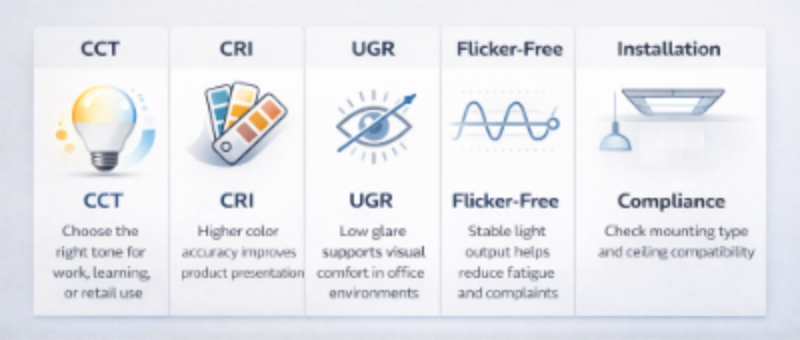
2. Color Temperature (CCT)
Color temperature shapes how a space feels and how people respond to it.
-
4000K: balanced, practical for offices and schools
-
5000K: sharper and more alert, but sometimes too harsh
-
3000K: warmer and more relaxed, but less suitable for task-focused spaces
What it means in practice:
The wrong CCT can make a room feel dull, overly cold, or tiring over time.
3. Color Rendering Index (CRI)
CRI shows how accurately colors appear under the light.
-
CRI 80+: suitable for many general commercial applications
-
CRI 90+: better for retail, displays, and product-focused spaces
What it means in practice:
Higher CRI helps products look more natural and materials appear closer to their true color.
4. Glare Control (UGR)
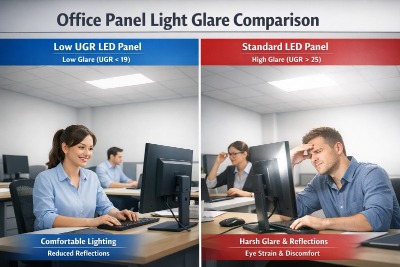
For offices and classrooms, glare is one of the most overlooked but most important factors.
- UGR<19 is a common target for better visual comfort
What it means in practice:
Low-glare panel lights reduce screen reflections, eye strain, and discomfort during long indoor use.
5. Flicker-Free Performance and Driver Stability
Flicker may not always be visible, but users can still feel its effects.
What it means in practice:
A stable, flicker-free driver helps improve comfort, reduce complaints, and support long-term performance.
6. Installation Method and Ceiling Compatibility
Common options include:
-
recessed installation
-
surface-mounted installation
-
suspended installation
What it means in practice:
The right installation type helps reduce retrofit difficulty, avoid ceiling mismatch, and control labor time.
7. Energy Efficiency and Maintenance
Efficiency should be considered together with maintenance planning.
What it means in practice:
Good long-term value depends not only on energy savings, but also on driver reliability, failure rate, and ease of replacement.
8. Compliance and Project Readiness
Commercial projects often require more than lighting performance alone.
Common checkpoints include:
-
CE / RoHS
-
UL or equivalent market-specific approvals
-
flicker-related requirements
-
efficiency-related requirements
-
technical documentation availability
What it means in practice:
A product may fit the application technically, but still be unsuitable if it cannot support compliance or project approval in the target market.
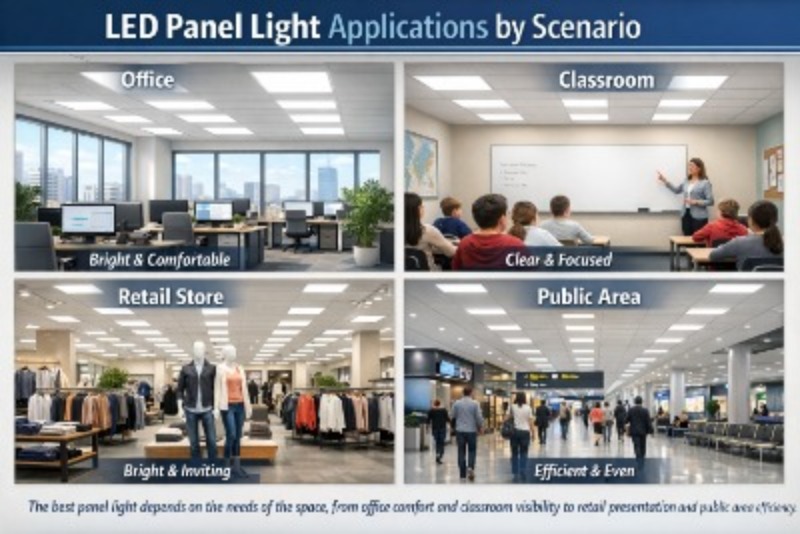
Best LED Panel Lighting Approaches by Scenario
Key takeaway: The best panel light depends on what the space needs people to do, not simply how bright the room looks.
Office Spaces
Typical problems:
Screen glare, eye fatigue, uneven lighting across workstations, and long-term discomfort.
Recommended direction:
Use UGR<19, 4000K, and a layout designed for even illumination.
Selection advice:
For offices, comfort is usually more important than pushing brightness too high.
Classrooms and Training Rooms
Typical problems:
Uneven lighting, reflections on boards or screens, and visual fatigue during reading.
Recommended direction:
Use balanced output, flicker-free drivers, and a layout that supports desks and teaching areas.
Selection advice:
In education spaces, evenness and comfort often matter more than a very cool or overly bright visual effect.
Retail Stores and Display Areas
Typical problems:
Products look flat, colors appear less accurate, and displays lack impact.
Recommended direction:
Use higher-CRI panel lights and combine them with accent lighting where necessary.
Selection advice:
In retail, ask not only whether the space is bright enough, but whether the lighting helps merchandise look right.
Meeting Rooms
Typical problems:
Glare on screens, uncomfortable brightness during presentations, and limited lighting flexibility.
Recommended direction:
Use low-glare panel lights and consider dimming if the project requires it.
Selection advice:
Meeting rooms usually benefit from softer, more controlled lighting than open office areas.
Corridors and Public Areas
Typical problems:
Over-lighting, wasted energy, and lighting levels that do not match actual usage.
Recommended direction:
Use practical brightness levels and consider sensor-compatible solutions where needed.
Selection advice:
These areas may not require the same specification level as offices, but consistency and easy maintenance still matter.
Common Mistakes Buyers Make
Key takeaway: Many lighting problems begin during product selection, long before installation starts.
Common mistakes include:
-
choosing based only on wattage or lumen output
-
ignoring glare control in office applications
-
selecting CCT by personal preference instead of actual use
-
overlooking driver quality and flicker performance
-
not checking ceiling compatibility before sourcing
-
comparing price without considering maintenance risk
-
assuming sample quality always equals batch consistency
-
ignoring compliance and documentation until late in the project
For B2B projects, these mistakes often lead to delays, complaints, or higher total cost after installation.
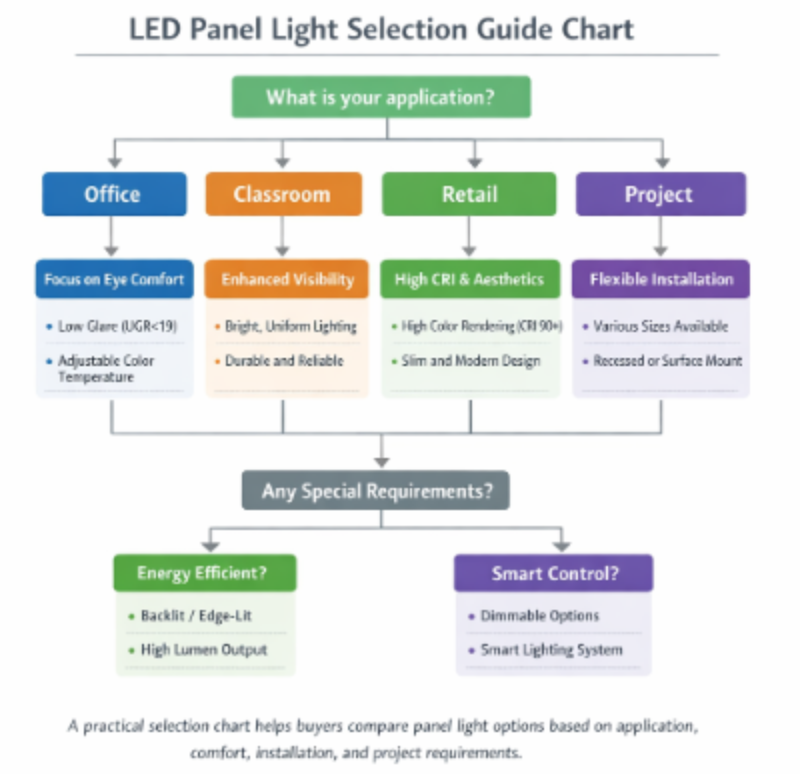
How to Choose the Right Product or Solution
A practical selection process should start with the application, then move to performance, installation, and sourcing reliability.
| Project Priority | What to Check | Why It Matters |
|---|---|---|
| Office comfort | UGR, uniformity, CCT | Helps reduce fatigue and screen glare |
| Classroom usability | Even distribution, flicker-free driver | Supports reading and focus |
| Retail presentation | CRI, brightness balance, lighting layers | Helps products appear more natural |
| Retrofit efficiency | Mounting type, panel size, ceiling fit | Avoids installation issues |
| Long-term reliability | Driver stability, maintenance planning | Reduces service risk |
| Market readiness | Certifications, documentation, consistency | Supports approval and import requirements |
Quick Selection Logic
-
For office spaces: start with 4000K + UGR<19 + uniform illumination
-
For classrooms: focus on even distribution + flicker-free performance + practical brightness
-
For retail: prioritize higher CRI + better product presentation + layered lighting support
-
For large-scale projects: also check consistency, documentation, certification, and supply stability
FAQ
What LED panel light is best for office use?
For most offices, a panel light with 4000K color temperature, low glare (UGR<19), and uniform illumination is a practical choice.
What color temperature is best for office panel lights?
4000K is widely preferred because it balances visual clarity and comfort.
Why does a room feel uncomfortable even when it is bright?
This is often caused by glare, uneven light distribution, or the wrong color temperature rather than low brightness.
What CRI is recommended for retail lighting?
For product presentation, CRI 90+ is often the better choice.
Are LED panel lights suitable for classrooms?
Yes, as long as they provide even illumination and stable flicker-free performance.
How do I choose between recessed and surface-mounted panel lights?
That mainly depends on ceiling structure, installation conditions, and retrofit requirements.
What should buyers check before sourcing commercial LED panel lights?
Key points include application fit, glare control, CCT, CRI, driver stability, installation compatibility, compliance, and batch consistency.
Why is driver quality important in LED panel lights?
The driver affects flicker, output stability, service life, and long-term user comfort.
Conclusion
Choosing the right LED panel light is not about selecting the highest specification on paper. It is about matching the product to the real application, the real user experience, and the real installation conditions.
For offices and schools, that usually means prioritizing comfort, glare control, and stable performance. For retail, it means choosing lighting that supports product presentation as well as general illumination. For large B2B projects, it also means checking consistency, compliance, and sourcing reliability before final selection.
Decision Summary
If the project is for offices or classrooms, start with 4000K, UGR<19, flicker-free drivers, and even illumination.
If the project is for retail, prioritize higher CRI and lighting quality that supports merchandise presentation.
If the project involves distribution, tender supply, or OEM/private label sourcing, also evaluate installation compatibility, driver reliability, certification requirements, and batch consistency.
Need Help Choosing the Right Panel Light?
If you are evaluating panel lighting for office, school, or retail projects, it helps to compare options based on:
- application scenario
- installation type
- market compliance
- brightness and glare requirements
- OEM/private label needs
You can also review suitable panel light categories, compare installation options, or request recommendations based on your project type and market requirements.
 GET IN TOUCH


