

A decorative lighting idea becomes manufacturable only when subjective language is translated into observable, measurable and approvable requirements. “Warm,” “premium,” “minimal” or “vintage” may describe the desired impression, but none of them tells an engineering or production team what may vary and what must remain fixed.
The practical solution is to separate the concept into controlled decisions: viewing distance and application, lit and unlit appearance, visible light-source geometry, color criteria, materials and finishes, dimensions and interfaces, electrical configuration, market requirements, prototype stages, a golden sample and production change control.
Begin with the Visual Job, Not a Product Name
Start by defining what the light must do in the space. Is it a focal object viewed at close range, a repeated decorative element across a restaurant, a background glow in a hotel corridor, or a retail accent that must preserve merchandise colors? The answer changes which details deserve the tightest control.
Write a short design narrative that states:
- the application and typical viewing distance;
- whether the product is primarily viewed switched on, switched off or both;
- the desired visual hierarchy: lamp, shade, fixture body, illuminated surface or surrounding architecture;
- the acceptable mood and the unacceptable failure modes;
- reference images, with notes identifying exactly what each reference is meant to communicate.
Reference images should not be treated as a complete specification. One image may communicate filament visibility, another the surface finish and another the scale. Mark those roles explicitly so the supplier is not expected to copy unrelated details. If the project is still choosing among product families, review the types of decorative lighting selection guide before freezing the build brief.
Convert Subjective Words into Approval Criteria
Each subjective adjective should be paired with evidence that two people can compare. The objective is not to eliminate design judgment; it is to make that judgment repeatable.
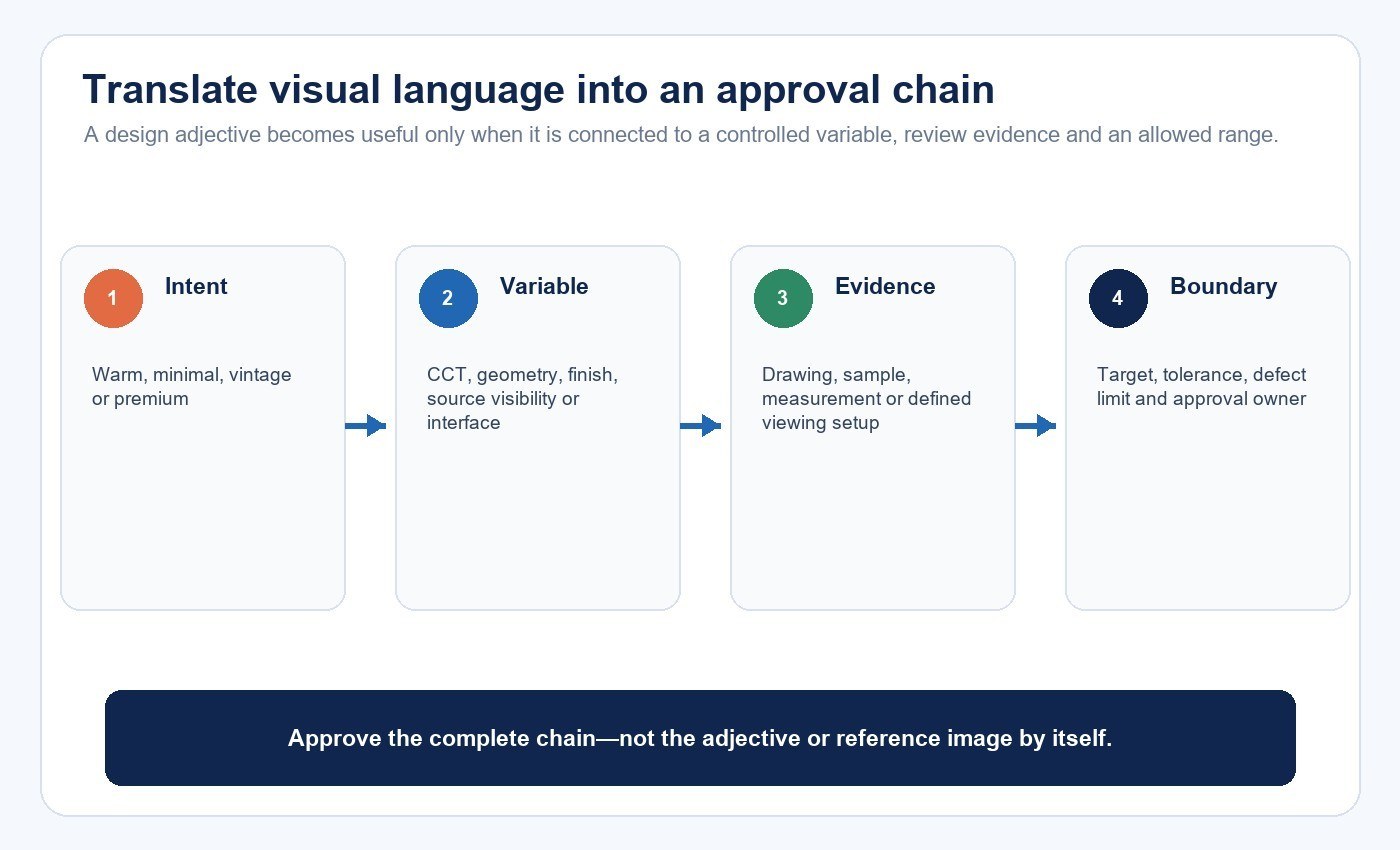
| Concept language | Questions to resolve | Approval evidence |
|---|---|---|
| Warm and intimate | Target CCT range? Dimming behavior? Is amber glass part of the effect? | Lit samples at defined input and dimming points, spectral or color data where relevant, and an approved viewing setup |
| Premium finish | Which substrate, coating, gloss and texture? Which surfaces are visible? | Material declaration, finish code, controlled sample and defect limits under defined lighting |
| Minimal form | Which dimensions and seams must disappear at normal viewing distance? | Dimensioned drawing, assembly sample and visual acceptance distance |
| Vintage appearance | Is the visual cue the filament geometry, glass tint, cap finish or lumen level? | Separate approval of unlit appearance, lit appearance and electrical performance |
| Consistent across a venue | What variation is visible when products are installed together? | Side-by-side sample set, color/finish tolerances and lot acceptance method |
Avoid making a single photograph the acceptance standard. Camera exposure, white balance, screen calibration and ambient light can all alter perceived brightness and color. Use photographs to identify intent, then approve physical samples and measurable attributes under a defined viewing condition.

Specify Lit and Unlit Appearance Separately
A decorative lamp is a physical object before it is switched on and an optical object after it is energized. Those two states can create different approval problems.
For the unlit state, document glass or diffuser color, transparency, coating uniformity, visible supports, cap alignment, seams, surface marks and the appearance of internal components. For the lit state, document source visibility, luminance pattern, hotspots, shadow lines, color appearance, dimming transition and reflections from nearby materials.
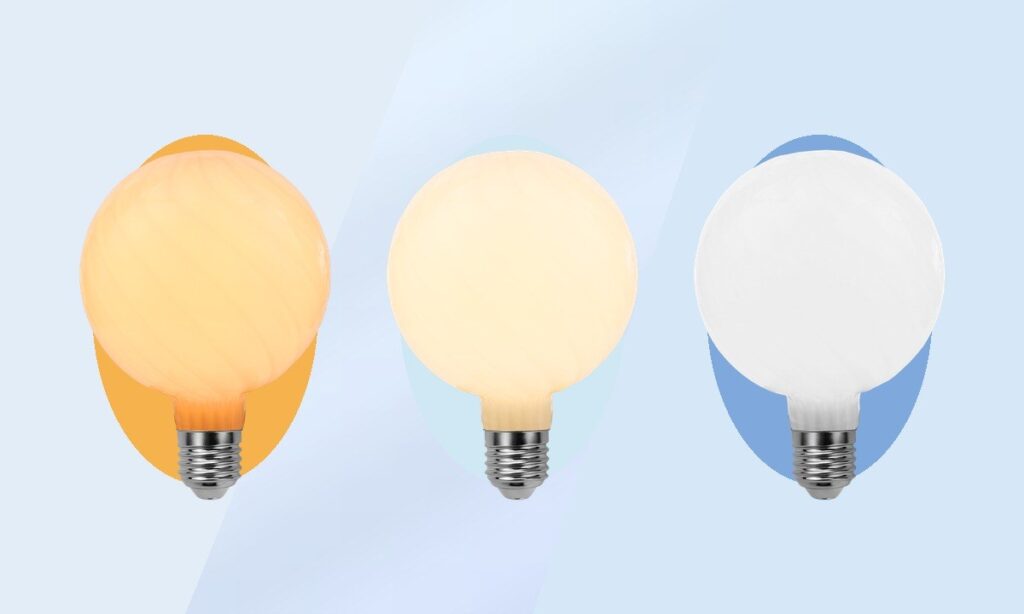
This distinction is especially important when comparing clear, tinted, frosted and coated envelopes. Frost can conceal internal structures and soften source contrast, but its density and uniformity affect the visual result. Clear glass can make the filament or LED structure part of the design, which also makes alignment and consistency more visible. The clear versus frosted filament bulb guide provides the upstream optical choice; the product brief must then define the chosen finish and how it will be judged.
Treat Color as a System Decision
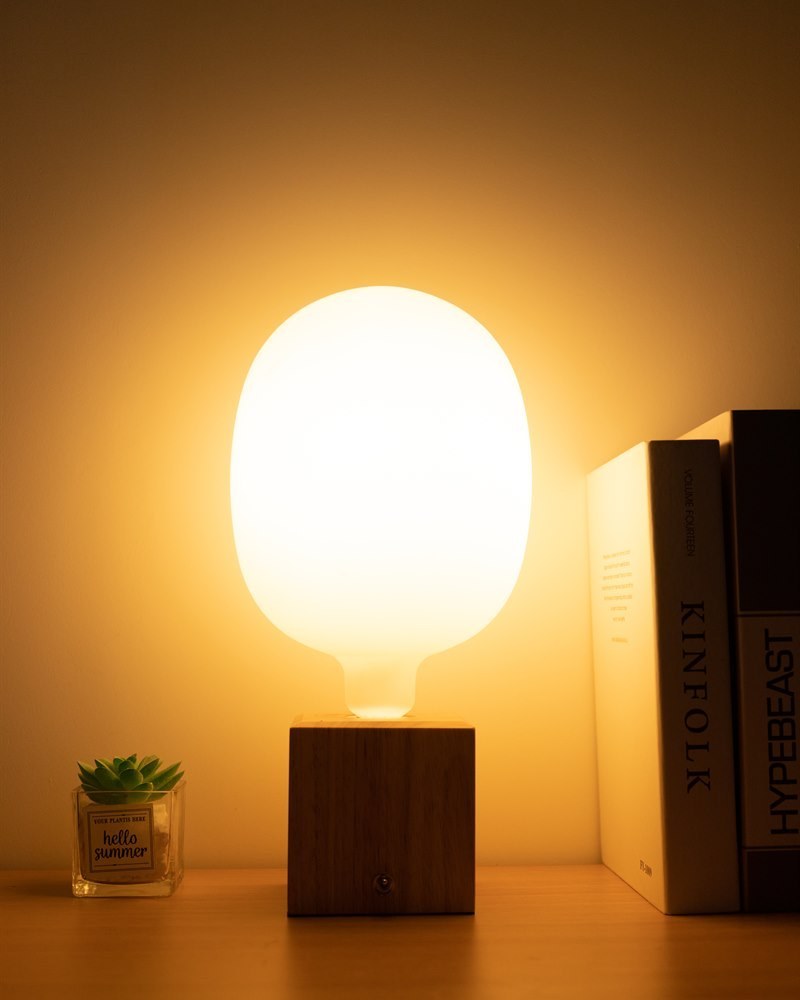
Color appearance is not described adequately by one marketing label. Define the target CCT or chromaticity range, allowable variation, dimming behavior, color-rendering requirements and the reference conditions used for approval.
The Illuminating Engineering Society cautions against treating average color fidelity as the entire visual experience or using one color-rendering specification for every application. A retail display, hospitality table and decorative lobby object can prioritize different aspects of color rendition. Specify the visual task and product category before setting acceptance limits.
Color-tunable products add another layer. The U.S. Department of Energy distinguishes dim-to-warm, white-tunable and full-color-tunable systems because they use different control logic and produce different user experiences. A tunable concept therefore needs an approved operating range, default state, control protocol, transition behavior, power-restoration state and user-interface logic—not merely a statement that the product “changes color.”
Freeze Geometry, Materials and Interfaces
Once the visual direction is accepted, convert it into drawings and a bill of materials. Record all dimensions that affect installation, appearance or interchangeability, including envelope size, cap or mounting interface, cord exit, canopy, shade clearance, centerlines and visible gaps.
For each visible material or finish, define:
- substrate and grade where relevant;
- coating, plating, paint or glass treatment;
- color reference and gloss or texture target;
- approved sample and allowable variation;
- scratch, dent, bubble, contamination and edge-defect limits;
- cleaning or handling constraints that affect appearance.
Do not specify a tolerance simply because it looks precise. A tight tolerance should protect an actual fit, safety or appearance need; otherwise it may add cost without improving the product. Conversely, a broad dimensional tolerance can make seams, alignment or repeated installations visibly inconsistent even when every unit remains functional.
Keep the Electrical and Market Configuration Attached to the Design
Decorative appearance does not replace electrical definition. The same visual form may require different caps, input voltage, frequency, plug, cord, driver, dimmer compatibility, mounting method, instructions and markings for different markets.
Create a configuration table rather than allowing these variants to remain in email threads:
| Configuration field | Required decision | Evidence before release |
|---|---|---|
| Destination and use | Country, indoor/outdoor environment, mounting and user type | Confirmed market and application scope |
| Input and control | Voltage, frequency, dimmer or control protocol, switching behavior | Electrical specification and representative functional test |
| Mechanical interface | Cap, holder, mounting, cord, plug, canopy and installation clearances | Drawing, mating-part check and installation sample |
| Thermal conditions | Enclosure, orientation, ambient range and nearby materials | Defined use conditions and engineering review |
| Labels and instructions | Ratings, warnings, language, model identity and installation limits | Approved artwork tied to the exact configuration |
| Compliance evidence | Applicable route for the product and destination | Model-bound reports, declarations, registrations or certifications as required |
If one product will serve several markets, use controlled variant codes. A shared marketing name should not hide different electrical or regulatory constructions. The factory and manufacturing overview shows the production context in which drawings, approved parts and release records must remain connected.
Use Prototype Stages for Different Questions
One prototype should not be expected to answer every question. Define the purpose of each sample before it is made.
- Appearance sample: checks scale, proportions, visible source, materials and finish. It may not represent final electrical performance.
- Engineering prototype: checks electrical architecture, thermal behavior, assembly, interfaces and control functions.
- Pre-production sample: uses intended materials, tooling, processes, labels and packaging to test whether the approved design can be repeated.
- Golden sample: becomes the controlled physical reference after the drawings, specification and market configuration are aligned.
Record what was intentionally different in each stage. Otherwise, a visually approved appearance sample may be mistaken for evidence that the final driver, thermal path or market configuration was approved as well.

Build a Golden-Sample Package, Not a Lone Object
A golden sample is useful only when it is linked to controlled documents. The release package should contain the approved drawing revision, bill of materials, finish references, electrical specification, labels, instructions, packaging, test plan, acceptance criteria and signed sample record.
Photograph the sample from defined angles and identify any hand-made characteristics that production must not copy. Assign a storage owner and condition, because coatings, adhesives, paper labels and polymers can change over time. If a later sample becomes the new reference, record the superseded sample and the reason for replacement.
Define Production Variation Before the First Order
The difficult question is not whether the approved sample looks good. It is how much variation can occur before installed products no longer look like the same design.
Prioritize characteristics that are visible in groups: CCT and chromaticity, brightness, filament or source alignment, glass tint, coating density, metal finish, seam position and overall dimensions. Decide whether acceptance will use measurements, a visual limit sample, side-by-side comparison or a combination.
For repeated installations, sample multiple units from the same lot and, where risk justifies it, across production dates. A single selected unit cannot reveal distribution. The order specification should state sample quantity, inspection conditions, acceptance rule and disposition of nonconforming units.
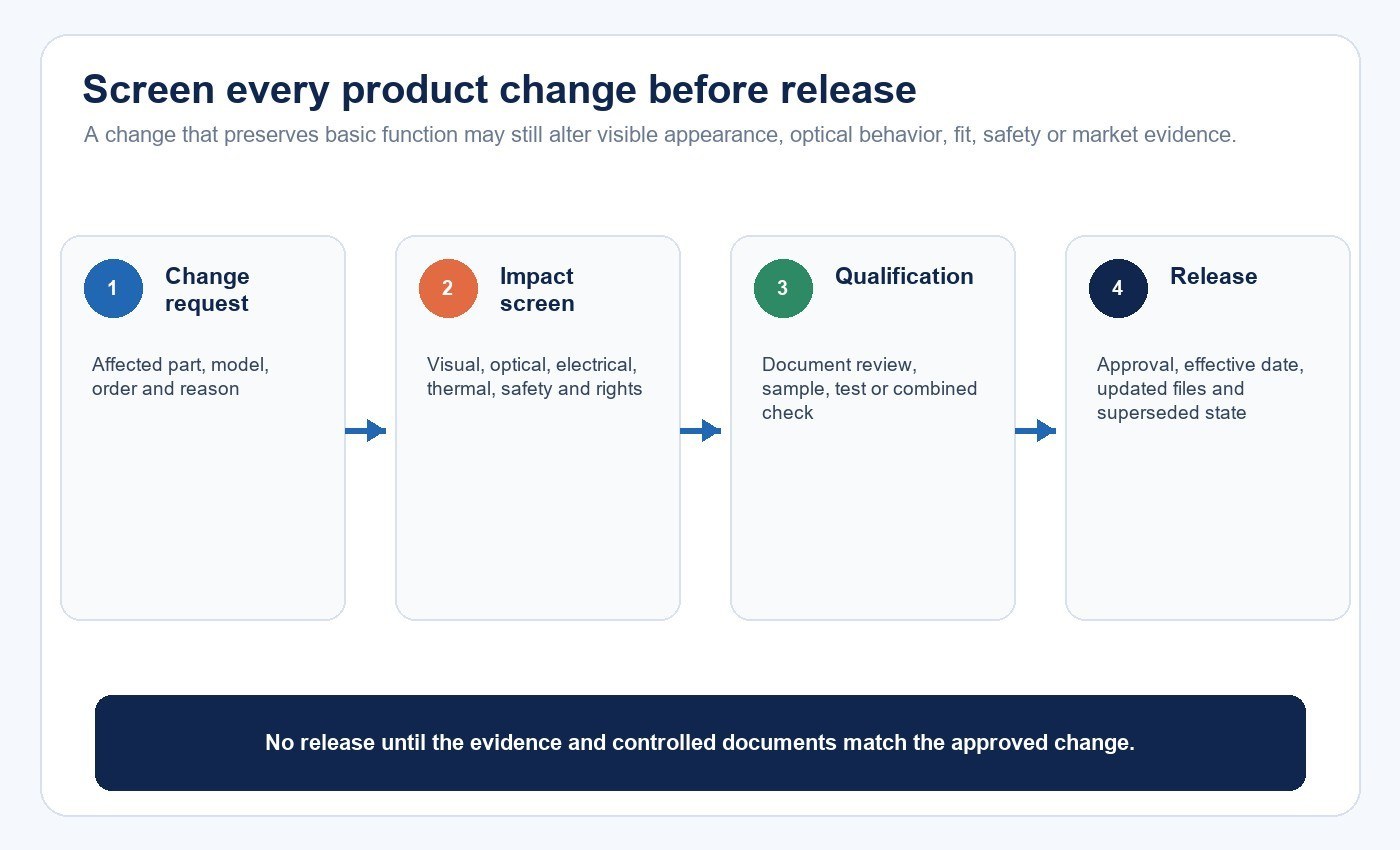
Control Changes That Preserve Function but Alter Appearance
Decorative products are sensitive to changes that may look minor in a conventional functional review. A replacement LED package, phosphor, coating supplier, diffuser, adhesive, driver, glass process or plating bath can alter lit color, off-state appearance, dimming or surface consistency.
Require written approval before changes to critical visual, optical, electrical or safety characteristics. The change notice should identify the affected model and orders, reason, old and new parts, qualification evidence, sample requirement and effective date. For buyer-controlled designs, the contact team can use the completed specification and evidence package to discuss feasibility without restarting from a mood board.
Protect Intellectual Property at the Concept Stage
Custom text, characters, logos, patterns and recognizable shapes may involve trademark, copyright, design-right or licensing questions. Approval to manufacture a lamp is not automatically approval to use every visual element supplied in a reference image.
Record who owns or licenses the design, what territories and product categories are covered, and who approves artwork. Do not assume that a publicly visible image is available for commercial reproduction. If rights are unclear, replace the element before tooling, packaging or promotion creates a larger exposure.
Release Checklist
Before production release, confirm that:
- the application, viewing distance and visual intent are written;
- lit and unlit appearance have separate acceptance criteria;
- color, materials, finish, geometry and interfaces are controlled;
- the electrical and market variant is explicit;
- prototype stages and unresolved differences are recorded;
- the golden sample is tied to current documents;
- production variation and inspection rules are defined;
- critical changes require approval;
- intellectual-property authorization is documented where relevant;
- the product, packaging and instructions carry the same model identity.
Frequently Asked Questions
Is a mood board enough to request an OEM quotation?
It is enough for an early feasibility conversation, but not for a firm production comparison. Add application, dimensions, materials, finish, optical behavior, electrical market configuration, quantity assumptions and the approval stages expected from each supplier.
Should CCT and CRI be the same for every decorative project?
No. Select them from the visual task, surrounding materials and application. Average color fidelity alone does not describe every aspect of appearance, and tunable products require additional control and transition criteria.
What is the difference between a prototype and a golden sample?
A prototype answers a defined development question and may contain temporary parts or processes. A golden sample is the final controlled visual reference linked to released drawings, specifications and market configuration.
Can a photograph be used as the finish standard?
Use it as supporting evidence, not the sole standard. Camera and display conditions alter color and gloss. Pair photographs with a physical sample, finish code, viewing conditions and measurable criteria where practical.
Which changes should trigger a new sample approval?
Any change that can affect visible appearance, optical output, electrical behavior, thermal conditions, safety, fit, markings or market evidence should be reviewed. The approved change plan determines whether a document review, partial test or new sample is required.
How many samples should be checked before production?
There is no universal number. Base the sample plan on order size, process capability, visual sensitivity, supplier history and consequence of failure. Repeated installations usually need more than one unit because variation across a group is part of the design result.
Editorial Sources
- Illuminating Engineering Society, “IES Position Statement on TM-30-18”: https://ies.org/advocacy/ps-11-18/
- U.S. Department of Energy, “Understanding LED Color-Tunable Products”: https://www.energy.gov/cmei/ssl/understanding-led-color-tunable-products
- U.S. Department of Energy, “LED Color Characteristics”: https://www.energy.gov/sites/prod/files/2016/08/f33/led-color-characteristics-factsheet.pdf