

“Professional grade” is useful only when it is translated into requirements that a supplier can document.
A commercial display may need predictable color, repeatable product configuration, planned cable routing, compatible replacement parts and evidence for the destination market. A temporary indoor installation, an exposed building outline and a battery-powered wreath do not need the same product architecture.
Start by defining the installation. Then select among light strings, replaceable bulbs, rope light and battery-powered systems. Compare the complete system—not just the LED—by its environment marking, power source, connections, controls, service method and supporting documents.
Start with the display, not the product name
Before requesting a quotation, document six points:
- Installation zone: indoor, covered outdoor or exposed outdoor.
- Use pattern: short event, seasonal installation or longer-term use.
- Display geometry: tree, façade, roofline, outline, column, wreath or freestanding feature.
- Power access: mains outlet, low-voltage power supply, solar source or battery pack.
- Control need: static output, timer, dimming, flashing or programmed effects.
- Destination market: country, installation rules, purchaser requirements and required certification evidence.
These facts eliminate unsuitable options faster than labels such as commercial, heavy duty or premium.
Compare the four main system types
| System | Useful design characteristic | Questions to resolve before purchase |
|---|---|---|
| Integrated LED light string | Repeated points of light on flexible wire | Indoor/outdoor marking, wire construction, connector system, allowable connections, failed-section behavior and replacement strategy |
| Replaceable-bulb string | Individual lamps installed in sockets | Base and voltage compatibility, socket sealing, lamp orientation, spare-lamp supply, wattage limits and mixed-lamp restrictions |
| LED rope light | Continuous or closely spaced light within a flexible jacket | Bend direction, minimum bend radius, cutting increments, connector sealing, maximum run, mounting clips, power feed and permitted environment |
| Battery-powered system | Installation without a nearby outlet | Cell chemistry, pack enclosure, operating profile, replacement access, timer/control load, low-temperature behavior and runtime test conditions |
This table describes decision areas, not universal product specifications. Actual values must come from the selected model’s instructions, datasheet and certification documentation.
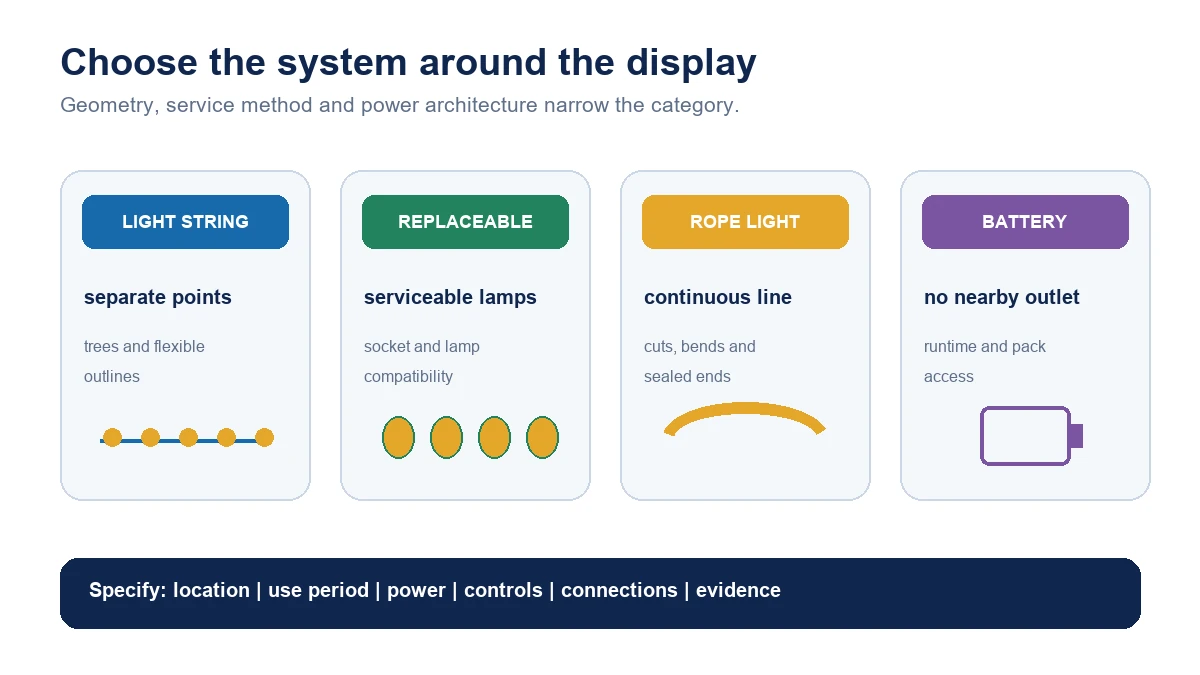
Each category can still contain several electrical architectures. Review current decorative string-light families and decorative LED bulb families only after the project boundary is clear.
Light strings: plan the electrical chain
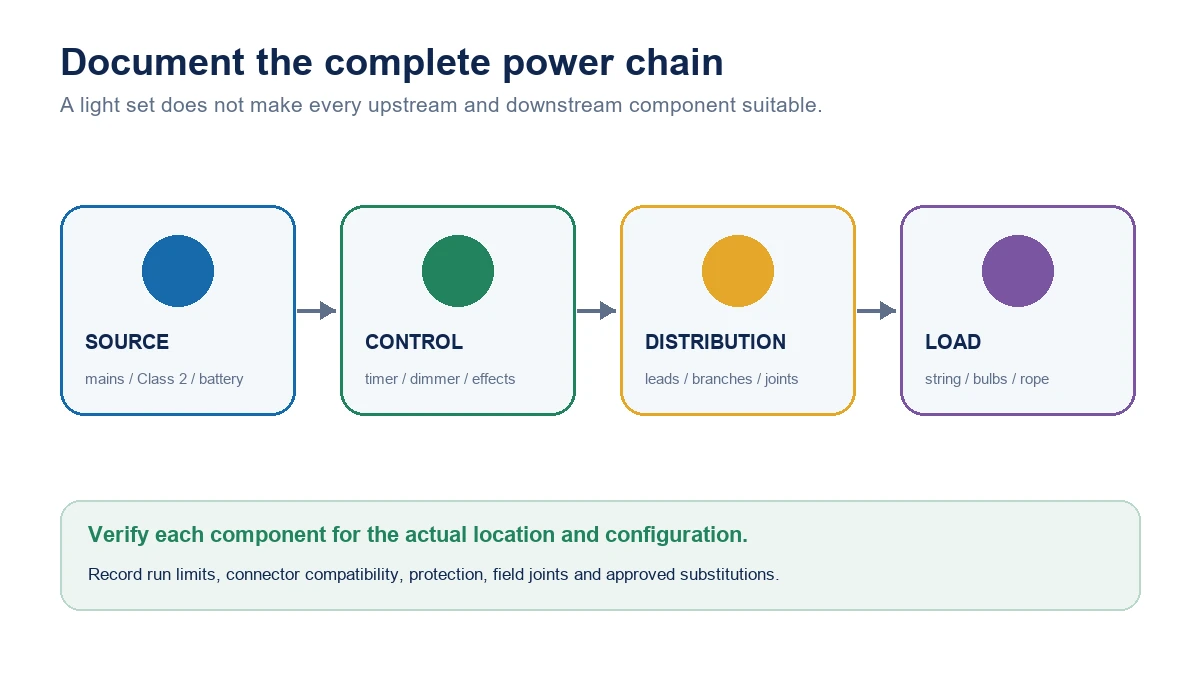
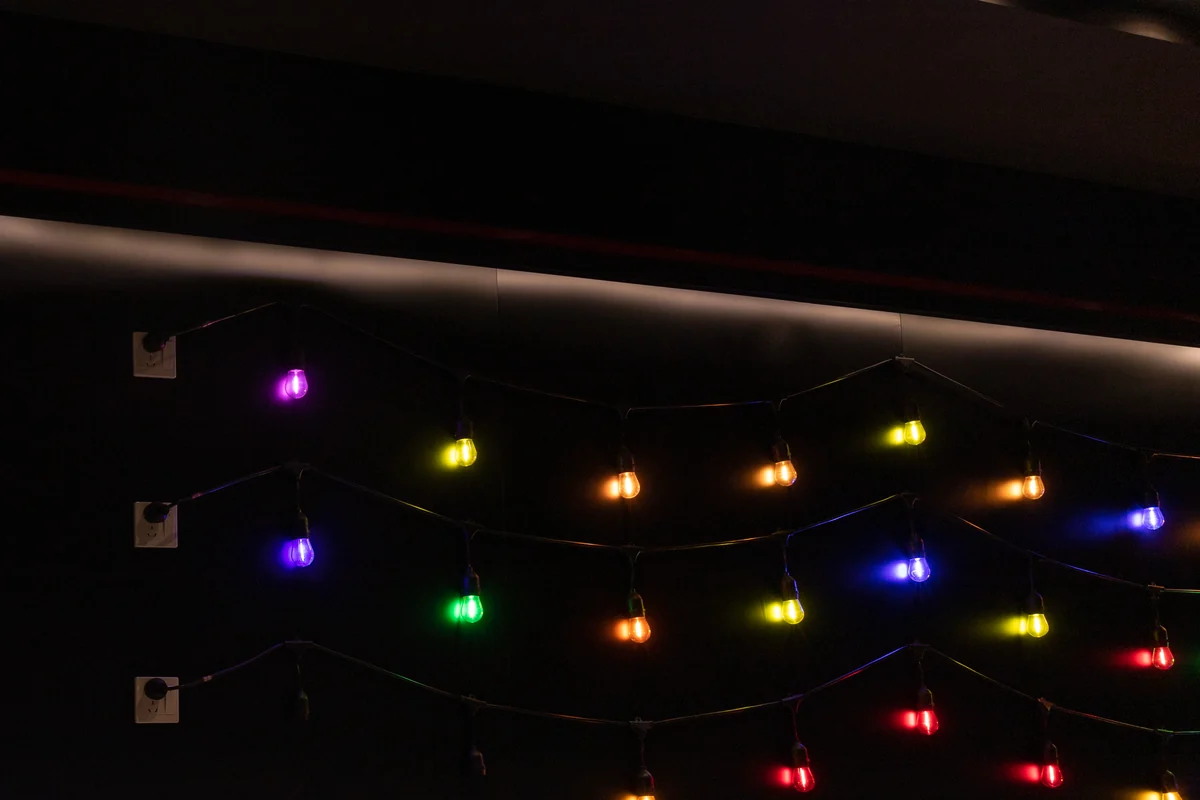
A light string is not only a row of lamps. It includes conductors, insulation, plugs or low-voltage connectors, strain relief, protective devices and sometimes a controller or power supply.
For a large display, prepare a connection schedule. Record how many sets are connected, where power is injected, what controller or transformer is used and how cables are protected from pulling, crushing and sharp edges. Do not copy a connection count from another product. Follow the limit stated for the exact model and operating configuration.
In the United States, CPSC identifies certain seasonal and decorative lighting products within section 15(j) requirements that reference specified UL 588 characteristics, including minimum wire size, strain relief and integral overcurrent protection. Scope matters: the same CPSC material says Class 2 power products, solar-powered products and rope lights or luminaires are outside those particular holiday-light requirements. That is a boundary for a specific provision, not permission to ignore all other product, workplace, electrical or local requirements.
Replaceable bulbs: compatibility must be explicit
Replaceable lamps can simplify localized service and let a display use different bulb shapes or finishes. They also add compatibility questions.
The purchase specification should identify:
- lamp base and socket type;
- rated supply or system voltage;
- permitted lamp wattage or current;
- whether lamps are replaceable while the string remains installed;
- gasket or sealing arrangement where applicable;
- approved replacement part numbers;
- restrictions on mixing lamp types, colors or electrical loads.
A bulb that physically fits is not necessarily electrically or environmentally compatible. A replacement program should use approved parts and retain a record of the original system configuration.
Rope light: verify geometry before ordering length
Rope light is often selected for continuous outlines, curves and linear accents. Its jacket can simplify the visual line, but it does not remove installation limits.
Ask for the allowable cutting increment, maximum run, bend direction, minimum bend radius, feed orientation, connector method, end treatment and mounting spacing. A plan view should mark every cut, feed and corner before production quantities are fixed.
The mounting surface also matters. Tight bends, unsupported spans, pinched sections or incompatible fasteners can damage the product. A curved façade may need short sections and purpose-designed connectors rather than one forced continuous run.
Do not infer outdoor suitability from a clear or thick jacket. Use the exact product marking and installation instructions, and confirm how field-made joints and end caps affect the permitted environment.
Battery systems: runtime is an operating condition
Battery lighting is useful where cables would be visually disruptive or outlets are unavailable. It shifts the design problem from cable routing to stored energy, enclosure access and maintenance.
Runtime cannot be specified honestly without conditions. The result depends on battery chemistry and capacity, LED load, control mode, timer schedule, ambient temperature, battery age and any power-conversion losses. A supplier’s runtime statement should therefore identify the battery type and test mode.
For replaceable-cell products, confirm cell size and chemistry, polarity marking, compartment access, retention method and replacement instructions. For rechargeable products, confirm the charger or input specification, charge protection, indicator behavior and storage guidance. In either case, the battery pack and wiring must be protected against physical damage and unintended short circuits.
CPSC’s broader battery-safety material emphasizes that product design, manufacturing quality, protective circuits and component control all contribute to risk management. A battery name alone does not establish system safety.
Indoor, covered outdoor and exposed outdoor are different decisions
“Outdoor” should be verified from the selected product’s marking and instructions. It should not be inferred from the product photo, cable color or seller description.
Define the exposure more precisely:
- Indoor: protected from precipitation, but still subject to contact, heat sources, cleaning and egress constraints.
- Covered outdoor: protected by a roof or enclosure, yet potentially exposed to humidity, wind-driven moisture and temperature changes.
- Exposed outdoor: directly subject to precipitation, wind, sunlight, temperature cycling and water around connections.
Power supplies, controllers, extension cords, connectors and junction points need their own suitability review. An outdoor-marked light set does not make an indoor-only power component suitable for an exposed location.
CPSC advises consumers to use lights marked for indoor or outdoor use as intended and to follow manufacturer limits on connecting sets. For commercial work, convert that basic advice into a documented installation schedule and approval check.
Temporary and long-term installations need different evidence
Many decorative systems are designed for temporary seasonal use. A product that performs well during a managed holiday program is not automatically suitable for permanent architectural installation.
For temporary displays, the plan should include installation and removal dates, inspection before reuse, storage method, spare parts and responsibility for damaged sections. For longer-term installations, ask whether the selected product and mounting system are explicitly intended for that duration and environment.
Do not extend the use period based only on LED lifetime language. Cable, connectors, jackets, adhesives, batteries, drivers and controls may have different limitations.
What documentation should a commercial buyer request?
Create a model-level evidence file rather than accepting a general certificate folder. It should contain:
- exact model and configuration;
- datasheet and installation instructions;
- product and packaging markings;
- bill-of-material or approved-component controls where available;
- certification or test documents required for the destination market;
- scope showing which models and variants the documents cover;
- connector, controller and power-supply compatibility;
- environmental and use-duration limitations;
- sample inspection and change-control record.
Certification marks should be checked against the actual model and issuing body’s records where applicable. A logo on an unrelated series page is not evidence for the product being purchased.
Build the quotation request around the real project
A useful request for quotation includes a drawing or annotated photo, total required length or point count, spacing, cable color, light color, installation zone, power locations, controller requirements, use period, destination market and delivery packaging needs.
Also identify what the supplier must include: power supplies, extension leads, branch connectors, end caps, mounting clips, spare lamps, batteries, chargers and controls. Many project delays come from an incomplete system boundary rather than from the light source itself.
Before volume production, review a representative sample in the intended layout. Check appearance, color consistency, connector fit, mounting, control behavior, service access and labeling. Record the approved configuration so later substitutions can be evaluated. The broader New Lights product range can be filtered only after these system requirements are documented.
To discuss a model-specific system, contact New Lights with the display layout, installation environment, power source, control method and destination market.
Buyer checklist
- [ ] Product category matches the display geometry.
- [ ] Indoor, covered or exposed location is documented.
- [ ] Temporary or longer-term use is confirmed.
- [ ] Power architecture and every system component are defined.
- [ ] Connection count, run length and feed plan use model-specific limits.
- [ ] Replaceable lamps and spare parts are electrically compatible.
- [ ] Battery chemistry, enclosure and runtime conditions are stated.
- [ ] Required market documents cover the exact model.
- [ ] Field joints, end caps and mounting methods are included in the review.
- [ ] A sample and change-controlled configuration are approved.
Frequently asked questions
What does professional grade mean for Christmas lights?
It is not a complete specification. Define the environment, use period, electrical architecture, service plan and required evidence, then compare models against those requirements.
Are LED rope lights better than string lights?
Neither is universally better. Rope light can suit continuous outlines, while strings provide separate points of light and different layout flexibility. Select by geometry, optical effect, connections, service and product limits.
Can indoor Christmas lights be used in a covered outdoor area?
Do not assume so. A covered area may still experience moisture and temperature changes. Follow the exact product marking and installation instructions.
How many light strings can be connected together?
Use the maximum stated for the exact product and configuration. The answer depends on the electrical design, load, connector system and protective devices.
How long will battery-operated Christmas lights run?
Runtime depends on battery chemistry and capacity, LED load, control mode, timer schedule, temperature and battery condition. Request a stated test condition rather than a context-free number.
Does a rope light’s exclusion from one CPSC holiday-light rule mean it needs no safety review?
No. It only describes the scope of that particular provision. Other product, electrical, workplace, retailer or local requirements may still apply.
Should I request a certification mark or a report?
Request evidence that can be traced to the exact model and configuration, then check the applicable issuing-body record and destination-market requirements. A mark by itself does not define the full product scope.
Editorial sources
- U.S. Consumer Product Safety Commission, “Overview of Battery Safety Requirements”: https://www.cpsc.gov/s3fs-public/2-2-Overview-of-Battery-Safety-Requirements-Transcript-English-FINAL.pdf
- U.S. Consumer Product Safety Commission, “Holiday Decoration Safety Tips”: https://www.cpsc.gov/s3fs-public/611.pdf
- U.S. Consumer Product Safety Commission, “Extension Cords Business Guidance”: https://www.cpsc.gov/Business–Manufacturing/Business-Education/Business-Guidance/Household-Electrical-Products/Extension-Cords
- UL Solutions, “BULLETIN: Decorative Lighting Strings”: https://www.ul.com/news/bulletin-decorative-lighting-strings
- UL Solutions, “Naughty or nice: where UL tests the safety of holiday products”: https://www.ul.com/news/naughty-or-nice-where-ul-tests-safety-holiday-products