

There is no single lifespan that applies to every filament LED bulb. The useful answer is the rated life published for the exact model, together with the definition, test basis and operating conditions behind that rating.
A filament bulb contains more than LED chips. It also includes a driver, electrical connections, an envelope and a thermal design. A lamp may gradually lose light output, change color beyond an acceptable limit, begin to flicker or stop operating because another component fails. Understanding those different outcomes is more useful than repeating one industry-wide hour range.
Rated Life Is Not a Countdown Clock
Rated life is a statistical or performance-based description established under defined conditions. It does not promise that every individual lamp will fail at the same hour.
For LED products, lifetime discussions often use lumen maintenance. The US Department of Energy explains that useful LED life is commonly described by the number of operating hours until light output falls to 70% of its initial level. This is often written as L70.
L70 is useful, but it does not describe every way a complete bulb can reach the end of useful service. The lamp may still emit light at L70, and a project may accept or reject that output depending on its requirements. Conversely, a driver or connection can fail before the LED emitters reach the projected lumen-maintenance point.
When comparing two products, first ask what the stated hours represent:
- A lumen-maintenance projection such as L70.
- A rated average life under a defined test method.
- A warranty period, which is a commercial commitment and not the same as rated life.
- A marketing statement with no visible test basis.
Those numbers should not be treated as interchangeable.
Why Filament Construction Does Not Produce One Universal Answer
LED filament bulbs use elongated light-emitting elements arranged inside the bulb envelope. The filament substrate, LED chips, phosphor system, drive current, gas or internal environment, envelope and driver design all contribute to operating temperature and performance.
Research published in the Journal of Luminescence shows that substrate dimensions and gas choices can affect thermal and optical behavior. Filament design details therefore belong in a complete-lamp comparison alongside the driver, operating conditions and rated-life basis.
The complete lamp must be evaluated as a system. Two bulbs with a similar clear-glass appearance can use different drivers, filament loading, components and thermal designs. Their rated lives may therefore differ even when their wattage and shape look alike. The filament LED and standard LED comparison explains how those construction differences affect product selection.
Lumen Depreciation and Abrupt Failure Are Different
An LED light source can continue operating while gradually producing less light. This is lumen depreciation. If the decline reaches the threshold used by the product’s life definition, the product may be considered to have reached the end of useful life even though it has not gone dark.
Abrupt failure is different. The lamp may stop operating, flicker, cycle, fail to start or become unstable because of a driver, connection or component fault. DOE reliability guidance emphasizes that lumen maintenance alone cannot describe every failure mode of an LED system.
For buyers, that distinction changes the evidence to request. LED package lumen-maintenance data can support one part of a lifetime assessment, but the complete bulb also needs a credible system-level rating, quality controls and model-specific documentation.
Heat and Operating Conditions Matter
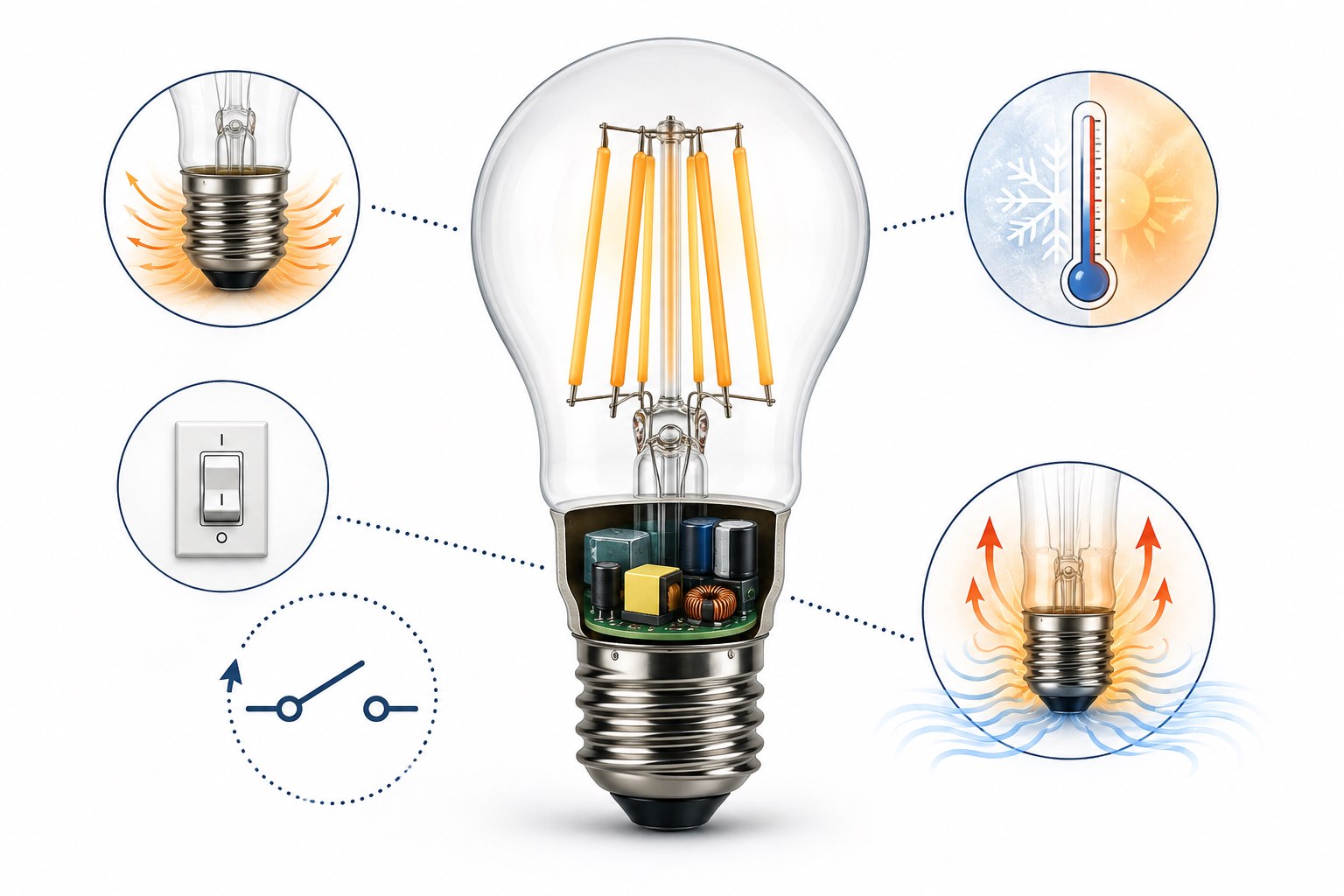
Temperature affects LED performance and the reliability of electronic components. The important temperature is not simply whether the glass feels cooler than an incandescent lamp. Heat can be concentrated around the filaments, driver or base, and the fixture changes how that heat is removed.
Factors to check include:
- Ambient temperature around the lamp.
- Open versus enclosed fixture construction.
- Lamp orientation.
- Power and drive current.
- Airflow around the bulb and base.
- Driver design and component ratings.
- Supply-voltage quality.
- Dimming system and operating level.
A bulb approved for an open pendant should not automatically be assumed suitable for a sealed globe or another enclosed fixture. Use the exact product’s fixture rating and operating limits.
The Driver Can Limit Complete-Bulb Life
The LED emitters need controlled electrical power. In an integral replacement bulb, that function is handled by electronics packaged within a small volume, often close to the lamp base.
DOE guidance identifies driver electronics and thermal conditions as important reliability concerns in LED systems. That does not mean the driver is always the first component to fail, but it explains why LED-chip lifetime cannot be presented as complete-bulb lifetime.
Model comparison should therefore consider more than a chip or filament claim. Ask whether the published rating applies to the complete lamp, which conditions were used, and whether the manufacturer can provide supporting product documentation.
How to Convert Rated Hours Into Years
Rated hours can be converted into an estimated calendar period with a simple calculation:
estimated years = rated hours ÷ (operating hours per day × 365)
This calculation only translates units. It does not improve the underlying rating or predict the exact failure date. If daily use changes, the calendar estimate changes. If the lamp operates outside its specified conditions, dividing the rated hours by daily use may create a misleading result.
US Lighting Facts labels for covered lamps present expected life using a defined daily-use assumption. For commercial projects with longer operating hours, recalculate the calendar estimate using the project’s realistic schedule and keep the original rated hours visible.
Do Filament LED Bulbs Last Longer Than Incandescent Bulbs?
LED and incandescent lamps generate light in different ways. An incandescent lamp heats a metal filament until it glows; a filament LED uses semiconductor emitters arranged in a filament-like form.
An individual product comparison should use the ratings and evidence for the two exact lamps. It is reasonable to compare their published life, watts, lumens and replacement requirements, but avoid converting a general technology difference into a guarantee for every model.
For a replacement project, also verify base, voltage, dimensions, color temperature, dimming and fixture suitability. A longer rated life does not compensate for an incompatible lamp.
Why a Bulb May Fail Earlier Than Expected
An early failure does not have one universal cause. A structured review should examine:
- Fixture conditions: Was the bulb used in an enclosed or hot fixture not allowed by its specification?
- Supply conditions: Was the voltage correct and stable for the model?
- Dimming: Was a dimmable lamp used with a compatible dimmer and within the intended load conditions?
- Operating environment: Did ambient temperature, vibration, moisture or contamination exceed the stated limits?
- Product consistency: Do failures cluster by batch, component or installation location?
- Failure mode: Did the lamp go dark, flicker, cycle, shift color or gradually lose output?
Record the model, batch, installation date, fixture, daily schedule and failure behavior. That evidence is more useful to a supplier or quality team than saying only that the bulb “did not last.”
What Lifetime Evidence Should a Supplier Provide?
| Evidence item | What it should identify | Why it matters |
|---|---|---|
| Rated-life value | The exact model and stated hours | Prevents a family-level claim from being applied to every bulb |
| End-of-life definition | Lumen-maintenance threshold, survival criterion or another stated endpoint | Separates gradual light loss from complete lamp failure |
| Test and operating conditions | Temperature, switching pattern, fixture restrictions and other declared conditions | Shows whether the evidence matches the intended application |
| Warranty | Coverage period, terms and exclusions | Keeps a commercial commitment separate from the technical life rating |
A useful lifetime statement should be traceable to a specific product rather than applied to an entire bulb family. Start with the model number, electrical rating and the declared operating conditions. Then ask how the stated hours were established and whether the value describes lumen maintenance, survival, a complete-lamp test or another criterion.
For a purchasing file, collect:
- The current datasheet showing the exact model and rated-life value.
- The definition used for end of useful life.
- Test conditions, sample information and any projection method referenced by the supplier.
- Temperature and fixture restrictions that apply to the rating.
- Dimming, switching and orientation conditions, where relevant.
- Warranty terms and exclusions as a separate commercial document.
- Batch identification and a process for reporting field failures.
The evidence should match the destination market and the application. A decorative lamp used for a few evening hours in an open pendant has a different operating profile from a lamp running long shifts in an enclosed hospitality fixture. Comparing those applications only by calendar years can hide the difference in daily operating hours and temperature.
Plan Maintenance Around the Application
Rated life helps estimate maintenance demand, but it should be combined with access, labor and replacement strategy. In a hotel chandelier, a single early failure may be visually disruptive even when access is easy. In a high ceiling, access equipment and labor may cost more than the lamp. In a group relamping program, color consistency between old and new lamps may matter as much as whether each lamp still operates.
Define the acceptable failure condition for the project. It may include low output, visible color difference, flicker, unstable dimming or complete failure. Keep a small number of approved replacement lamps from the same specification, and record installation dates and locations. That creates a field history that can be compared with the supplier’s rating and used to improve the next purchase.
A Buyer’s Lifetime-Claim Checklist
Before approving a filament LED bulb, request or confirm:
- Rated life in hours for the exact model.
- The definition used for that rating.
- Whether the value applies to the complete lamp or only an LED component.
- Operating temperature and fixture restrictions.
- Enclosed-fixture suitability where required.
- Dimmable status and control compatibility.
- Voltage, frequency and base.
- Warranty terms, kept separate from rated life.
- Relevant test or certification evidence for the destination market.
- Sample performance in the intended fixture.
If a quotation lists only a large hour number without the model, conditions or definition, the claim is not ready for a purchasing comparison.
Frequently Asked Questions
Do all filament LED bulbs have the same rated life?
No. Rated life is model-specific and depends on the product design and stated test basis.
Is L70 the same as complete lamp failure?
No. L70 describes a lumen-maintenance point. The lamp may still emit light, while other components can also create different end-of-life conditions.
Does a higher hour rating guarantee a longer real-world life?
No. It is useful only when the compared ratings use credible definitions and the lamps operate within their specified conditions.
Can an enclosed fixture shorten service life?
It can increase operating temperature. Use a bulb in an enclosed fixture only when the exact model is rated for that condition.
Does frequent switching reduce filament LED life?
The answer depends on the complete lamp and driver design. Do not publish a universal switching limit unless the model documentation provides one.
Is the warranty the same as rated life?
No. Rated life is a performance or statistical specification; a warranty is a commercial commitment with its own duration, conditions and remedies.
Prepare a Model-Level Comparison
When requesting a filament bulb recommendation, provide the bulb shape, base, voltage, lumen target, color temperature, dimming system, fixture type, expected daily hours and destination market. Review available LED filament bulb families and send project-specific questions through the New Lights contact page. For a broader format decision, compare filament LED and standard LED bulbs.
The product’s rated-life evidence should be reviewed together with the actual fixture and operating conditions before samples or production quantities are approved.