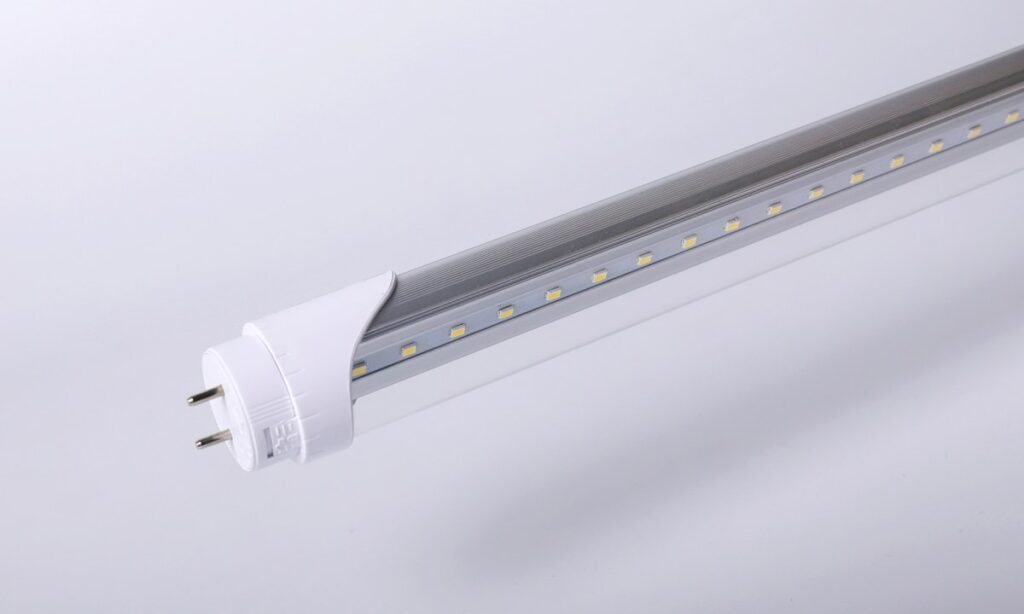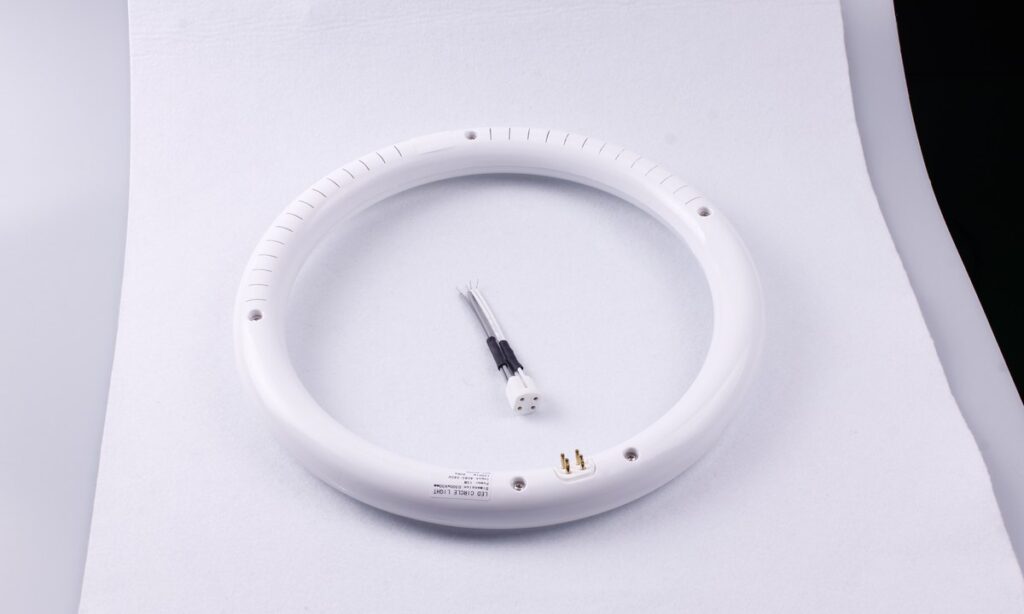


A spiral bulb that flickers is often a compact fluorescent lamp, or CFL, but identify the lamp from its marking before troubleshooting. Some modern products use a spiral-looking envelope or decorative form while relying on a different technology.
If it is a CFL, visible flicker can come from the lamp’s integrated ballast, an incompatible dimmer or control, poor contact in the fixture, a fixture fault or a broader supply problem. The symptom alone cannot prove which cause is present.
Start with non-invasive checks. Switch off power and allow the lamp to cool before handling it. Stop using the fixture and call a qualified electrician if you see damage, smell overheating, hear arcing or buzzing from the socket, or find that several lights on the circuit behave abnormally.
First, confirm what the spiral bulb is
Read the printing on the base or packaging. Look for:
- technology, such as CFL or LED;
- rated wattage;
- input voltage and frequency;
- dimmable or non-dimmable status;
- base designation;
- manufacturer and model;
- disposal or mercury information.
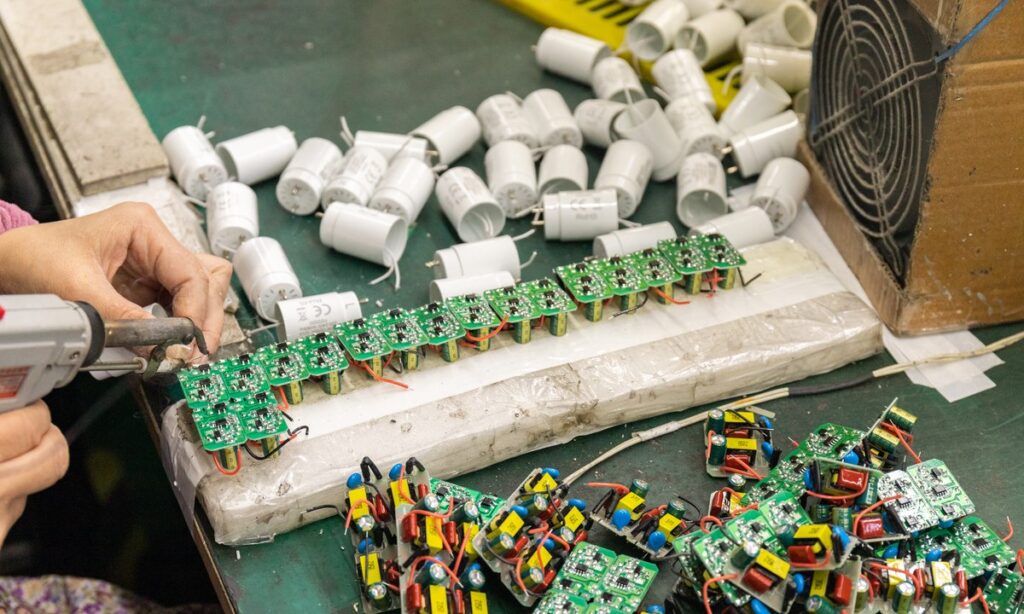
DOE defines an integrated CFL as a lamp containing the components required for starting and stable operation and able to connect through a standard lamp base. In a spiral CFL, the curved fluorescent tube is visible above the base, while the ballast electronics are housed in the base.
Do not disassemble the base. It is not a user-serviceable ballast.
What flicker means—and what it does not mean
Flicker is a variation in light output over time. DOE uses the broader term temporal light modulation for the changing waveform and temporal light artifacts for visible or other responses to that modulation.
Electric light sources and their control gear can produce different modulation patterns. Fluorescent operation depends on ballast behavior, while LED operation depends on driver and control design. A phone-camera banding pattern is not a complete diagnostic test because camera shutters can reveal modulation that a person does not see, and camera settings can change the result.
For troubleshooting, record the observed pattern:
- continuous visible flicker;
- intermittent flashes;
- flicker only during startup;
- flicker only at one dimmer setting;
- flicker after the lamp becomes warm;
- several lamps flickering together;
- flicker accompanied by sound, odor or heat.
The pattern helps isolate the next check, but it does not authorize repair of energized equipment.
| Pattern | First question | Safer next step |
|---|---|---|
| One lamp flickers | Does a compatible known-good lamp operate normally? | Power off, cool the lamp and make a controlled lamp swap in an intact fixture |
| Flicker changes with dimmer position | Are the exact lamp and control documented as compatible? | Stop using an uncertain pairing and check both manufacturers’ instructions |
| Several lamps change together | Is a shared control or circuit involved? | Leave the circuit investigation to a qualified electrician |
| Flicker comes with odor, arcing, smoke or unusual heat | Is there an immediate fixture or connection hazard? | Switch off and stop using the fixture |
| Spiral tube is broken | Has the area been isolated and ventilated? | Follow current EPA cleanup guidance and local disposal rules |
Possible cause 1: the lamp or integrated ballast is aging
The ballast inside an integrated CFL provides the starting and operating conditions for the fluorescent tube. Components can age, and the lamp may become unstable near end of service.
If only one lamp flickers while other equivalent lamps on the same fixture or circuit operate normally, the lamp itself is a reasonable first item to isolate. After switching off power and allowing it to cool, replace it with a known-good lamp that is compatible with the fixture and control.
If the known-good lamp operates normally, retire the suspect CFL rather than repeatedly cycling or disassembling it. Follow local recycling rules for mercury-containing lamps.
If the replacement is stable, the original lamp is the practical suspect. The internal failure mode does not need to be identified before the lamp is removed from service and recycled.
Possible cause 2: the lamp is not compatible with the dimmer
Many spiral CFLs are non-dimmable. A non-dimmable CFL should not be operated on a dimming control. Even a dimmable CFL needs a compatible control and connected load.
Check the exact lamp and dimmer documentation. Do not rely on a wall plate that merely looks like a standard switch. Some smart controls, illuminated switches, sensors or timers can also interact with the lamp differently from a plain mechanical switch.
Clues that justify a compatibility review include:
- flicker only at reduced settings;
- difficulty starting at a low setting;
- flashing after switch-off;
- buzzing from the lamp or control;
- stable operation on a documented compatible non-dimming test fixture.
Do not bypass or rewire the control yourself unless you are qualified and the work follows applicable requirements. The safer user-level action is to stop using the questionable combination and have the correct lamp-control pairing specified.
Possible cause 3: poor seating or damaged contact
A lamp that is not seated correctly may make intermittent contact. Turn off power, allow the lamp to cool and remove it by holding the base—not the spiral glass tube. Inspect without touching or modifying internal socket contacts.
Look for:
- damaged or corroded base threads;
- cracked insulation;
- darkening or heat discoloration;
- debris in the lampholder;
- a loose or damaged fixture;
- signs that the lamp was cross-threaded or overtightened.
Gently install a compatible known-good lamp until it is snug. Do not force it and do not bend a socket contact tab. If the lampholder is damaged, loose or discolored, leave the fixture off and arrange professional repair or replacement.
Possible cause 4: the fixture is thermally unsuitable
Some CFLs have restrictions for enclosed fixtures, high temperatures or operating orientation. Heat can stress ballast electronics and change lamp behavior.
Check the lamp packaging or datasheet and the fixture instructions. Record whether the lamp is inside a sealed globe, surrounded by insulation, near another heat source or used in an orientation not permitted by the manufacturer.
Do not remove a protective cover or alter the fixture to create ventilation. Use a lamp and luminaire combination documented for the actual conditions.
Possible cause 5: the problem is in the fixture or circuit
If more than one compatible known-good lamp flickers in the same socket, the fixture or supply becomes a stronger suspect. If multiple lights flicker together, especially on the same circuit, the issue may extend beyond one lamp.
Stop and seek a qualified electrician when:
- several lights change together;
- flicker responds to other appliances switching on;
- the fixture, switch or panel makes unusual sounds;
- there is an odor, visible arcing, smoke or excessive heat;
- the socket is loose, cracked or discolored;
- breakers trip or fuses open;
- the problem persists with a known-good compatible lamp.
Do not open the fixture, expose conductors or test energized terminals as a DIY troubleshooting step.
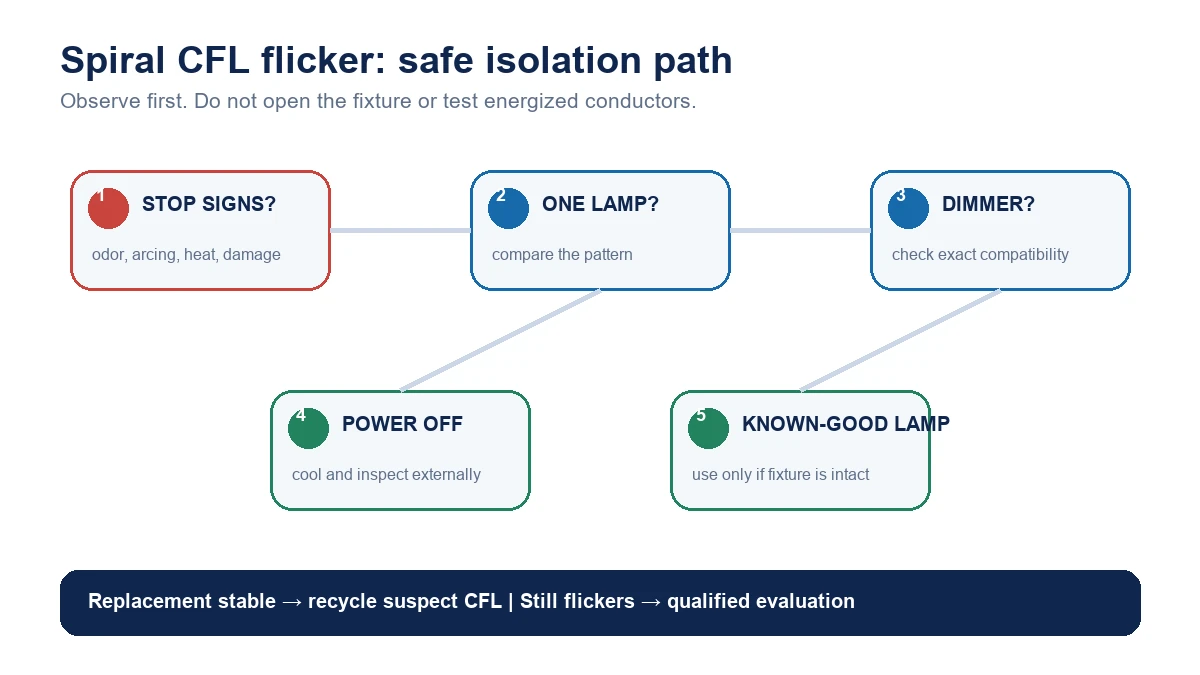
A safe isolation sequence
- Observe without touching. Note whether one lamp or several are affected and whether a dimmer or control is present.
- Switch off power. If there are signs of overheating or arcing, stop using the fixture and isolate it according to qualified safety practice.
- Allow the lamp to cool. CFL tubing and base components can be hot.
- Read the marking. Confirm technology, voltage, wattage and dimmable status.
- Inspect externally. Look for cracks, discoloration, damaged threads or fixture damage.
- Try a known-good compatible lamp. Do this only in an intact fixture and without modifying the socket.
- Compare the result. If the replacement is stable, recycle the suspect CFL. If it also flickers, stop and have the fixture or circuit evaluated.
- Document commercial cases. Record lamp model, fixture, control, circuit pattern and operating conditions before requesting technical support.
If the spiral CFL breaks
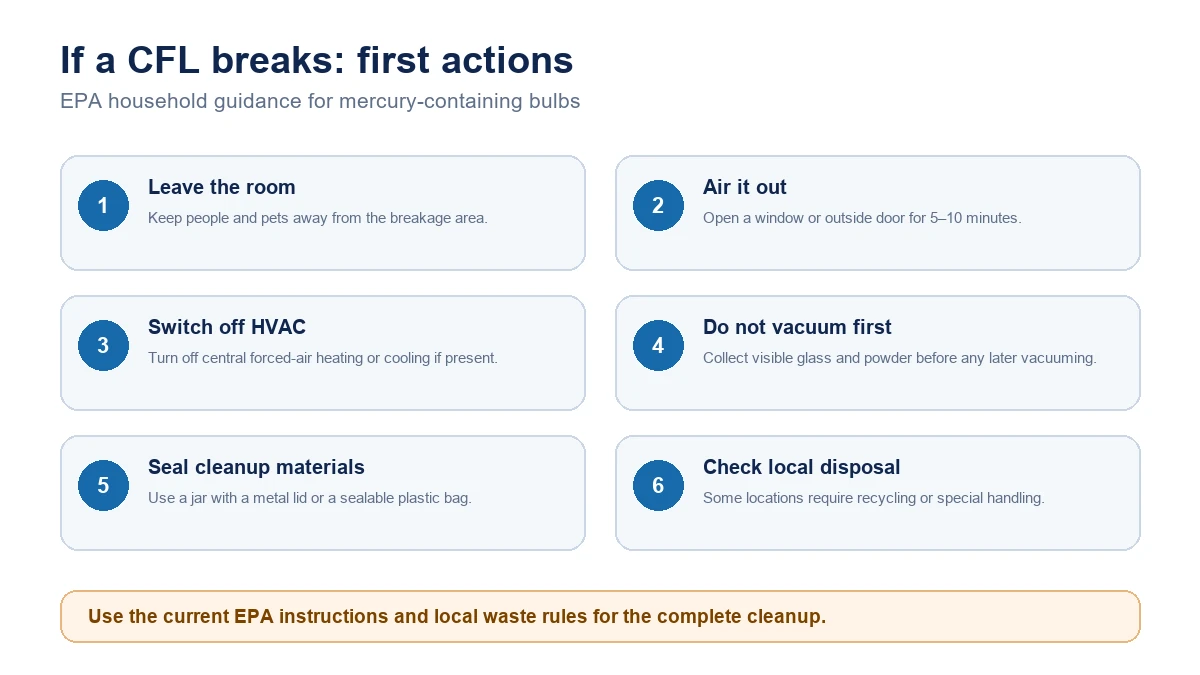
CFLs contain a small amount of mercury sealed inside the tubing. EPA provides specific cleanup guidance. For a household breakage in the United States, EPA advises people and pets to leave the room, air it out, shut off central forced-air heating or cooling where applicable, and follow its detailed collection and disposal steps.
EPA advises against vacuuming during the initial cleanup because vacuuming can spread mercury-containing powder or vapor. Do not improvise by sweeping aggressively or handling fragments with bare hands. Follow the current EPA page and local waste rules, which may require recycling or special disposal.
An intact CFL does not release mercury during normal use, but it should still be recycled or disposed of according to local requirements at end of life.
Should you replace the CFL with an LED?
An LED replacement can be appropriate when it matches the required lumens, base, voltage, dimensions, fixture enclosure, operating environment and control. Do not choose only by the CFL’s wattage. Start with the LED bulb category or browse the broader New Lights product range after recording the existing lamp and fixture conditions.
If the fixture uses a dimmer, select an explicitly dimmable LED and verify the dimmer combination. If the CFL broke, complete the approved cleanup before installing another lamp.
For a commercial replacement inquiry, contact New Lights with the lamp marking, fixture type, control model, symptom pattern and whether other lamps are affected.
FAQ
Is every spiral bulb a CFL?
No. The familiar exposed spiral tube is commonly a CFL, but identify the technology from the product marking before applying CFL-specific advice.
Is brief flicker at startup normal?
Startup behavior varies by product and temperature. Repeated, persistent or worsening visible flicker should be compared with the manufacturer’s instructions and isolated using a compatible known-good lamp.
Can I use a non-dimmable CFL on a dimmer at full brightness?
Do not assume this is acceptable. Follow the lamp and control instructions; a non-dimmable lamp should not be used on a dimming control unless the manufacturer explicitly permits the combination.
Why do several bulbs flicker at the same time?
That pattern is less consistent with one failed lamp and may involve a shared control, fixture connection or circuit condition. Stop non-invasive testing and arrange qualified electrical evaluation.
Can I tighten or bend the socket contact?
Do not modify internal socket contacts as a user-level fix. A damaged or loose lampholder should be repaired or replaced by a qualified person with the circuit safely isolated.
Can a flickering CFL be repaired?
An integrated CFL is not intended for user repair. Replace and recycle it if lamp-level isolation identifies it as the suspect.
What should I do if the CFL breaks?
Leave and ventilate the room, avoid initial vacuuming, and follow EPA’s current broken-CFL cleanup steps and local disposal requirements.
Editorial sources
- U.S. Department of Energy, “Compact Fluorescent Lamps”: https://www.energy.gov/cmei/buildings/compact-fluorescent-lamps
- U.S. Department of Energy, “Fluorescent Lamp Ballasts”: https://www.energy.gov/cmei/buildings/fluorescent-lamp-ballasts
- U.S. Department of Energy, “Flicker Basics”: https://www.energy.gov/cmei/ssl/flicker-basics
- U.S. Environmental Protection Agency, “Compact Fluorescent Light Bulbs”: https://www.epa.gov/mercury/compact-fluorescent-light-bulbs-cfls
- U.S. Environmental Protection Agency, “Cleaning Up a Broken CFL”: https://www.epa.gov/mercury/cleaning-broken-cfl