

International lighting buyers do not reduce supplier selection to a factory photograph, a certificate logo or the lowest quotation. Those items may help start a conversation, but they do not show whether a supplier can translate a specification into repeatable production for a particular market.
The useful question is not simply, “Is this a good supplier?” It is, “Can this supplier deliver this defined product, with the required evidence and controls, for this order and destination market?” Answering that question requires a structured qualification process.
This guide explains the evidence buyers can request from a Chinese lighting supplier, how to compare responses and where common shortcuts create risk.
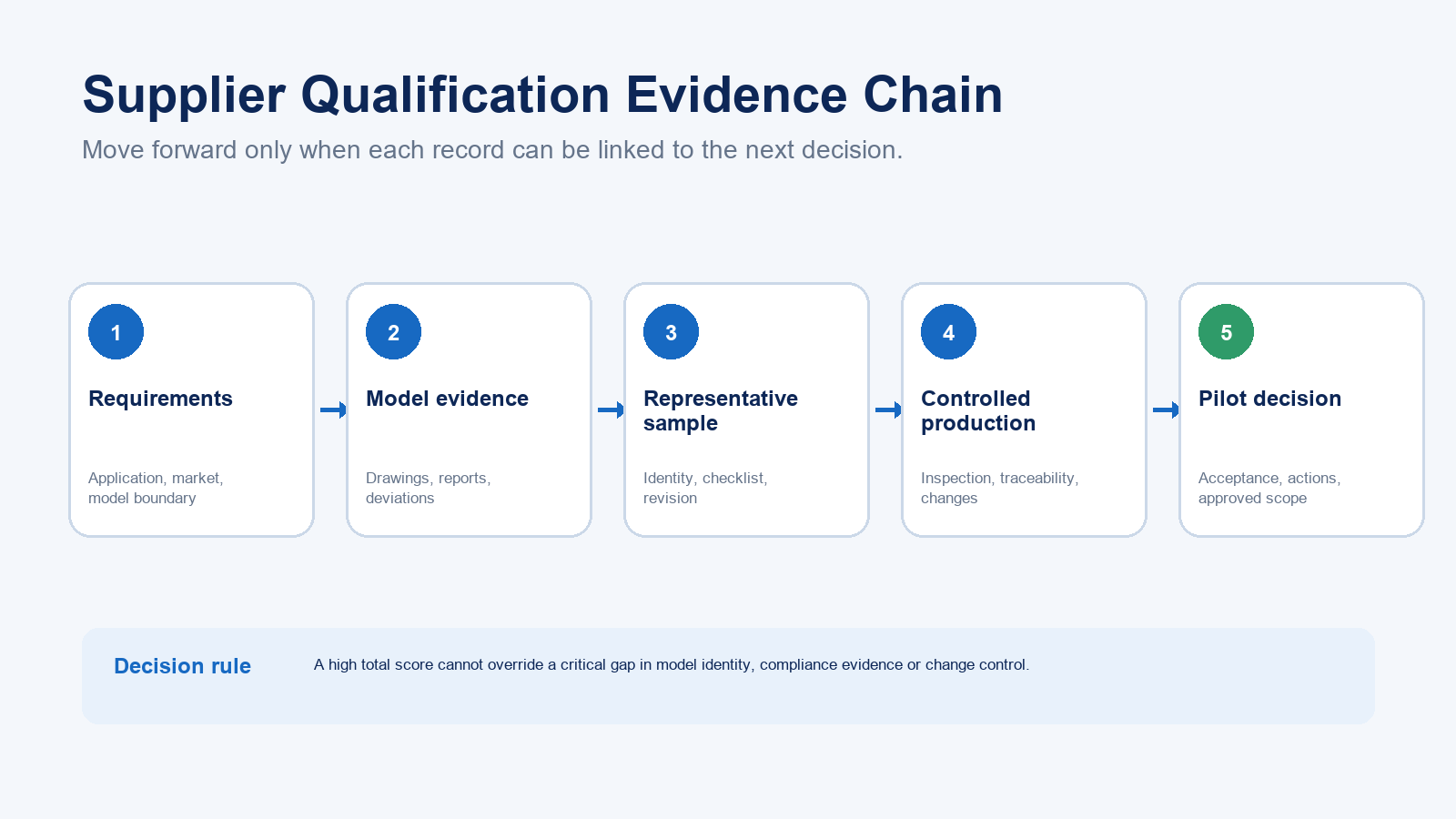
The most reliable sequence is simple: define the requirement, map evidence to the exact model, approve a representative sample, verify controlled production and limit the first commitment through a pilot order. Each stage should produce a record that the next stage can reference.
Start With Your Requirements, Not the Supplier’s Catalogue
A supplier cannot quote or engineer accurately against an undefined request. Before evaluating companies, create a short requirements package covering:
- product type and intended application;
- target market and buyer role;
- required electrical, optical, mechanical and control characteristics;
- installation and environmental conditions;
- estimated quantities and order pattern;
- packaging, labeling and branding needs;
- required drawings, test reports, declarations or certificates;
- sample, inspection and change-approval expectations.
This does not need to be a complete engineering specification at the first inquiry. It does need to distinguish confirmed requirements from open questions. If every supplier receives a different description, their prices and proposed configurations cannot be compared fairly.
ISO’s supply-chain guidance makes an important distinction: ISO 9001 specifies requirements for a quality management system, but it does not define the goods a buyer is purchasing. The buyer still has to define product needs through specifications, drawings, standards or other controlled documents.
| Qualification area | Minimum evidence to request | Stronger evidence | Stop condition |
|---|---|---|---|
| Product fit | Named model, datasheet and recorded deviations | Drawing, controlled specification and component boundaries | Offer cannot be mapped to one configuration |
| Market compliance | Model-linked reports, declarations or certificates as applicable | Verified scope, entity, dates and tested configuration | Logo or document cannot be linked to the quoted model |
| Production control | Inspection points and revision method | Traceable records, calibrated equipment and nonconformance process | Substitutions can occur without notice |
| Sample control | Identified sample and written checklist | Approved reference sample linked to drawings and revision | Sample identity or production relationship is unclear |
| Commercial fit | Aligned quotation, inclusions, terms and packaging | Pilot-order plan with acceptance and corrective-action steps | Material exclusions appear only after comparison |
1. Verify Product and Engineering Fit
Begin with evidence that the supplier understands the product rather than with a general company presentation. Ask the supplier to identify the proposed model, construction, critical components and deviations from your request.
A strong technical response should separate standard configuration from optional or custom features. It should show which parameters are fixed, which can be adjusted and which need engineering confirmation. Where the product is a family, the quotation should maintain a clear relationship between model, wattage, dimensions, output, controls and accessories.
Pay attention to the questions the supplier asks. Clarification about voltage, mounting, dimming, driver access, target market or packaging can indicate that the team is examining the actual application. A rapid “yes” to every request, without conditions or model references, provides little evidence of engineering fit.
Useful evidence may include controlled datasheets, drawings, bills of materials at an agreed level, component specifications, installation instructions and sample records. The required depth depends on product risk and project complexity. A buyer can begin with the New Lights product families to identify a product direction, but the inquiry should still name the required configuration rather than relying on a category page alone.
2. Review Compliance at Model and Market Level
Compliance is not a folder of unrelated logos. The buyer should establish which requirements apply to the exact product, destination market, use and economic-operator role. Then request evidence that can be mapped to the offered model.
For products within the EU CE-marking framework, the European Commission describes responsibilities for manufacturers, importers and distributors. The manufacturer may be responsible for conformity assessment, technical documentation and the EU declaration of conformity where applicable, while importers and distributors also have duties to understand and check applicable requirements. A company importing or selling a product under its own name may carry additional responsibilities. CE marking is not an EU authority’s approval of a product and does not identify its origin.
In the United States, CPSC guidance states that manufacturers and importers of general-use products subject to applicable CPSC rules must certify compliance in writing. This does not mean every lighting product follows one identical certificate route. Applicability must be determined for the product and rules involved.
For each document, check:
- the legal entity named;
- product and model coverage;
- applicable standards or rules;
- issuing or testing organization;
- report and certificate dates;
- configuration tested;
- differences between the tested sample and quoted production model;
- validity and verification method.
Do not transfer evidence from a visually similar product without a documented relationship. If components, construction or ratings change, ask whether the existing evidence remains applicable.
3. Examine the Quality System Beyond the Certificate
An ISO 9001 certificate can support confidence in a supplier’s quality management system, but it is not product certification. ISO describes several ways to assess QMS confidence, including supplier declarations, customer or second-party assessment and independent third-party certification.
When reviewing a certificate, confirm the certified legal entity, site, scope, certification body and validity. Then examine how the system operates for the proposed product. Relevant questions include:
- How are incoming critical components checked?
- Which characteristics are controlled during assembly?
- What production and final inspections are recorded?
- How are measuring devices calibrated or verified?
- How are nonconforming materials segregated and resolved?
- How are complaints traced to production records?
- Who approves corrective actions?
- How are specification and component changes controlled?
A buyer does not need every internal document. The objective is to see whether the supplier can provide traceable evidence proportional to the order’s risk.

4. Make the Sample Representative
A sample is useful only when its identity and relationship to production are clear. Record the model, revision, components, finish, control configuration and date. Mark any hand-built or substitute element that will differ in mass production.
Evaluate the sample against a written checklist rather than general appearance. Depending on the product, this can include dimensions, mounting, connectors, finish, visible workmanship, switching, dimming, light distribution, labeling and packaging. Technical or compliance testing should follow the applicable plan; visual approval is not a substitute. The LED lighting sample evaluation checklist provides a separate record structure for this stage.
After approval, keep a controlled reference or “golden sample” where appropriate. Pair it with drawings and an approved specification so that production teams are not expected to reproduce an undocumented visual memory.
Sample success does not by itself prove production consistency. It proves that one identified sample met the agreed review. The next step is to verify that the supplier can reproduce it through controlled materials and processes.
5. Test Change Control Before It Is Needed
Many sourcing problems occur after approval: a driver becomes unavailable, a housing supplier changes, a finish is adjusted or a connector is replaced. A capable supplier should not treat these as invisible purchasing decisions.
Define which changes require notification and buyer approval. Critical changes may include electrical components, LEDs, optics, materials, dimensions, firmware, controls, labels, packaging or manufacturing location. The exact list depends on the product.
Ask how the supplier records revisions, assesses impact and determines whether retesting is needed. Also define the evidence required before approval. A lower-cost substitute is not equivalent merely because it fits physically.
Change control is one of the clearest differences between receiving an attractive sample and managing a repeat supply program.
6. Look for Production and Inspection Visibility
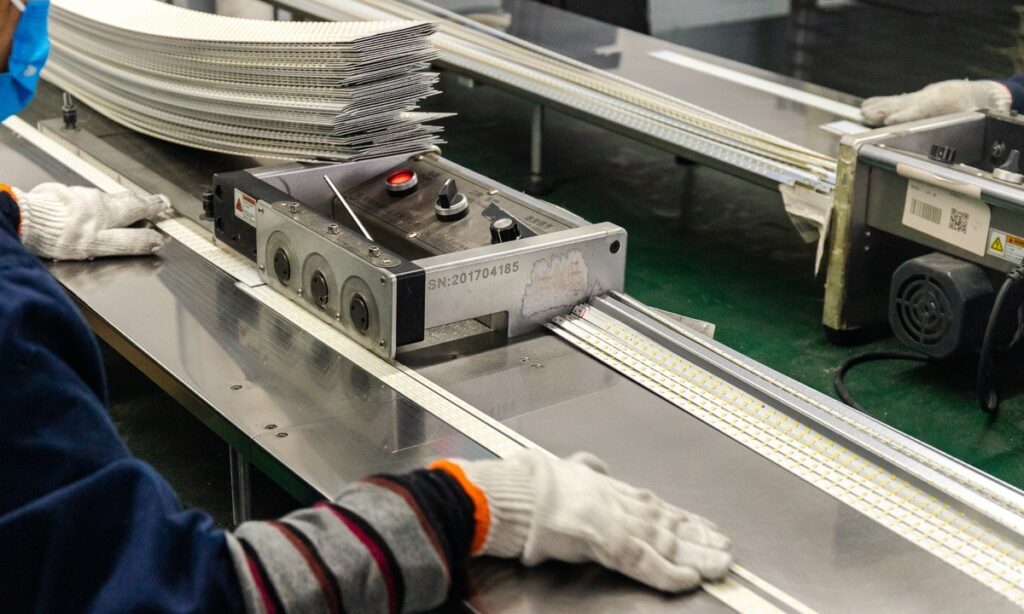
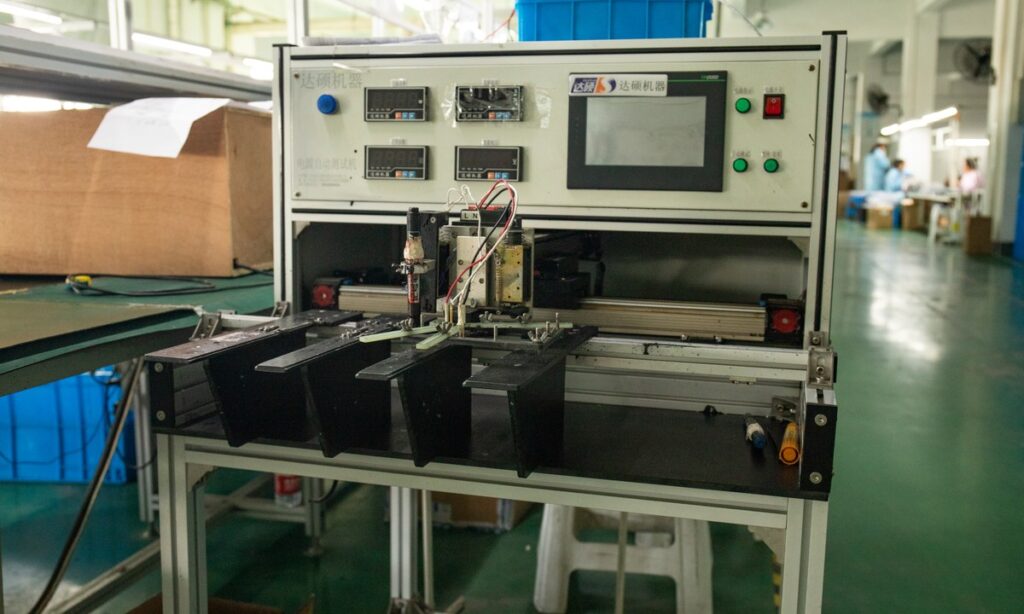
Capacity claims should be linked to the proposed process and schedule. Ask which steps occur at the quoted site, which are outsourced and where critical components originate. Understand tooling, production-line constraints, testing stations and inspection points relevant to your product.
For a significant program, a factory assessment may be appropriate. It can be conducted by the buyer or a qualified third party. The scope should be tailored to risk instead of relying on a generic photo checklist.
Before shipment, agree on inspection timing, sampling method, acceptance criteria and the documents to be provided. Clarify how failed inspections will be contained and corrected. Inspection does not replace process control, but it can verify whether the finished lot matches defined requirements.

7. Evaluate Communication as a Controlled Process
Fast replies are helpful, but response speed is not the same as reliable communication. Buyers need accurate answers, clear ownership and documented decisions.
During qualification, observe whether the supplier:
- answers each technical question or flags it for confirmation;
- identifies assumptions and deviations;
- maintains consistent model names and revisions;
- records meeting decisions and changes;
- distinguishes estimated from confirmed dates;
- escalates problems before shipment;
- provides one controlled response rather than conflicting messages.
Good communication includes saying that a point is not yet confirmed. An unsupported immediate answer can create more risk than a documented engineering follow-up.
8. Compare Commercial and Logistics Fit
Price matters, but the comparison basis must be aligned. Check whether quotations cover the same model, components, accessories, testing, packaging, Incoterm, payment terms and quantity. A lower unit price may exclude drivers, mounting parts, inspections or documentation included elsewhere.
Review minimum order quantities, sample charges, tooling ownership, production lead-time assumptions, spare-part arrangements and warranty procedure. For repeat programs, ask how forecasts, buffer materials and discontinued components are managed.
Logistics review should cover carton construction, labels, palletization where needed, shipping marks and documentation. Packaging must protect the actual product and support the buyer’s receiving process; it should not be treated as a last-minute graphic task.
Use a Weighted Supplier Scorecard
A scorecard reduces the influence of one impressive meeting or one unusually low quotation. Weight categories according to project risk. The example below totals 100 points, but the weights should be adjusted before suppliers are scored—not after the results are known.
| Example category | Weight | What earns the score |
|---|---|---|
| Product and engineering fit | 20 | Proposed model, drawings, configuration and deviations are controlled |
| Model-level compliance evidence | 15 | Applicable evidence maps to the legal entity, market and exact configuration |
| Quality and traceability controls | 15 | Inspection, measurement, nonconformance and traceability records are usable |
| Representative sample | 15 | Identified sample passes a written, risk-based review |
| Change control | 10 | Notification, approval and retest decisions are defined |
| Production and inspection visibility | 10 | Process ownership, inspection points and lot acceptance are clear |
| Communication | 5 | Answers, assumptions, revisions and dates are recorded consistently |
| Commercial and logistics fit | 10 | Scope, inclusions, packaging, terms and pilot plan are aligned |
Record evidence beside each score. “Certificate supplied” is weaker than “certificate entity, scope and validity verified.” “Sample looks good” is weaker than “identified sample passed the agreed checklist with deviations recorded.”
The scorecard should support judgment, not automate supplier approval. A critical failure—such as missing model evidence or an undisclosed substitution—may outweigh a high total score.
Move From Shortlist to Pilot Order
A practical qualification sequence is:
- Issue the same controlled request to shortlisted suppliers.
- Compare technical responses and recorded deviations.
- Verify company, QMS and product evidence.
- Evaluate a representative sample.
- Resolve specifications, packaging and approval records.
- Place a controlled pilot or initial production order where appropriate.
- Inspect results and close corrective actions.
- Approve the supplier for a defined product and scope—not indefinitely for every category.
This staged process creates decision points before exposure grows. It also gives the supplier a fair opportunity to demonstrate performance against clear requirements.
Warning Signs That Require More Evidence
Warning signs do not always prove a supplier is unsuitable, but they justify deeper verification:
- certificates cannot be linked to the quoted entity or model;
- model names change between documents;
- technical values conflict without explanation;
- every customization is accepted before engineering review;
- requested production changes are not documented;
- sample components are unidentified;
- factory and trading roles are unclear;
- quotation exclusions are discovered late;
- problems are disclosed only after shipment deadlines are missed.
The correct response is not an assumption. Ask for clarification, supporting records or a narrower pilot scope. If documentation is missing, the New Lights download center can be used to locate public product information before requesting project-specific files.
Frequently Asked Questions
Does ISO 9001 prove that a lighting product is compliant?
No. ISO 9001 addresses a quality management system. It does not replace model-specific product requirements, testing or market documentation. Verify the certificate and also review evidence for the exact product.
Is a factory audit always necessary?
Not for every purchase. The need and depth depend on product risk, order value, customization and the buyer’s existing evidence. A high-risk or strategic program may justify an on-site or third-party assessment; a bounded standard order may use a more limited process.
How many samples should a buyer request?
There is no universal number. The sample plan should cover meaningful variants, critical configurations and testing needs. Record which production models each sample represents and where it does not provide coverage.
Should the lowest quotation be rejected?
Not automatically. First normalize the comparison. Confirm product configuration, included components, evidence, packaging, terms and inspection scope. A lower price is useful only when the offer still meets the defined requirements.
What should be approved before mass production?
At minimum, approve the product specification, model mapping, drawings where relevant, sample status, critical components or boundaries, labeling, packaging, documentation and change-control expectations. The exact approval package should match project risk.
Select Evidence, Not Impressions
International buyers are ultimately looking for predictable execution: the right product, supported by the right evidence, reproduced under controlled conditions and communicated clearly when something changes.
That cannot be established by nationality, factory size, a low price or a page of logos. It is established through a controlled request, model-level documentation, representative samples, traceable quality processes and a proportionate pilot.
To discuss a defined OEM/ODM lighting requirement, including target market, product configuration, quantity and documentation needs, contact New Lights.
—
Editorial Sources
- International Organization for Standardization, “ISO 9001 in the Supply Chain”: https://www.iso.org/files/live/sites/isoorg/files/archive/pdf/en/iso_9001_supply-chain.pdf
- International Organization for Standardization, “How Can You Have Confidence That Your Supplier Meets ISO 9001?”: https://www.iso.org/files/live/sites/isoorg/files/store/en/PUB100304.pdf
- European Commission, “CE Marking”: https://single-market-economy.ec.europa.eu/single-market/goods/ce-marking_en
- European Commission, “Importers and Distributors”: https://single-market-economy.ec.europa.eu/single-market/goods/ce-marking/importers-and-distributors_en
- U.S. Consumer Product Safety Commission, “General Use Products: Certification and Testing”: https://www.cpsc.gov/Business–Manufacturing/Testing-Certification/General-Use-Products-Certification-and-Testing