

An LED export pack-out should be designed as one controlled system: product protection, unit packaging, master cartons, transport loads, labels, barcodes and shipment documents must describe the same released product. Start with the real distribution route and product risks, assign an owner to every data field, approve one revision, and stop shipment when physical goods and records do not reconcile.
Connect Every Packaging Level to One Product Identity
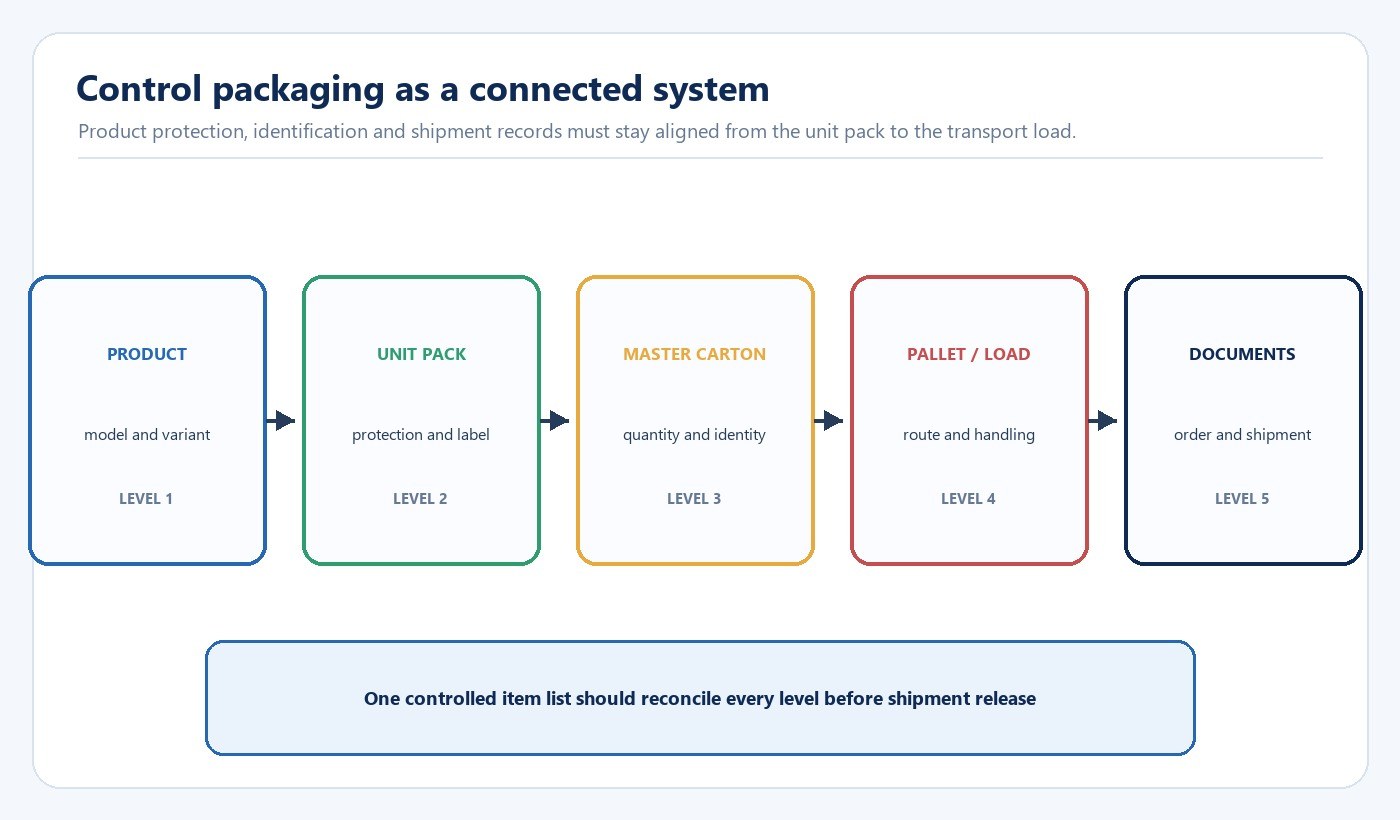
The pack-out begins with the exact released configuration. Record the model, variant, input, CCT, finish, accessories and quantity before designing cartons or shipping marks. A product-family name is not enough when two variants need different inserts, legal data or barcodes.
Use a packaging-level matrix to keep the layers connected:
| Level | Primary job | Controlled information | Release evidence |
|---|---|---|---|
| Product | Preserve the approved item | Model and variant identity | Released configuration |
| Unit pack | Protect one saleable unit | Product label, quantity, accessories | Approved sample and artwork |
| Master carton | Group and handle units | Item, count, weight, dimensions, marks | Carton specification |
| Pallet or load | Stabilize transport | Carton count, stack pattern, handling | Load plan and photos |
| Shipment documents | Reconcile the order | PO, SKU, quantity, parties, origin | Approved document set |
The matrix also exposes where a change propagates. A new cable or accessory can alter net weight, insert geometry, carton quantity, barcode identity and customs data. Update the controlled source first, then regenerate affected outputs.
Map the Distribution Route Before Choosing a Test
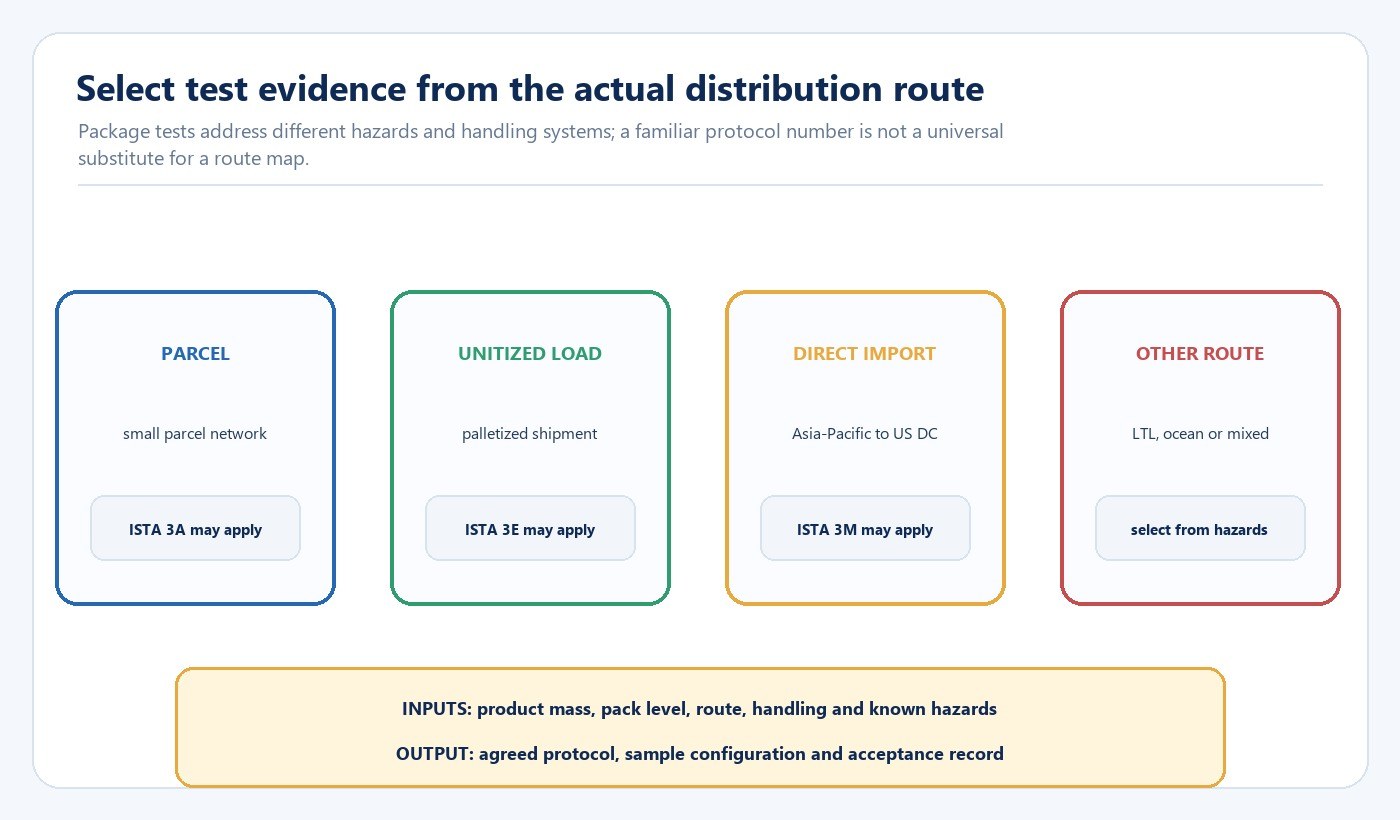
The International Safe Transit Association (ISTA) separates screening procedures from general-simulation procedures and publishes different protocols for different distribution systems. Its 3A procedure addresses packaged products moving through parcel delivery systems up to 70 kg, 3E addresses unitized loads, and 3M addresses certain direct-import movements from the Asia-Pacific region to a US distribution center or fulfillment center. These descriptions help define the decision boundary; the parties still need to select the procedure and sample configuration that match the actual route.
Build a route map covering factory handling, consolidation, ocean or air movement, port transfers, distribution centers, parcel or LTL handling, storage and final delivery. Then identify credible hazards: drops, repeated shock, vibration, compression, humidity, water exposure, temperature, abrasion and load instability.
A drop test alone is rarely a complete export-packaging strategy. It may miss long-duration vibration, stacked compression, rubbing between parts, moisture-sensitive paper materials or pallet behavior. Conversely, adding every available test without a route rationale increases cost without creating a clearer release decision.
For each agreed test, state the sample configuration, conditioning, sequence, acceptance criteria and evidence. A pass/fail statement should be supported by the tested pack revision and observations such as functional condition, cosmetic damage, carton deformation, label legibility and accessory retention.
Design Protection Around the Product and Failure Mode
Long LED tubes, linear fixtures, glass lamps, luminaires and electronic accessories fail differently in transit. The protection system should prevent the specific damaging movement rather than merely fill space.
| Product risk | Packaging response to evaluate | Evidence to record |
|---|---|---|
| Long product bending | End support, span support and carton stiffness | Deflection and post-test function |
| Glass envelope impact | Separation, cushioning and controlled clearance | Breakage and contact marks |
| Surface scratching | Sleeves, dividers and clean contact materials | Cosmetic inspection |
| Loose accessories | Dedicated cavity or sealed sub-pack | Count and retention |
| Heavy carton compression | Board grade, stacking limit and pallet pattern | Carton condition and stack stability |
Do not assume more cushioning is always better. Excess clearance can allow acceleration before impact; excessive compression can load fragile surfaces; poorly located blocks can concentrate force. Prototype the complete pack with the production product and accessories, not an empty carton or substitute mass.
Use Pre-Packaging Inspection as a Release Point

Pre-packaging inspection should confirm that the released product is entering the released pack. Typical checks include model and variant, appearance, function, included parts, label revision and quantity. The inspection method should match the risk and the agreed quality plan.
This checkpoint is also where mixed revisions often become visible. If old and new labels, instructions or accessories are present in the same area, quarantine the affected material and reconcile quantities before packing continues. The LED lighting sample evaluation checklist provides a useful structure for comparing a physical unit with its controlled specification and evidence set.
Keep Packaging Materials and Revisions Controlled

Control the carton drawing, board specification, insert material, bag, sleeve, tape, pallet pattern and any moisture protection that forms part of the approved pack. Record supplier, material specification and revision where substitution could change protection, print quality or recyclability information.
If wood pallets, crates or dunnage are used in international trade, determine whether ISPM 15 applies. The International Plant Protection Convention (IPPC) guidance covers raw wood packaging material and dunnage and provides implementation information for regulated wood packaging. Processed wood products and other materials may fall outside that scope, so record the actual material instead of adding a mark by habit.
The factory and manufacturing overview explains New Lights’ production context. Project-specific pack materials, inspection records and approvals belong in the order file.
Release Labels, Barcodes and Documents From One Data Set
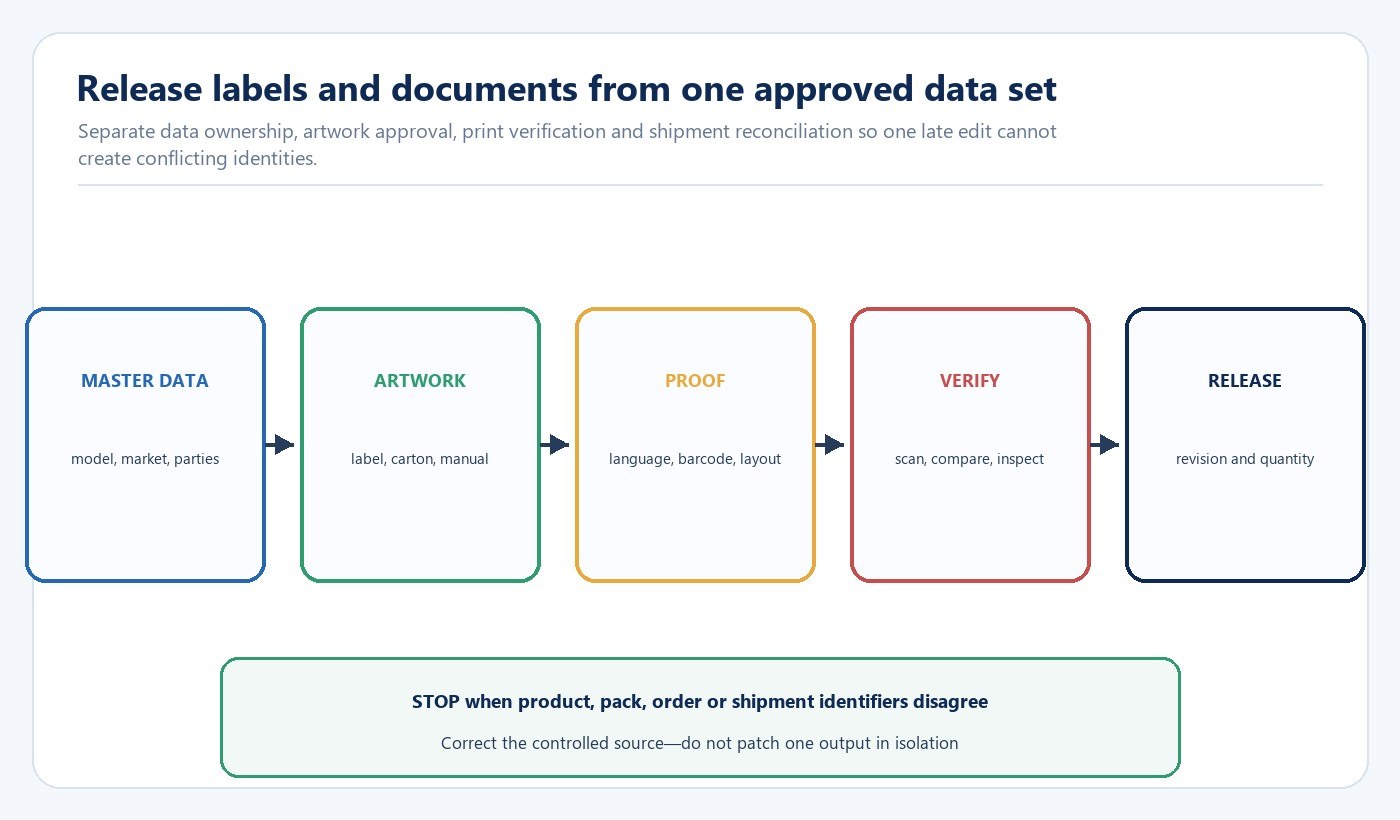
Create a master data table for the exact SKU and market. It should identify the legal product name, model, variant, brand owner, responsible economic operators where applicable, electrical ratings, quantity, country of origin, language set, barcode data and revision owner.
GS1 General Specifications govern how GS1 identification keys and barcodes are used. Barcode choice, size, quiet zones and placement depend on the application and scanning environment. Do not treat a visually clean barcode as verified. Generate it from approved data, print it with the intended process and substrate, then verify both encoded data and print quality.
The European Commission’s 2022 Blue Guide explains identification and traceability responsibilities under applicable EU product rules. Product identification may move to packaging or accompanying documents only in limited circumstances. Determine the legal requirements for the exact product and destination before artwork approval; do not use a generic EU label template as a substitute.
Keep a controlled register covering the product label, rating label, unit box, master carton, manual, declaration, test-report index, packing list, commercial invoice and any market-specific document. Each item needs an owner, language, source file, revision, approval date and applicability.
Reconcile the Physical Shipment Before Release
The final pack audit should compare physical goods with the purchase order, approved configuration, packing specification and document set. Sample checks should include carton count, quantity per carton, model mix, shipping marks, weight and dimensions, barcode scan results, pallet pattern and visible damage.
Use a three-way reconciliation:
- Product to pack: the item, accessories and labels match the released unit-pack specification.
- Pack to order: carton identity and quantities match the purchase order and packing list.
- Order to shipment: invoice, origin data, consignee information and transport records describe the same shipment.
If any identity, quantity or revision disagrees, stop release and correct the controlled source. Hand-editing one carton mark or spreadsheet can make the immediate document look right while leaving the rest of the evidence inconsistent.
The OEM and ODM LED lighting RFQ guide helps define packaging, artwork and evidence responsibilities before quotation. Buyers can review available New Lights product families, use the Download Center for published files, or contact New Lights with the destination, product, quantity and distribution route for a project-specific discussion.
Export Pack-Out Checklist
- Freeze the exact product configuration and market.
- Map unit pack, master carton, pallet or load and document levels.
- Record the distribution route and credible hazards.
- Agree the test procedure, sample revision and acceptance criteria.
- Approve packaging materials, dielines and pallet pattern.
- Release labels, barcodes and manuals from one master data set.
- Inspect products before pack-out and quarantine mixed revisions.
- Reconcile goods, cartons, order and shipment documents.
- Retain approved artwork, test evidence, scan results and release records.
Frequently Asked Questions
Is a carton drop test enough for LED export packaging?
Not by itself. The required evidence depends on the distribution route, pack level, product risks and acceptance criteria. Vibration, compression, conditioning or load-stability evaluation may also be relevant.
Can the same barcode be used on the product, unit box and master carton?
Only when the identification scheme and trading-level requirements support it. Consumer units, inner packs and logistics units may need different identifiers. Confirm the application and scanning environment before artwork release.
Who should approve market language and responsible-party information?
The organization responsible for placing the product on the destination market should assign a qualified owner. The supplier can prepare artwork, but unresolved legal identity or language requirements should not be guessed.
When does ISPM 15 matter?
It is relevant when regulated raw wood packaging material or dunnage is used in international trade. Confirm the material and destination requirements; do not apply the rule to all packaging materials indiscriminately.
Editorial Sources
- International Safe Transit Association, “Test Procedures”: https://www.ista.org/test_procedures.php
- GS1, “Barcodes”: https://www.gs1.org/standards/barcodes
- GS1, “GS1 General Specifications”: https://www.gs1.org/docs/barcodes/GS1_General_Specifications.pdf
- European Commission, “The Blue Guide on the implementation of EU product rules 2022”: https://eur-lex.europa.eu/legal-content/EN/TXT/?uri=CELEX%3A52022XC0629%2804%29
- International Plant Protection Convention, “ISPM 15 implementation”: https://www.ippc.int/en/archive-old-pages/phytosanitary-system/ispm-15-implementation/