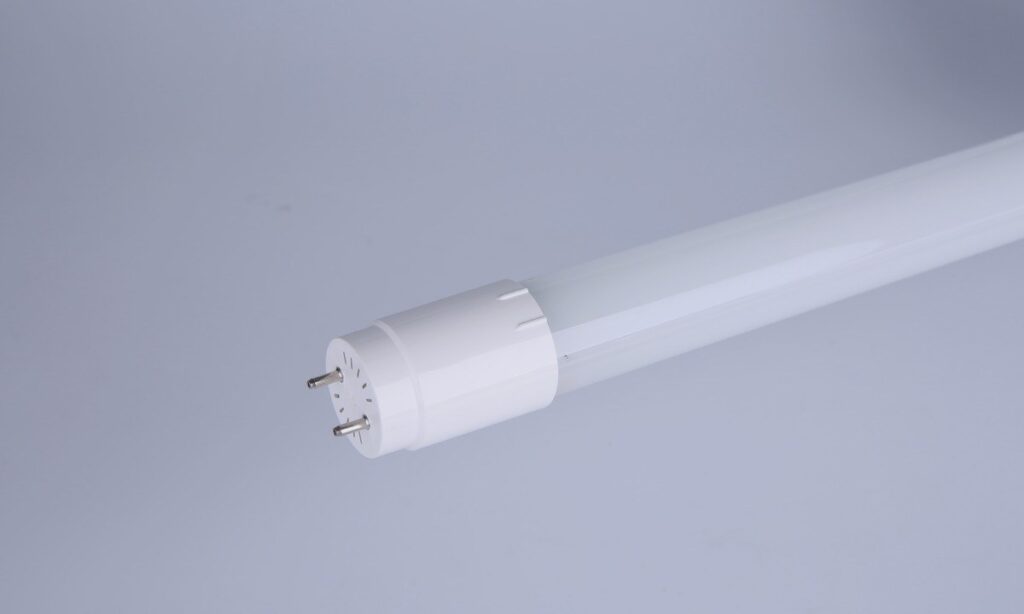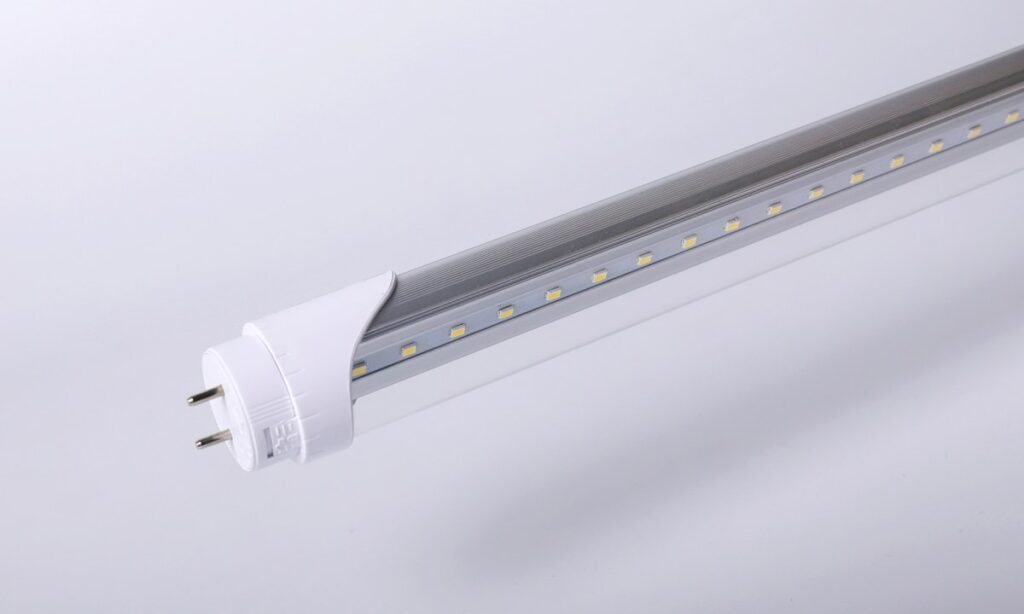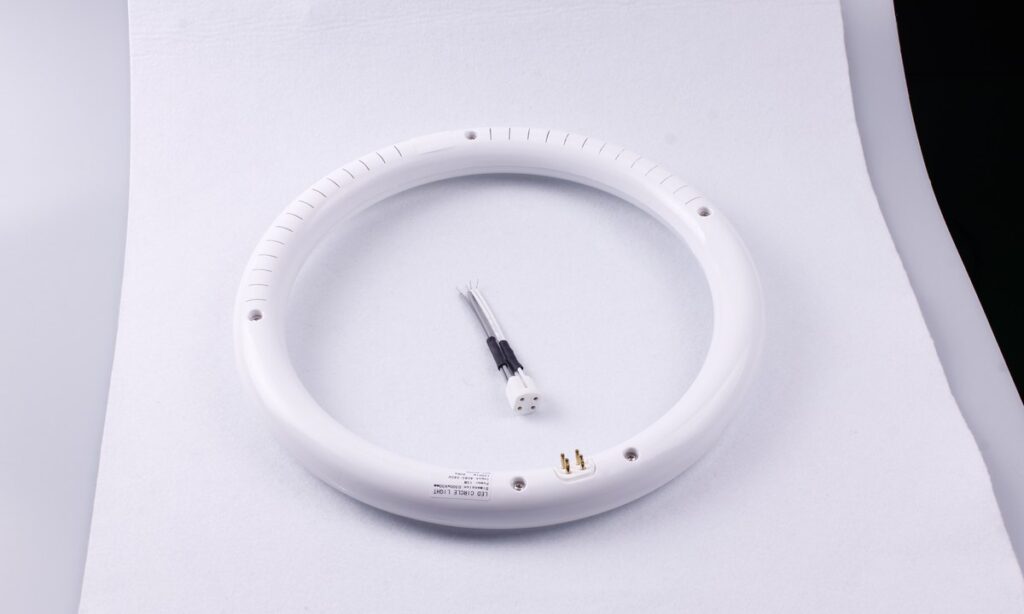


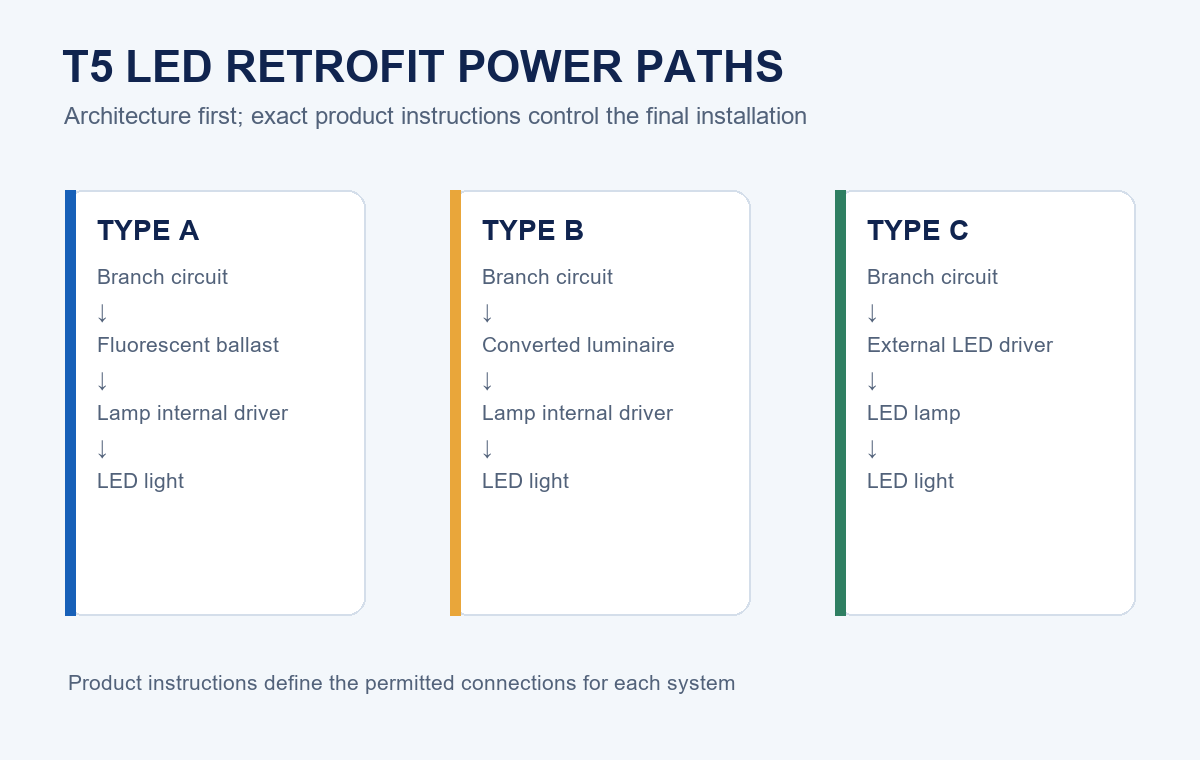
The practical difference is the power path. A Type A T5 LED tube operates through a compatible fluorescent ballast. A Type B tube removes the ballast from the operating circuit and uses an internal driver supplied from the branch circuit after an approved luminaire conversion. Type A usually reduces initial disruption; Type B removes a future ballast-maintenance item but requires more conversion work and stricter control of wiring, labels and replacement lamps.
Choose the architecture only after identifying the installed ballast, lampholders, voltage, controls, emergency functions and local approval requirements. A matching G5 base or tube length establishes mechanical fit, not electrical compatibility.
Type A and Type B Use Different Power Paths
UL Solutions defines Type A lamps as direct fluorescent-lamp substitutions that operate from the host luminaire’s integral ballast without modifying the luminaire. It defines Type B lamps as lamps intended for fluorescent-style lampholders wired directly to the branch circuit, whether the luminaire was built that way or converted under a retrofit program.
The U.S. Department of Energy’s Federal Energy Management Program uses the same practical distinction in its tubular LED guidance: Type A retains the ballast; Type B disconnects it and supplies line voltage to an internal lamp driver. Type C is a third architecture in which an external LED driver supplies the lamps. Understanding all three prevents a project team from treating every tube-shaped LED as the same retrofit product.
| Decision point | Type A: ballast-compatible | Type B: ballast-bypass |
|---|---|---|
| Existing ballast | Remains in the operating circuit | Disconnected from the operating circuit |
| Initial work | Lamp replacement after exact compatibility confirmation | Luminaire conversion, wiring work and required marking |
| Main dependency | Lamp-to-ballast compatibility | Certified wiring arrangement, lampholders and input configuration |
| Future maintenance | Lamp and ballast remain service items | Ballast is removed; replacement lamp must match the converted fixture |
| Power comparison | Use total system input, including ballast losses | Use converted-luminaire input under the final configuration |
| Best starting point | Stable, identified ballasts and minimum disruption | Planned conversion with controlled installation and documentation |
When Type A Is the Better Starting Point
Type A is attractive when a facility has consistent, serviceable ballasts and wants to minimize the first installation step. The existing wiring stays in place, so the project may avoid opening and converting every fixture. That can be useful in occupied areas, short shutdown windows or phased maintenance programs.
The tradeoff is dependency. Compatibility must be established for the exact lamp and ballast combination; two visually identical fixtures may contain different ballast models. Ballast age, control interfaces and emergency equipment can also change behavior. A sample that starts successfully does not settle every question: the pilot should check stable operation, light output, flicker, dimming or switching behavior, temperature and emergency operation where applicable.
Type A also keeps the ballast as a future failure point. A maintenance plan should therefore include the expected response when a ballast fails: replace the ballast, install another compatible lamp-and-ballast pair, or convert that fixture to a different architecture. The T5 versus T8 guide helps separate tube diameter and base questions from the electrical retrofit decision.
When Type B Is the Better Starting Point
Type B is often considered when a project wants to remove aging ballasts, standardize future service around one power architecture, or avoid ballast losses. The converted fixture no longer depends on a fluorescent ballast, but the conversion itself becomes part of the product-selection and compliance scope.
The lamp’s approved wiring arrangement matters. Type B products may use single-ended or double-ended input, and the permitted lampholder configuration follows the exact product instructions and certification. A G5 lampholder that physically accepts a T5 tube cannot be assumed suitable for any line-voltage conversion. Use qualified personnel, the certified kit or lamp instructions, required field-applied labels and the local authority’s rules.
UL Solutions states that a Type A/B lamp may be used for luminaire conversion only when it has also been investigated to UL 1598C as part of a certified conversion kit and carries the applicable dual certification mark. A lamp-only listing is not the same as approval for every converted luminaire. For a broader installation workflow, see how to install LED tube lights safely.
Mechanical Fit Does Not Establish Retrofit Suitability
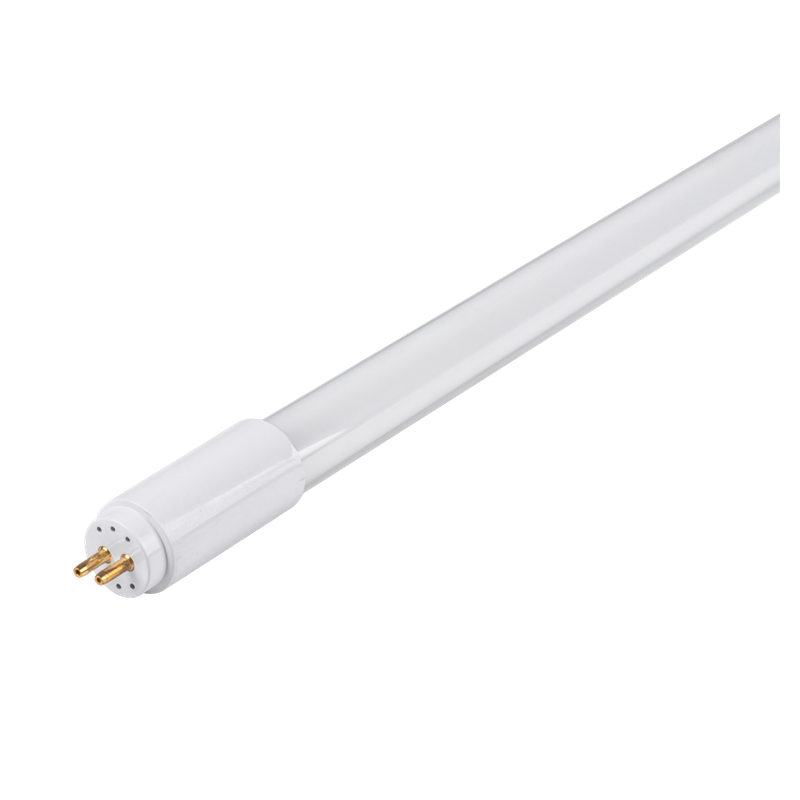
T5 commonly refers to a 5/8-inch nominal tube diameter, while G5 identifies the pin-base format. Those labels help identify the physical family, but the power architecture still has to be read from the lamp marking, instructions and certification scope.
IEC 62776 specifies safety and interchangeability requirements within its published scope for double-capped LED retrofit lamps with G5 and G13 caps. That scope does not turn every G5 lamp, ballast or converted fixture into an interchangeable system. Market requirements, wiring arrangements and product instructions still control the final selection.
Compare System Power, Not Lamp Watts Alone
Lamp watts are not a complete energy comparison. For Type A, the ballast remains in the circuit, so the relevant input is the measured or documented total system power. For Type B, use the final converted-luminaire input. Then compare both options at the same delivered light level, distribution and operating schedule.
Annual lighting energy can be estimated as:
Annual kWh = quantity × measured system watts × annual operating hours ÷ 1,000
The cost model should also include installation labor, replacement ballasts, compatible lamp inventory, access equipment, disposal, relabeling and future service visits. A slightly lower first cost can be overtaken by repeated ballast work; a conversion with a higher first cost may be difficult to justify where access is simple and the existing ballasts are recent and consistent.
Audit the Installed T5 System Before Quoting
A useful survey records conditions at fixture level rather than assuming one building equals one configuration. Start with representative areas, then increase sampling where the installed stock is mixed.
| Survey field | Why it changes the decision |
|---|---|
| Fixture manufacturer and model | Defines the host construction and approval context |
| Existing lamp code and length | Confirms the physical lamp family |
| Ballast manufacturer and model | Determines whether a Type A compatibility list can be applied |
| Supply voltage and frequency | Must match the selected product and conversion instructions |
| Lampholder type and condition | Affects mechanical fit and the permitted wiring arrangement |
| Controls and sensors | May introduce switching, dimming or standby compatibility requirements |
| Emergency function | Requires a separately verified emergency-lighting solution |
| Ambient and enclosure conditions | Affects thermal and environmental suitability |
| Access and operating schedule | Changes labor cost and acceptable shutdown time |
Photograph the labels and wiring state before procurement. Record how many fixtures belong to each verified configuration. The LED lighting sample evaluation checklist can then be used to define the pilot, measurements and acceptance record.
Treat Special Systems as Separate Decisions
Emergency circuits, dimming systems, occupancy controls, hazardous locations, cold rooms and enclosed fixtures require their own evidence. Do not carry a result from a standard open fixture into these applications without checking the exact product and system.
UL Solutions distinguishes ordinary tubular lamps from emergency-lighting equipment certified under UL 924, and it identifies additional certification requirements for retrofit kits used in hazardous locations. The key project lesson is simple: the architecture label alone does not approve a special application.
For projects that include varied fixture types, the fluorescent lighting replacement solution provides a broader route from existing-system audit to sample validation and rollout planning.
A Practical Type A vs Type B Decision Sequence
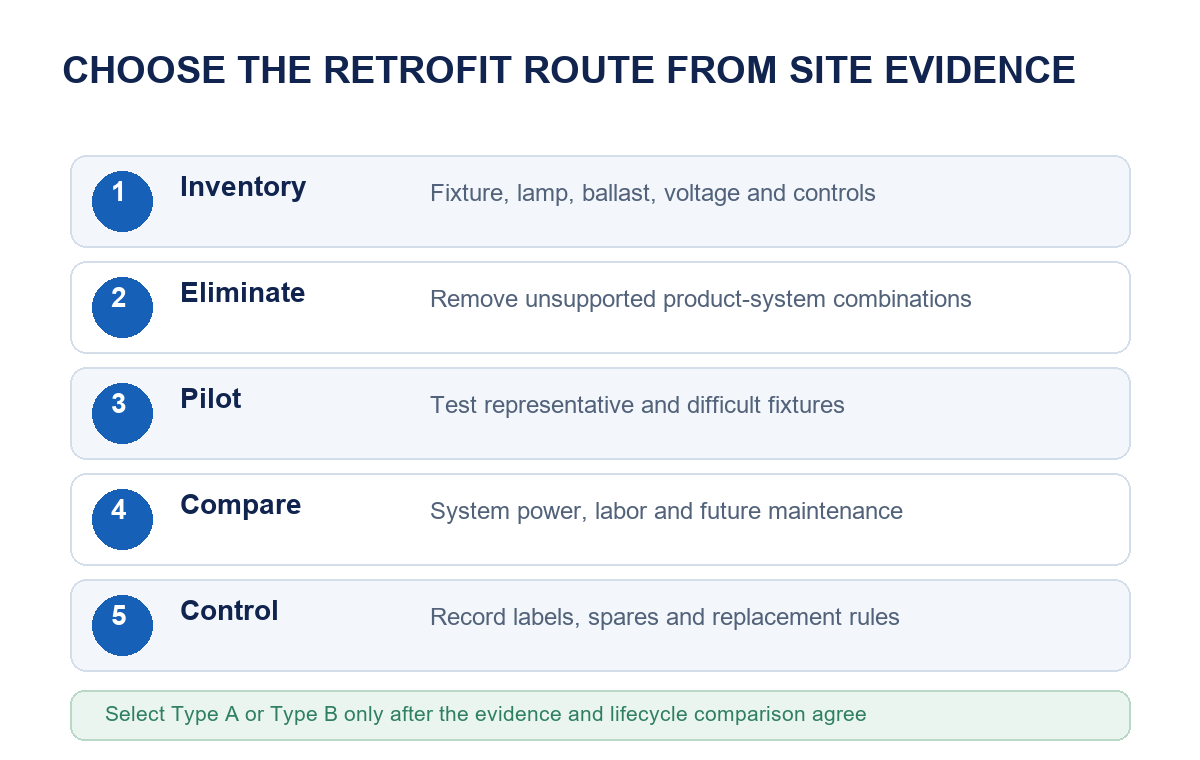
- Inventory the fixture, lamp, ballast, voltage, lampholders, controls and special functions.
- Remove any candidate that lacks exact compatibility, instructions or market-specific certification for the intended configuration.
- Compare representative samples at the same required light level and operating conditions.
- Calculate total system power and annual operating cost rather than comparing lamp watts alone.
- Price the complete installation route, including conversion labor, labels, disposal and access.
- Define the future replacement rule so maintenance staff cannot install an incompatible fluorescent or LED lamp.
- Pilot the most difficult representative fixtures before approving the rollout.
The Electronic-Ballast-Compatible T5/T6 LED Tubes page is a relevant starting point for Type A enquiries, but the project still requires the exact ballast list and product documentation. For other architectures, browse the T5 and T6 LED tube category and match the final product to the verified installation scope.
Frequently Asked Questions
Is Type A always easier to install?
It usually involves less fixture modification, but only after the exact lamp-to-ballast combination is confirmed. Mixed or aging ballasts can turn a simple relamp into a larger survey and maintenance problem.
Is Type B always more energy efficient?
Removing the ballast eliminates ballast losses, but the project comparison still needs measured total system input and equivalent delivered light. Product design, operating conditions and controls affect the result.
Can any G5 socket be used for a Type B T5 tube?
No. G5 identifies the mechanical cap format. The permitted lampholder and wiring configuration must follow the exact product instructions, certification and local requirements.
Can Type A and Type B tubes be mixed in one facility?
Different architectures may exist across a facility, but each fixture must be clearly identified and maintained under its approved configuration. Mixed stock increases the importance of labels, records and controlled spare-lamp storage.
What should be included in a T5 retrofit sample request?
Provide the fixture and ballast models, existing lamp code, supply voltage, control and emergency functions, tube length, quantity, market and required certification. Include representative photos of labels and lampholders.
Build the Decision Around the Existing System
Type A is the lower-disruption route when the installed ballast population is known, compatible and worth retaining. Type B is the deliberate conversion route when removing ballast dependency justifies the added installation, labeling and maintenance controls. Neither label is a universal recommendation.
Before placing an order, assemble the survey record and acceptance criteria. Contact New Lights with the fixture, ballast, voltage, controls, tube length, quantity and market requirements to narrow the product and documentation review.
Editorial Sources
- UL Solutions, “FAQ – UL Certified LED Retrofit Luminaire Conversion Kits”: https://www.ul.com/thecodeauthority/knowledge/faq-ul-certified-led-retrofit-luminaire-conversion-kits
- U.S. Department of Energy, Federal Energy Management Program, “LED Retrofit Kits, TLEDs, and Lighting Controls: An Application Guide”: https://www.energy.gov/sites/default/files/2017/03/f34/led_troffer_retrofit_guide.pdf
- IEC, “IEC 62776:2014 — Double-capped LED lamps designed to retrofit linear fluorescent lamps — Safety specifications”: https://webstore.iec.ch/en/publication/7425