
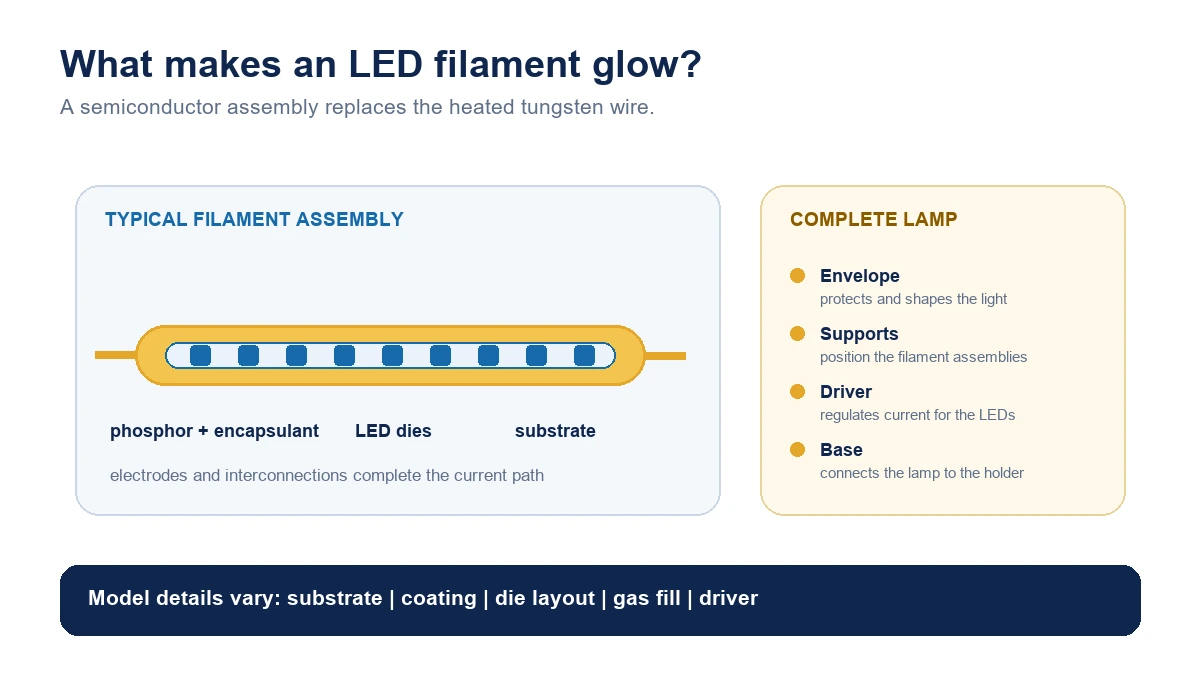
An LED filament is not a tungsten wire. It is typically a narrow semiconductor assembly made from multiple LED dies attached to a substrate, electrically connected, and covered with encapsulating and often phosphor-conversion materials.
The glowing strip is designed to resemble the visible filament of an incandescent bulb, but it produces light through electroluminescence in semiconductor devices—not by heating a metal wire until it glows.
The exact substrate, encapsulant, phosphor, electrical interconnection and gas fill vary by design. When these details affect a project, use the construction record for the specific model rather than treating a typical diagram as a bill of materials.
LED filament versus tungsten filament
An incandescent lamp passes current through a thin tungsten wire. Electrical resistance raises the wire to a very high temperature, and the hot material emits visible light along with substantial heat.
An LED filament contains a series or combination of semiconductor LED dies. When the driver supplies the required current, electrons and holes recombine in the semiconductor and release energy as light. In a white filament, part of that emission is commonly converted by phosphor materials to create the desired white spectrum.
The two products may look similar through a clear bulb envelope, but their light-generation mechanisms and electrical requirements are fundamentally different.
The typical component stack
| Component | Main role | What the name alone does not confirm |
|---|---|---|
| LED dies | Generate light when supplied with regulated current | Die count, loading, output or quality |
| Substrate | Positions the dies and supports electrical, optical and thermal paths | Glass, sapphire, ceramic or another material |
| Electrodes and interconnections | Carry current through the die string | Circuit layout or protection method |
| Encapsulant and phosphor | Protect the assembly and convert or shape emitted light | Exact formulation, CCT, CRI or color consistency |
| Internal gas and envelope | Support heat transfer, protection and optical form | Gas composition or thermal margin |
| Driver | Converts and regulates incoming power | Dimming, flicker, power quality or lifetime |
1. LED dies
The active light sources are small semiconductor dies arranged along the filament. They are electrically connected to create the voltage and current behavior required by the lamp design.
The number, type, spacing and loading of the dies can vary. More visible segments do not automatically mean more output or better performance. Those outcomes depend on the complete electrical, optical and thermal design.
2. Narrow substrate
The dies need a structure that holds them in position and supports electrical and thermal paths. The U.S. Department of Energy’s 2022 manufacturing report describes optically clear glass substrates, with sapphire also used in some filament constructions. Peer-reviewed studies have examined ceramic and other substrate approaches.
The substrate affects:
- mechanical support;
- light escape around the strip;
- die placement;
- electrical insulation;
- heat movement;
- resistance to handling and thermal stress.
There is no basis for assigning one substrate material to every filament bulb. Use the model’s construction evidence when the material matters to a specification.
3. Electrodes and electrical interconnections
Conductive electrodes are formed on or attached to the substrate. The LED dies are connected through bonding structures or other interconnect methods so current can pass through the assembly.
The filament ends connect to internal support wires, which also hold the visible arrangement inside the bulb. The complete electrical path continues to the driver in the lamp base.
A decorative support-wire pattern should not be interpreted as the full circuit diagram. The driver and internal connections remain product-specific.
4. Encapsulant
The LED dies and connections need protection. A transparent encapsulating material surrounds or covers the assembly and helps hold conversion materials in place.
The same DOE report describes a phosphor/silicone overcoat in typical filament construction and identifies the coating as part of the structural-reliability problem. Formulation, process control and qualification still belong to the individual product specification.
5. Phosphor-conversion material
Many white LED filaments use blue-emitting LED dies with phosphors that convert part of the light into other wavelengths. The combined emission appears white. The phosphor mixture and optical design help determine color temperature, spectrum and color rendering.
The yellow appearance of an unlit filament often comes from this conversion layer. Its visible color is not a complete specification of the emitted light. Two yellow-coated filaments can produce different CCT, color quality and output.
Some colored or multi-channel products can use different dies or conversion approaches. Do not apply a white-filament explanation mechanically to every colored decorative lamp.
What is inside the glass bulb?
The visible filament assemblies are mounted inside an envelope, commonly with internal supports and electrical leads. The bulb may contain a selected gas intended to support thermal management, but the gas composition is not universal.
DOE manufacturing guidance and peer-reviewed studies discuss high-thermal-conductivity gases such as helium in certain filament-lamp designs. Chen et al. tested different helium ratios in defined A60 lamps in 2019. A 2024 Journal of Luminescence study compared substrate dimensions and filling gases in a defined test design. The applicable gas and pressure remain model-specific.
The bulb envelope itself can influence mechanical protection, appearance and heat transfer. Clear, frosted, tinted and shaped envelopes may serve different optical and decorative roles.
Where is the driver?
An LED filament cannot normally be connected to mains power as if it were a tungsten wire. The lamp contains driver electronics that convert and regulate the incoming electricity for the LED assemblies.
In a replacement bulb, the driver is typically located in or near the base, where space is limited. Its design affects:
- input voltage and frequency;
- current regulation;
- power factor and harmonics;
- dimmability;
- flicker behavior;
- thermal stress;
- protection functions;
- complete-lamp reliability.
The visible filament alone does not determine these properties. Two bulbs with similar envelopes can use different drivers and behave differently on a dimmer or in an enclosed fixture.
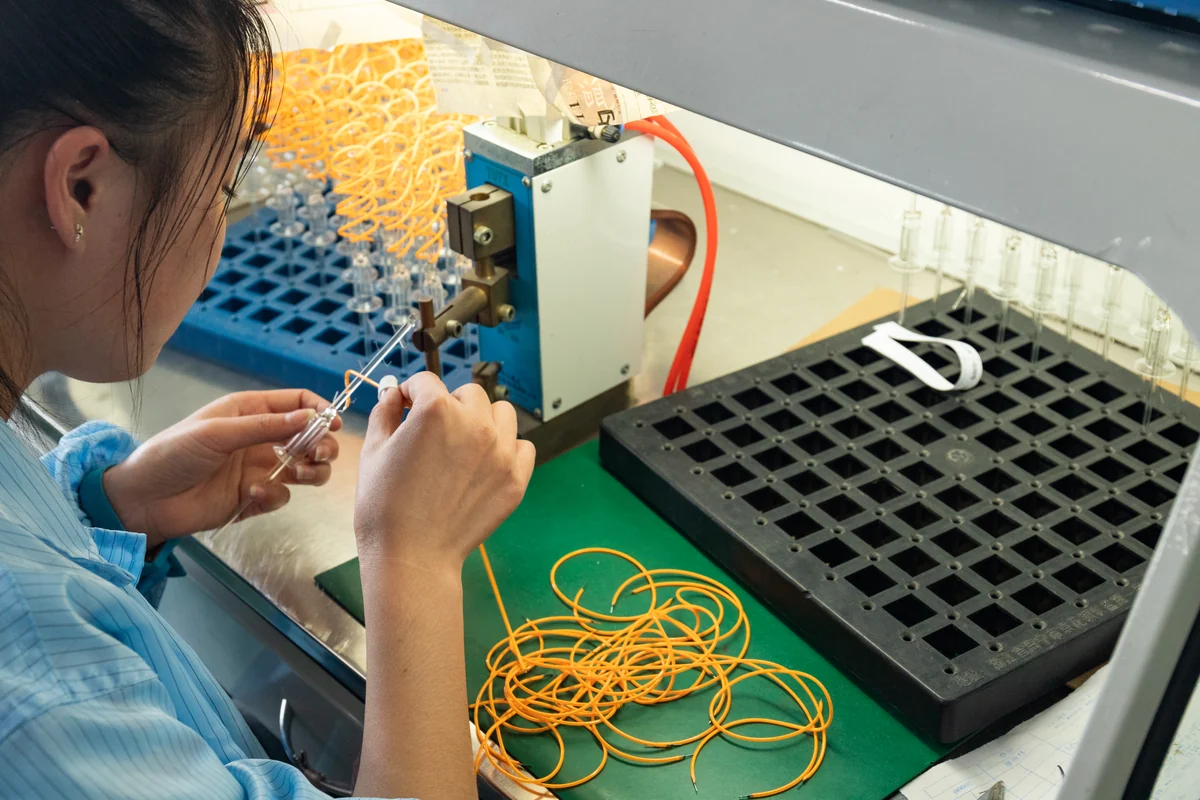
How the filament creates broad light distribution
Traditional LED bulbs often place emitters on a board near the base and use a diffuser. Filament lamps arrange narrow luminous strips inside a clear or lightly diffused envelope. This can support light emission over a broad range of directions and create the appearance expected from decorative bulbs.
It should not be described as perfectly omnidirectional without photometric evidence. The substrate, die placement, coating, support wires, number and orientation of filaments, base shadow and envelope all influence distribution.
For a project that depends on a specific distribution, compare the exact lamp’s photometric data in the intended fixture.
Thermal management without a conventional heat sink
Filament bulbs often preserve a classic clear-bulb appearance, leaving little room for the large metal heat sink seen on some conventional LED lamps. Heat must move from the dies through the filament structure, internal gas, envelope and surrounding air.
Peer-reviewed studies show that substrate dimensions, materials, encapsulation and gas can affect thermal and optical performance in the tested designs. The practical buying lesson is not that one material is always best. It is that appearance alone does not reveal thermal margin.
Check the exact product’s:
- ambient-temperature limits;
- enclosed-fixture suitability;
- operating orientation;
- rated life and test basis;
- dimming conditions;
- warranty exclusions.
Why materials matter to color and reliability
The filament coating must transmit and convert light while surviving heat and operating stress. Changes in the phosphor, encapsulant or optical materials can affect output, color and structural integrity.
For B2B sourcing, control changes to critical materials and processes. A sample can look correct initially even if its construction differs from the approved production version. The specification should identify which substitutions require notice, new samples or renewed testing.
When a supplier states a substrate or encapsulant advantage, ask for the test or design evidence connecting that material to the claimed outcome. Material names alone are not performance guarantees.
A buyer’s construction checklist
If filament construction affects your project, request:
- complete model and revision;
- substrate material or approved description;
- LED die arrangement and electrical architecture at the permitted disclosure level;
- encapsulant and phosphor system description;
- internal gas declaration where relevant;
- driver location and control method;
- thermal and lifetime evidence;
- envelope material and finish;
- operating orientation and enclosure conditions;
- change-control requirements for critical components.
Buyers can review the LED filament bulb family and the broader New Lights product range to identify the relevant shape and application. For a model-level construction question, contact New Lights with the target bulb and the material or performance field that needs confirmation.
FAQ
Is an LED filament made of tungsten?
No. It is a semiconductor LED assembly. Tungsten is used in the heated filament of an incandescent lamp.
What are the yellow strips inside an LED filament bulb?
They are typically LED filament assemblies covered with a phosphor-containing encapsulation. The coating converts part of the LED emission and helps create white light.
Are the LEDs mounted on glass?
Some designs use glass substrates, while others may use sapphire, ceramic or another construction. Verify the exact model.
Does every filament LED bulb contain helium?
No universal claim is justified. Helium and other gas approaches have been used or studied for heat transfer, but the actual gas fill is product-specific.
Where is the LED driver?
In a replacement lamp, it is commonly housed in or near the base. The exact circuit and location depend on the product.
Does the filament coating determine color temperature?
It contributes, together with the LED emission and optical design. The unlit coating color alone does not establish CCT or color quality.
Are LED filaments fragile?
They are narrow assemblies and require mechanical protection, but fragility and durability are model-specific. Use test evidence and handling instructions rather than a universal conclusion.
Editorial sources
- U.S. Department of Energy, “2022 SSL Manufacturing Status & Opportunities”: https://www.energy.gov/sites/default/files/2022-02/2022-ssl-manufacturing-status-opportunities_0.pdf
- Chen et al., “Optimization of Helium Inflating on Heat Dissipation and Luminescence Properties of the A60 LED Filament Lamps”: https://onlinelibrary.wiley.com/doi/10.1155/2019/6292036
- “Influence of Substrate Size and Gas on Thermal and Optical Performance of LED Filament Bulbs,” Journal of Luminescence: https://www.sciencedirect.com/science/article/pii/S0022231323007640
- U.S. Department of Energy, “LED Basics”: https://www.energy.gov/cmei/ssl/led-basics