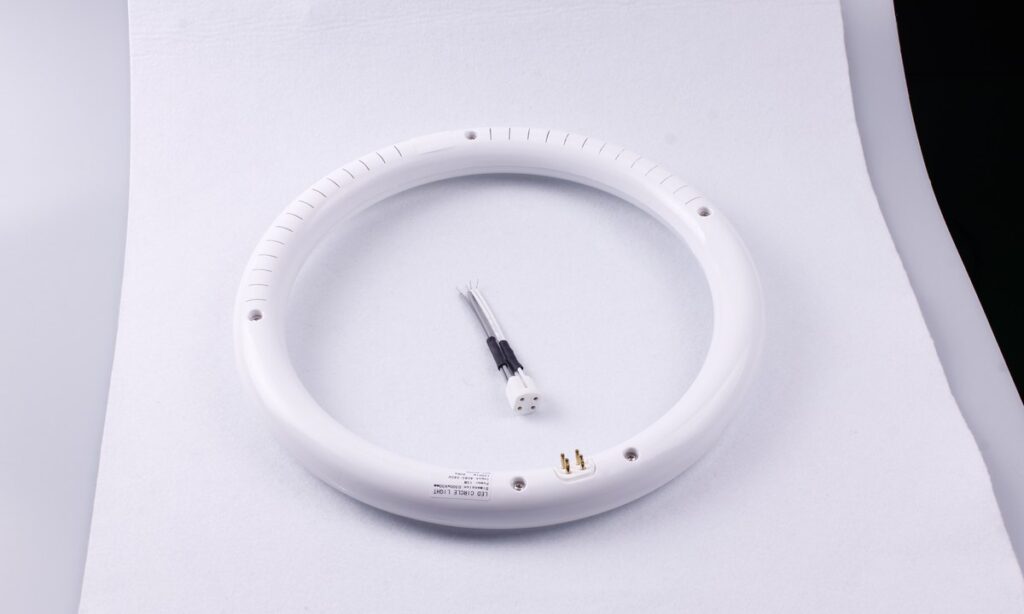


The best LED replacement for an FC12T9 circular fluorescent lamp is not determined by diameter alone. A replacement must match the fixture mechanically and must be documented for the existing ballast or for an approved rewiring method. It also needs to fit inside the fixture, work with its controls and satisfy the requirements of the destination market.
That is why two products described as “12-inch T9 LED circline replacements” may not be interchangeable. One may operate on a limited list of electronic ballasts, another may require ballast bypass, and a third may support both methods under different instructions.
This guide explains how to identify an FC12T9 system and compare the available replacement paths. The New Lights T9 circular-lamp range includes G10q models in several ring sizes, while the final match still depends on the surveyed fixture, electrical architecture and destination-market requirements.
What Does FC12T9 Mean?
FC12T9 is a legacy lamp designation used for a circular fluorescent tube. In common product literature:
- FC identifies a fluorescent circline lamp;
- 12 refers to the nominal circular size family;
- T9 describes the tube diameter family in eighths of an inch.
Current Lighting and Signify documents show common FC12T9 examples with a G10q four-pin base and an outside diameter near 12 inches. Documented fluorescent examples are commonly around 31 or 32 watts, but the complete code and suffix still matter. Color, output and other characteristics can differ.
Do not identify the lamp only by looking at the ring. Read every marking on the tube and photograph the connector, ballast label and fixture interior before purchasing a replacement.
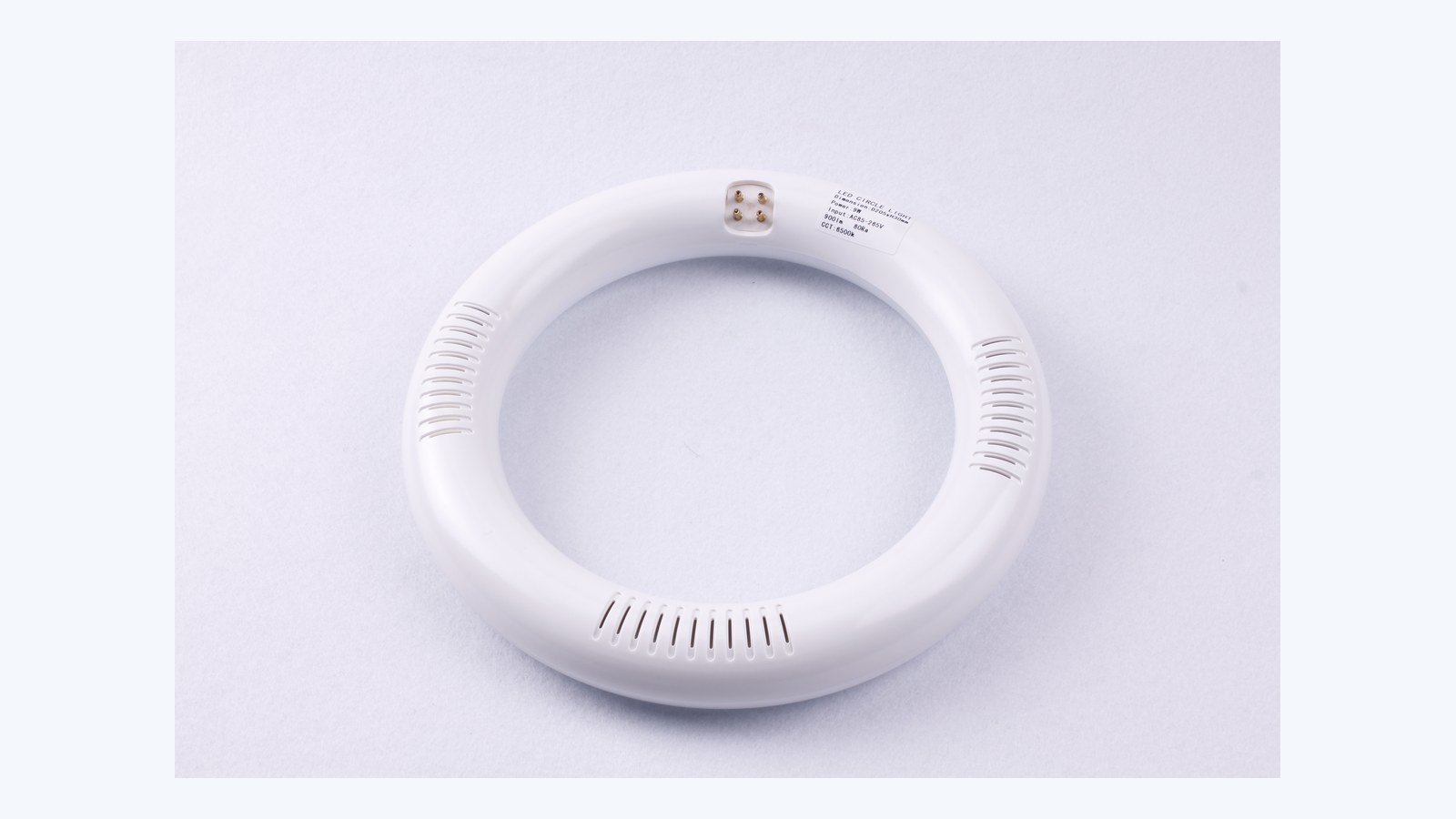
Why a 12-Inch G10q Lamp May Still Be Wrong
A replacement can resemble the old lamp and still fail for several reasons.
First, nominal size is not a complete dimensional drawing. The outside diameter, inside diameter, tube thickness, connector position and fixture clearance all matter. A lamp that touches the diffuser, mounting clips or housing should not be forced into place.
Second, G10q describes the four-pin base but not the operating architecture. It does not tell you whether the LED lamp expects a fluorescent ballast, direct line voltage or another driver arrangement.
Third, the fixture may contain different ballast types under the same exterior cover. An LED product approved for selected electronic ballasts may not work on a magnetic ballast or on an unlisted electronic model.
Finally, color temperature, output and light distribution affect the visible result. A product described as an electrical replacement is not automatically a photometric match for every fixture.
Record the Existing System First
Before comparing LED lamps, collect a basic fixture survey.
Lamp code and suffix
Record the complete text printed on the fluorescent tube, not only FC12T9. Suffixes may identify color or another variant. If a fixture contains two rings, record both lamp codes because the inner and outer lamps may be different sizes and wattages.
Base and connector
Confirm the four-pin base and photograph its orientation. Inspect the socket for discoloration, cracking, looseness or heat damage. A replacement should not be used to conceal a damaged holder.
Physical dimensions
Record outside diameter, tube diameter and available fixture clearance. Use the proposed LED manufacturer’s drawing for the final comparison. Do not rely only on the retail description “12 inch.”

Linear and circular lamp families use different dimensional conventions. The comparison in this T5 versus T8 guide shows why a family name never replaces a complete drawing and connector check.
Ballast label
Photograph the full label showing manufacturer, model, supported lamp combination, input and wiring diagram. If the label is unreadable or several ballast models exist across the building, treat them as separate configurations.
Supply and controls
Identify supply voltage, switching, dimming, sensors and emergency functions. This work should be performed or verified by qualified personnel. A non-dimmable replacement should not be assumed to work correctly on a dimming system.
Fixture condition
Check the lens, clips, wiring, socket, grounding, ballast compartment and signs of overheating or deterioration. If the fixture itself is near the end of serviceable life, replacing the complete luminaire may be more appropriate than installing a new lamp into a poor enclosure.
Replacement Paths at a Glance
| Replacement path | Existing component retained | Evidence required before approval | Maintenance consequence |
|---|---|---|---|
| Type A ballast-compatible lamp | Existing supported ballast | Exact lamp-and-ballast compatibility list, installation instructions and sample result | Ballast remains a service component |
| Type B ballast-bypass lamp | Fixture body and suitable holder | Wiring diagram, power-entry method, fixture marking and market requirements | Future replacement must match the converted wiring |
| Type A/B hybrid lamp | Ballast in Type A mode or converted fixture in Type B mode | Evidence for the selected mode, not merely the hybrid label | Maintenance records must identify the mode used |
| Complete LED luminaire | Building mounting point and supply | Luminaire dimensions, photometric data, controls, installation and compliance documents | Lamp-and-ballast compatibility is removed from the maintenance path |
Replacement Path 1: Ballast-Compatible LED Circline
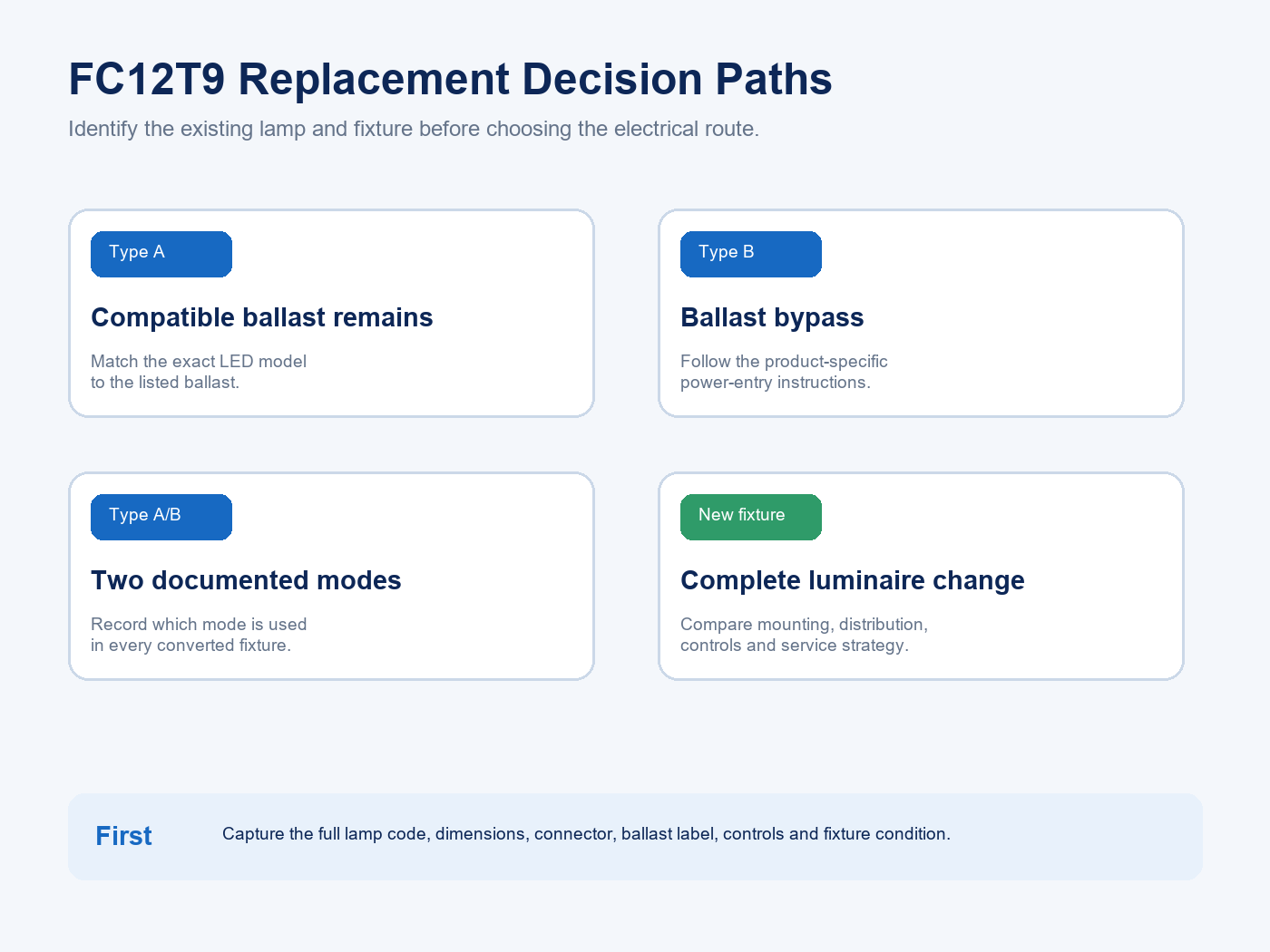
A ballast-compatible, often called Type A in North American literature, LED circline is intended to operate with a supported fluorescent ballast. This path can minimize fixture modification when the existing ballast is suitable.
The important word is supported. Compatibility should be confirmed against the exact LED model and current ballast list. A statement such as “works with most electronic ballasts” is not enough when the installed model is unknown.
For example, current third-party FC12T9 LED literature shows products that support Type A operation only on compatible electronic ballasts and exclude magnetic ballasts. The example illustrates why compatibility remains tied to the exact lamp and ballast pair.
Advantages of a compatible Type A path may include a simpler installation and retention of the existing ballast. The limitations are that ballast losses and condition remain part of the system, and future ballast failure may require another decision. Representative fixtures should be tested before a large purchase because a facility can contain different ballast revisions.
Replacement Path 2: Ballast-Bypass LED Circline
A ballast-bypass, often called Type B, product operates from a supply arrangement defined in its installation instructions. The fluorescent ballast is disconnected or removed from the operating circuit.
This eliminates ongoing dependence on ballast compatibility, but it is not a universal two-wire conversion. Power-entry arrangement, connector requirements, fixture labeling and permitted wiring are product-specific. The work modifies the fixture and should be completed by qualified personnel in accordance with the exact instructions and applicable requirements.
Do not purchase a Type B lamp until the installer has reviewed the product instructions and existing fixture. The correct question is not only whether the ballast can be bypassed, but whether the complete converted assembly is permitted and serviceable.
The preparation sequence in this LED tube installation guide is also useful for circline projects: identify the operating type first, isolate the circuit and keep the approved wiring record with the fixture.
Replacement Path 3: Hybrid Type A/B
Some circline LED products are designed for either a compatible ballast or a defined ballast-bypass mode. This is commonly described as Type A/B or hybrid.
Hybrid capability can give a facility two operating paths, but it does not make compatibility universal. The ballast mode still depends on the manufacturer’s list. The bypass mode still follows the lamp’s specified power-entry and labeling requirements.
Record which mode is used in each fixture. Future maintenance personnel should not have to guess whether line voltage or a ballast is present behind an identical diffuser.
Replacement Path 4: Replace the Complete Fixture
Sometimes the most appropriate LED replacement is a new luminaire rather than a tube. Consider complete fixture replacement when:
- the existing ballast, holders or wiring are deteriorated;
- the enclosure lacks clearance for available LED circlines;
- controls or emergency functions cannot be supported reliably;
- the existing distribution does not meet the lighting task;
- labor to modify and document each fixture is disproportionate;
- long-term replacement availability is uncertain.
A complete luminaire changes the scope of comparison. Review mounting, dimensions, output, distribution, controls, environment, documentation and installation—not only the old lamp code.
How to Compare Candidate FC12T9 LED Products
Use a model-by-model evidence table. At minimum, compare the following.
Mechanical identity
Confirm outside diameter, tube or housing dimensions, G10q configuration, connector location, weight and fixture clearance. Check mounting clips and diffuser depth.
Electrical architecture
Identify Type A, Type B, Type A/B or another clearly documented system. For Type A, record every supported ballast model in your fixture population. For bypass operation, have qualified personnel review the exact instructions.
Light output and distribution
Compare lumens, color temperature, color rendering and emitting direction where documented. Treat “32W replacement” as a reference label; compare fixture output, distribution and appearance separately.
Controls and operating conditions
Verify dimming, sensors, emergency systems, enclosed-fixture use, temperature and damp-location conditions as relevant. Use explicit permitted-use statements for every operating condition that affects the project.
Compliance and documentation
Request the exact datasheet, installation instructions, compatibility list and applicable test or certification documents. Confirm that model numbers match across the package and that documents apply to the target market.
For a repeatable document review, use the evidence fields in the LED lighting sample evaluation checklist and bind each file to the exact candidate model.
Maintenance and change control
Ask whether the ballast list and product construction can change, how revisions are identified and what replacement will be available later. Retain the approved model and installation mode in the facility record.
| Candidate field | Existing fixture record | Supplier evidence | Approval question |
|---|---|---|---|
| Ring geometry | Outside diameter, inside clearance, clip locations and diffuser depth | Dimensioned drawing for the exact model | Does the lamp fit without stressing the ring, holder or cover? |
| Connector | G10q holder orientation, lead length and socket condition | Base drawing, cable arrangement and installation instructions | Can the connector be seated and routed without interference? |
| Electrical route | Ballast make/model, input supply and existing wiring | Compatibility list or bypass wiring instructions | Is the selected route documented for every surveyed fixture group? |
| Lighting result | Existing output, color and visual distribution | Candidate lumens, CCT, CRI and distribution data | Does a representative sample meet the task requirement? |
| Controls and environment | Dimming, sensors, emergency function, enclosure and ambient conditions | Explicit operating limitations and control compatibility | Are all required operating conditions permitted? |
| Market documents | Destination country and project specification | Applicable model-specific compliance and installation files | Do the document model numbers match the supplied product? |
A Practical Decision Sequence
- Identify the complete legacy lamp code. Confirm that it is an FC12T9 family rather than another circline size.
- Inspect the fixture and ballast. Record all configurations instead of assuming the site is uniform.
- Choose an architecture. Decide whether a verified ballast-compatible path, a documented bypass conversion or complete fixture replacement fits the project.
- Shortlist exact models. Match dimensions, base, operating method, controls and environment.
- Review documentation. Resolve gaps before purchase.
- Test representative fixtures. Include each ballast and fixture variation.
- Approve and label the final configuration. Keep installation and maintenance records.
This sequence is slower than buying from a photograph, but much faster than returning incompatible lamps or troubleshooting an undocumented conversion across many fixtures. For volume projects, the New Lights manufacturing overview explains how sample approval and production controls connect to repeat orders.
Common Mistakes
Buying by ring diameter alone
Nominal diameter leaves connector position, clearance and electrical compatibility unresolved. Compare the complete drawing and operating system.
Assuming every electronic ballast works
Ballast-compatible LED lamps are tested or approved against defined ballast models. An electronic label by itself is insufficient.
Treating Type B as universal
Bypass products have specific power-entry, socket and labeling instructions. Never transfer the wiring concept from one lamp to another.
Ignoring a second circline lamp
Some fixtures contain two rings with different codes. The ballast may be designed for that combination. Survey the complete fixture before replacing either lamp.
Comparing only watts
LED input watts do not show distribution, fixture output or visual equivalence. Review photometric and application evidence.
Skipping a pilot
A sample in one fixture does not cover every ballast or control configuration in a building. Test representative groups and document coverage.
Frequently Asked Questions
Is FC12T9 always a 32-watt fluorescent lamp?
Common manufacturer examples are around 31–32 W, but read the complete lamp and ballast labels. Do not order from the family name alone, especially in a multi-lamp fixture.
Does every FC12T9 use a G10q four-pin base?
G10q is common in documented FC12T9 fluorescent examples, but the actual lamp and socket should still be inspected. The base does not identify the LED operating architecture.
Can I install a Type A LED without removing the ballast?
Only when the exact LED tube is designed for ballast operation and the installed ballast is supported. Follow the current compatibility list and instructions, then test representative fixtures.
Is ballast bypass more efficient or reliable?
It removes the fluorescent ballast from the operating system, but project results depend on the LED product, installation and maintenance plan. It also requires a documented fixture modification. Do not infer a universal performance advantage without comparing exact systems.
Can an FC12T9 LED replacement be dimmed?
Only if the complete proposed system is documented for dimming. Check the LED lamp, ballast or bypass architecture and control device. Many listed circline replacements are non-dimmable.
When should I replace the whole fixture?
Consider it when the existing fixture is damaged, has unsupported controls or ballasts, lacks clearance, produces unsuitable distribution or would require extensive modification. Compare complete lifecycle and installation scope rather than lamp price alone.
The Best Replacement Is the Verified System Match
There is no responsible universal answer to “the best FC12T9 LED replacement.” The correct choice matches the complete lamp identity, G10q connection, fixture dimensions, ballast or bypass architecture, controls, environment and target lighting result.
For a nominal 12-inch project, compare the surveyed lamp and fixture with the XGYT9-LCIR-E12 dimensions and S/U input options shown on the current New Lights 3-CCT LED T9 circular lamp page. To request a model-mapped review, send clear photos of the lamp code, connector, ballast label, fixture and supply details when you contact New Lights.
—
Editorial Sources
- Current Lighting, “FC12T9/CW T9 Circline Lamps”: https://www.led.com/catalog/t9-circline-lamps-33890
- Signify, “FC12T9 Daylight Deluxe”: https://www.assets.signify.com/is/content/Signify/928028605435_NA.en_US.PROF.FP
- SATCO, “S16511 FC12T9/LED/CIR/CCT/DM/A-B”: https://www.satco.com/products/S16511
- Feit Electric, “12 in. G10q T9 Replacement Type A Circline LED”: https://www.feit.com/products/12-in-20w-32w-equivalent-daylight-deluxe-white-6500k-g10q-t9-replacement-direct-replacement-type-a-non-dimmable-circline-led-light-tube-fc12-865-led