

LED decorative light strings use less power than many older incandescent sets, but lower power does not eliminate electrical shock, overheating or fire risk. The complete product includes flexible cord, plug, overcurrent protection, strain relief, lamp holders, connectors, controller and any power supply. Damage or misuse at any of these points can make the set unsafe.
The safest approach is to verify the product category and markings, inspect the complete string before every installation, follow the exact connection and location limits, and remove damaged equipment from service. Damaged cords, plugs, holders, controllers and sealed electrical assemblies should remain de-energized until the manufacturer or a qualified service process determines the correct disposition.
For product selection alongside these checks, compare the construction and stated scope of the available decorative string-light range. For planning a temporary seasonal display, the professional Christmas-lighting selection guide covers the specification decisions that should be made before installation.
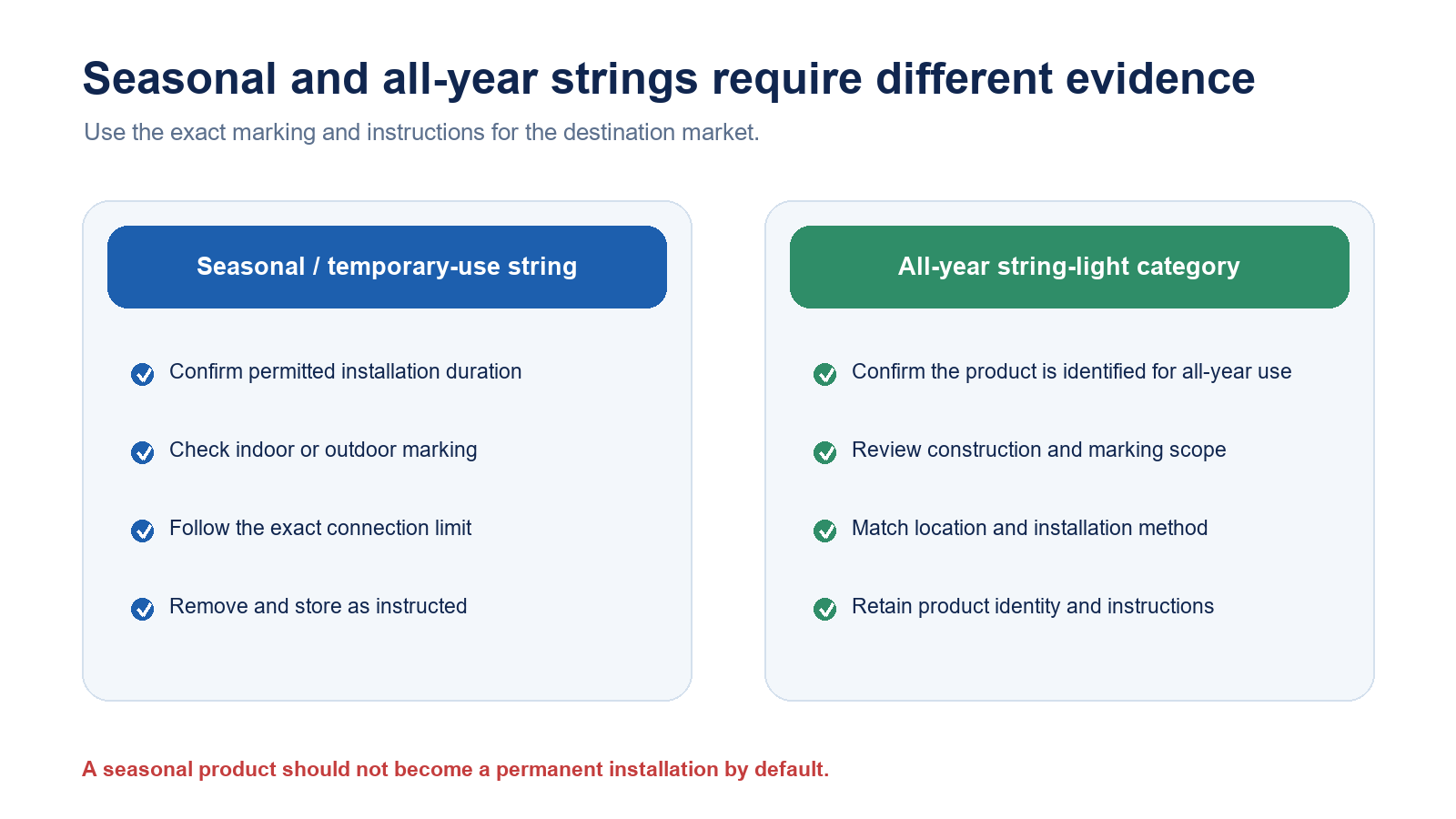
Seasonal Lighting Strings and All-Year String Lights Are Not the Same
Some decorative lighting strings are intended for seasonal or holiday use. In the United States, the U.S. Consumer Product Safety Commission (CPSC) describes covered seasonal and decorative products as portable, plug-connected, temporary-use lighting products and accessories with nominal 120-volt input.
UL Solutions also identifies a separate category for certain factory-assembled string lights intended for all-year use. Its guidance explains that all-year products have different construction and markings from seasonal strings.
Do not turn a seasonal string into a permanent patio installation simply because it operated outdoors for one holiday. Read the cord tag, product identity and instructions. Look for the intended duration, indoor/outdoor scope, mounting method and connection limit. If the label is missing or cannot be matched to reliable documentation, do not guess.
Market categories vary. A US UL category does not automatically prove compliance in another country. Buyers and importers need the exact destination-market evidence for the offered model.
| Evidence to check | Seasonal or temporary-use string | All-year string-light category |
|---|---|---|
| Product identity | Confirm that the model is identified for seasonal or temporary use | Confirm that the model is specifically identified for all-year use |
| Installation duration | Follow the permitted period in the markings and instructions | Follow the stated permanent or extended-use installation conditions |
| Location | Verify indoor-only or indoor/outdoor scope | Match the location, support method and environmental scope |
| Connections | Follow the exact compatible-string and load limit | Review the complete connected system and retained documentation |
| Removal and records | Remove and store as instructed after the display period | Retain product identity, instructions and inspection records |
Hazard 1: Frayed, Crushed or Bare Conductors
Flexible cords can be damaged by storage, doors, windows, sharp edges, furniture, vehicles, animals, staples or repeated bending. Frayed insulation or exposed conductors can create shock and short-circuit risk.
Uncoil the string and inspect its full length before use. Look for:
- Cuts, cracks or brittle insulation.
- Flattened, pinched or crushed sections.
- Bare wire.
- Burn marks or melted areas.
- Stiff or discolored points near connectors.
- Improvised splices or tape repairs.
CPSC and NFPA both advise against using sets with worn or damaged cords. Do not treat electrical tape as a universal repair. Remove a damaged string from service and follow the manufacturer or qualified service process for that product and market.
Hazard 2: Cracked Sockets and Loose Lamp Connections
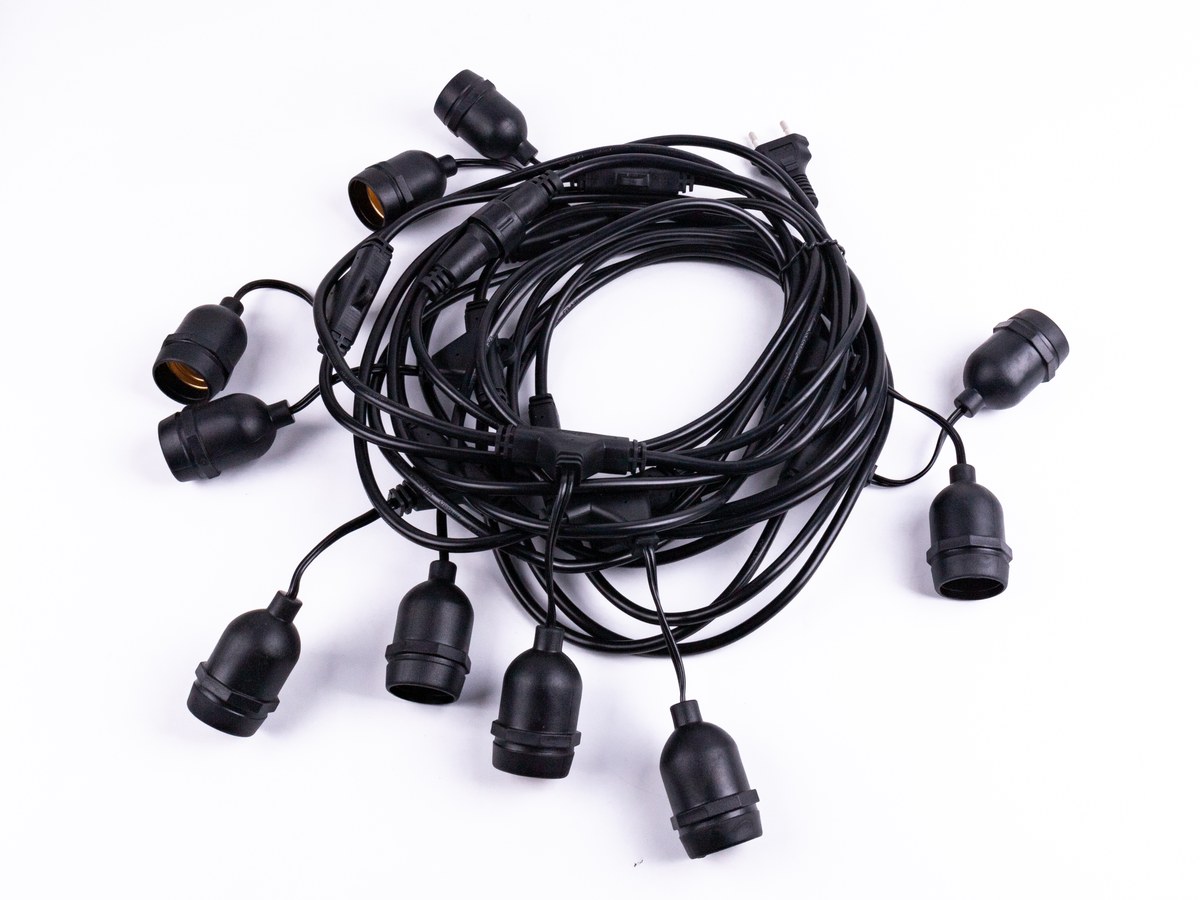
Cracked lamp holders can expose live parts or lose mechanical protection. Loose bulbs or contacts can create intermittent operation, local heating or arcing.
Inspect each holder and diffuser. Check for cracks, deformation, missing parts and signs of moisture or heat. Follow the instructions for replaceable lamps; do not install a different wattage, base or construction because it physically fits.
For sealed or non-replaceable LED strings, do not open a molded holder or controller. A failed section may indicate product damage that requires replacement or manufacturer evaluation.
Hazard 3: Failed Strain Relief
Strain relief prevents pulling forces on the cord from being transferred directly to electrical connections. CPSC identifies sufficient strain relief as one of three observable safety characteristics for covered US seasonal and decorative lighting products.
Check where the cord enters the plug, controller, power supply, connector and end fitting. Stop using the product if the cord pulls out, conductors are visible, the entry is loose or the assembly has separated.
Do not hang objects from the cord or use the electrical cable as a structural suspension unless the product is specifically designed and marked for that method. Decorative sockets, shades, ornaments and added loads can exceed the intended mechanical design.
Hazard 4: Missing or Incorrect Overcurrent Protection
Overcurrent protection helps limit the consequences of overload or fault conditions. CPSC identifies this as another key safety characteristic for covered seasonal products.
Do not bypass a fuse, bridge contacts or replace a protective device with an unapproved type. If protection opens repeatedly, disconnect the string and investigate the configuration and product condition through qualified channels. Repeated operation is a warning, not an inconvenience to defeat.
The presence of a fuse does not permit unlimited connection. Follow the maximum end-to-end quantity, wattage or load stated on the exact product.
Hazard 5: Connecting Too Many Strings
End-to-end connection limits vary with the product architecture, wire, plug, protection and input power. Older safety advice sometimes gives a generic number of sets, but that number should not override current manufacturer markings.
Read the tag and instructions for the maximum connected load or number of compatible strings. Do not mix series- and parallel-connected product types or join incompatible brands merely because the connectors fit.
Include controllers, adapters and extension cords in the load and compatibility review. Avoid daisy-chaining extension cords or power strips. If the desired display exceeds one string’s permitted capacity, use a properly designed distribution arrangement reviewed for the location.
Hazard 6: Indoor Products Used Outdoors
Outdoor exposure can include rain, condensation, snow, sunlight, temperature change, wind and contact with wet surfaces. An indoor-only set is not suitable simply because it is under an eave.
UL distinguishes indoor-only from indoor/outdoor decorative strings within its certification program. Verify the mark, product identity and instructions rather than relying on packaging color or a seller’s title.
Outdoor suitability of the string does not automatically make every extension cord, receptacle, timer or field connection suitable. Keep connections out of standing water and use complete equipment approved for the actual environment. Local electrical requirements and qualified installation review still apply.
The wider site conditions matter as much as the string itself. Use the outdoor-lighting installation checklist to record supply, mounting, drainage, access and maintenance conditions before the display is energized.
Hazard 7: Physical Damage From Fasteners and Supports
Nails, tacks and sharp staples can pierce or crush flexible cord. NFPA recommends using clips rather than nails for holiday lights.
Choose supports designed for the surface and string. Avoid excessive tension, unsupported spans, sharp edges and locations where doors or windows close on the cord. Account for wind movement outdoors. A string should not rub repeatedly against metal, masonry or branches.
Do not route cords across walkways, exits or vehicle paths. Besides trip risk, foot and wheel traffic can damage insulation and connections.
Hazard 8: Heat Sources and Combustible Materials
LED strings generally use less power than comparable incandescent strings, but plugs, drivers, controllers and failed connections can still generate heat. Keep the product away from heaters, fireplaces, grills, candles and other heat sources according to its instructions.
Do not bury power supplies under fabric, leaves, insulation or decorations that block heat dissipation. Keep the string clear of materials that could ignite, and maintain required spacing.
If a plug, controller, connector or cord becomes unusually hot, smells abnormal, discolors or melts, disconnect the display safely and stop using it. Do not wait for the lights to fail completely.
Hazard 9: Water at Connections
Water around plugs and connectors can create shock and fault risk. Position outdoor connections to reduce direct water exposure, while following product and local requirements. Use required covers or closures on unused connectors.
Do not wrap a wet or unsuitable connection in plastic as an improvised waterproofing method. Plastic can trap moisture and heat. Use the correct listed or approved system for the location.
After storms or flooding, disconnect the display according to safe procedures and inspect before reuse. Equipment submerged or visibly water-damaged needs qualified evaluation or replacement.
Hazard 10: Unattended Operation
The National Fire Protection Association (NFPA) advises turning off light strings and decorations before leaving home or going to bed. Controls and timers can help reduce unnecessary operation but do not replace inspection or supervision of a suspect product.
Use timers and smart controls only when they are compatible with the string and location. Confirm their load, environmental suitability and power-restoration behavior. A timer should not repeatedly energize a damaged string after a protective device or user has turned it off for investigation.
For commercial displays, document daily visual checks, opening and closing procedures, fault reporting and emergency isolation. High-footfall environments add risks from public contact, tampering and cable damage.
The same control discipline applies to connected decorative products. A smart decorative lamp string still needs a verified supply, suitable connection points and a shutdown process; remote control does not make damaged wiring acceptable.
Counterfeit, Untraceable and Recalled Products
Look for traceable brand, model, instructions and recognized certification appropriate to the destination market. A printed logo by itself is not proof. Verify certification through the relevant directory when the claim is important.
Check current recall databases before deploying a large quantity or reusing stored products. CPSC recalls and safety notices can change after an article is published, so this check must happen near purchase and installation.
Be cautious when the cord tag, manufacturer identity, voltage, indoor/outdoor scope or connection limit is missing. A low price does not justify accepting an untraceable electrical product.
For an OEM or private-label order, build traceability into the approval package: model identity, rating label, instruction version, packing reference and destination-market evidence should agree. New Lights’ factory and manufacturing overview explains where product definition, sampling and production controls fit into that process.
Stop-Use Decision Matrix
| Observation | Immediate decision | Next controlled action |
|---|---|---|
| Frayed insulation, exposed conductor or crushed cord | Keep the string de-energized | Segregate it and follow the manufacturer or qualified disposition process |
| Cracked holder, loose lamp or deformed connector | Stop use | Identify the model and obtain the correct replacement or product decision |
| Loose cord entry or failed strain relief | Stop use | Remove pulling load and replace or evaluate the complete assembly |
| Missing label, voltage or location scope | Do not install | Recover the instructions and traceable model evidence before use |
| Repeated fuse or protective-device operation | Do not re-energize repeatedly | Review the connected load, compatible components and product condition |
| Water intrusion, melting, odor or abnormal heat | Isolate safely and stop use | Arrange qualified evaluation and replace affected equipment where required |
Pre-Use Safety Checklist
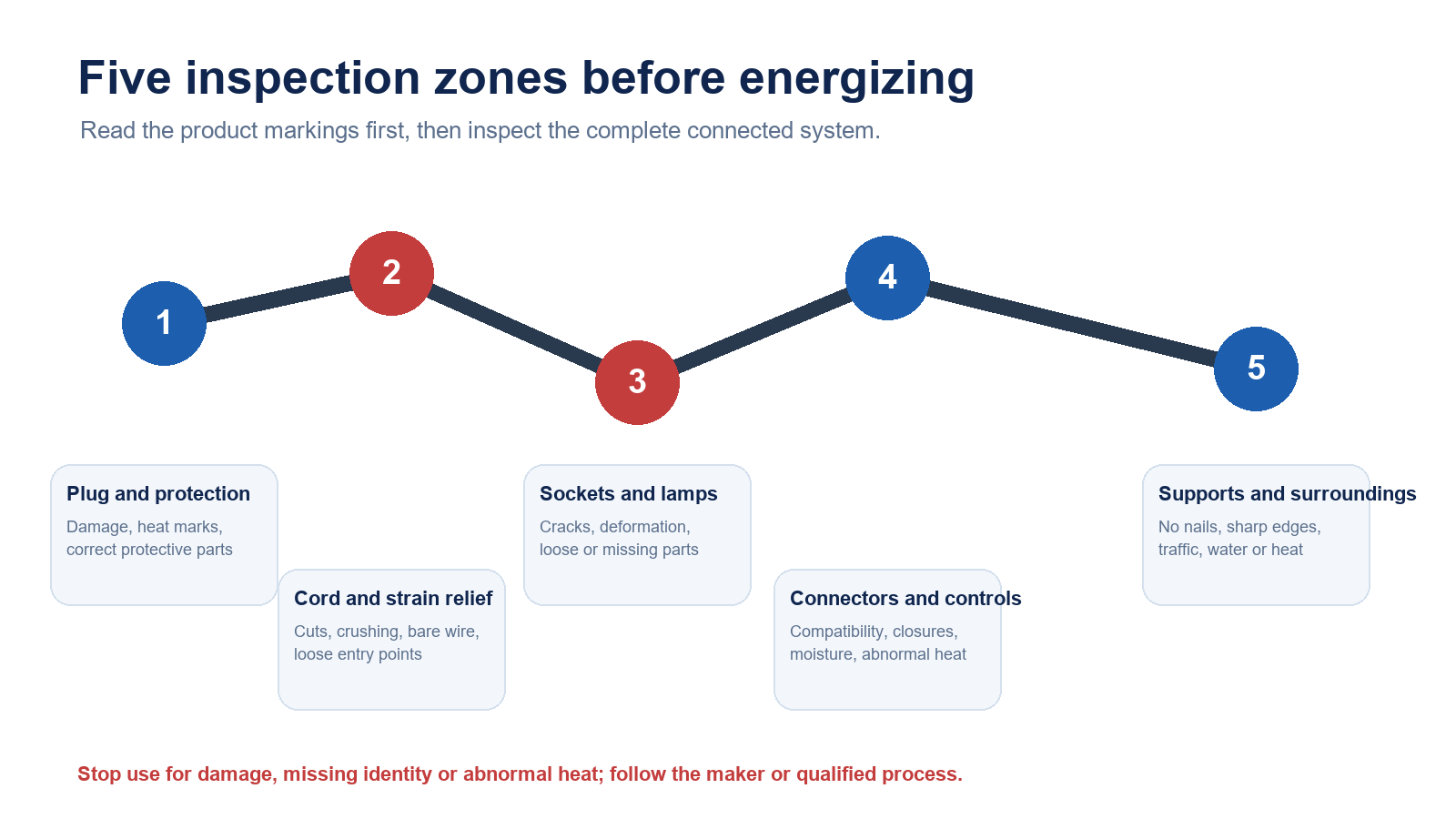
Before energizing a decorative string:
- Identify seasonal or all-year product scope.
- Verify indoor or outdoor use marking.
- Confirm supply voltage and destination-market documentation.
- Inspect plug, fuse or protection, cord and strain relief.
- Inspect every socket, connector and controller.
- Reject cracked, frayed, bare, melted or improvised repairs.
- Confirm maximum connection load and compatible products.
- Use suitable supports without piercing the cord.
- Keep cords clear of traffic, water and heat sources.
- Test controls and establish shutdown procedures.
- Check current recalls.
- Retain instructions and product identity records.
Procurement teams can keep the label, instruction sheet, approved sample photos and test records together in the project file. If a document is missing, check the New Lights download center or request the model-specific record before the purchase or installation decision is closed.
Frequently Asked Questions
Can LED string lights cause a fire?
Yes. Lower power reduces some heat compared with older products but does not remove risks from damaged wire, poor connections, overload, unsuitable components or misuse.
Can indoor string lights be used under a covered patio?
Do not assume so. Use a product marked and documented for the actual outdoor exposure, and ensure every cord, connector, timer and receptacle is also suitable.
How many LED strings can be connected end to end?
Use the maximum quantity or load stated for the exact product. There is no safe universal number for all LED strings.
Can a frayed string-light cord be repaired with tape?
Do not rely on tape as a generic repair. Remove the damaged set from service and follow the manufacturer or qualified repair/replacement process.
Can seasonal holiday lights stay installed all year?
Not unless their product category and instructions permit that use. UL distinguishes seasonal decorative lighting strings from a separate all-year string-light category.
What information is needed to review a product’s scope?
Provide clear photos of the cord tag, plug, model, instructions and certification marking, plus the destination market, indoor/outdoor location, installation duration and proposed connected load. Buyers can contact New Lights for a model-level review after the evidence is assembled.
Editorial Sources
- U.S. Consumer Product Safety Commission, “Seasonal and Decorative Lighting Products.”
- U.S. Consumer Product Safety Commission, “Holiday Decoration Safety Tips.”
- UL Solutions, “Bulletin: Decorative Lighting Strings.”
- UL Solutions, “String Lights for All-Year Use.”
- National Fire Protection Association, “Winter Holiday Safety.”