

The EU Energy Performance of Buildings Directive (EPBD) makes built-in lighting part of the wider building-performance conversation, but it does not create one lighting specification for every renovation. Buyers still need the applicable national rules, an evidence-based building baseline, and a project brief that defines lighting quality, controls, installation interfaces, commissioning and handover.
According to the European Commission, the revised Directive (EU) 2024/1275 entered into force on 28 May 2024, its general transposition deadline was 29 May 2026, and final national building renovation plans are due by 31 December 2026. Because implementation is national, a procurement team should use the EU framework to ask better project questions—not to assume that the same threshold, incentive or technical solution applies in every country.
What the EPBD changes—and what it does not
The current consolidated Directive text published by EUR-Lex treats built-in lighting as part of a building’s technical systems and includes lighting energy in the building-performance methodology. It also addresses building automation and control, indoor environmental quality and the renovation of existing buildings. That wider system boundary matters because lighting decisions can affect energy use, visual conditions, control integration, electrical work and the sequence of a renovation.
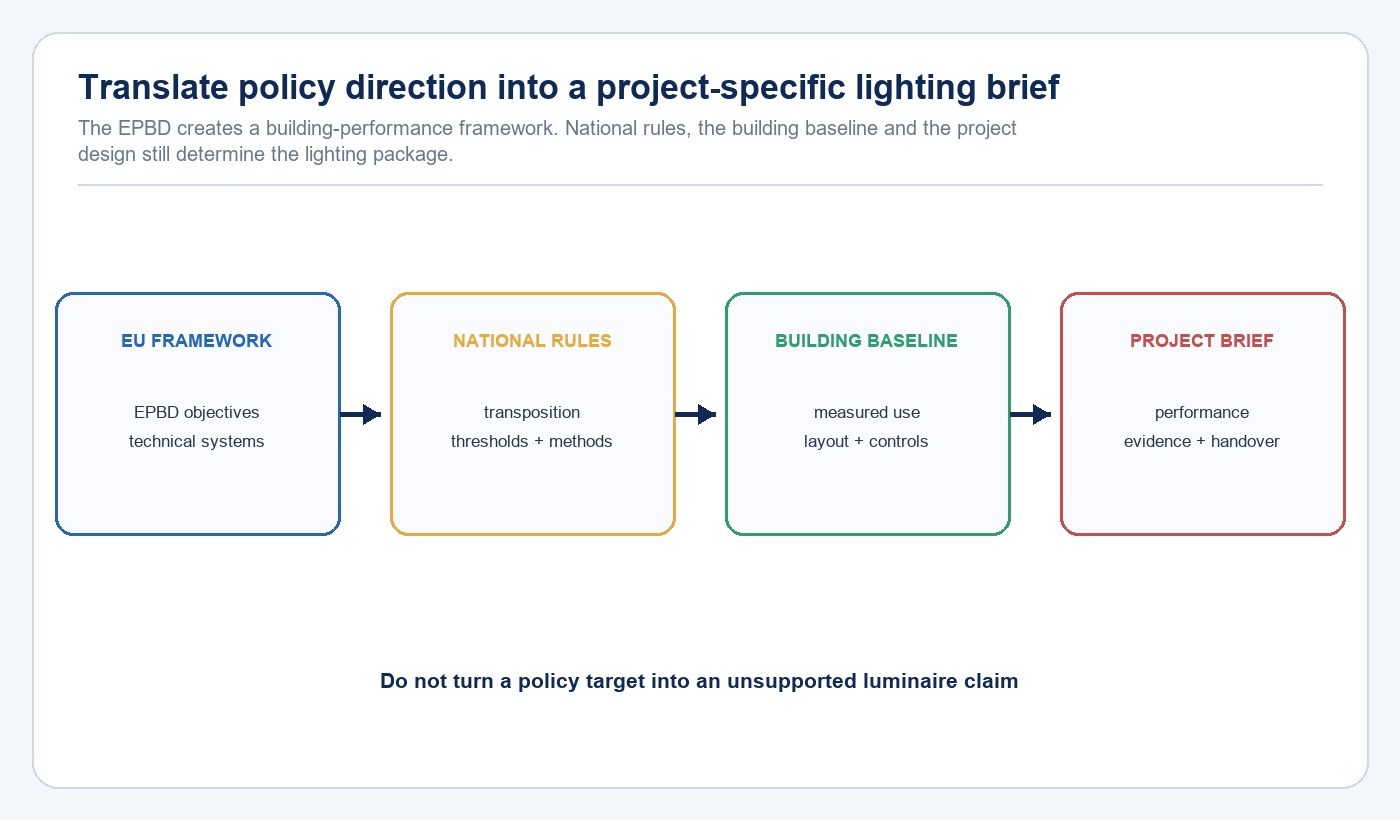
It does not replace product legislation, national building rules, workplace-lighting requirements or project calculations. Nor does it establish a universal luminaire wattage, UGR value, control protocol or payback period. Those decisions remain conditional on the country, building type, room use, existing installation and selected product.
This distinction is the first procurement gate: treat the EPBD as a planning framework, then identify the legal and technical documents that govern the actual project location.
Build a measured lighting baseline before comparing offers
A renovation proposal needs a reference condition. Start with an inventory of luminaires, lamps or LED modules, drivers, emergency components, controls, circuit arrangement and mounting method. Record room use, occupied hours, cleaning and maintenance access, ceiling changes and any constraints on shutdown or phased installation.
Energy data should describe the system rather than a catalogue value. Useful inputs include measured circuit power where available, operating schedules, control states and evidence of after-hours use. Lighting-quality observations should identify the tasks, work-plane locations, glare concerns, vertical surfaces, display areas and areas where color appearance or flicker is material.
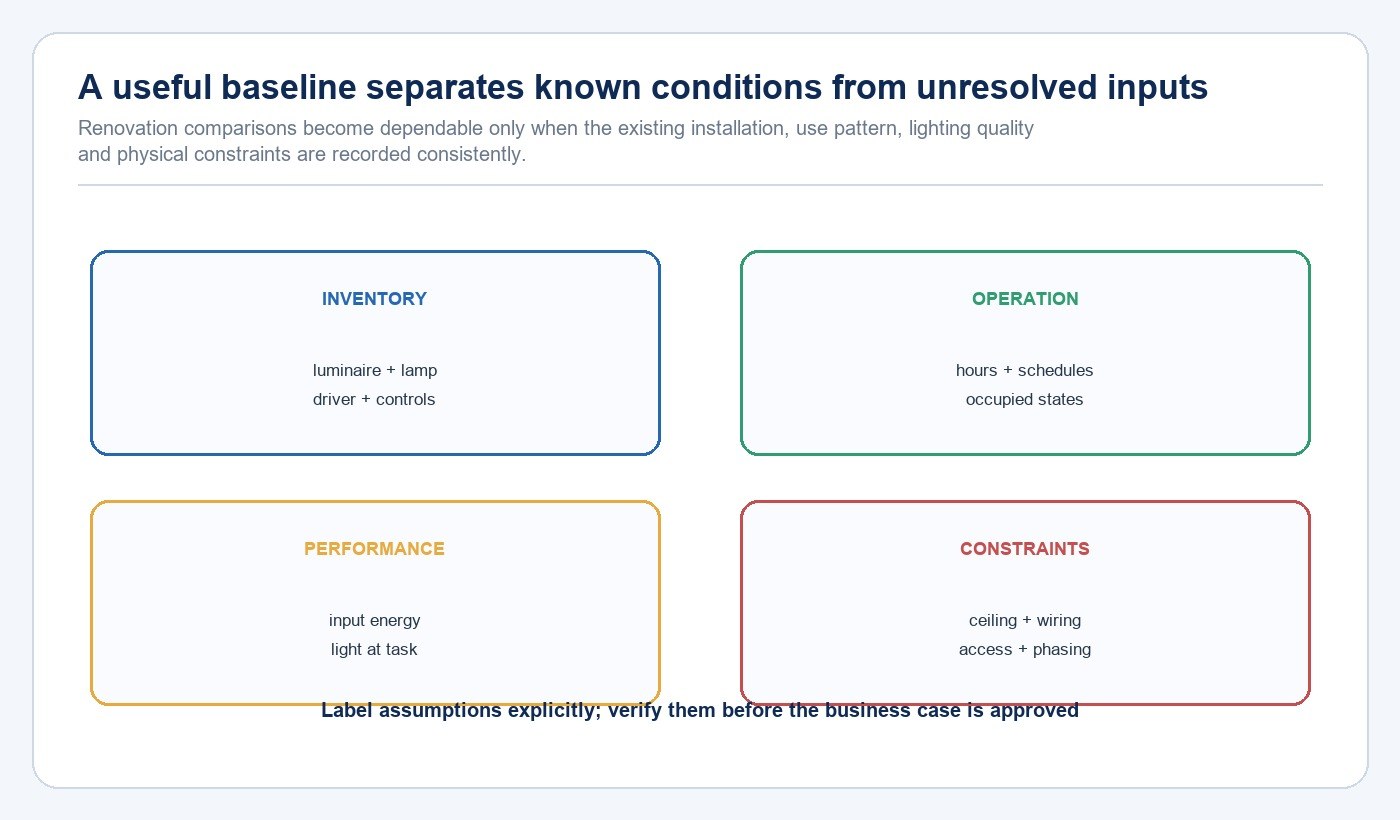
The table below turns that survey into comparable inputs.
| Basisfeld | Zu sammelnder Nachweis | Warum dies die Entscheidung verändert |
|---|---|---|
| Existing equipment | Schedule, photographs, order references, driver and control identity | Reveals compatibility and removal scope |
| Betrieb | Occupied hours, schedules, overrides and after-hours states | Establishes the operating pattern behind energy use |
| Lighting condition | Task locations, measured values where required, glare and color concerns | Prevents an energy-only comparison |
| Physical condition | Ceiling, openings, wiring, access, hazardous or wet areas | Defines feasible mounting and installation routes |
| Project interfaces | HVAC, ceiling, emergency, fire, BMS and tenant works | Assigns responsibility and sequencing |
| Evidence gaps | Unknown circuits, missing drawings, unverified hours or controls | Shows what must be surveyed or tested before approval |
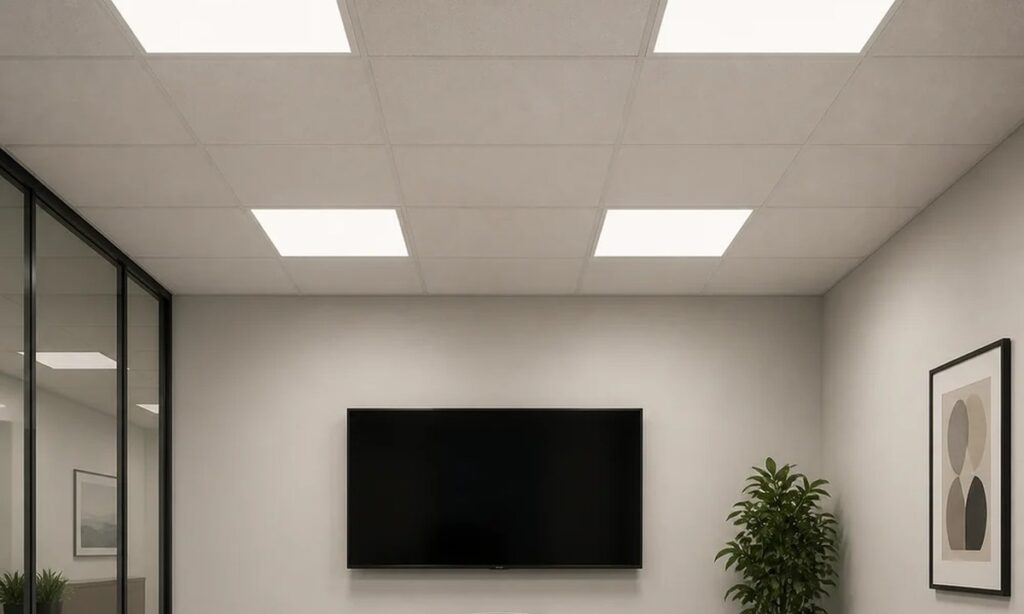
For projects considering broad-area luminaires, the New Lights Slim LED Side-Emission Panel is one current product-family starting point. Product selection should follow the room calculation and installation boundary, not precede them.
Define the renovation scope before selecting products
Separate three common scopes: direct replacement, luminaire replacement with control improvements, and full lighting redesign. A direct replacement may preserve locations and wiring but still requires checks for dimensions, emergency functions, dimmer or sensor compatibility and maintained light levels. A control upgrade adds zoning, sequences, wiring or wireless infrastructure and commissioning. A redesign can change quantities, optics, mounting positions and room appearance, so it needs a new calculation and coordination with other trades.
Die Beleuchtungslösungen für Gewerbe und Einzelhandel page provides application context for offices, retail and public spaces. It should be used to frame the application; the final schedule must still identify the exact luminaire, driver, control option, accessory and destination-market evidence.
Specify lighting outcomes, not replacement wattages
An offer is not comparable if it contains only quantity, wattage and a generic lumen value. Define the lighting tasks and acceptance method. Depending on the project, the brief may need maintained illuminance, uniformity, glare control, vertical illumination, color rendering, correlated color temperature, flicker criteria, emergency performance and scene requirements.
Die UGR, CRI and flicker guide explains why these metrics answer different questions. A low input wattage cannot compensate for unsuitable distribution, uncomfortable glare, poor color quality or unstable operation. Likewise, a high efficacy value does not by itself prove that the design delivers useful light where the room needs it.
Steuerungen als Betriebssequenz behandeln
Terms such as “sensor-ready,” “daylight control” or “BMS compatible” are incomplete without a sequence. Define what happens when a space becomes occupied or vacant, daylight changes, a user overrides the system, a schedule expires, communications fail or power returns. State the minimum and maximum light levels, fade behavior, timeout, priority between inputs and the party responsible for programming.
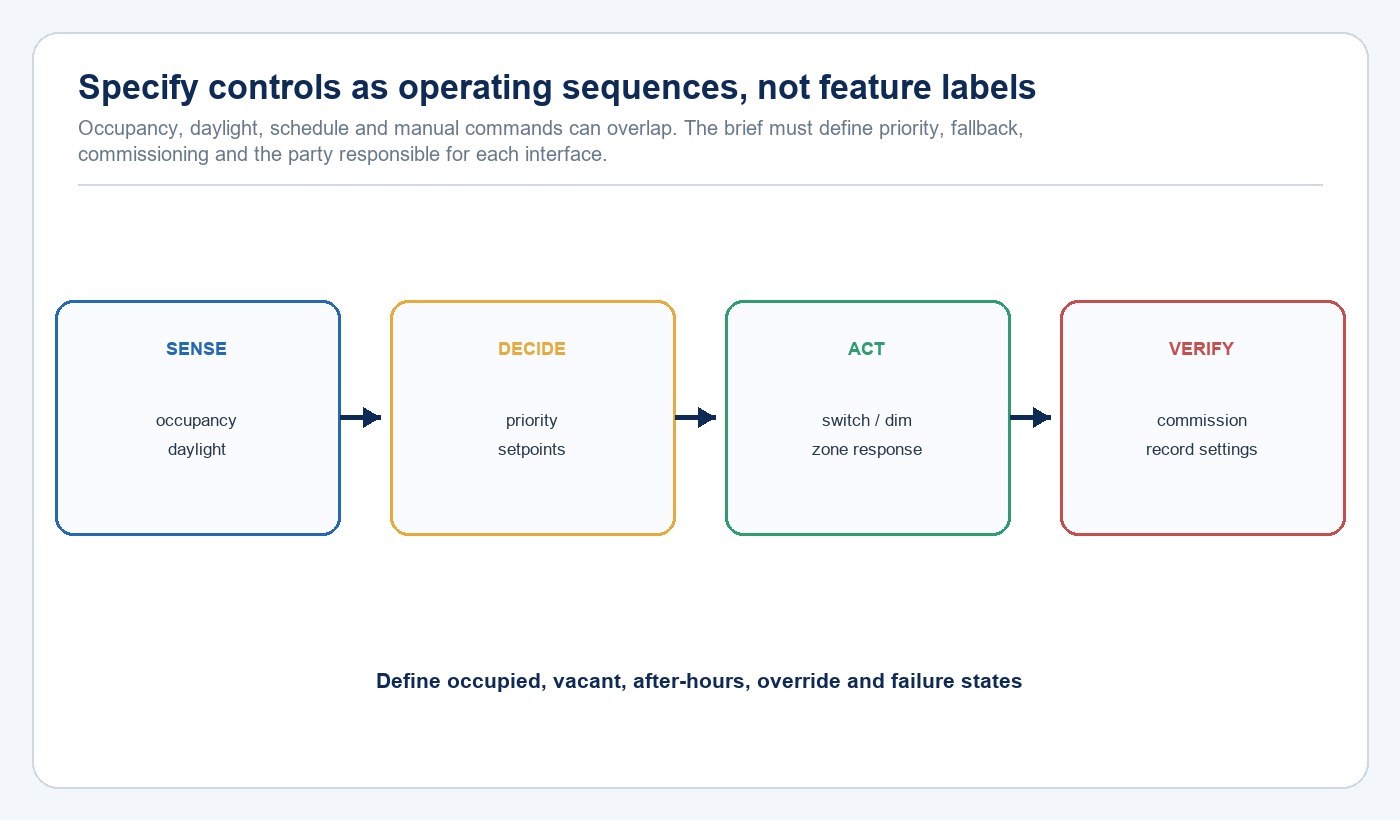
Die connected-lighting specification guide provides a deeper interface and commissioning checklist. Use it when gateways, software, network responsibilities or integration with building systems are inside the project scope.
Compare offers on system boundaries and evidence
Two quotations can look similar while assigning different responsibilities. One may include sensors but exclude commissioning; another may include emergency versions but omit the monitoring interface; a third may assume reusable wiring that has not been surveyed. Normalize each offer against one scope matrix before comparing price.
| Entscheidungsbereich | Supplier should identify | Project team should approve |
|---|---|---|
| Produktidentität | Exact model, option codes, driver, accessories and revisions | Approved schedule and substitution rules |
| Photometric basis | Files and calculation inputs tied to the quoted model | Room geometry, reflectance assumptions and acceptance points |
| Steuerung | Devices, topology, protocol, software and commissioning scope | Sequence, interfaces, access rights and fallback behavior |
| Installation | Mounting parts, wiring assumptions and environmental limits | Site conditions, trade boundaries and phasing |
| Konformität | Market-specific declarations, reports, labels and instructions | Applicable project and national requirements |
| ?bergabe | As-built schedule, settings, test records and maintenance information | Required format, owner and retention location |
Verwenden Sie die Checkliste zur Bewertung von LED-Beleuchtungsmustern before releasing a representative model. The sample should test the intended configuration and acceptance criteria rather than serve as a visual-only approval.
Plan installation and replacement continuity
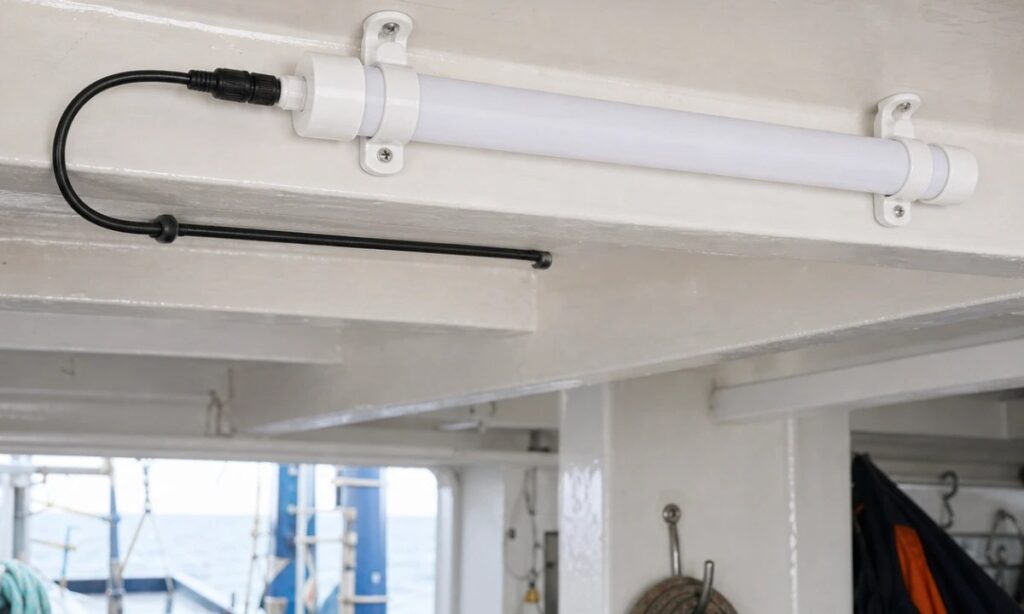
Renovation logistics can change the best technical option. Confirm isolation periods, ceiling access, waste handling, tenant or production constraints, temporary lighting and the sequence with ceiling or electrical works. Where the building remains occupied, representative pilots should include difficult conditions—not only the easiest room.
Replacement continuity matters after handover. Record the driver, module or lamp reference, control settings, approved alternatives and the process for reviewing a substitution. If the product or firmware changes, repeat the checks affected by that change rather than relying on the original sample.
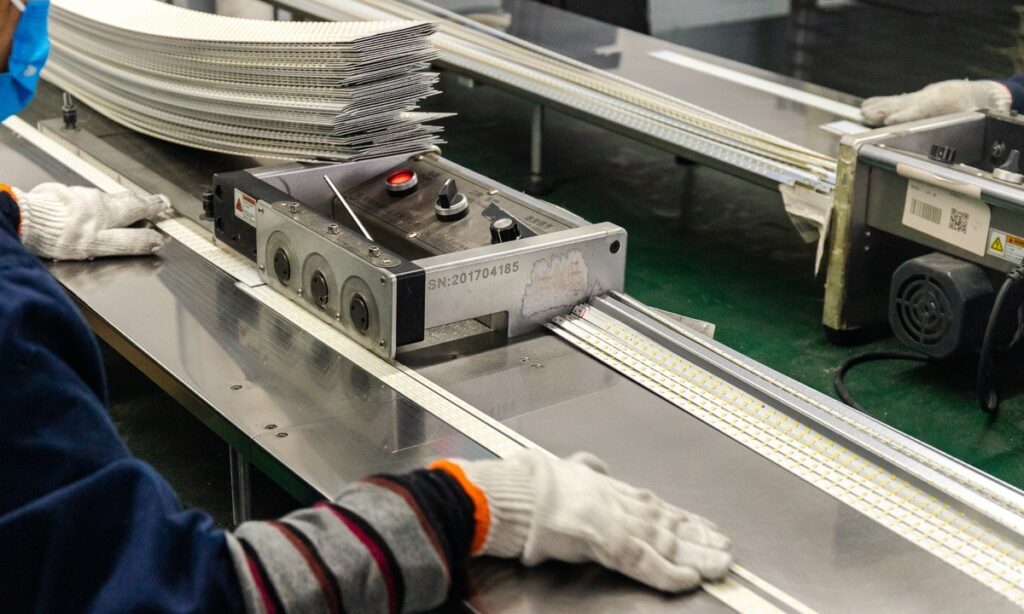
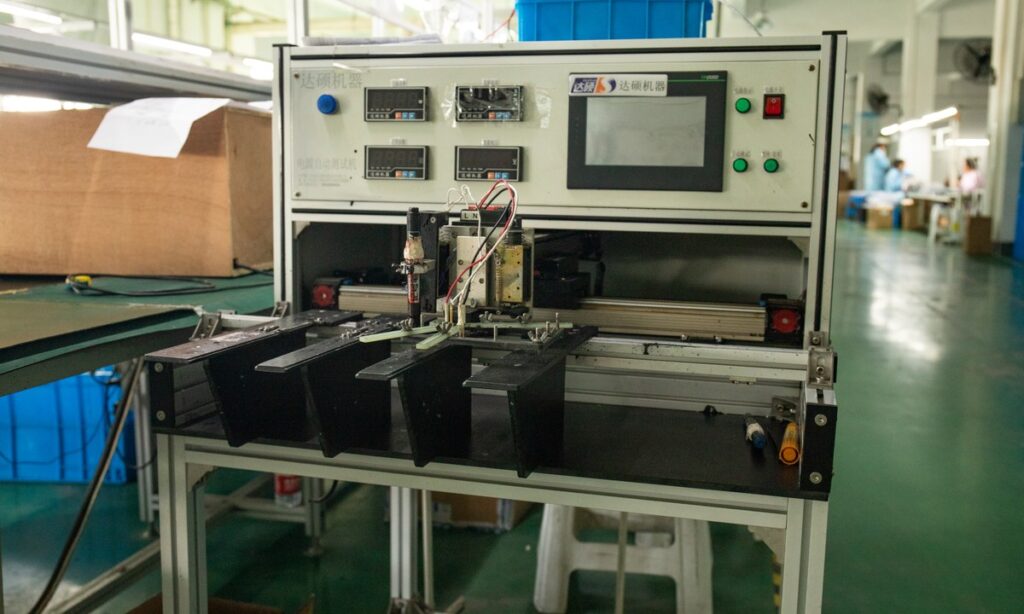
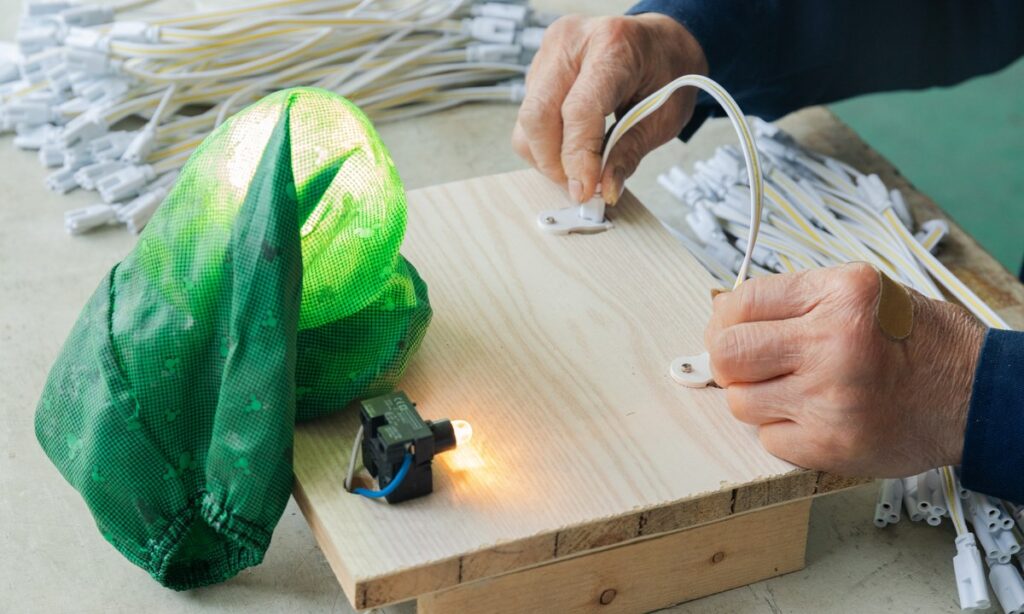
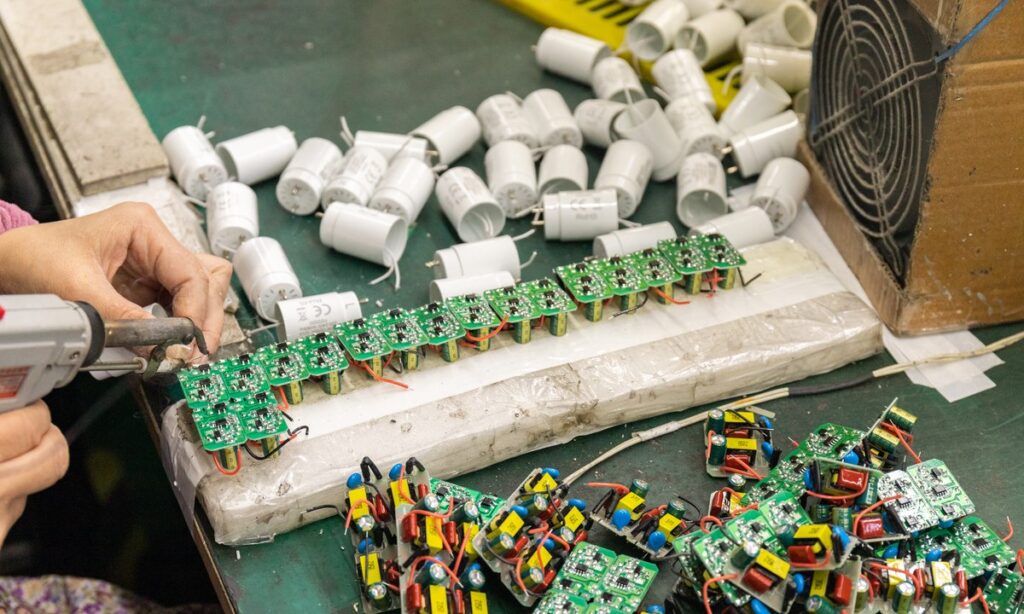
Die New Lights factory and manufacturing overview provides context for production, inspection and change-control discussions. Available product documentation can be reviewed through the download centre.
Build a handover package that survives personnel changes
The Directive’s system perspective makes operating evidence especially useful. A complete handover package can include as-built drawings, luminaire and driver schedules, control-zone maps, programmed settings, commissioning results, emergency-lighting records, maintenance instructions, warranties and approved replacement references.
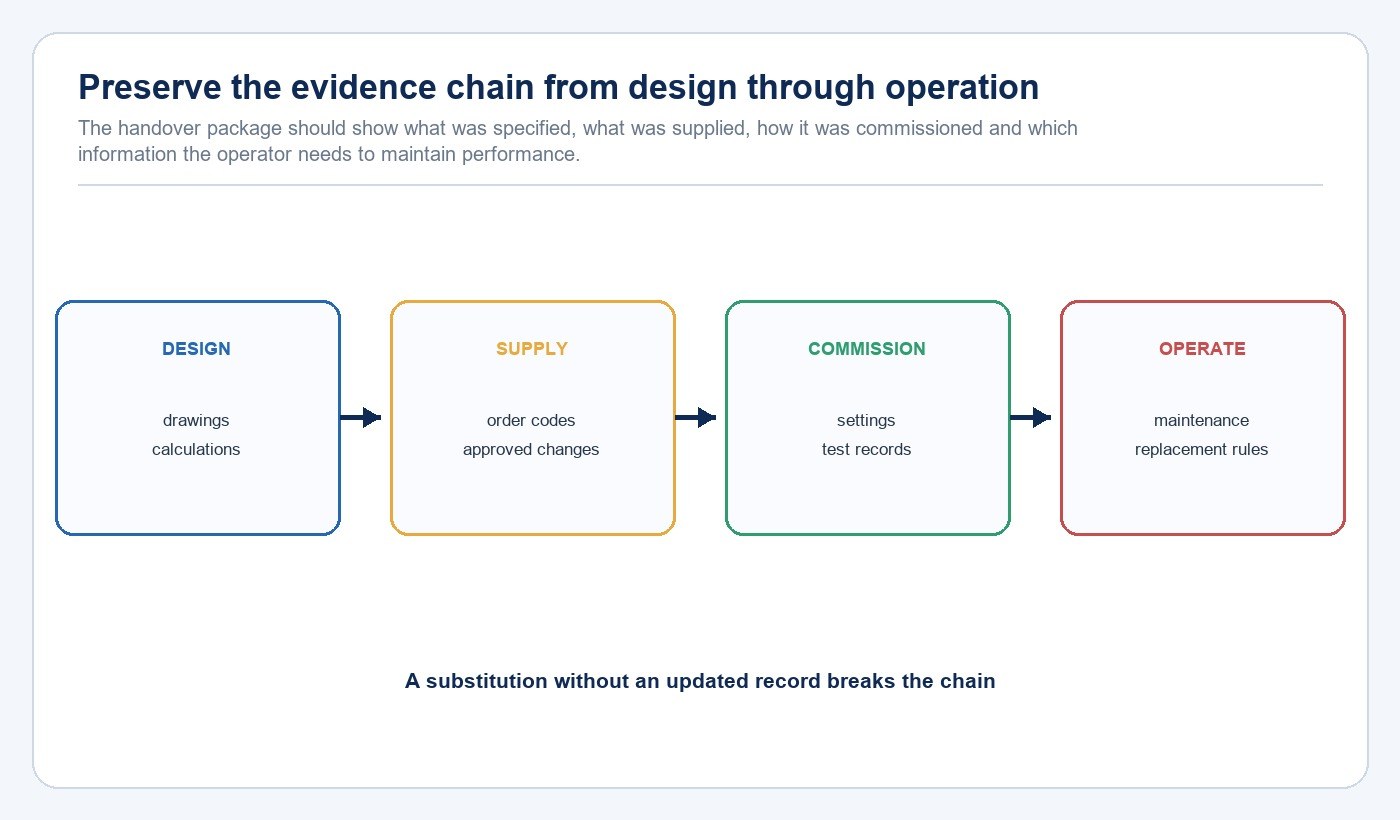
Store final records where the building operator can retrieve them. A technically successful installation can lose performance if schedules are reset, sensors are bypassed, replacement components are chosen without compatibility review or nobody owns the software account.
Buyer checklist for an EU lighting-renovation package
- Identify the country, building type and current national requirements.
- Record the existing lighting, controls, operation and physical constraints.
- Separate measured data from assumptions and assign unresolved surveys.
- Define whether the work is replacement, control upgrade or redesign.
- Specify lighting-quality outcomes and the acceptance method.
- Write control sequences for every normal, override and failure state.
- Normalize supplier offers against the same scope and evidence matrix.
- Pilot representative difficult areas before releasing the full rollout.
- Freeze order codes and require documented approval for substitutions.
- Define the as-built, commissioning and maintenance handover package.
Häufig gestellte Fragen
Does the EPBD require every building to replace its lighting?
No universal lighting-replacement rule applies to every building. The Directive establishes an EU framework, while national implementation, building type, renovation trigger and project requirements determine the applicable obligations.
Does an LED retrofit automatically satisfy building-performance requirements?
No. Product efficiency is only one input. The project may also require a building calculation, lighting-quality assessment, controls, installation coordination, commissioning and national compliance evidence.
Should buyers wait for every national renovation plan before preparing projects?
No. Teams can build accurate inventories, operating baselines, control sequences and evidence requirements now. Final investment and compliance decisions should still be checked against the current national rules for the project location.
Can catalogue wattage be used to calculate guaranteed savings?
Not by itself. Savings depend on the installed system, quantities, operating hours, control behavior and baseline method. Use documented or measured project inputs and state assumptions explicitly.
What should be fixed before requesting quotations?
Fix the building and room scope, required outcomes, mounting and electrical constraints, control sequence, compliance market, acceptance method and handover requirements. Suppliers can then identify an exact product configuration and evidence set.
Prepare a comparable project brief
For a renovation review, Kontaktieren Sie New Lights with the building type, country, existing schedule, room plans, operating hours, target outcomes, control interfaces, installation constraints and required evidence. A clear baseline and responsibility matrix make quotations easier to compare and later changes easier to control.