

Connected lighting should be specified as a complete operating system, not added as a feature after luminaires have been selected. Choose the architecture first, then connect each luminaire, driver, sensor, control protocol, gateway, software interface and commissioning test to that architecture. The right level of connectivity is the simplest system that can deliver the required sequences, integration and maintainability.
Choose the architecture before the device list
Stand-alone controls can suit a room or simple zone where local sensors and switches provide the required behavior. Room-based systems coordinate several devices and scenes without necessarily depending on a central network. Centrally networked systems can support scheduling, remote configuration, monitoring, analytics and building-system integration, but they also add software, account, network, cybersecurity and lifecycle duties.
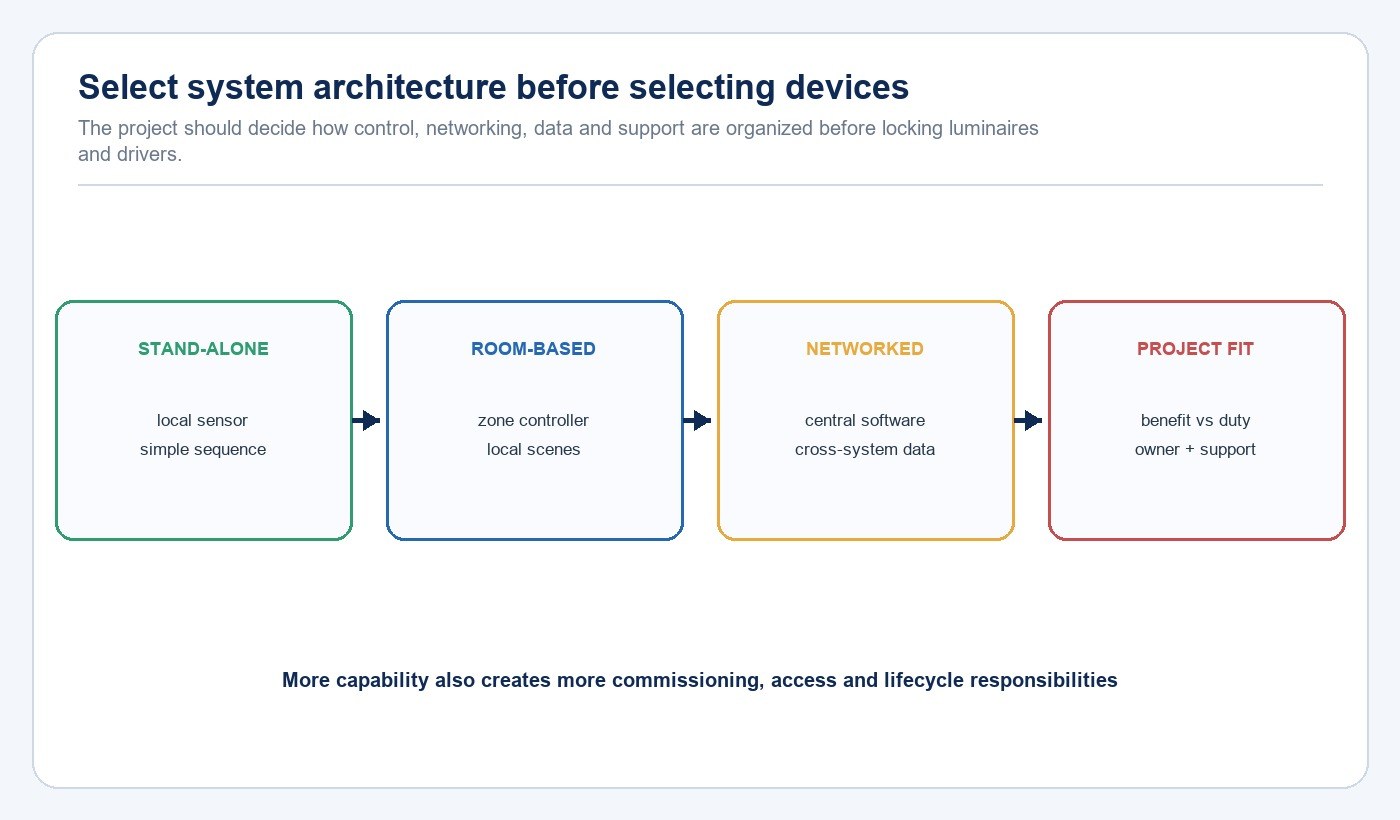
The US Department of Energy and Pacific Northwest National Laboratory describe connected lighting systems as platforms that can combine networked sensors, Internet connectivity and interfaces with other building controls. Those capabilities are useful only when the project has a defined use case and an owner for the resulting data and system responsibilities.
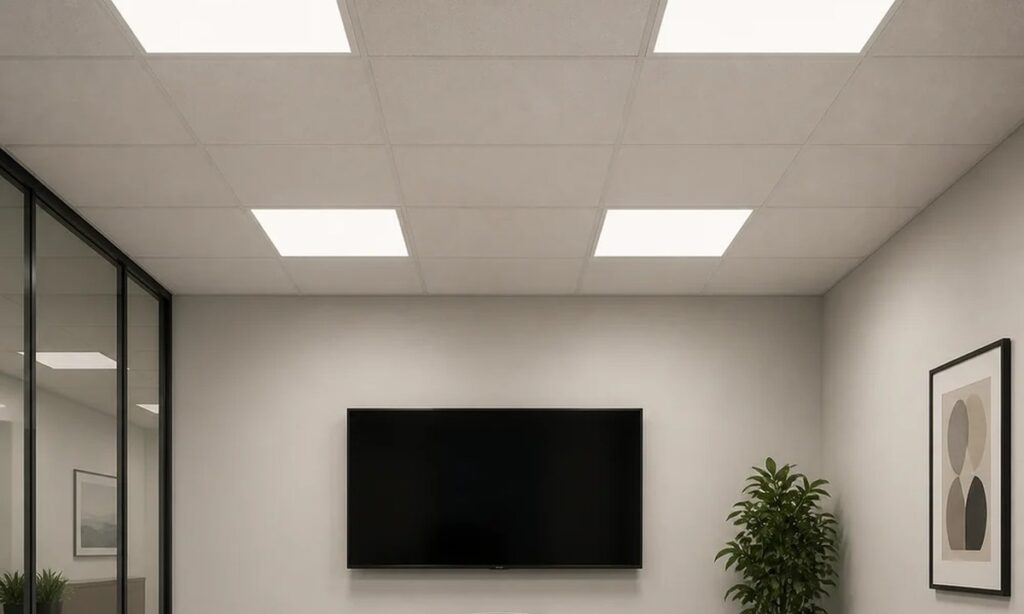
For offices, retail and public spaces, the commercial and retail lighting solutions page provides application context. The project specification should still state which rooms and decisions actually require connectivity.
Define the driver and protocol boundary
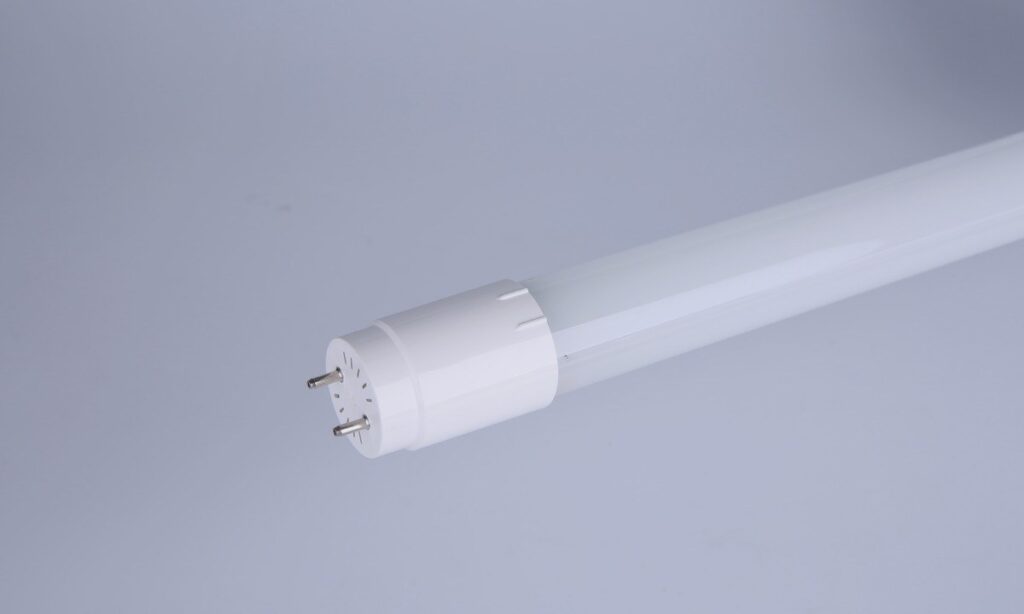
“Dimmable” is not a complete interface specification. State whether the path uses switching, phase control, 0–10 V, DALI, a named wireless protocol or another defined method. Record the driver model, dimming range, control curve, standby behavior, auxiliary power, wiring polarity, addressability and failure state.
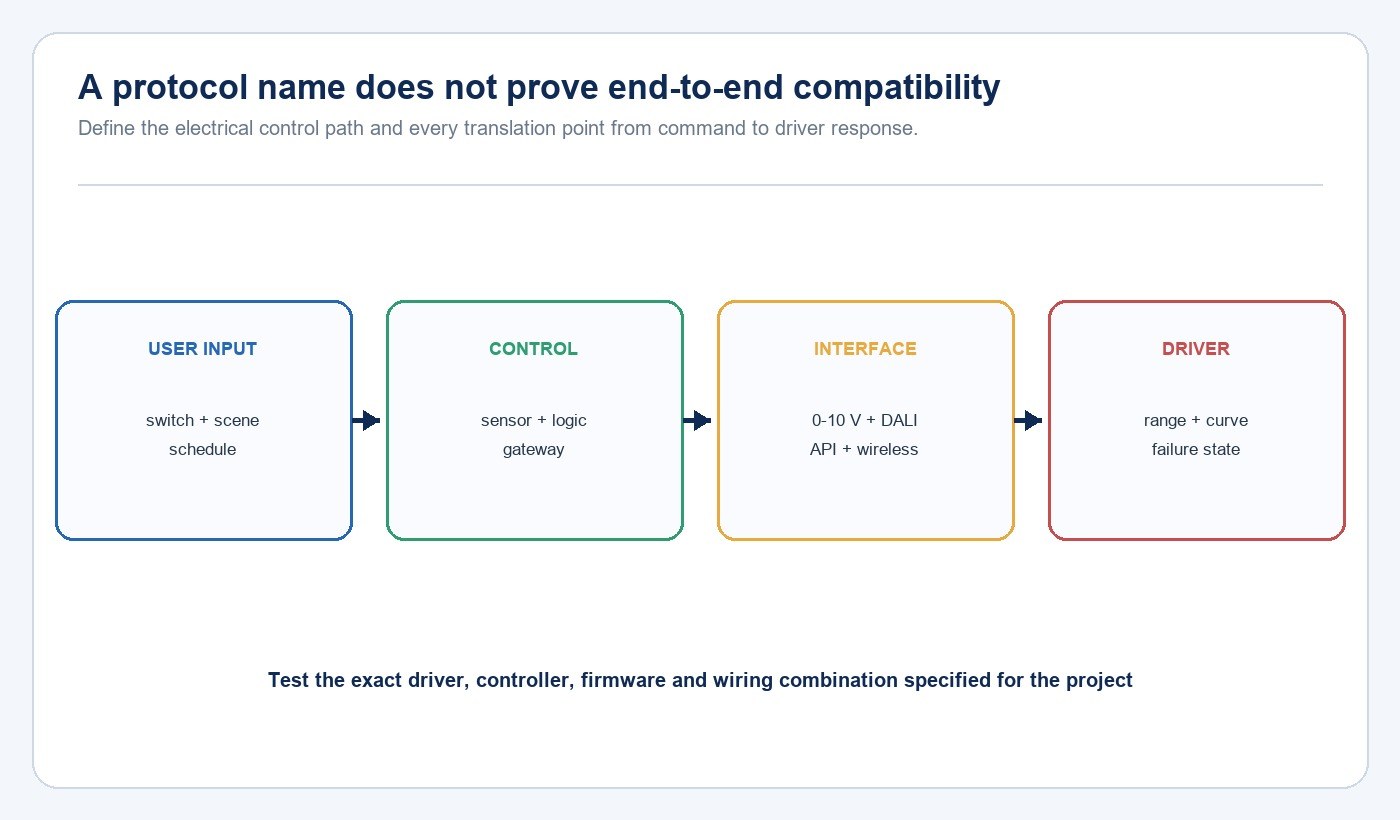
Die LED driver, dimming and control compatibility guide explains why protocol labels alone do not confirm stable operation across the full range. Test the exact driver, controller, firmware and wiring combination intended for the project.
Convert rooms into zones and testable sequences
A reflected ceiling plan or room schedule should show controlled luminaires, sensors, wall stations and zone boundaries. For each zone, define occupied, unoccupied, daylight, after-hours, manual override, emergency and communication-loss behavior.
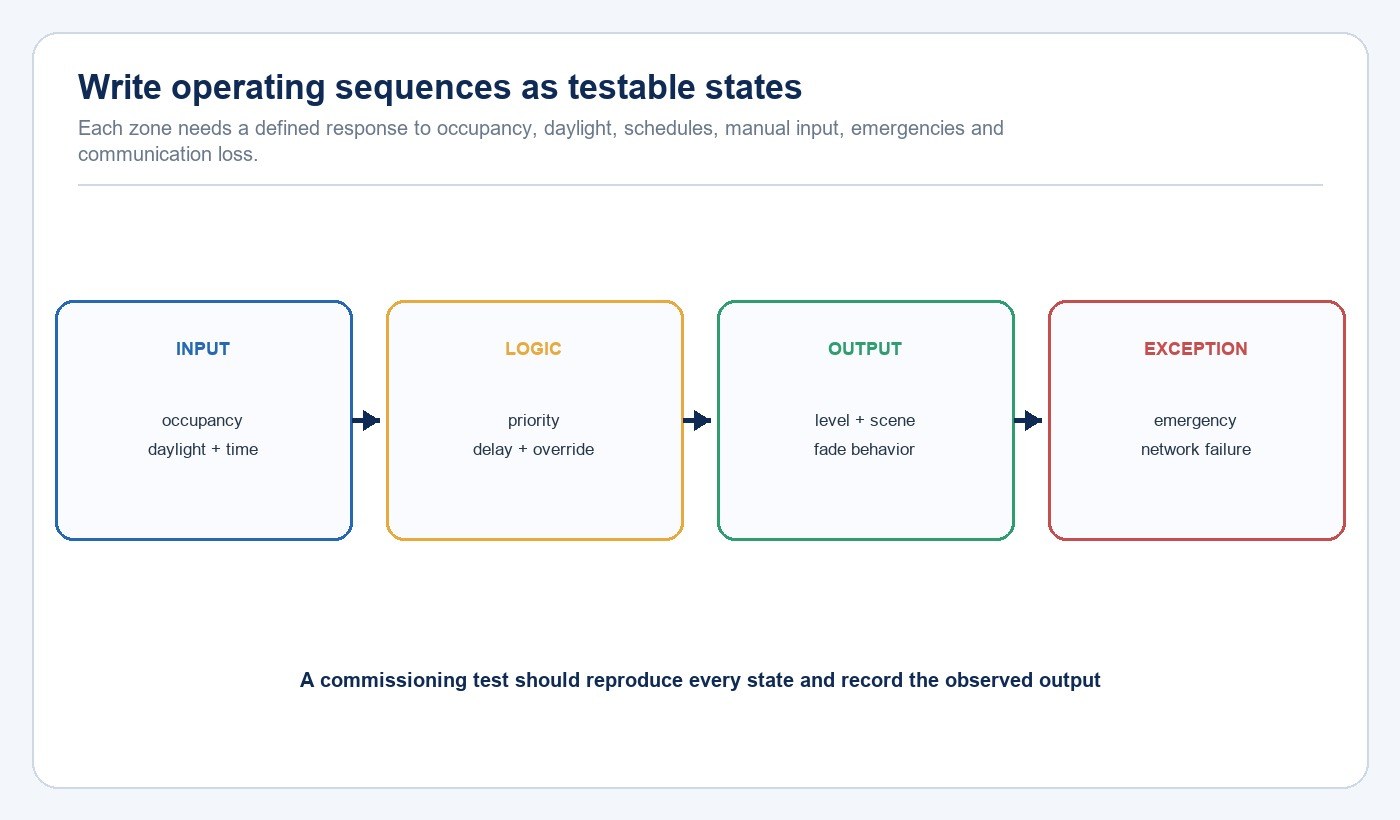
Avoid phrases such as “daylight control where required” without a target and response. State sensor location assumptions, setpoint or target method, minimum and maximum level, fade behavior, delay, override duration and interaction with schedules. Where visual quality is material, the UGR, CRI and flicker guide helps separate luminaire and driver metrics from the control sequence.
Specify integration and data ownership
For building automation integration, identify the interface, gateway, data points, update frequency, command priority and failure behavior. Decide whether the building automation system reads lighting status, sends commands or both. Name the party responsible for each side of the interface and the acceptance test.
The US Department of Energy notes that connected-lighting interoperability has involved APIs as well as limitations and trade-offs. An available API does not guarantee that the required points, permissions, latency or lifecycle support are present. Require the exact interface documentation and version used for the project.
Define cybersecurity and account responsibilities
The security scope should follow the selected architecture. A local stand-alone sensor has different exposure from a cloud-managed network. Record network segmentation, user roles, administrator ownership, password and credential transfer, remote-access policy, update responsibility, event logging, backup and service-end planning.
Do not leave the account registered to an installer without a handover route. Also define what happens if a cloud service, gateway or Internet connection is unavailable. The question is not whether the product is called “secure,” but whether the project can identify owners, access paths, update decisions and recovery steps.
Commission against an acceptance matrix
Commissioning should reproduce the specified states rather than confirm only that lamps switch on. Test at least one representative point in each zone and every exception that could materially change operation.
| Abnahmebereich | Test action | Record at handover |
|---|---|---|
| Device identity | Match address, model and physical location | As-built device schedule |
| Zone operation | Trigger each sensor, scene and schedule | Observed level, timing and result |
| Dimmen | Test minimum, maximum, fade and off behavior | Driver/controller combination and settings |
| Integration | Read and command agreed BAS points | Interface version, point list and exception result |
| Fehlermodus | Remove network, gateway or sensor input as specified | Default state and recovery behavior |
| Access control | Test user and administrator roles | Account owner and credential-transfer record |
Die Dimmbares RGB+CCT LED-Panellicht is a relevant product route when multi-channel output and control are part of the brief. Its use in a project still depends on the exact control method, configuration and evidence approved for that project.
Turn commissioning into a maintainable handover
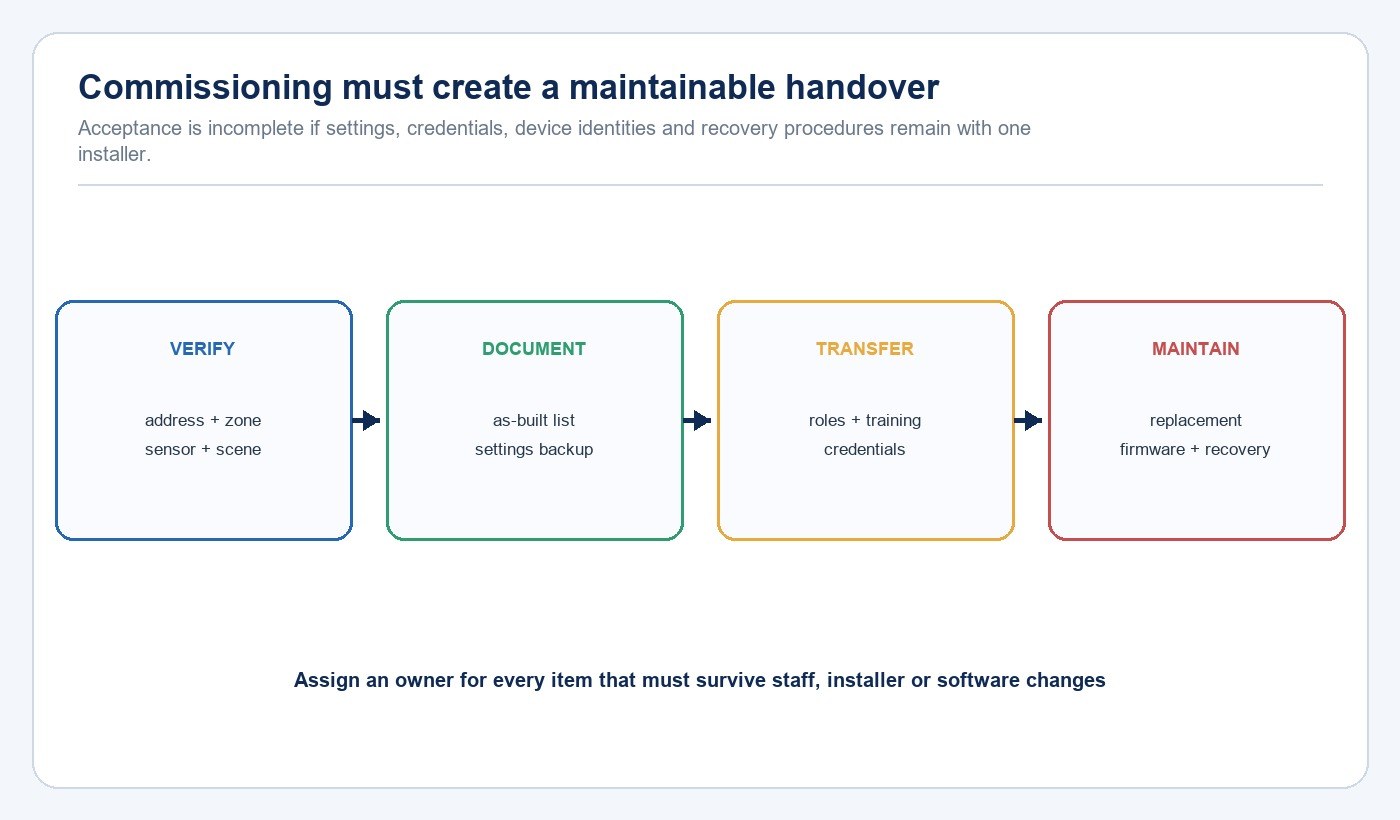
Provide the as-built device list, zone map, sequence, settings export, firmware versions, gateway details, administrator roles, training record and replacement procedure. Confirm whether a replacement driver or sensor must be re-addressed and how the previous configuration is restored.
Verwenden Sie die New Lights factory and manufacturing overview when aligning luminaire configuration and production records, and the download centre for currently released product files. Product documentation and the final project settings should remain distinguishable but linked.
Ask lifecycle questions before approval
Confirm who supports the software, how long compatible replacements are expected to remain available, whether settings can be exported, how firmware updates are approved and what happens when a gateway or service is retired. Avoid a design that can meet the opening-day sequence only while one installer account remains active.
The same principle applies to project data. The EU Digital Product Passport data-readiness guide covers a different regulatory task, but its identity and revision-control method is useful for linking devices, firmware, documents and effective dates.
Häufig gestellte Fragen
Does every commercial project need networked lighting?
No. Use networked control when its scheduling, monitoring, integration or data functions solve a defined project requirement. A stand-alone or room-based system may be easier to commission and maintain for simpler spaces.
Does DALI or 0–10 V guarantee dimming compatibility?
No. The protocol or interface is only one boundary. Confirm the exact driver, controller, operating range, wiring, firmware and required behavior together.
What belongs in a connected-lighting handover?
Include device identities, zone maps, sequences, settings backups, firmware versions, interface documents, user roles, credentials, training and replacement or recovery procedures.
Who should own the cloud or administrator account?
The project should name the responsible operating organization and transfer process before acceptance. Installer access can remain only within an agreed support and security model.
Write the operating sequence before the purchase order
For a connected-lighting RFQ, Kontaktieren Sie New Lights with the room schedule, required sequences, control protocol, luminaire types, integration points, network constraints, commissioning tests and handover requirements. That information is more useful than requesting “smart lighting” as an undefined feature.