

No. A 365 nm source is a strong candidate for a mosquito trap, but it is not a universal winner. In one 2024 forest study, 365 nm produced the highest catch among the LED wavelengths tested. In a 2022 urban Bangkok study, fluorescent UV produced the highest total catch and 375 nm led the five LED wavelengths. Different mosquito populations, seasons, source outputs and trap conditions can change the ranking.
The useful specification is therefore larger than a peak-wavelength label. It should define the target mosquitoes, spectral distribution, radiant output, emitting area, trap geometry, placement, safety controls and field-test method. Compare candidate sources inside the same trap under the same protocol before approving a rollout.
What the Field Evidence Shows
The two studies answer related but not identical questions. The 2024 forest experiment used six locations in a replicated Latin-square design over 36 nights. Among its tested LEDs, 365 nm collected the most mosquitoes; 365 and 385 nm were comparable with the UV fluorescent reference. The response also varied by genus, with stronger results for some groups than others.
The 2022 Bangkok experiment randomized five LED wavelengths and a fluorescent source across six urban locations over 72 collection nights in dry and wet seasons. Fluorescent UV produced the largest total catch. Among the LEDs, 375 nm ranked first, followed closely by 405 and 395 nm; 365 nm did not lead that field result. Culex quinquefasciatus dominated the collection, so its species mix matters when applying the finding elsewhere.
| Evidence set | Tested context | Main result | Practical interpretation |
|---|---|---|---|
| Forest field study, 2024 | Six locations, 36 nights, multiple UV LED wavelengths and fluorescent UV | 365 nm led the tested LEDs; 365 and 385 nm were comparable with fluorescent UV | Include 365 nm in a forest-field trial, but check the target genus and complete source specification |
| Urban Bangkok study, 2022 | Six locations, 72 collection nights, 365–405 nm LEDs and fluorescent UV | Fluorescent UV led overall; 375 nm led the LEDs | Do not transfer a 365 nm ranking across species, settings or trap systems without a local comparison |
| Review of mosquito light attraction | Laboratory and field evidence across species and source conditions | Short wavelengths are often attractive, but response varies with species, intensity and conditions | Treat wavelength as one controlled variable rather than the entire design |
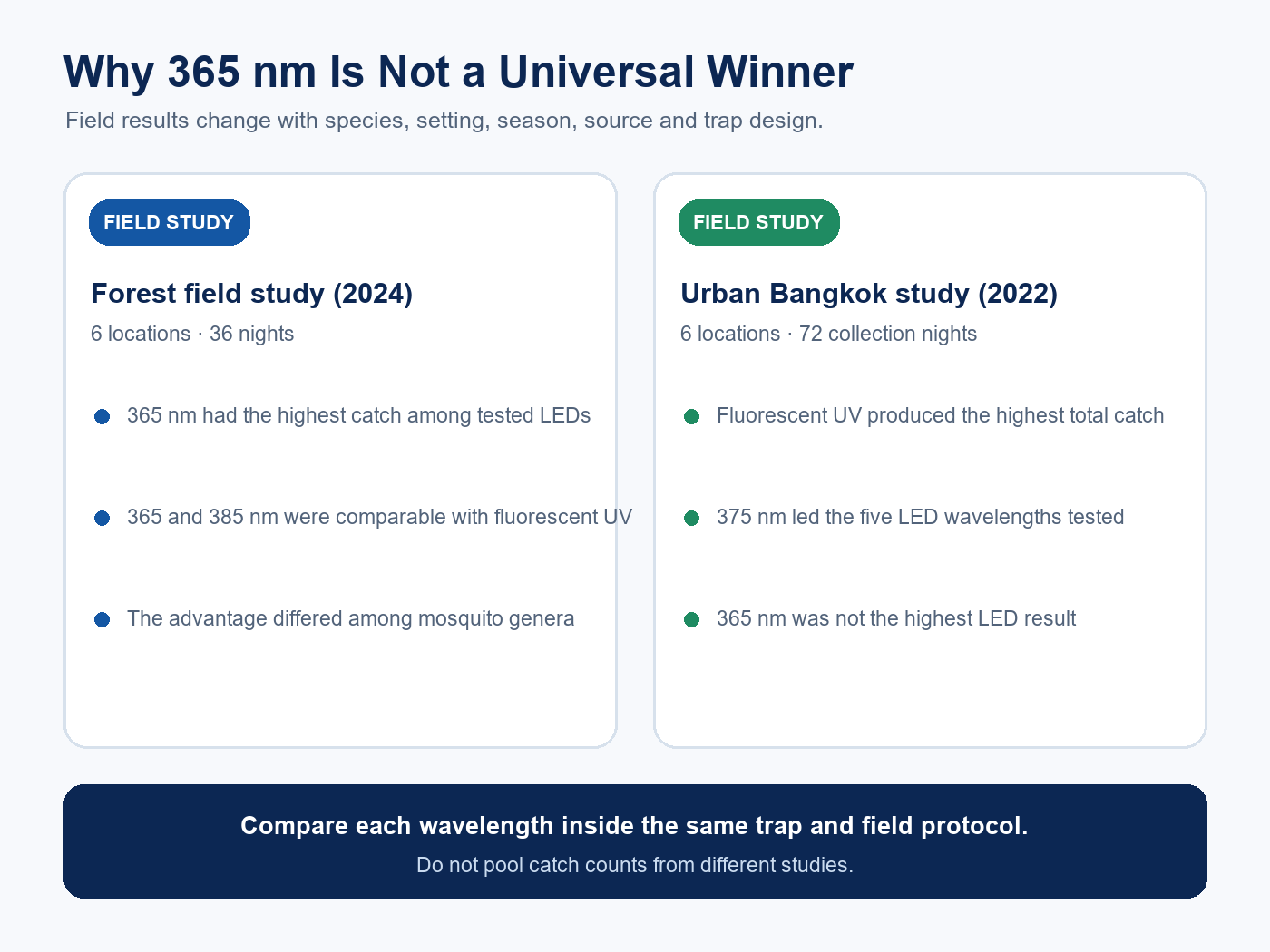
Catch totals from separate studies should not be combined as though they came from one experiment. Trap type, airflow, source power, local abundance, weather and sampling duration differ. The transferable lesson is the decision method: test the candidate spectrum in the intended system and location.
Peak Wavelength Is Not the Complete Spectrum
“365 nm” usually identifies a nominal peak, not all radiation emitted by the source. Two products with the same nominal peak can have different spectral bandwidths, peak tolerances, radiant output and optical distribution. A fluorescent UV tube and a UV LED source can also have very different emitting areas and spectra even when both are sold for insect attraction.
Ask for a spectral power distribution or a measured spectrum for the exact configuration. Record the peak and bandwidth, but also compare output over the relevant wavelength region. Electrical wattage alone cannot provide that comparison because driver losses and source efficacy vary.
This is the same specification principle used in other spectral applications: color names and category labels are useful starting points, while measured distribution defines what the source emits. The full-spectrum versus red-blue grow-light comparison explains that distinction in a different lighting context.
Why Mosquito Species and Life Stage Matter
Mosquitoes are not one behavioral target. Species differ in habitat, active period, host-seeking behavior and response to visual cues. A wavelength that performs well for a dominant Culex population may not preserve the same ranking for Aedes, Anopheles or another local group. Sex and physiological state can also influence what reaches a trap.
Define the purpose before choosing a source. A surveillance team may need representative sampling of several species. A facility may care mainly about nuisance mosquitoes near a specific entrance. A research program may target a vector species and require identification-quality specimens. Each purpose changes the acceptance metric.
Species identification is more informative than one total count. Record the composition of every replicate and report catch per trap-night by relevant group. If only the total is recorded, a large increase in one abundant species can hide weak performance for the actual target.
Radiant Output and Emitting Area Change the Test
A fair comparison needs optical output data. More electrical power does not necessarily mean more UV radiation at the trap entrance, and a higher peak does not guarantee a larger useful field. Measure or obtain radiant flux, irradiance at defined points, spectrum and source geometry for each candidate.
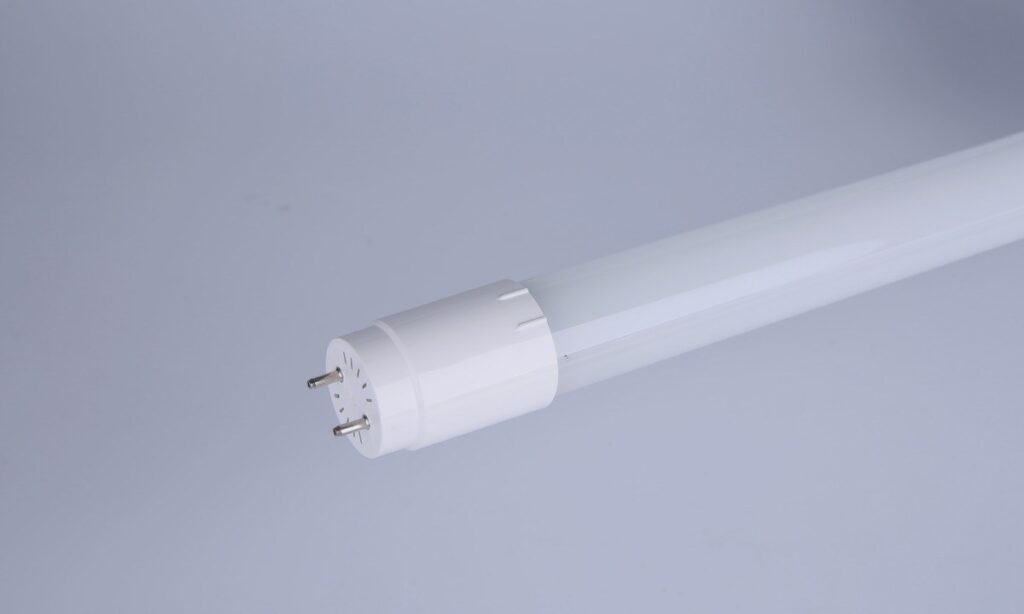
Emitting area matters because mosquitoes approach a visible source inside a physical trap. A long fluorescent tube, an LED tube, a compact array and a single high-power emitter distribute radiation differently. Reflectors, covers, mesh and internal surfaces can redirect or absorb part of the output.
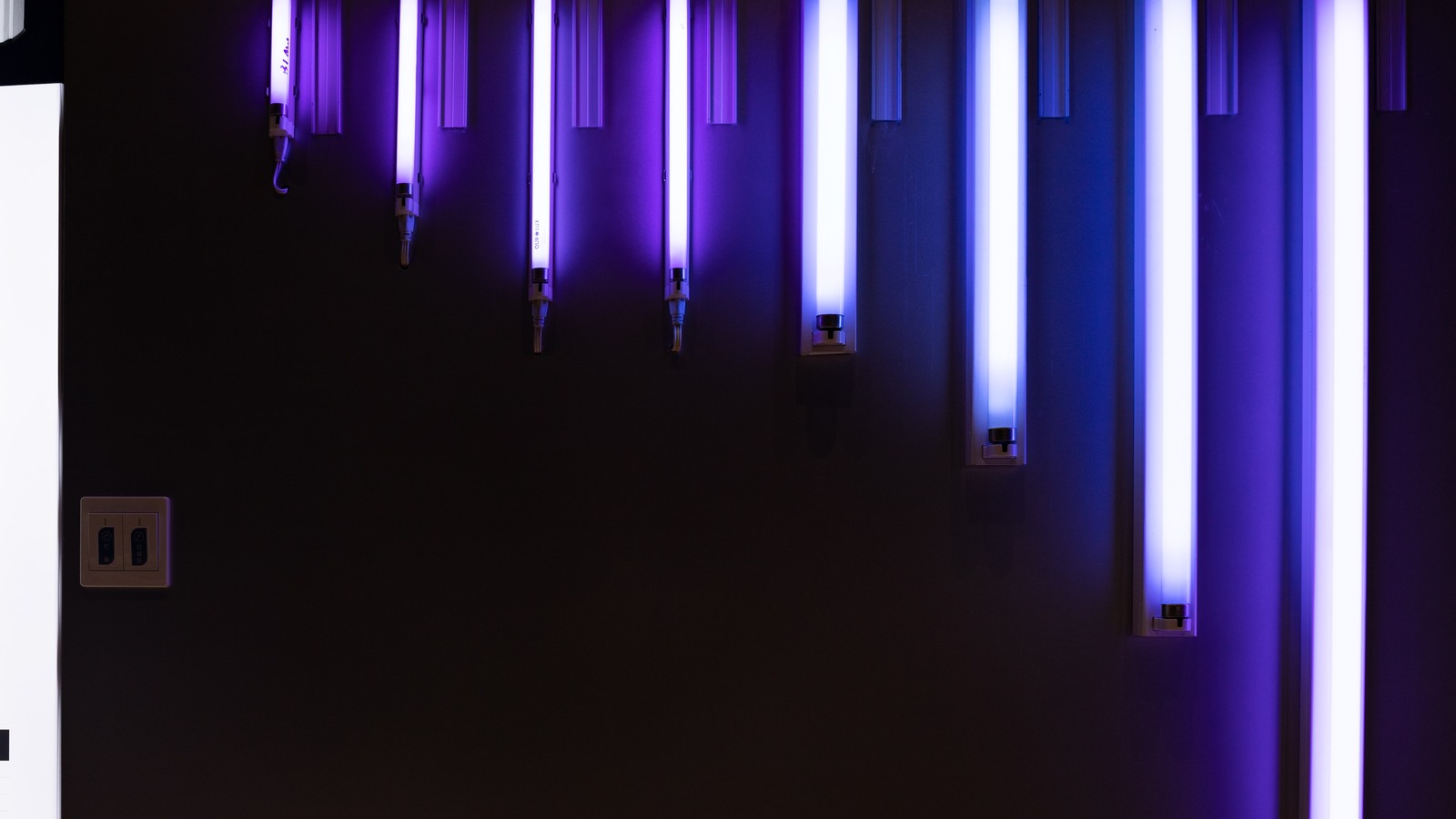
When changing from fluorescent UV to LED, do not assume that matching tube length or electrical wattage recreates the original optical field. Document source position and orientation, then compare irradiance at the same points around the entrance and capture zone.
Trap Geometry Is Part of the Optical System
The lamp attracts an insect toward a system; the trap must then intercept and retain it. Entrance shape, fan airflow, suction path, adhesive area, electrified grid, mesh, escape routes and dead zones all influence the measured catch. A wavelength may look weak when the optical field does not align with the effective capture zone.
Keep trap geometry constant during a wavelength comparison. If the replacement source needs different holders, drivers or clearances, document those changes and confirm that they do not alter airflow or block the entrance. The LED driver and control compatibility guide provides a useful framework for separating source behavior from the electrical system.

How 365, 375, 385, 395 and 405 nm Differ as Candidates
365 nm
The 2024 forest study makes 365 nm a credible first candidate. It is deeper in the UVA range than 395 or 405 nm and produces less visible violet light for a given radiometric condition. That visual difference does not by itself establish greater attraction. Source output, bandwidth and target species still need comparison.
375 and 385 nm
The Bangkok study found its 375 nm LED produced the largest LED catch, while the forest study found 385 nm comparable with its fluorescent UV reference. These results make the middle of the tested UVA range relevant, not merely a compromise between 365 and 395 nm. Request exact product data because a nominal wavelength does not define the full spectrum.
395 and 405 nm
Sources near 395 and 405 nm emit closer to the visible violet boundary. They may be easier for people to see, but visible brightness is not a measurement of useful UVA output or mosquito attraction. The Bangkok results show that these wavelengths should not be dismissed automatically: 405 and 395 nm followed 375 nm among its LEDs.
The shortlist should be evidence-led. If an existing trap performs acceptably with fluorescent UV, include that source as the control and test two or more LED candidates rather than selecting a nominal peak from a catalog alone.
Environmental Variables Can Reverse a Ranking
Ambient light competes with the trap’s visual signal. Nearby luminaires, signs, windows and moonlight can change contrast. Placement near walls, vegetation, entrances, people or airflow changes the population that encounters the trap. Rain, temperature, wind and season affect mosquito activity and total abundance.
Use a randomized rotation so each source occupies each trap position. Run simultaneous replicates where practical, record operating failures and keep collection windows consistent. A single trap in a single position cannot separate wavelength from location.
For outdoor or washdown locations, choose enclosures and connections from actual exposure conditions. An IP code describes defined ingress tests, not every environmental risk; see the IP ratings guide when specifying the enclosure around the source and driver.
UV-A Safety Still Requires an Exposure Assessment
The wavelengths discussed here sit in or near the UVA region, but “UVA” does not mean unrestricted exposure. The World Health Organization notes that ultraviolet radiation can affect eyes and skin, and ICNIRP provides occupational exposure guidance across 180–400 nm.
Evaluate the complete installed source: accessible radiation, viewing distance, exposure duration, reflections, servicing position and foreseeable misuse. Shield the source where the trap design permits, prevent direct close viewing, isolate power before service and provide the appropriate installation and maintenance instructions. Product-specific photobiological assessment and applicable local requirements should guide the final design.
Safety review and attraction testing answer different questions. A higher catch does not override an unacceptable exposure condition, and a safe source is not automatically effective in a particular trap.
A Practical Validation Plan
Start with a written test brief. The LED lighting selection framework can be adapted to define the application boundary, evidence and acceptance criteria before samples are ordered.
| Validation item | Record for every candidate | Keep constant or control | Acceptance question |
|---|---|---|---|
| Target | Species or genus, surveillance or control purpose, collection window | Identification method and counting rules | Does the source improve the relevant catch rather than only the total? |
| Optical source | Peak, bandwidth, spectrum, radiant flux, irradiance points, emitting area | Measurement method and warm-up condition | Is optical performance stable and traceable to the exact sample? |
| Electrical system | Input, driver, wiring, temperature and operating failures | Supply and operating schedule | Does the source operate reliably in the intended trap? |
| Trap | Position, orientation, reflector, entrance, airflow and retention | Same trap body or documented matched units | Is wavelength being compared without an unintended geometry change? |
| Field protocol | Site, rotation, weather, ambient light, dates and trap-nights | Randomized placement and equal collection periods | Are location and time effects separated from the source effect? |
| Safety | Accessible irradiance, distance, exposure time, shielding and service method | Same assessment procedure | Can the installed system meet the required exposure controls? |
Use production-representative samples after the first engineering comparison. Run enough replicates to see normal variation, then review failures and species composition before calculating an average. Preserve the model, batch, measurement files and trap configuration so a later shipment can be checked against the accepted sample.
For OEM work, include spectrum, output measurement conditions, mechanical interface, driver, thermal limits, labeling and acceptance tests in the RFQ. The OEM/ODM LED lighting RFQ guide helps organize those requirements. For a source or trap review with New Lights, send the target species, trap drawing and test protocol with the inquiry.
Frequently Asked Questions
Is 365 nm the best wavelength for attracting mosquitoes?
It is a strong candidate, not a universal best. A forest study found 365 nm led its tested LEDs, while an urban Bangkok study found 375 nm led its LEDs and fluorescent UV led overall. Test 365 nm against alternatives in the intended trap and field context.
Is 395 or 405 nm ineffective?
No. The Bangkok study recorded substantial catches at both wavelengths, with 405 and 395 nm ranking behind 375 nm among its LEDs. Performance depends on species, optical output, trap design and conditions.
Are UV fluorescent tubes better than UV LEDs?
Neither category always wins. The urban study favored fluorescent UV overall; the forest study found 365 and 385 nm LEDs comparable with its fluorescent reference. Compare exact sources using measured optical data and the same trap protocol.
Can electrical wattage compare two UV sources?
No. Wattage is electrical input. Compare spectrum, radiant output, irradiance at defined points, emitting area and distribution as well as input power.
Is UVA safe around people?
UVA still requires an exposure assessment. Consider accessible irradiance, distance, duration, reflections, shielding, servicing and applicable occupational or product requirements.
Does a higher catch prove mosquito control or disease reduction?
No. Catch count measures retained specimens under the test protocol. Population control and disease-risk reduction require different study designs and outcomes.
Choose a Testable System, Not Just a Number
Use 365 nm as one candidate when the target and source data support it. Add 375 or 385 nm—and the existing fluorescent source where relevant—to the same controlled field comparison. Define the spectrum, output, geometry, species, placement and acceptance metric before testing.
The best source is the one that performs consistently for the target population inside the approved trap, while meeting electrical, environmental and exposure requirements. A nominal wavelength starts that evaluation; it does not finish it.
Editorial Sources
- U.S. National Library of Medicine, “Efficacy of light-emitting diodes with various wavelengths for collecting mosquitoes in a forest field”: https://pubmed.ncbi.nlm.nih.gov/39213441/
- PLOS ONE / PubMed Central, “Field evaluation of different wavelengths of light-emitting diodes for mosquito trapping in an urban setting in Bangkok, Thailand”: https://pmc.ncbi.nlm.nih.gov/articles/PMC9225645/
- Parasites & Vectors / PubMed Central, “The role of visual stimuli in host-seeking behaviour of mosquitoes”: https://pmc.ncbi.nlm.nih.gov/articles/PMC7789162/
- World Health Organization, “Radiation: The known health effects of ultraviolet radiation”: https://www.who.int/news-room/questions-and-answers/item/radiation-the-known-health-effects-of-ultraviolet-radiation
- International Commission on Non-Ionizing Radiation Protection, “Guidelines on Limits of Exposure to Ultraviolet Radiation of Wavelengths Between 180 nm and 400 nm”: https://www.icnirp.org/cms/upload/publications/ICNIRPUV2004.pdf