

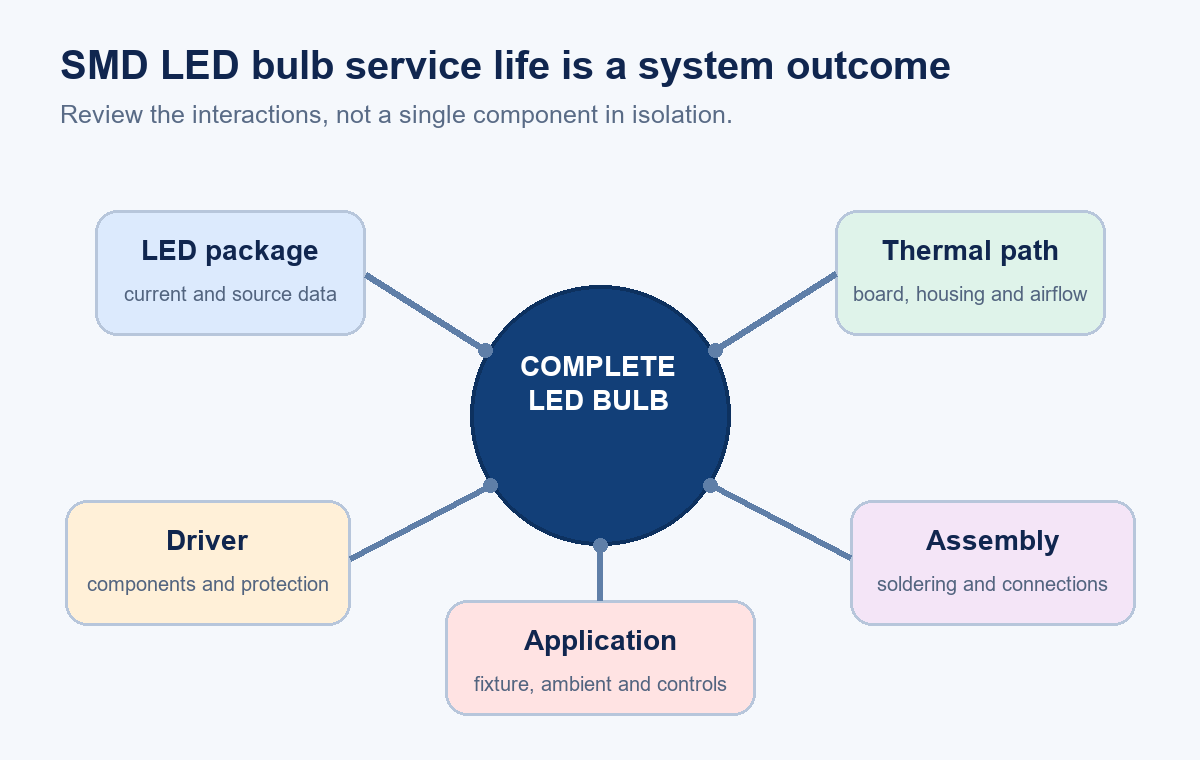
The service life of an SMD LED bulb is shaped by the complete lamp, not by the LED package alone. Heat must travel from the LED board through the housing, the driver must manage electrical stress, solder joints and connectors must remain stable, and the lamp must operate within the temperature, switching and fixture conditions for which it was designed.
That is why two bulbs using a similar SMD package can age differently. Their thermal paths, driver components, assembly controls and applications may be very different. A useful comparison starts with the exact lamp and its evidence package, then connects that evidence to the intended luminaire and operating environment.
Start With the Complete-Lamp System
An SMD LED bulb normally combines LED packages on a printed circuit board, optical components, a driver, electrical connections, a heat-spreading structure and a cap. Each part can influence light output, colour stability, flicker, start-up behaviour or continued operation.
The weakest part is not fixed across every design. In one application, sustained heat may accelerate driver-component ageing. In another, repeated switching, supply disturbances, poor contact at the lampholder or an enclosed fixture may dominate. Treating “SMD” as a lifetime rating hides these system differences.
The SMD versus COB LED guide explains how package formats differ. Package format is useful design information, but it is only one input to a complete-bulb reliability review.
| System area | What to review | Typical evidence | Why it matters |
|---|---|---|---|
| LED package and board | Package identity, operating current, board material and layout | Package data, board drawing and design record | Sets the light-generating and heat-transfer starting point |
| Thermal path | Junction-to-board path, interface, housing and airflow | Thermal design, temperature measurements and sample review | Higher sustained temperature can accelerate ageing across several components |
| Driver | Capacitors, protection, current regulation and component loading | Circuit design, component specification and electrical tests | Driver drift or failure can end useful lamp operation before the LEDs |
| Assembly | Solder profile, placement, connections and process consistency | Process controls, inspection records and production samples | Variation can create intermittent faults or uneven thermal contact |
| Application | Enclosure, ambient temperature, switching, voltage and controls | Site survey, fixture details and pilot results | The same lamp can experience very different field stress |
Heat Usually Connects Several Failure Mechanisms
LED packages convert part of their input power into light and the rest into heat. The board, interfaces, housing and surrounding air must carry that heat away. A bulb installed base-up in a tight enclosure may retain more heat than the same lamp in an open fitting, while a high ambient temperature leaves less thermal margin.
Heat also affects more than the LED package. Electrolytic capacitors, polymers, solder joints, adhesives and optical materials can all be temperature-sensitive. A design should therefore be reviewed as a chain: package to board, board to housing, housing to fixture and fixture to room or outdoor environment.
Useful supplier evidence includes temperature measurements at defined points, the test orientation, ambient conditions, input voltage, stabilisation period and exact sample identity. A single temperature number without these conditions is difficult to compare. For broader product-family review, the New Lights LED bulb category provides a starting point for selecting the form, cap and application before requesting model documents.
Driver Design and Supply Conditions Matter
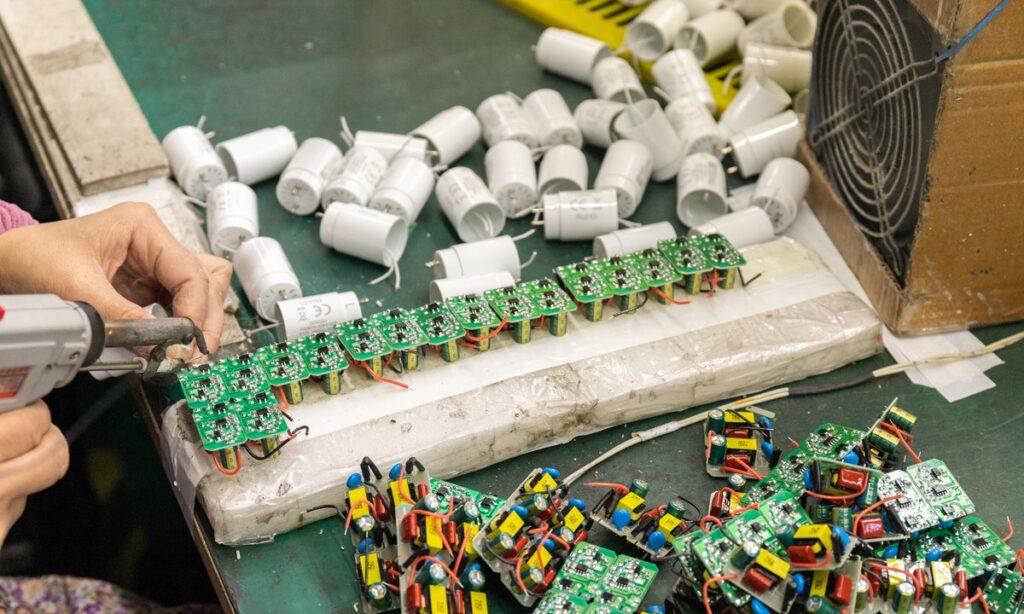
The driver converts the supply into the regulated electrical conditions required by the LEDs. Its component selection and loading affect start-up, current stability, power quality, dimming behaviour and resilience to supply disturbances.
Review the intended voltage and frequency, permitted operating range, switching pattern, dimmer or sensor compatibility and any surge environment relevant to the project. A bulb designed for steady operation on a stable circuit may face different stress when used with frequent occupancy switching, incompatible phase-cut controls or a supply with repeated transients.
Failure is not always a sudden dark lamp. Driver ageing can also appear as delayed start-up, cycling, visible flicker, reduced output or colour inconsistency. These symptoms should be investigated against the exact lamp, circuit and control combination rather than attributed automatically to the LED chips.
LED Package Data Has a Defined Boundary
LM-80 data describes lumen-maintenance testing for LED packages, arrays or modules under specified conditions. TM-21 provides a method for projecting long-term lumen maintenance from qualifying LM-80 data. These tools are valuable for understanding the LED source, but the complete bulb also contains a driver, connections, optics, housing and thermal interfaces.
When a supplier presents an LM-80 or TM-21 result, ask which package it covers, how the package is operated in the proposed lamp and how the complete product has been evaluated. Keep package-level lumen maintenance separate from driver survival, colour shift, switching endurance and complete-lamp functional life.
| Evidence item | What it can support | What still needs separate review |
|---|---|---|
| LED package datasheet | Package ratings and operating limits | Actual drive current, temperature and board integration |
| LM-80 report | Measured lumen-maintenance data for the tested source and conditions | Driver, connections, optics and complete-lamp failure modes |
| TM-21 projection | A bounded lumen-maintenance projection from qualifying data | Complete-product lifetime and application-specific stress |
| Complete-lamp test report | Results for identified samples under stated test conditions | Production consistency and the target site’s operating conditions |
| Field or pilot record | Behaviour in a representative installation | Longer-term performance across other sites and batches |
Assembly Consistency Turns a Design Into a Product
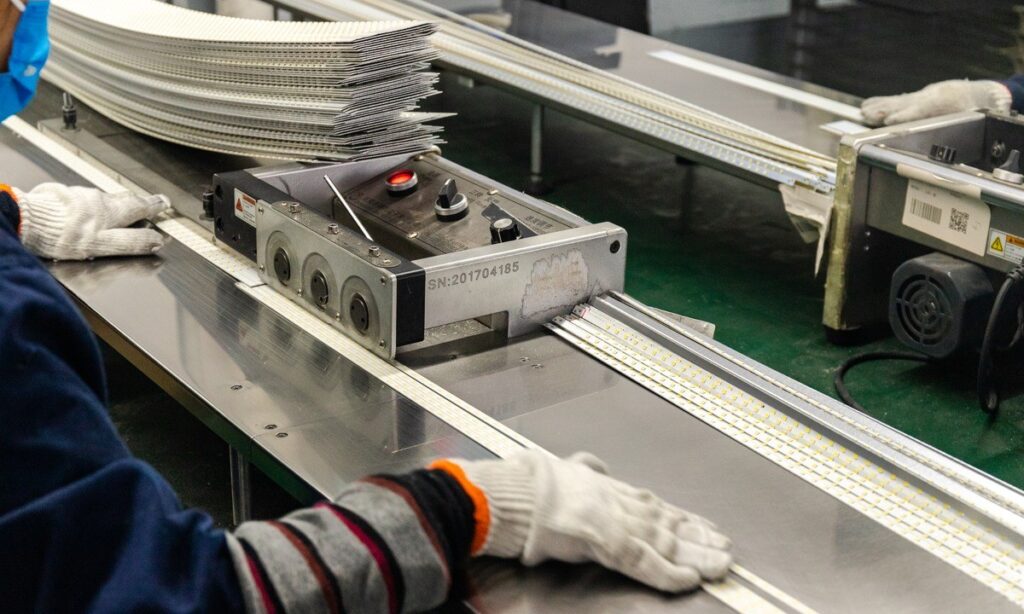
A sound design still depends on repeatable manufacturing. Solder paste deposition, component placement, reflow profile, board handling, thermal-interface application, driver assembly and cap connection all need controlled processes. Deviations can alter electrical contact, heat transfer or mechanical stability.
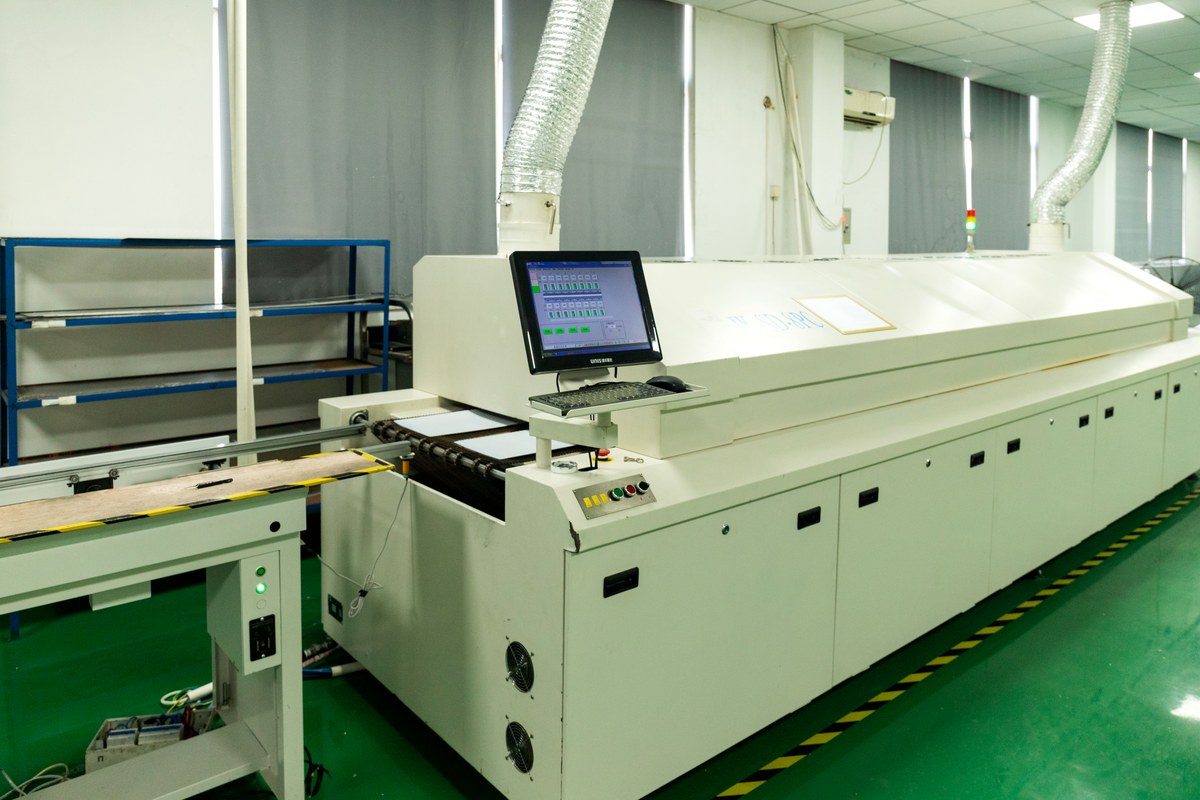
Process evidence should identify the product family and control point. For example, a reflow profile is meaningful when it is tied to the relevant board, solder system and production instruction. Inspection records are more useful when they show the acceptance criteria, sample plan, date and batch identity.
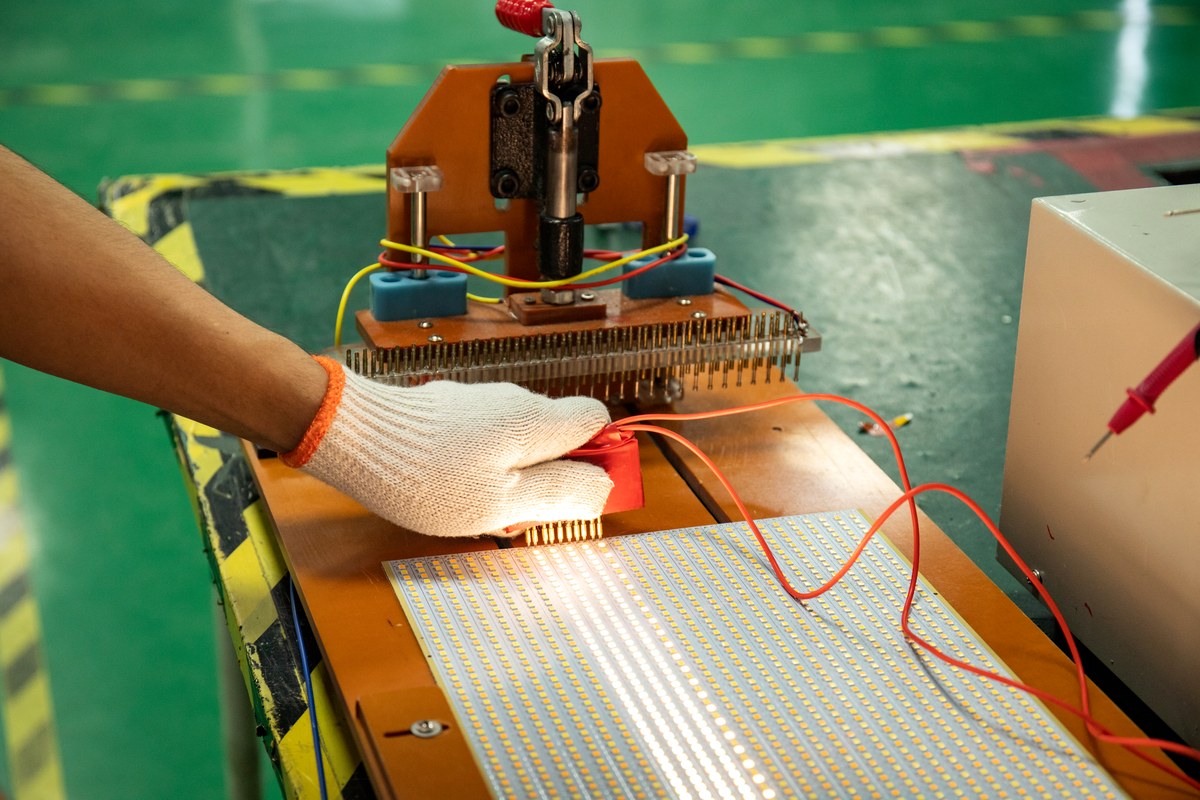
Incoming components, in-process checks and finished-lamp tests serve different purposes. A buyer should ask how the supplier connects them: which critical components are controlled, which tests are performed on every lamp or by sampling, how nonconforming results are handled and how records map back to a production lot.
The Fixture and Operating Environment Change the Result
Bulb selection cannot be separated from the host luminaire. An enclosed decorative shade, recessed can, high-temperature ceiling void or base-up orientation may change the temperature around the lamp. Outdoor, damp or dusty locations add environmental requirements that must match the exact product marking.
Switching and controls also matter. Frequent starts, occupancy sensors and dimmers can impose conditions different from continuous operation. Verify control compatibility and minimum-load behaviour using the selected lamp and actual control equipment. For household projects, the guide to choosing an LED bulb beyond the SMD label covers cap, shape, output, colour and fixture fit. For a technology comparison, see filament LED versus standard LED bulbs.
Turn a Lifetime Claim Into a Comparable Evidence Package
Do not compare two quoted hour values until their definitions and test bases are aligned. One value may describe lumen maintenance, another warranty duration and another an internal complete-lamp test. Record the exact metric, threshold, confidence or sample basis where available, test conditions and model identity.
Ask each supplier for the same evidence set:
- Exact lamp model, revision and bill-of-materials control.
- Rated-life definition and the event that ends the rating.
- LED package identity and relevant LM-80/TM-21 documentation where used.
- Complete-lamp test conditions, sample quantity and recorded outcomes.
- Driver-component and protection rationale for the target supply.
- Thermal measurements with orientation, ambient and fixture conditions.
- Switching, dimming and environmental tests relevant to the application.
- Production inspection plan, lot traceability and change-control process.
- Warranty scope, exclusions and claim-handling route.
If the project is comparing A-series general-service lamps, the New Lights A-series SMD LED bulb family is a relevant product destination. Match every requested document to the quoted reference rather than transferring evidence between visually similar models.
Use a Representative Pilot for the Intended Application
A pilot should recreate the operating conditions that matter: fixture enclosure, orientation, ambient temperature, supply, controls, switching schedule and expected daily operating hours. Record start-up, stable light output, visible flicker, colour consistency, temperature observations and any control interaction.
The pilot is also a maintenance check. Confirm access, lamp identification, replacement consistency and whether staff can distinguish approved and unapproved variants. Retain the sample identity and test record with the procurement file so later production lots can be checked against the approved basis.
Frequently Asked Questions
Does the SMD chip determine the life of the whole LED bulb?
No. The LED package is one part of a system that also includes the board, thermal path, driver, connections, optics, housing and operating environment.
Can LM-80 or TM-21 be used as the rated life of a complete bulb?
Not by itself. LM-80 and TM-21 address lumen maintenance of the LED source under defined conditions. Complete-bulb life also depends on the driver and other product-level failure mechanisms.
Why can an LED bulb fail before its quoted hours?
Possible causes include excess temperature, driver or connection failure, supply disturbances, incompatible controls, mechanical damage or operation outside the product conditions. Diagnosis should use the exact lamp and installation.
Do enclosed fixtures shorten LED bulb life?
They can raise operating temperature. Use a lamp permitted for the fixture type and compare the product instructions, thermal conditions and intended orientation.
What should I send a supplier for a service-life review?
Send the exact lamp and fixture requirements, voltage and controls, enclosure and orientation, ambient range, switching schedule, destination market, expected quantity and the evidence fields required by the project. Contact New Lights with that project information.
Build the Decision Around the Application
Service-life planning begins with the actual fixture and duty cycle, then moves back through the complete lamp to the component evidence. This order keeps package data, factory controls and field conditions in their proper roles and gives buyers a consistent basis for comparing suppliers.
Editorial Sources
- Illuminating Engineering Society, “PS-10-18: IES Position on LED Product Lifetime Prediction”: https://ies.org/advocacy/ps-10-18/
- U.S. Department of Energy, “LED Systems Reliability Consortium”: https://www.energy.gov/cmei/ssl/led-systems-reliability-consortium
- International Electrotechnical Commission, “IEC 62612: Self-ballasted LED lamps for general lighting services with supply voltages greater than 50 V — Performance requirements”: https://webstore.iec.ch/en/publication/7259