

An IP65 mark can be an important part of an LED fixture specification. It indicates that the enclosure has been classified for defined protection against dust and water entry. It does not mean that the fixture has escaped every environmental limit.
Outdoor and industrial sites add temperature extremes, condensation, ultraviolet exposure, salt, chemicals, impact, vibration, cable strain and maintenance practices. None of those questions should be answered by the IP code alone. A reliable selection process starts with the exact exposure, confirms the tested enclosure configuration and then checks every remaining hazard separately.

| Environmental question | IP65 alone? | Separate evidence |
|---|---|---|
| Dust and defined water ingress | Within the applicable classification | Exact report and configuration |
| Operating temperature | No | Rated range and thermal validation |
| Condensation | No | Humidity, dew point and cycle assessment |
| UV and corrosion | No | Material and exposure-specific tests |
| Chemicals and cleaning | No | Compatibility and wash-process evidence |
| Impact and vibration | No | Mechanical rating or project test |
Read IP65 as an Enclosure Classification
IEC 60529 covers degrees of protection provided by enclosures for electrical equipment. In the familiar two-digit code, each digit addresses a defined ingress category. The classification belongs to the tested enclosure and conditions, not to a broad marketing description such as waterproof or all-weather.
The IP ratings guide for LED lighting explains how the two digits separate solids and water protection and why project exposure still needs its own definition.
The correct procurement question is: which complete model and configuration was tested, and does that configuration match the offered product? The report should identify the enclosure, seals, cable entries, plugs, fasteners and mounting condition. A badge without configuration traceability is weak evidence.
Do not assume that a similar-looking model inherits the result. A change in housing material, gasket, length, connector, end cap or assembly method can affect protection. OEM options need a documented review.
Understand What IP65 Does Not Establish
IP65 should not be interpreted as an immersion rating. It does not automatically approve underground installation, flooding or permanent standing water. It also does not by itself define suitability for high-pressure or high-temperature washdown.
The code does not provide a complete operating-temperature range, resistance to condensation, ultraviolet durability, salt-spray performance, chemical compatibility, impact strength or corrosion life. Those properties require separate specifications and evidence.
An IP65 fixture can therefore be correctly classified yet still be unsuitable for a freezer, coastal loading dock, food-processing wash zone or chemical plant. The mismatch is not necessarily a failure of the IP rating; it is a failure to evaluate the full environment.
Start with the Product’s Stated Application Boundary
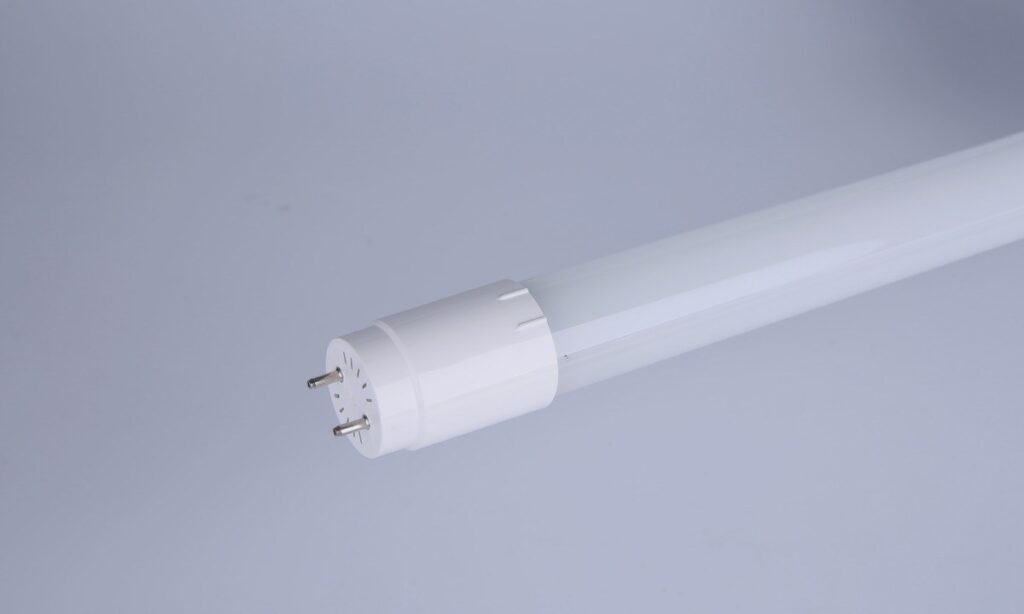
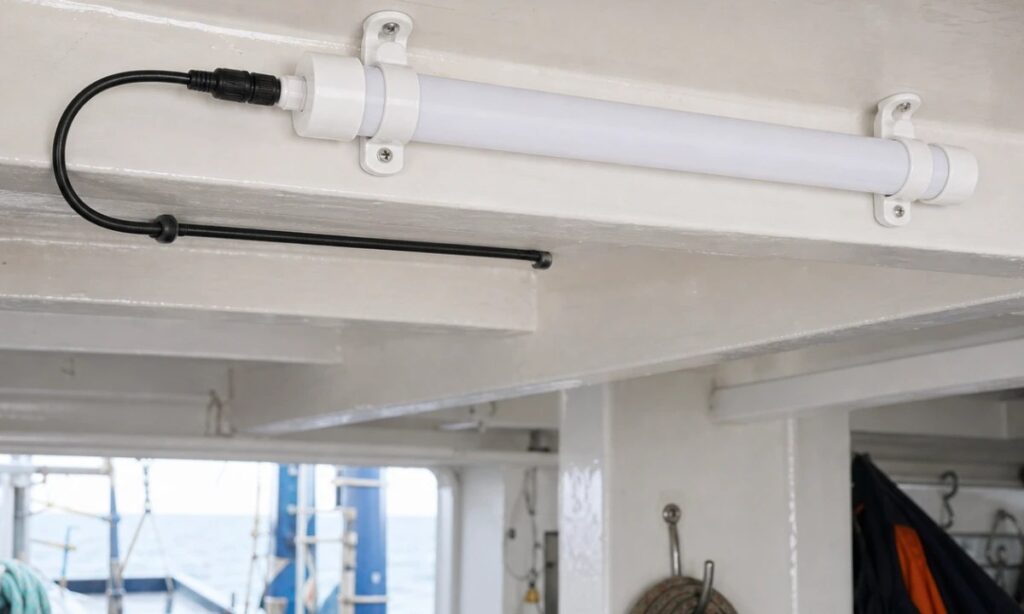
The current New Lights IP65 Waterproof LED Linear Fixture page describes a full-PC base and diffuser, direct-mounted SMD LEDs, sealed end caps, an internal driver and a PG7 cable gland. Screw-fixed metal clips support wall or ceiling surface mounting. The TY-FCG02 series remains one configuration within this broader current family.

That indoor label matters. It prevents the IP65 badge from being used as stand-alone proof of unrestricted outdoor suitability. A covered damp interior, an exposed exterior wall and a ground-level installation can impose very different water, UV and drainage conditions.
Current model status, exact IP report and intended installation conditions must be confirmed before the range is specified. The legacy article’s claims about an IP68 breathing valve, graphene cooling, decade-long life and enhanced corrosion performance are not supported by the retrieved product evidence and should not be reused.
Classify the Water Exposure
Describe how water reaches the fixture. Is the exposure occasional condensation, wind-driven rain, hose spray, sanitation washdown, roof runoff, pooling or temporary flooding? Record likely direction, pressure, distance, duration, frequency and water temperature.
Installation can intensify exposure. Water running along a cable can reach an entry even when the fixture body is sheltered. A horizontal ledge can hold water against an end seal. A wall or roof edge can concentrate runoff beyond the general weather condition.
Use the outdoor lighting installation checklist when mounting, cable routing, drainage and commissioning are part of the decision.
If cleaning is involved, document the nozzle, pressure, distance, angle, water temperature and cleaning agents. Do not substitute the words “water jet” for an actual comparison with the applicable test and product instructions.
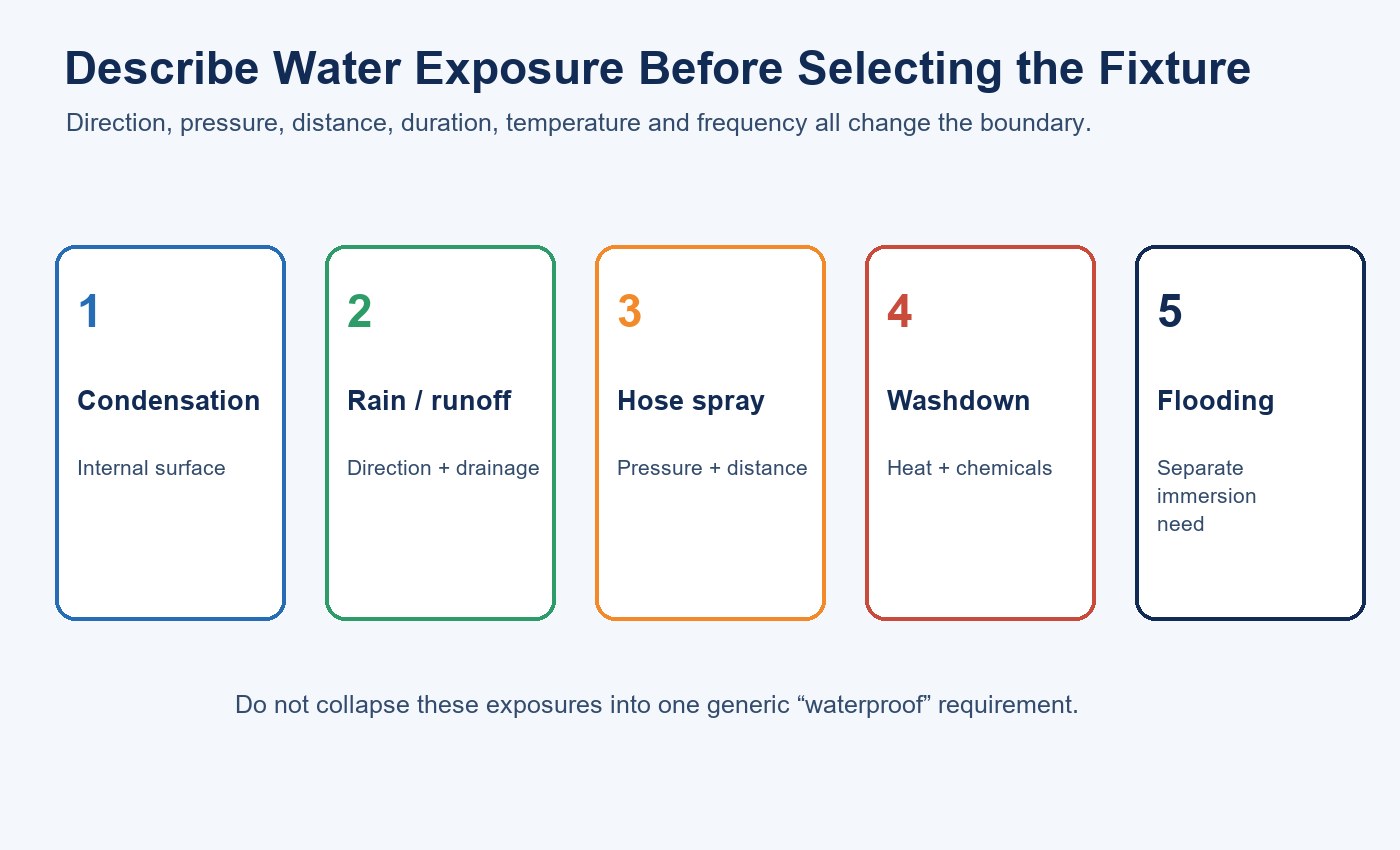
| Exposure | Define before selection | Additional question |
|---|---|---|
| Rain or runoff | Direction, drainage, duration and frequency | Is outdoor mounting supported? |
| Hose spray | Pressure, distance, angle and duration | Does the product evidence match? |
| Washdown | Pressure, heat, detergent and frequency | Are materials compatible? |
| Pooling | Depth, duration and drainage | Can water remain against a joint? |
| Flooding or immersion | Depth and time | What separate classification is required? |
Evaluate Dust and Contamination
Dust protection does not answer every contamination problem. Fine conductive dust, oily deposits, fibers and airborne chemicals may affect surfaces, seals and heat dissipation differently. Deposits can block a verified vent, hold moisture against a joint or reduce cooling.
Define the dust type, concentration, cleaning interval and whether the material is conductive, abrasive or chemically active. Confirm that enclosure and gasket materials tolerate the exposure. Plan inspection access without destroying the seal.
Check Temperature and Condensation
Request the product’s operating and storage temperature ranges. Verify them against ambient conditions and the local temperature around the fixture, including heat from adjacent equipment and solar gain where relevant. Low-temperature starting and battery or driver behavior may require separate evidence.
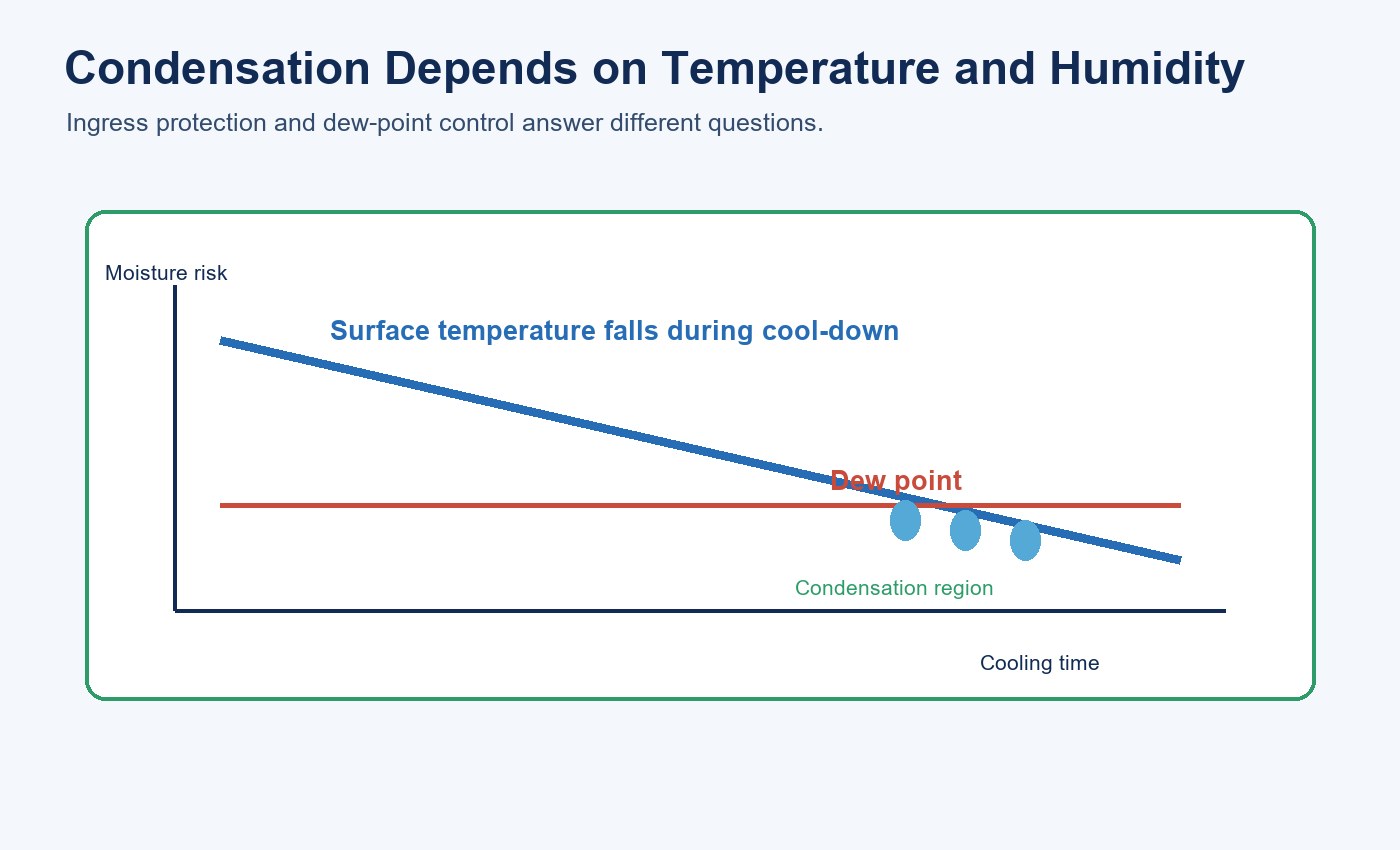
Condensation is a humidity and temperature problem, not simply an external-water problem. Moist air trapped during assembly or servicing can condense when an internal surface cools below the dew point. Repeated heating and cooling can also stress seals through expansion and contraction.
Ask for thermal-cycle and condensation evidence if the project has rapid changes, cold rooms or frequent wash cycles. A fixture that passed a static ingress test may still need additional qualification for these conditions.
For cold environments, use the T8 low-temperature installation guide to structure temperature, condensation, wiring and commissioning checks without transferring tube-specific results to this fixture.
| Moisture observation | Possible mechanism | Record before opening |
|---|---|---|
| Droplets after cool-down | Internal humidity reached dew point | Ambient humidity, air and surface temperature |
| Water near the entry | Cable path, gland fit or local condensation | Cable size, gland condition and exposure direction |
| Moisture after washdown | Direct ingress, retained water or chemical damage | Nozzle, pressure, distance, heat and detergent |
| Repeated moisture after service | Damaged gasket or incorrect resealing | Service date, replaced parts and closure condition |
Verify UV, Salt and Chemical Resistance
Outdoor sunlight can age plastics, coatings and seals. Coastal air and deicing salts can attack metals and connections. Cleaning chemicals, oils, ammonia and process vapors can soften, swell, embrittle or discolor materials.
Match the actual substance and concentration to material-compatibility data or project testing. The word corrosion-resistant is not enough. Specify substrate, coating, fasteners and test method where corrosion matters.
If a fixture is offered in multiple plastics or metal constructions, do not assume equal resistance. The approved bill of materials must match the tested sample and production order.
Consider Impact, Vibration and Mechanical Stress
IP and impact protection are different properties. Forklifts, tools, balls, doors, machinery vibration or cable pull can damage an enclosure while leaving its original IP label unchanged. Obtain an applicable impact rating or project test when mechanical exposure exists.
Mounting hardware and spacing must support the fixture without twisting the housing. Long linear products can distort if clips are misplaced. Cable glands need strain relief so movement does not open a leak path.
Transport damage also matters. Inspect covers, clips, end caps and entries before installation. A cracked corner or displaced gasket can invalidate the intended protection.
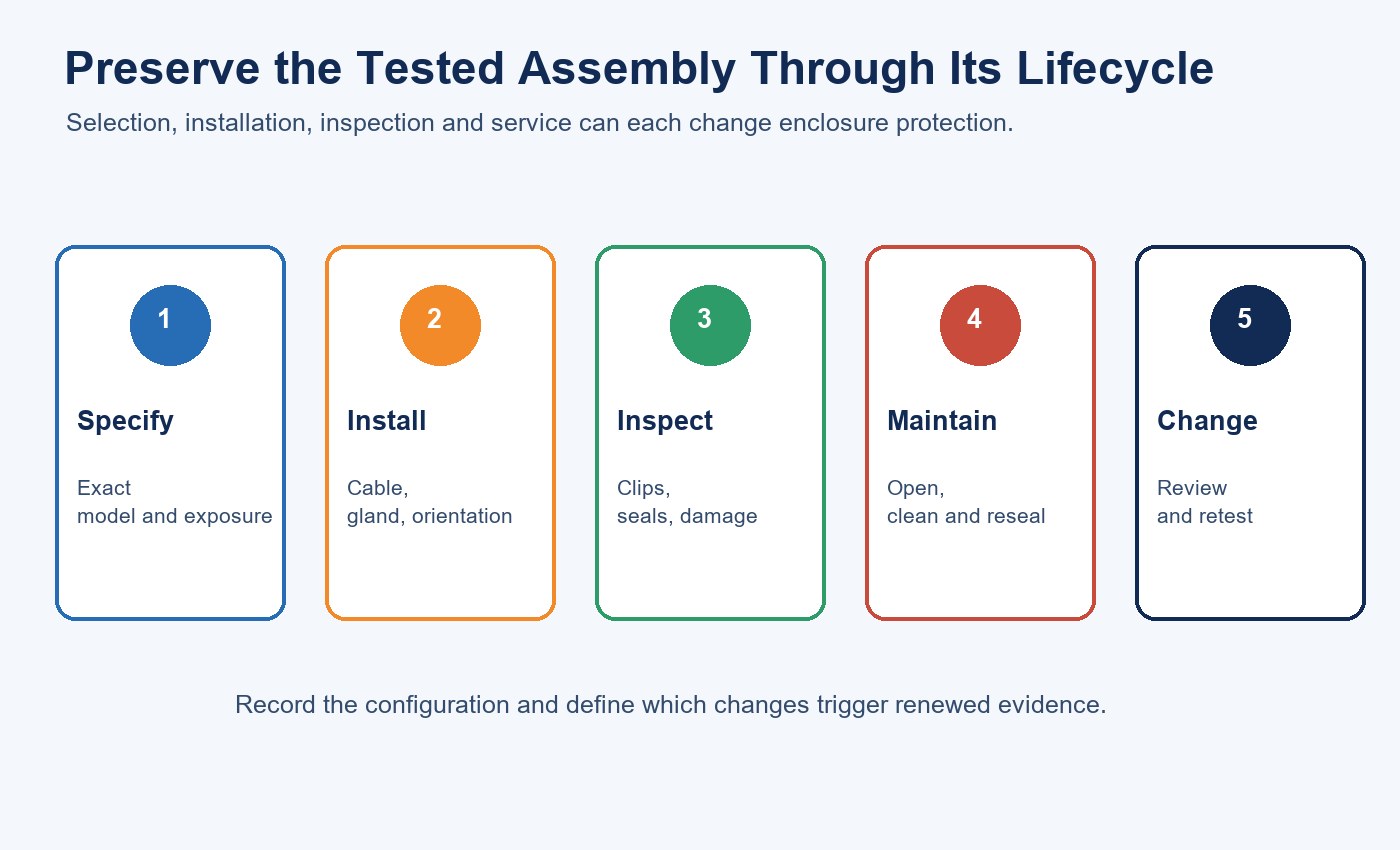
Preserve the Tested Configuration During Installation
Use the approved cable range and gland components. Tighten entries and fasteners according to instructions, and fit plugs to unused ports. Do not drill additional holes unless the modified configuration is engineered and validated.
Follow mounting-orientation and drainage requirements. Add drip loops where specified. Keep joints away from concentrated runoff when the instructions require it. After wiring, inspect the complete seal before energizing.
Any maintenance opening creates a resealing task. Clean the mating surfaces, inspect the gasket for cuts or permanent deformation and replace it when required. Restore every clip and fastener. The IP label does not guarantee protection after poor servicing.
Build an Environmental-Fit Matrix
Create one row for each site hazard: dust, water, temperature, condensation, UV, salt, chemicals, impact, vibration and electrical exposure. For each row, record the actual condition, product limit, evidence source, installation control, maintenance action and unresolved gap.
This matrix prevents one positive attribute from hiding several unknowns. It also makes supplier comparison more useful: two products may both show IP65 while only one has the temperature or material evidence required by the project.
| Hazard | Site condition | Required evidence | Installation control | Open gap |
|---|---|---|---|---|
| Water | Direction, pressure, duration | Applicable enclosure report | Entry orientation and drainage | Record unresolved exposure |
| Temperature | Minimum, maximum, cycling | Operating range and thermal test | Clearance and local heat sources | Confirm margins |
| UV or salt | Dose, distance, location | Material or corrosion evidence | Shielding and hardware choice | Define inspection interval |
| Chemicals | Substance, concentration, cleaning | Compatibility data or trial | Approved agent and procedure | Retest substitutions |
| Impact or vibration | Source, energy, frequency | Rating or project test | Brackets, spacing and strain relief | Monitor damage |
Use the LED lighting sample evaluation checklist to keep the exact model and test setup with the approval record. The lighting supplier factory audit checklist extends the review to incoming parts, assembly and change control.
For a bounded review, provide the exact model, location, water exposure, temperature range, humidity, cleaning process, chemicals, mounting orientation and cable details when you contact New Lights. Suitability can then be assessed against a defined environment rather than a generic waterproof claim.
Maintain Protection Over Time
Schedule inspections according to the environment and applicable local requirements. Look for cracked covers, loose clips, damaged glands, corrosion, blocked drainage, seal deformation and internal moisture. Clean only with approved methods and agents.
The lighting maintenance and spare-parts planning guide helps preserve approved glands, seals, clips and housings after installation. For warehouses, add access and operating conditions from the warehouse lighting RFQ checklist.
Record failures by location and configuration. Repeated moisture at one end may indicate orientation or cable-entry issues; widespread gasket damage may point to chemical incompatibility or assembly control. Correct the cause and retest affected configurations when necessary.
Review the supplier’s configuration and production controls alongside the New Lights factory and manufacturing capability page.
FAQ
Can an IP65 LED fixture be used outdoors?
Only when the manufacturer supports that use and the full environment is within the product’s documented limits. IP65 alone does not establish UV, temperature, corrosion or mounting suitability.
Is IP65 suitable for heavy washdown?
Not automatically. Compare the actual pressure, distance, temperature, duration and chemicals with the product evidence and applicable requirement.
Can an IP65 fixture be immersed?
Do not infer immersion suitability from IP65. Specify and verify the protection required for flooding or submersion separately.
Does IP65 stop condensation?
No. Condensation depends on humidity, trapped air, surface temperature and thermal cycling. Separate controls or evidence may be needed.
Does IP65 include impact resistance?
No. Mechanical impact and vibration require their own ratings or tests.
When can an IP rating become unreliable in service?
Damage, incorrect cable entries, missing clips, modified holes, aged seals and poor resealing after maintenance can compromise the tested enclosure configuration.
Editorial Sources
- New Lights, “LED Linear Fixtures” catalogue: https://www.new-lights.com/new-lights/2024/12/06/ledlinearfixtures.pdf
- IEC, “IEC 60529 — Degrees of protection provided by enclosures (IP Code)”: https://webstore.iec.ch/en/publication/2452