

A 3-step CCT LED filament bulb lets one decorative lamp provide three selectable white-light appearances. It works best where the visible filament form matters and the same fixture needs a small number of repeatable scenes. The purchase decision still depends on the exact CCT states, switching logic, brightness control, fixture fit and behavior of several lamps on one circuit.
New Lights lists a three-step CCT filament-bulb family in several decorative shapes. The current family table covers 4 W and 6 W options, a nominal 2700–6500 K CCT range and multiple envelope sizes. In the G95 product imagery shown below, the three states are labeled 3000 K, 4000 K and 6500 K. The ordered model and approved sample should define the final three values and sequence.
Start with the function, not the room name
Correlated color temperature describes the apparent color of white light in kelvins. A lower value generally looks warmer; a higher value looks cooler. A higher CCT is not inherently better. The useful setting depends on the surfaces, other light sources, illuminance, glare and visual task in the actual space.
Three-step CCT means three discrete states. It does not automatically mean continuous white tuning, dim-to-warm behavior or brightness dimming. Those functions use different control relationships and should appear as separate lines in the specification.
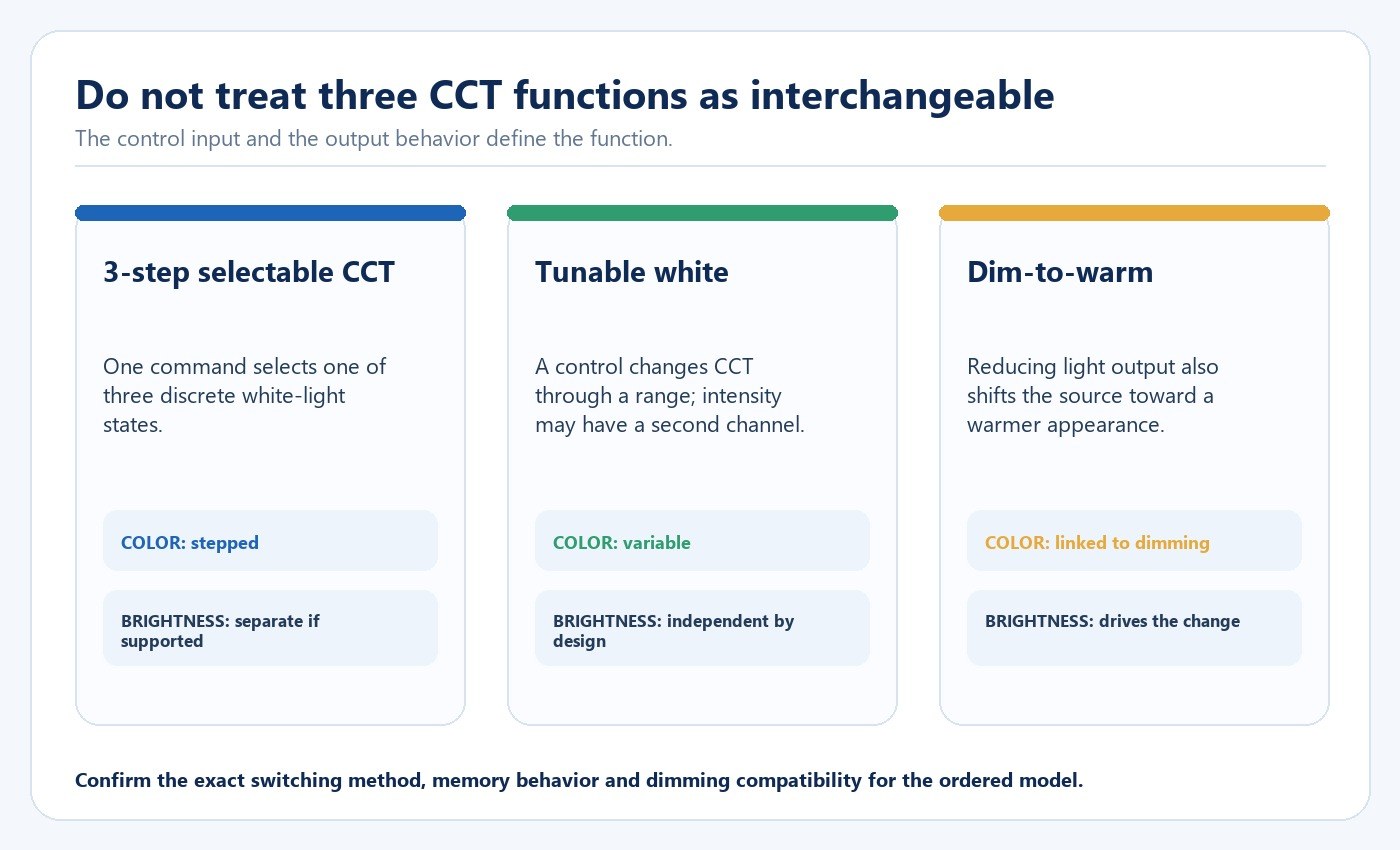
| Function | What the user changes | Expected output | What to verify |
|---|---|---|---|
| 3-step selectable CCT | A switch cycle, selector or defined command | One of three discrete CCT states | Values, order, reset interval and memory |
| Tunable white | A dedicated color control | CCT moves through a range | Range, control protocol, output consistency and calibration |
| Dim-to-warm | Brightness level | Light becomes warmer as output falls | Dimming curve, minimum level, color path and dimmer match |
| Brightness dimming | Dimmer or control signal | Light output changes | Compatible controls, range, flicker, pop-on and drop-out |
The U.S. Department of Energy separates selectable CCT from continuously color-tunable and dim-to-warm systems. This distinction matters in an RFQ: a supplier can meet “three colors” without providing independent brightness control, and a dimmable lamp can keep nearly the same CCT while its light output changes.
Use the real product states to judge the visual range
The New Lights 3-Step CCT LED Filament Bulbs page identifies a family of replaceable decorative lamps. The G95 imagery below shows how one globe format presents three white-light states. The lamp silhouette, visible filament structure, glass appearance and cap remain part of the design even when the CCT changes.

Do not approve a setting from a product image alone. Compare physical samples in the intended shade and room with the camera white balance fixed for documentation. Record measured CCT and output for each state when color consistency or equal brightness is important.
Match applications to scene needs
A selectable lamp earns its place when three repeatable states solve a real operating need. If occupants will leave the lamp in one state for its entire life, a fixed-CCT lamp may be simpler. If they need frequent fine adjustments, a controlled tunable-white system may be more appropriate.
| Application | Where three states can help | Main decision boundary |
|---|---|---|
| Restaurant or dining pendant | Separate an intimate service scene from setup and cleaning | Staff must be able to restore a consistent state across all lamps |
| Hotel guest room | Give one decorative fixture a warmer and a more neutral option | Switching must be intuitive after power interruption |
| Lounge or residential living area | Support relaxed, general and detail-oriented use | Other room lighting should not create an unintended CCT mixture |
| Boutique display | Adjust the overall white-light appearance around changing displays | Verify color rendering, glare and product appearance under every state |
| Decorative multi-lamp chandelier | Preserve visible filament styling across several scenes | All bulbs must cycle and recover in synchronization |
For exposed sockets, evaluate the unlit product too. Glass tint, filament arrangement, support wires and driver housing remain visible. The broader LED filament bulb category helps compare shapes before committing to one envelope.
Confirm switching sequence and memory
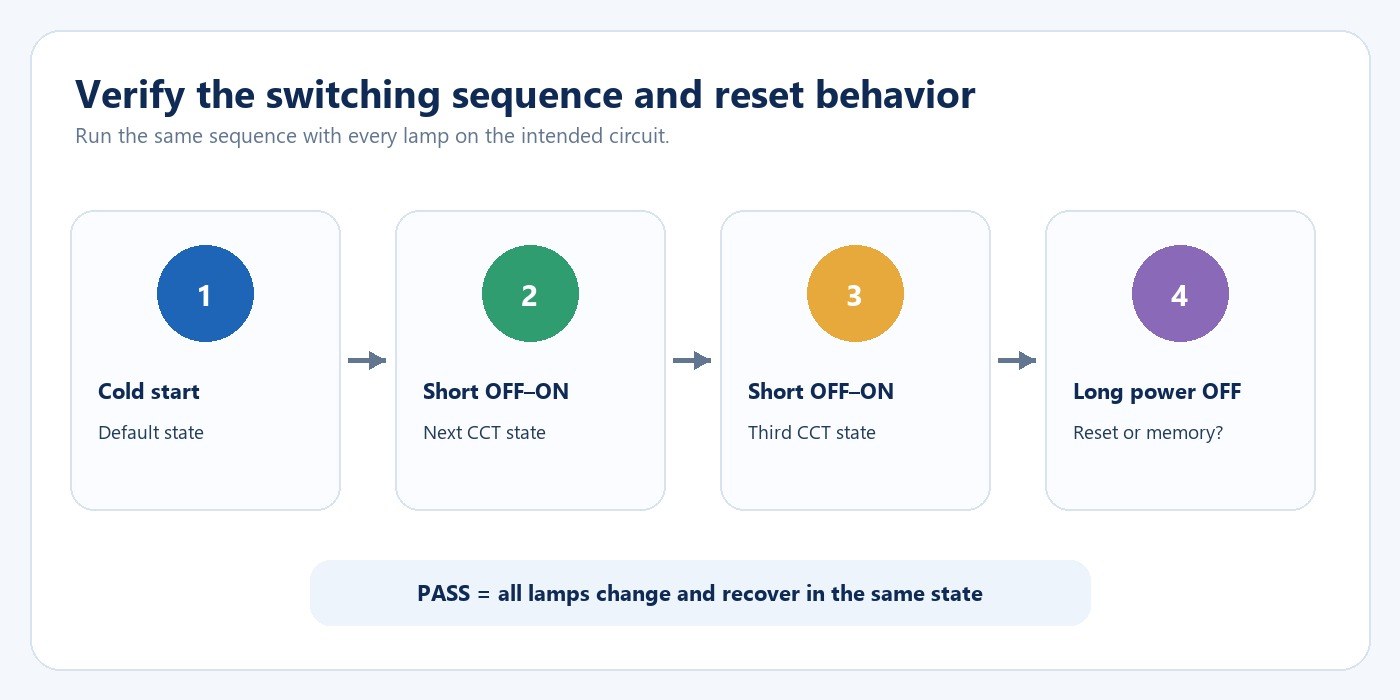
The label “3-step” does not tell the installer how a lamp changes state. A product may respond to short power interruptions, a selector or another control input. Define the cold-start state, the sequence after a short off-on cycle, the time that resets the lamp and the state that returns after a longer outage.
This becomes an operations issue in restaurants, hotels and retail areas. If staff use an ordinary wall switch and every rapid cycle advances the color, routine switching can leave the room in an unintended state. If several lamps do not remain synchronized, one chandelier can show mixed colors.
Test the intended number of lamps together. Start from a long power-off condition, cycle through every state, interrupt power at realistic intervals and repeat the sequence. Record whether one lamp misses a step and how the group returns to the designated scene.
Treat dimming as a second compatibility decision
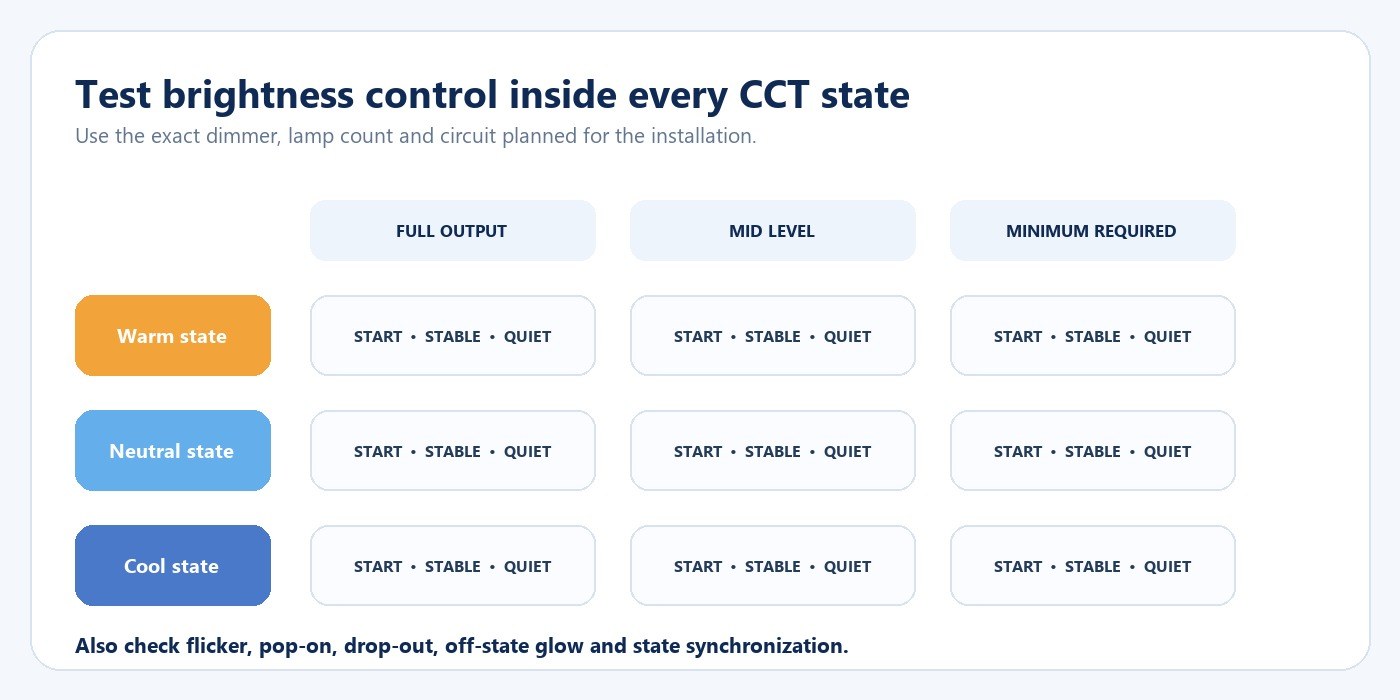
If brightness control is required, request it explicitly. Confirm whether every CCT state is dimmable, the supported dimming method and the controls tested with the exact lamp. A generic “LED dimmer” label cannot establish smooth operation for every lamp count.
At each CCT state, test full output, a representative middle level and the required minimum level. Look for delayed start, pop-on, drop-out, flicker, audible noise, off-state glow and loss of synchronization. A dimmer, smart relay, occupancy sensor or illuminated switch can also affect power-cycle logic.
The filament LED bulb dimming compatibility guide covers the dimmer–lamp–load relationship. If an unstable lamp needs diagnosis, use the separate filament bulb flicker workflow rather than assuming the CCT function is the cause.
Check the fixture before approving the lamp
Confirm the base, voltage, envelope diameter, overall length, weight, orientation and clearance. A globe or elongated decorative lamp can fit the socket yet collide with a shade or glass cover. The current New Lights family includes shapes with substantially different diameters and lengths, so the shape code belongs in the approval record.
Thermal conditions matter because the driver is inside the lamp. Test the sample in the actual fixture, orientation and operating environment. Do not extend a result from an open pendant to a sealed enclosure, outdoor fitting or damp location unless the ordered model is specified for that condition.
Direct-view glare is another boundary. A visible filament can support a decorative effect at one output level and become uncomfortable at another. Judge normal viewing angles, shade geometry and reflected brightness in the finished space.
Build a model-bounded RFQ
| RFQ field | Minimum entry | Why it changes the decision |
|---|---|---|
| Lamp identity | Model code, shape, base, wattage and voltage | Prevents data from one envelope or driver being applied to another |
| Three CCT states | Nominal CCT, tolerance and sequence | Defines the actual selectable function |
| Output by state | Lumens, power, efficacy and CRI for each state | Reveals state-to-state output or color differences |
| Switching logic | Input method, reset interval, default and memory | Determines whether everyday operation is predictable |
| Dimming | Method, compatible controls, range and lamp count | Defines the complete control circuit |
| Fixture condition | Open/enclosed, orientation, ambient and location rating | Establishes fit and thermal suitability |
| Change control | Driver, LED mix, firmware and glass revisions | Identifies changes that require partial or full requalification |
Ask the supplier to connect every result to the same model and revision. A family brochure can guide discovery, but sample approval and production release need an exact reference.
Run a complete sample acceptance sequence
The fastest reliable test follows one fixed order: verify identity and fit, document the CCT sequence, test brightness control, check multi-lamp synchronization, run the lamp to thermal stability and lock the approved reference. Changing several variables at once makes a failure difficult to interpret.
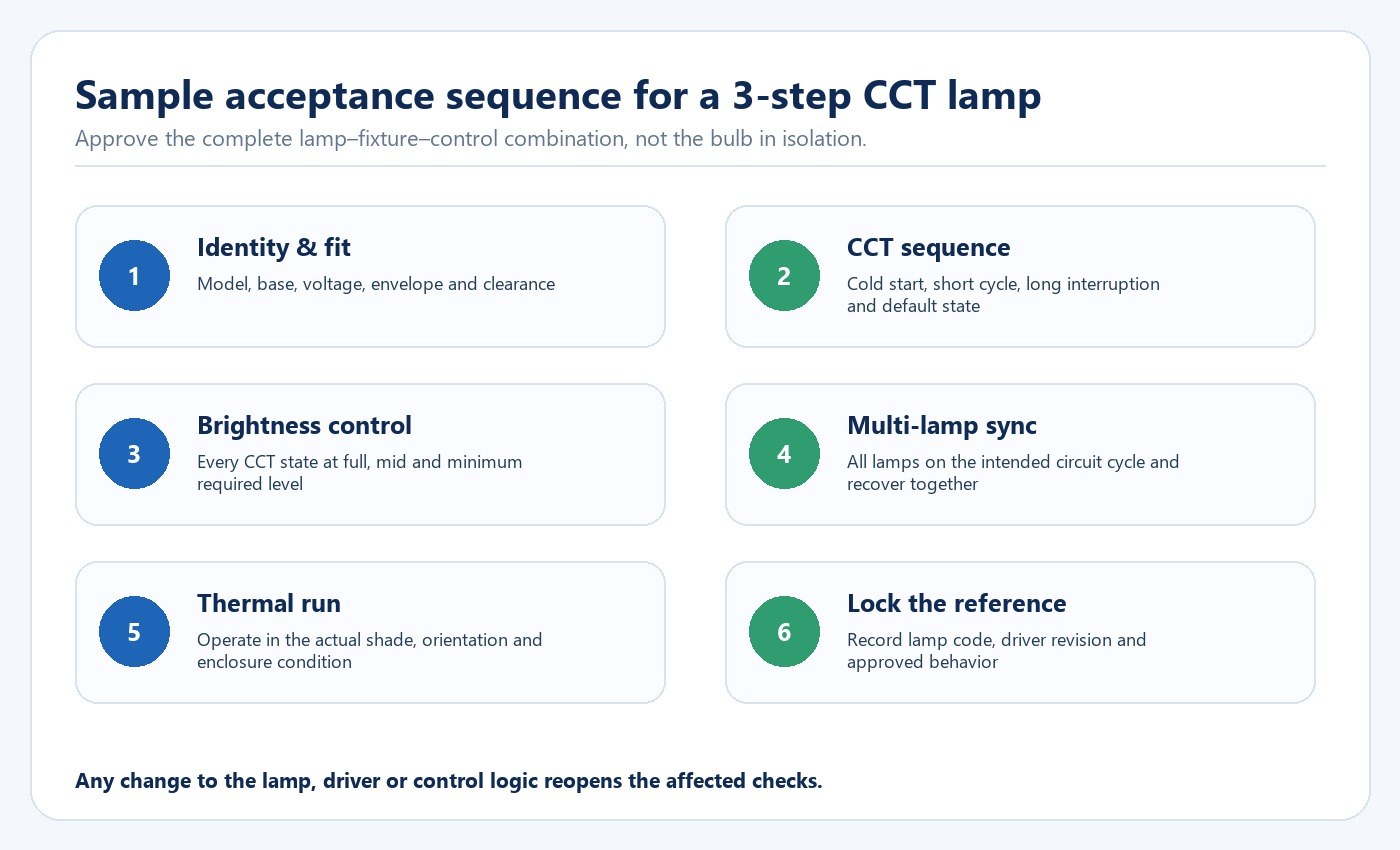
Use at least several lamps from the intended production reference for a multi-lamp application. Run every state and control level after thermal stabilization. Photograph the final scenes with fixed camera settings, record the approved lamp and driver revision, and define which later changes trigger a new test.
If you are preparing a project sample, contact New Lights with the lamp shape, base, voltage, fixture type, desired CCT states, control model and quantity per circuit.
Frequently Asked Questions
Is 3-step CCT the same as dim-to-warm?
No. Three-step CCT selects among discrete color states. Dim-to-warm links a warmer color appearance to lower brightness. A product must specifically define the behavior it supports.
Are all three-step CCT filament bulbs dimmable?
No. Dimming is a separate feature. Verify the exact model, compatible control and intended lamp count, then test every CCT state.
What are the three CCT values?
They depend on the ordered reference. The New Lights G95 image set shown here identifies 3000 K, 4000 K and 6500 K; the current family page spans a nominal 2700–6500 K range.
Can several bulbs stay synchronized in one chandelier?
They can only be approved after a group test. Cycle the intended number of lamps through short and long power interruptions and verify that every lamp returns to the same state.
Can the bulb be used in an enclosed or outdoor fixture?
Only when the exact model is specified for the fixture condition and location. Confirm dimensions, orientation, thermal limits and applicable location rating.
Is a cooler CCT always better for detailed work?
No. The task also depends on illuminance, distribution, glare, contrast and color rendering. Evaluate the complete lighting condition rather than CCT alone.
Editorial Sources
- New Lights, 3-Step CCT LED Filament Bulbs: https://www.new-lights.com/products/led-bulbs/led-filament-bulbs/led-filament-bulb-3-step-cct/
- U.S. Department of Energy, LED Lighting and Controls Guidance for Federal Buildings: https://integratedlightingcampaign.energy.gov/sites/default/files/2024-10/LED%20and%20Controls%20Guidance%20for%20GSA_0.pdf
- U.S. Department of Energy, Understanding LED Color-Tunable Products: https://www.energy.gov/cmei/ssl/understanding-led-color-tunable-products
- ENERGY STAR, Light Fixtures (Downlights): https://www.energystar.gov/products/light_fixtures