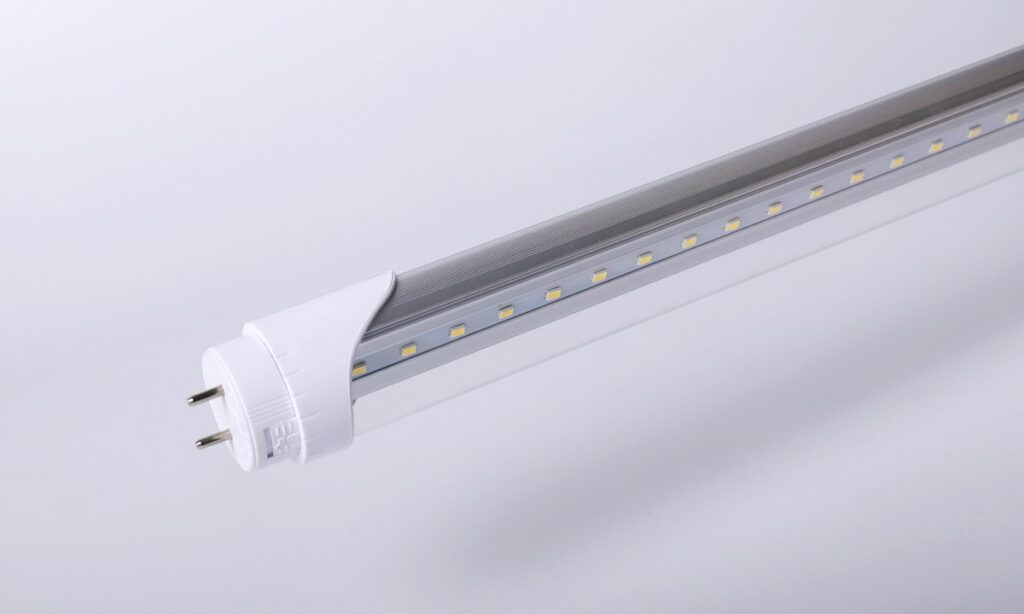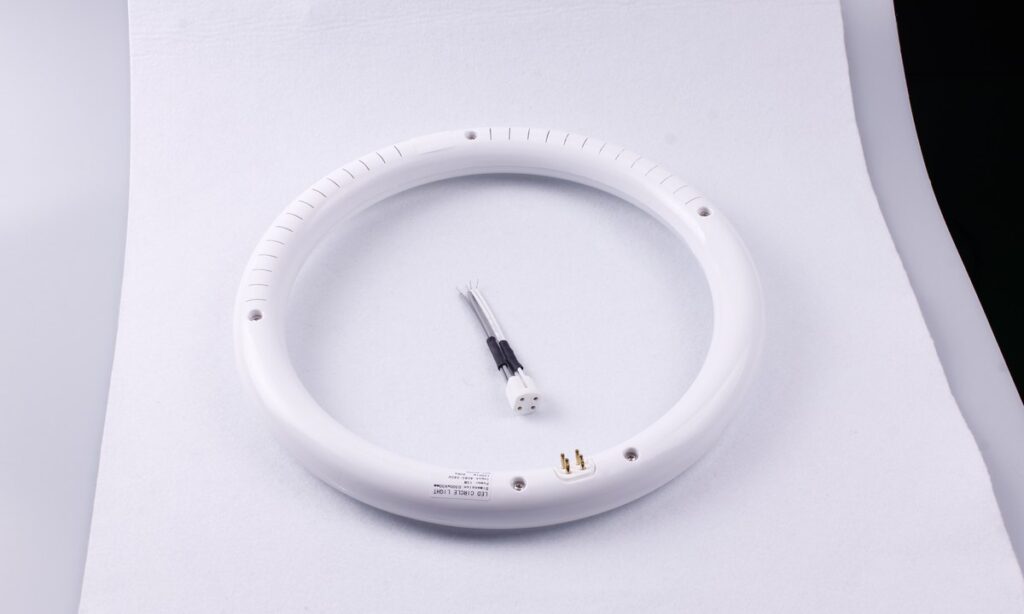


Decorative lighting is often described by product names—string lights, pendants, wall sconces or filament bulbs. That list is useful, but it is not enough for a purchasing decision. Two products that look similar in a photograph may create different visual effects, require different mounting methods or carry different location and control limitations.
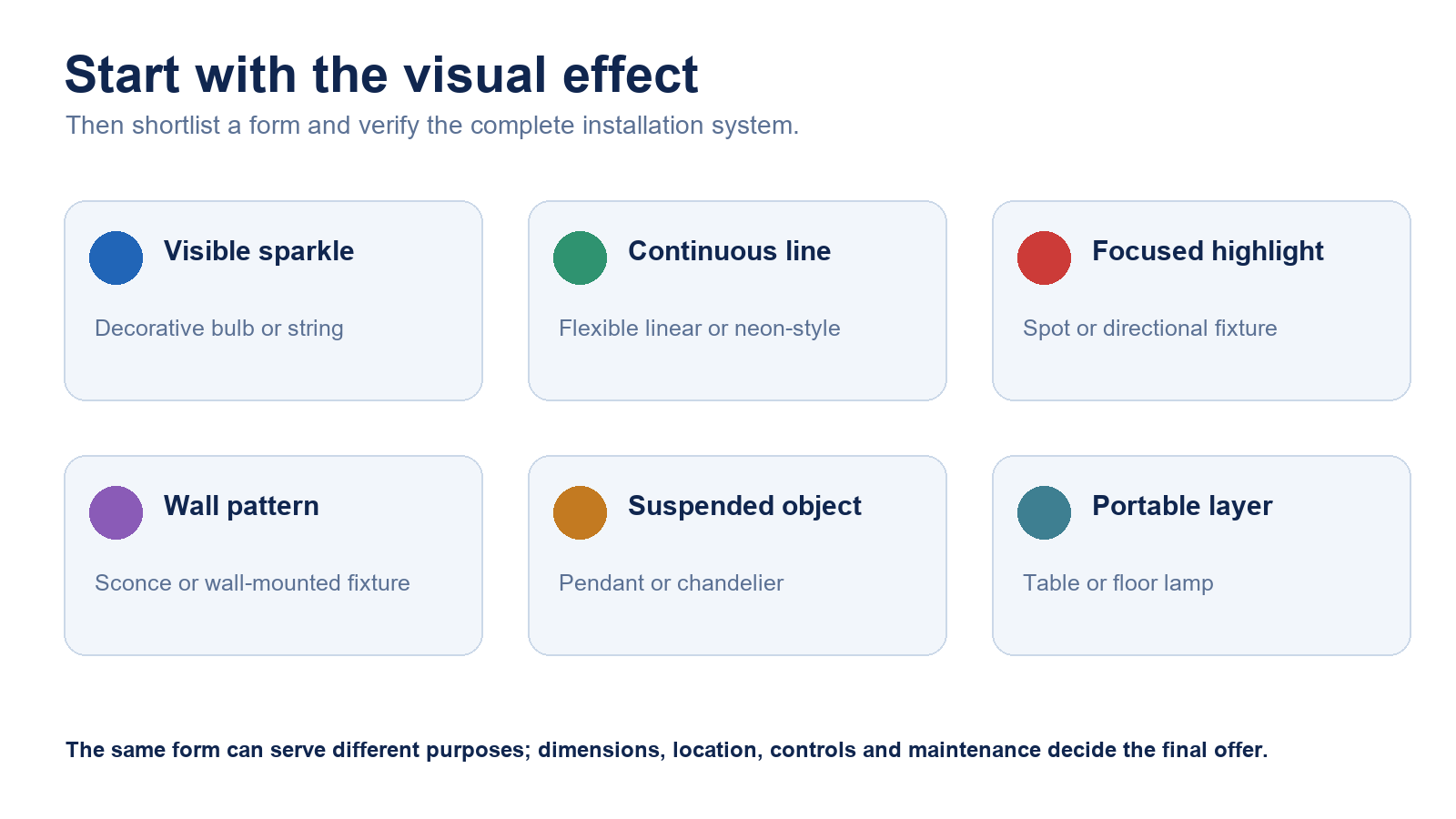
A better starting point is to define the visual job. Do you want visible points of sparkle, a continuous illuminated line, a focused highlight, a decorative object suspended in the space or a soft layer of ambient light? Once that goal is clear, the appropriate fixture family becomes easier to identify.
UL Solutions describes indoor and decorative lighting as a broad field that can contribute to ambient, task and accent functions, while the U.S. General Services Administration notes that accent lighting adds emphasis and visual variety. These roles help define the intent, but an orderable specification still needs the geometry, location, power, controls and evidence for the exact system.
This guide organizes the main types of decorative lighting by both form and purpose. It also explains the questions buyers should resolve before comparing models, samples and supplier quotations.
Decorative Lighting Is a Purpose, Not One Product Category
Decorative lighting can contribute to ambient, task or accent lighting, but its distinguishing role is visual. The light source, fixture or illuminated surface forms part of the appearance of the space. In some projects, the fixture itself is the focal object. In others, the product is concealed and only the resulting line, wash or highlight is visible.
That distinction matters. A chandelier selected as a centerpiece is evaluated differently from a flexible linear light concealed in a cove. A decorative bulb used in an open pendant must look acceptable when switched off as well as when illuminated. A facade product must be assessed for its mounting location and environmental exposure, not simply for the color shown in a rendering.
The categories below therefore describe common product forms, but the final choice should always be checked against installation, electrical, control and maintenance requirements.
| Desired visual effect | Likely product form | Questions that change the selection |
|---|---|---|
| Visible sparkle | Decorative bulb or light string | Is the source intentionally visible, and what finish or spacing is required? |
| Continuous illuminated line | Flexible linear, rope or neon-style light | What are the run length, bend direction, cut points and feed locations? |
| Focused highlight | Spot or directional fixture | What is the target size, viewing position, beam distribution and glare boundary? |
| Wall pattern or wash | Sconce or wall-mounted fixture | What are the wall texture, projection, mounting height and junction position? |
| Suspended focal object | Pendant or chandelier | What are the drop, scale, weight, support and cleaning access? |
| Portable decorative layer | Table or floor lamp | What are the stability, plug, cord route, switch and destination-market requirements? |
1. Decorative Bulbs and Visible Lamps
Decorative bulbs are designed to remain visible or to contribute to the appearance of an open fixture. Common forms include candle, globe and elongated filament-style lamps. They are widely used in pendants, chandeliers, wall fittings and table lamps where the shape of the lamp is part of the design.
The first selection question is compatibility with the fixture: base type, available space, supply voltage and permitted lamp size. The second is visual performance. Clear and frosted finishes produce different impressions. A clear envelope emphasizes the internal light source and can create a sharper sparkle; a frosted finish softens the visible source and generally appears more diffuse. The practical differences are compared in our guide to clear and frosted LED filament bulbs.
Buyers should also check whether the lamp is intended to work with the proposed dimmer. A lamp being dimmable does not by itself guarantee satisfactory operation with every control device. Compatibility should be confirmed for the actual lamp and control combination.
2. Decorative Light Strings
Light strings create a repeated sequence of small points. They are useful for outlining edges, wrapping structures, decorating trees, forming overhead canopies and adding temporary seasonal detail. Their visual rhythm is different from the uninterrupted line produced by rope or neon-style products.
The category includes products intended for short-term decorative use as well as products designed for more durable installations. UL Solutions treats all-year string lights as a distinct category with different construction, marking and compliance considerations. Those descriptions should not be treated as interchangeable. Verify the product marking and instructions for indoor or outdoor use, connection limits, mounting method and replacement conditions. Outdoor suitability should be established from the specific product documentation rather than inferred from the cable appearance. The decorative light-string safety guide provides a separate pre-use and installation checklist.
For a permanent commercial installation, the buyer should also consider how failed sections can be accessed, whether multiple strings can be connected, where the power connection will be located and whether the visible cable color suits the background.
3. Flexible Linear, Rope and Neon-Style Lighting
Flexible linear products are used when the design calls for a continuous luminous line rather than separated points. They can trace architectural edges, curves, lettering, shelving, coves and decorative profiles. Diffused neon-style products can produce a more uniform visible surface, while other flexible products may reveal individual light points at close viewing distances.
These products require more technical coordination than their simple appearance suggests. Bend direction and minimum bend radius can vary. Cut points, maximum run length, connector design, power-feed arrangement and profile compatibility are model-specific. Match every proposed curve to the exact product’s permitted bend direction and minimum radius.
Before ordering, translate the design into actual run lengths, corners, feed locations and mounting details. Confirm whether the installation needs a channel, clips, an end cap or a separate driver, and establish which components are included in the quotation. Use the decorative and ambient lighting category as a starting point for identifying the form, then compare model-level construction.
4. Accent, Spot and Directional Lighting
Accent lighting uses controlled direction to emphasize an object, surface or architectural detail. Spotlights and adjustable directional fixtures can highlight artwork, merchandise, display niches, textured walls and planting. The fixture may be visually discreet, but the concentrated beam creates the decorative effect.
Selection should be based on the target and the viewing position, not only on fixture wattage. Beam distribution, aiming range, glare control, mounting distance and contrast with the surrounding light all affect the result. The U.S. General Services Administration identifies distribution, shields and optical control as factors in glare management. A narrow beam can create a defined focal point; a wider distribution may be more suitable for a larger object or surface.
Mock-ups are valuable where the target material is reflective, dark, highly textured or viewed from several angles. They allow the team to evaluate the real beam and glare conditions before committing to a full quantity.
5. Wall Sconces and Decorative Wall Lighting
Wall-mounted decorative fixtures can serve as visible objects, produce an upward or downward pattern, wash a surface or support circulation lighting. They are commonly used in hospitality spaces, corridors, entrances, residential interiors and facade compositions.
The wall itself is part of the result. Color, texture and distance from the light source affect the visible pattern. Installation planning should address mounting height, junction-box position, projection from the wall and alignment across repeated units. For exterior locations, the environmental rating and mounting instructions must match the actual exposure.

6. Pendants and Chandeliers
Pendants and chandeliers combine illumination with a strong physical presence. They can organize a reception area, dining space, stairwell, retail zone or other focal area. A single pendant may mark a small area, while a cluster or large chandelier can define the scale of an entire room.
Dimensions deserve as much attention as style. Check suspension length, ceiling height, canopy size, mounting support, overall weight and access for cleaning or lamp replacement. For grouped installations, spacing and drop heights should be documented rather than left to visual estimation on site.
The light source may be integrated or replaceable. This affects maintenance planning, future color consistency and the procedure when an individual unit fails. Buyers should understand that distinction before approving a decorative family for a repeat installation.
7. Table and Floor Lamps
Portable table and floor lamps add a decorative layer without requiring a fixed ceiling or wall position. They are useful in lounges, guestrooms, reception areas, residences and flexible work or hospitality settings. The shade, base and visible lamp can all contribute to the design language.
Because these products are accessible to occupants, stability, cord routing, switch location and surface temperature deserve attention. The project should also define whether the units are loose furniture items or part of a controlled room package. If a standard plug, socket or voltage varies by destination market, the correct configuration must be specified in the order.
8. Landscape, Facade and Exterior Decorative Lighting
Exterior decorative lighting can reveal paths, planting, walls, rooflines and building features after dark. Typical approaches include concealed linear accents, wall-mounted patterns, in-ground or surface-mounted highlights and decorative strings for defined settings. For a broader project check, use the outdoor lighting installation checklist before freezing quantities and mounting details.
Exterior selection begins with the real environment. Exposure to rain, irrigation, dust, impact, corrosion, temperature and maintenance activity can differ greatly between locations. Environmental suitability must come from the product specification and installation instructions; the word “outdoor” alone is not a complete project definition.
Direction also matters. Poorly controlled exterior light can create glare, spill beyond the intended area or contribute to light trespass. Aim and output should be limited to the visual task, and local requirements should be reviewed by the project team.
9. Color-Changing and Controlled Decorative Lighting
Dynamic products can change color, intensity or scenes through a controller, remote interface or building-control connection. They are used for events, hospitality, entertainment, branded environments and architectural features where the appearance changes over time.
The control method is part of the system, not an optional detail to resolve later. Confirm the driver, controller, signal protocol, addressing method, cable requirements and maximum supported run or device count. The buyer should also establish who will commission the scenes and what happens when power or communication is interrupted.
“Smart” or “color-changing” does not establish compatibility with a particular platform. Compatibility should be documented for the complete proposed system.
Convert the Design Intent into an Orderable System
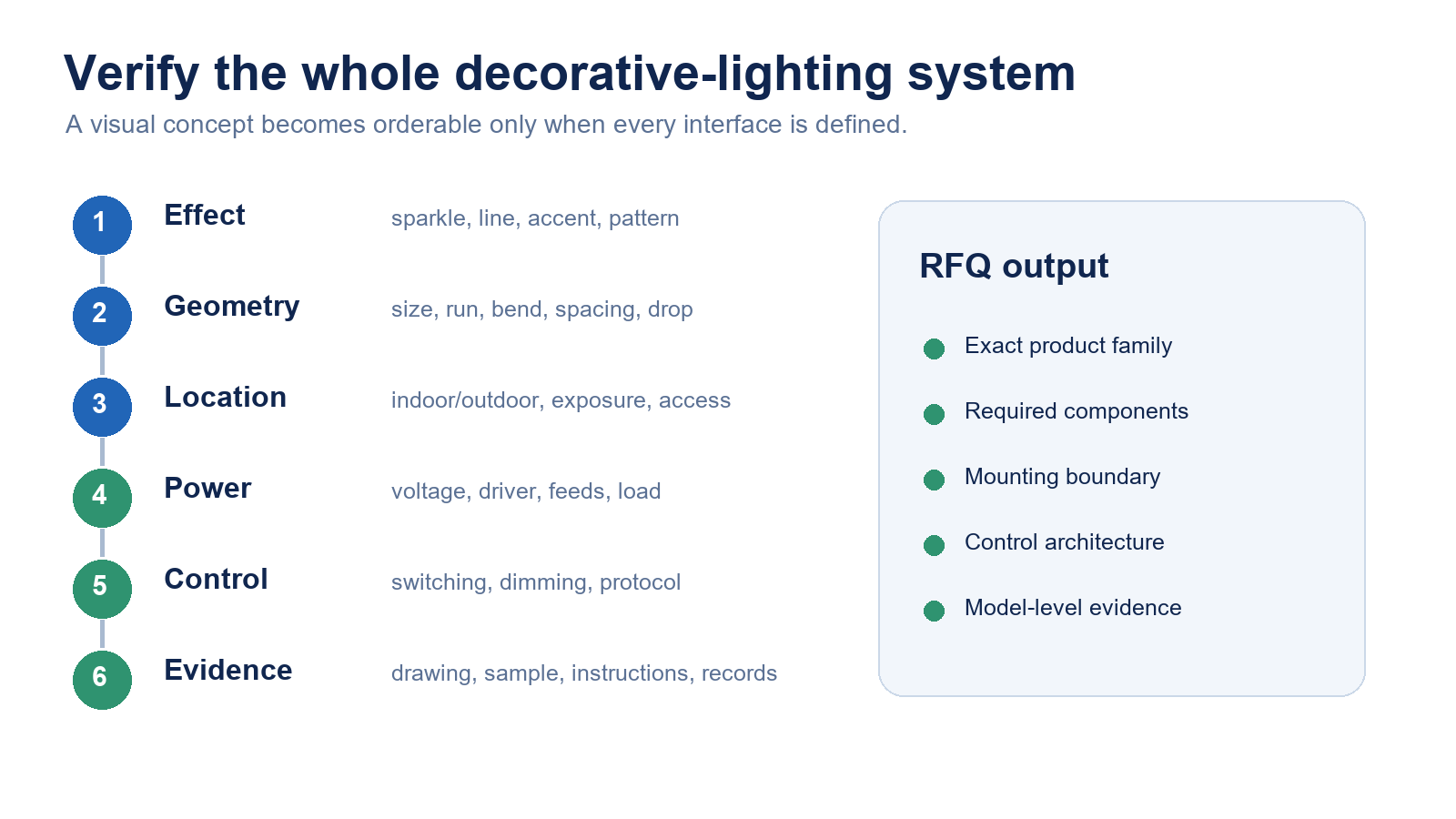
Product-family names help with discovery, but the quotation should resolve every interface that affects installation or operation.
| System layer | Inputs the buyer should provide | Evidence to compare |
|---|---|---|
| Visual intent | Effect, viewing distance, finish and reference images | Representative sample, render or mock-up criteria |
| Geometry | Dimensions, runs, curves, drops, spacing and feed points | Dimension drawing and installation layout |
| Location | Indoor/outdoor, permanent/temporary, exposure and access | Product marking, rating and installation instructions |
| Power | Supply, driver position, circuit arrangement and component load | Datasheet, wiring information and component schedule |
| Controls | Switching, dimming, protocol, addressing and commissioning owner | Compatibility statement and control documentation |
| Maintenance | Cleaning, replacement access, spares and future matching | Service method, replaceable-part list and project records |
A Practical Selection Workflow
The following sequence helps turn a broad decorative concept into a specification that suppliers can answer accurately.
1. Define the visual effect
State whether the project needs visible sparkle, a continuous line, a focused accent, a wall pattern, a decorative suspended object or general ambient character. Include reference images, but describe the required effect in words so that appearance is not judged from one image alone.
2. Record the installation location
Identify indoor or outdoor use, permanent or temporary installation, mounting surface, available space and likely exposure. Note viewing distance and whether the product remains visible when switched off.
3. Establish dimensions and mounting
Provide run lengths, fixture quantities, suspension drops, bend locations, cut positions and feed points. Confirm mounting accessories and structural support instead of assuming they are included.
4. Define electrical and control requirements
Record supply voltage, driver location, switching or dimming method, control protocol and any destination-market plug or connection requirement. Ask the supplier to identify every required system component.
5. Plan access and maintenance
Consider cleaning, replacement, failed-section access and future product matching. A visually attractive concept can become expensive to maintain if connectors, drivers or lamps are concealed without service access.
6. Request evidence for the exact offer
Compare model-specific datasheets, drawings, installation instructions, ratings and control documentation. If appearance is critical, request a representative sample or mock-up under realistic viewing conditions. Do not transfer a claim from a similar product to the quoted model without confirmation. For projects requiring custom construction, the New Lights manufacturing overview explains the production and coordination context that can be discussed during sampling.
Questions to Include in an RFQ
A useful decorative-lighting RFQ should give the supplier enough information to identify the correct configuration. Include:
- the intended visual effect and application;
- installation location and expected exposure;
- drawings, dimensions, run lengths and quantities;
- supply voltage and control method;
- required color appearance and finish;
- mounting and accessory requirements;
- destination market and documentation needs;
- sample or mock-up expectations;
- packaging, labeling and replacement-part requirements.
This information makes quotations easier to compare because each supplier is responding to the same application boundary. A decorative package spanning indoor focal fixtures and architectural accents can also be framed through the residential and decorative lighting solution.
Frequently Asked Questions
What is the difference between decorative and accent lighting?
Decorative lighting makes the fixture or illuminated form part of the visual design. Accent lighting directs attention to a particular object or surface. One installation can perform both roles—for example, a visually expressive spotlight that highlights artwork—but the two purposes should still be evaluated separately.
Are decorative lights suitable for outdoor use?
Only when the exact product is specified and marked for the intended location and exposure. Do not infer outdoor suitability from appearance or from a similar model. Review the product documentation, installation method and environmental conditions.
Which decorative lighting type is best for outlining a shape?
Flexible linear, rope or neon-style lighting is commonly considered for continuous outlines, while string lights create separated points. The correct choice depends on bend direction, curve radius, cut points, run length, mounting and the desired level of diffusion.
Can decorative LED lighting be dimmed?
Some products can be dimmed, but compatibility must be confirmed across the lamp or module, driver and control device. A generic “dimmable” description is not proof that every combination will operate correctly.
Should a project request samples?
Samples or mock-ups are useful when finish, visible light points, diffusion, beam shape, dimming behavior or color appearance is important. They should represent the proposed construction and configuration as closely as possible.
Choose the Effect First, Then Verify the System
There is no single decorative-lighting category that is best for every project. Visible lamps create sparkle, strings create rhythm, flexible products draw lines, directional fixtures emphasize targets, and pendants or chandeliers become visual objects. The right family follows from the intended effect and installation context.
After selecting the family, verify the exact model as a complete system: fixture or lamp, power components, controls, mounting accessories and maintenance access. For an OEM/ODM discussion based on your drawings, target market and application requirements, contact New Lights.
—
Editorial Sources
- UL Solutions, “Indoor and Decorative Lighting.”
- UL Solutions, “String Lights for All-Year Use.”
- UL Solutions, “Bulletin: Decorative Lighting Strings.”
- U.S. General Services Administration, “Lighting.”
- U.S. General Services Administration, “Facilities Standards for the Public Buildings Service (P100), 2022 Addendum.”